Understanding Snow Fountains Weeping Cherry (Prunus ‘Snow Fountains’): History, Feature, Cultivation, Problems and More
Some trees are chosen for their size, their shade, or their fruit. The Snow Fountains Weeping Cherry is chosen for one reason above all others: it is beautiful in a way that is almost impossible to walk past without stopping.
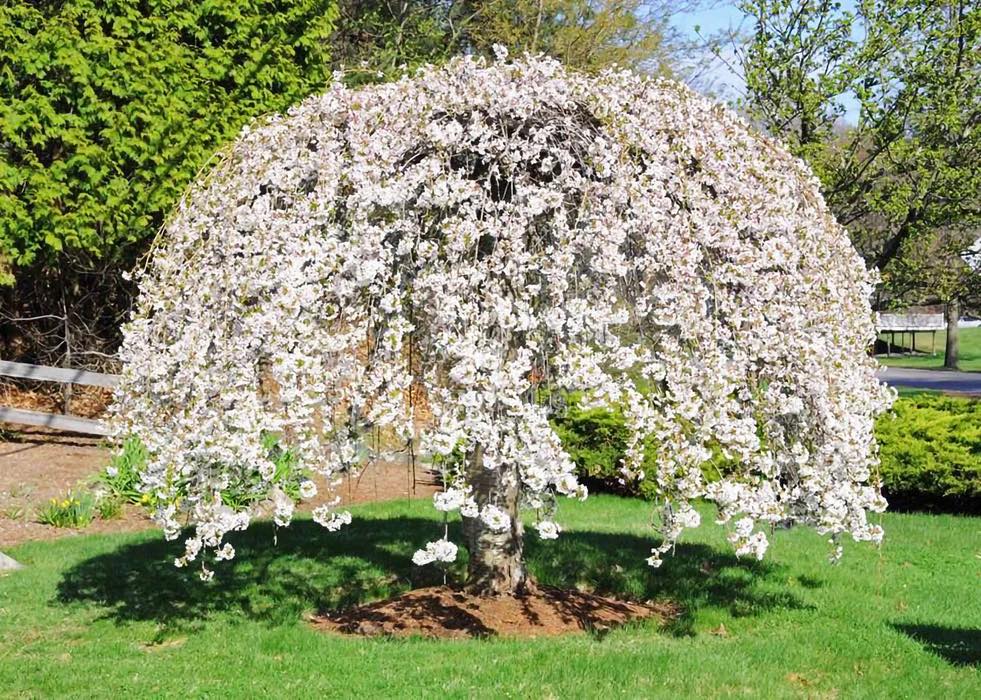
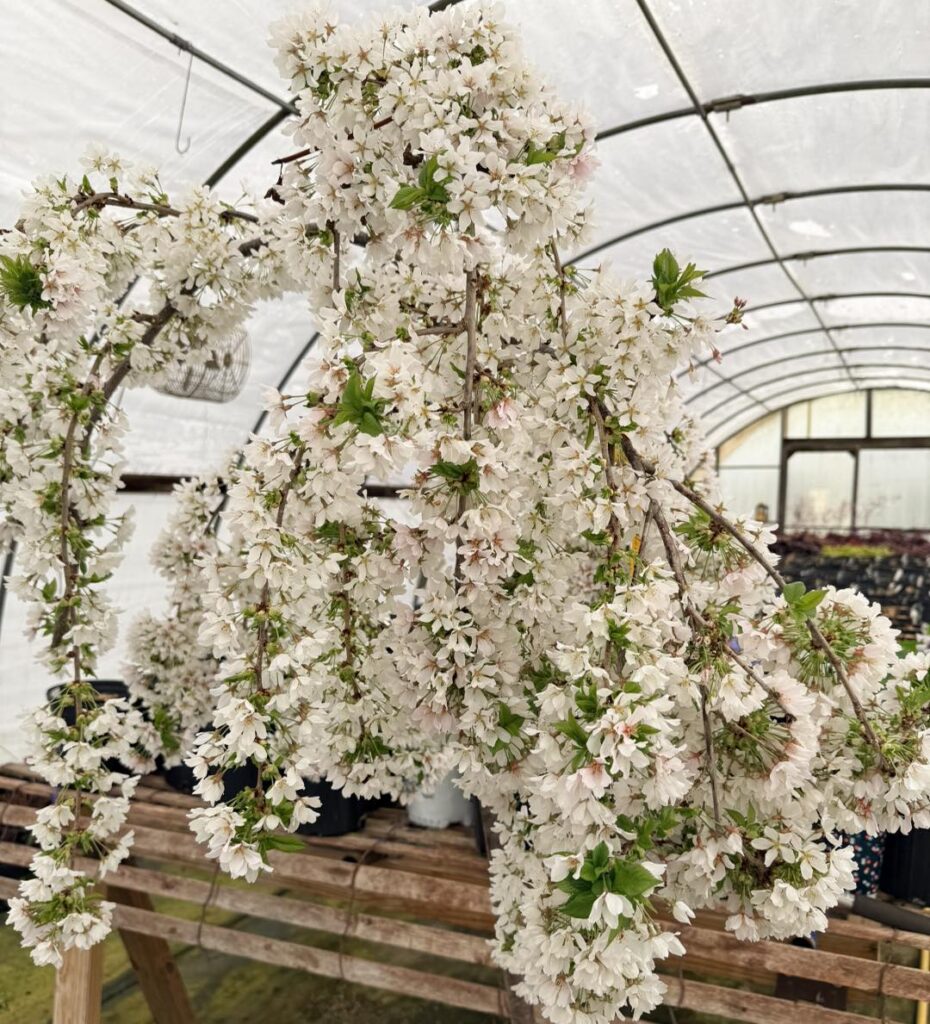
When it blooms in spring — cascading white flowers pouring down its arching, ground-sweeping branches like a frozen waterfall — it earns its name completely. “Snow Fountains” is not marketing language. It is an accurate description of what this tree looks like in full flower.
I have seen it in small front gardens, in formal landscape beds, and in large containers on terraces, and it always commands attention. What makes it even more valuable is that it delivers this drama in a compact, manageable form that fits almost any garden size.
This guide covers everything you need to know to grow, care for, and make the most of Prunus ‘Snow Fountains’.
What Is the Snow Fountains Weeping Cherry?
Snow Fountains Weeping Cherry, sold under the trade name Snow Fountains® and botanically registered as Prunus ‘Snofozam’, is a compact, weeping ornamental cherry tree. It is widely considered one of the finest small weeping cherry trees available for residential and commercial landscapes.
The tree is a cultivar within the Prunus genus — the large plant family that includes all ornamental cherries, as well as plums, peaches, apricots, and almonds. It belongs to the Rosaceae family.
Unlike the larger Prunus subhirtella ‘Pendula’ (Weeping Higan Cherry), Snow Fountains stays genuinely small — typically 8 to 15 feet tall — making it one of the few weeping ornamental trees that works comfortably in tight spaces, small gardens, and even large containers.
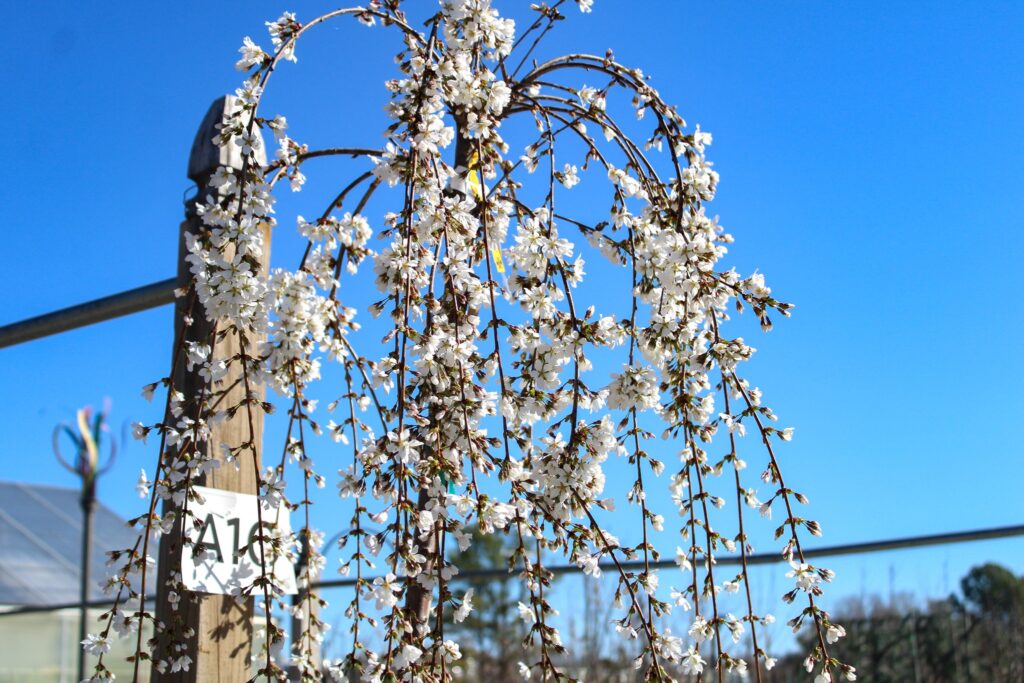
Its flowers are pure white, which sets it apart from most weeping cherries that bloom in shades of pink. That white bloom, cascading from strongly pendulous branches that often touch or sweep the ground, creates the signature “fountain of snow” effect that defines the tree’s character.
Key Characteristics at a Glance
Mature Height: 8 to 15 feet (2.4 to 4.5 metres), depending on the graft height and growing conditions.
Mature Spread: 6 to 10 feet (1.8 to 3 metres). The canopy spreads as the weeping branches lengthen with age.
Growth Rate: Moderate — typically 12 to 18 inches per year.
Bloom Time: Mid-spring — typically April to early May in most temperate climates, just slightly after the earliest cherries.
Flower Colour: Pure white, single flowers with five petals, carried in small clusters along the length of the pendulous branches.
Foliage: Small, narrowly oval, dark green leaves that emerge after flowering. Autumn foliage turns orange to bronze-red, providing a second season of colour.
Bark: Warm brown to reddish-brown with horizontal lenticels, providing quiet winter interest.
Fruit: Small, dark cherries form after flowering and attract birds in summer.
USDA Hardiness Zones: 5 to 8, making it adaptable to a wide range of temperate climates.
Lifespan: Typically 15 to 25 years in landscape settings, consistent with most ornamental cherry cultivars.
Origins and Background
Snow Fountains Weeping Cherry was introduced to the trade in the 1980s by the Shibamichi Honten nursery in Japan, with subsequent introduction and promotion in North America. Its botanical name, ‘Snofozam’, is the registered cultivar name, while ‘Snow Fountains’ is the more widely used trade name under which it is sold commercially throughout the United States, Europe, and beyond.
The exact parentage is not definitively documented in the public record. It is generally classified as a Prunus serrulata type or treated within the broad grouping of Japanese flowering cherries, though some references associate it with Prunus × snofozam as a distinct hybrid.
What matters practically is that it was selected specifically for its compact weeping habit, its pure white flowers, and its reliable garden performance — qualities it consistently delivers.
It received the Royal Horticultural Society’s Award of Garden Merit, a mark of quality that reflects consistent performance across a range of temperate garden conditions. This is a meaningful distinction, not a marketing claim.
Why Snow Fountains Stands Apart from Other Weeping Cherries
The ornamental cherry market offers several weeping varieties. Understanding how Snow Fountains differs helps you decide whether it is the right choice for your specific situation.
Size is the primary distinction. Prunus subhirtella ‘Pendula’ (the most common weeping cherry) reaches 20 to 30 feet at maturity. Snow Fountains reaches 8 to 15 feet. For gardens where a large weeping cherry would be overwhelming, Snow Fountains is the solution.
The flower colour is unique. Almost all commonly available weeping cherries bloom in shades of pink — pale blush, medium rose, or deep carmine. Snow Fountains blooms pure white. This makes it a distinctly different aesthetic choice and an important option for garden designs that call for white or neutral flower tones.
The weeping habit is particularly pronounced. The branches of Snow Fountains hang almost vertically, creating a very dense, curtain-like canopy. On a well-established tree, the branches reach and sweep along the ground — creating the enclosed, bower-like space beneath the canopy that makes weeping trees so romantically appealing.
It is container-viable. While all weeping cherries are ground-planting trees at heart, Snow Fountains’ compact size makes it more suitable for large container culture than most other ornamental cherries — a practical benefit for terrace gardens, rooftop plantings, and courtyard spaces.
Ideal Growing Conditions
Sunlight
Full sun is essential. Snow Fountains Weeping Cherry requires a minimum of six hours of direct sunlight per day. Eight or more hours produces the best flowering performance, the strongest canopy development, and the healthiest foliage.
In partial shade, flowering is noticeably reduced. The canopy becomes thin and uneven. Disease pressure — particularly fungal issues — increases in shaded, poorly ventilated positions.
Soil
This tree performs best in moist, well-drained, moderately fertile soil with a slightly acidic to neutral pH (5.5 to 7.0). It adapts to loamy, sandy-loam, and even moderately clay soils provided drainage is adequate.
Poor drainage is the most serious threat to Snow Fountains and ornamental cherries generally. Waterlogged roots lead quickly to root rot, crown rot, and the general decline that makes so many ornamental cherries short-lived in unsuitable sites. If your soil holds water after rain, address the drainage before planting.
Water
Consistent moisture is important during establishment — typically the first two full growing seasons after planting. Water deeply and infrequently, soaking the entire root zone rather than watering shallowly and frequently, which promotes weak surface roots.
Once established, Snow Fountains has moderate drought tolerance but benefits from supplemental irrigation during dry summer periods. Drought stress in summer affects flower bud formation for the following spring, so consistent moisture through the growing season has a direct impact on next year’s display.
Climate
Hardy in USDA Zones 5 to 8, Snow Fountains tolerates winter cold well and performs reliably across a broad temperate range. In Zone 5, it handles temperatures down to approximately -20°F (-29°C).
Late spring frosts can damage open flowers — a risk common to most early-blooming ornamental trees. In gardens with a known late-frost exposure, a slightly sheltered position (near a south-facing wall, for example) reduces this risk without compromising full sun requirements.
Planting Instructions
Starting correctly is the single most important investment you make in a long-lived, healthy tree.
Best planting time: Early spring before bud break, or autumn after leaf drop. Container-grown stock can be planted throughout the growing season with consistent post-planting irrigation.
Understanding the graft: Like all weeping cherries, Snow Fountains is a grafted tree. The weeping top (‘Snofozam’) is grafted onto an upright rootstock at a specific height — often 4 to 6 feet above ground — which determines the ultimate height and the “umbrella” shape of the finished tree. The graft union must remain above the soil line. If it is buried, the rootstock may dominate and the weeping character will be lost.
Hole preparation: Dig a hole two to three times the width of the root ball and only as deep as its height. Do not dig deeper — settling into a deep hole will bury the root flare and graft union.
Backfill: Use the excavated soil to backfill, without added fertiliser or rich compost in the planting hole. This encourages roots to expand into native soil.
Mulching: Apply 2 to 3 inches of organic mulch over the root zone. Keep mulch at least 6 inches clear of the trunk — mulch piled against bark retains moisture and encourages rot and pest problems.
Staking: Young trees may need temporary staking to prevent wind rocking during establishment. Use a single low stake with flexible ties and remove it after the first growing season. Long-term staking weakens trunk wood.
Watering: Water thoroughly at planting and maintain consistent moisture through the first full growing season.
Fertilisation
Snow Fountains does not require heavy or frequent feeding. In most garden soils, a single spring application of a balanced slow-release fertiliser is adequate. Use a 10-10-10 formulation or a dedicated tree and shrub product, following label guidance based on canopy spread or trunk diameter.
Avoid high-nitrogen fertilisers. Excess nitrogen pushes lush, rapid vegetative growth at the expense of flower production. It also attracts aphids and creates soft tissue more vulnerable to disease.
In soils of reasonable fertility, the tree may need no additional fertilisation beyond the first year or two. Observe the tree’s annual growth and foliage colour — pale, slow-growing trees benefit from feeding; vigorous, deep-green trees generally do not.
Pruning Snow Fountains Weeping Cherry
Pruning is where many gardeners feel uncertain with weeping cherries, and the uncertainty is understandable. The weeping form is unusual, and it is not always obvious how to intervene without disrupting it.
The good news is that Snow Fountains requires relatively little pruning when given adequate space. Its naturally cascading habit develops well without intervention.
Prune immediately after flowering — late spring, as the last blossoms fade. This timing avoids removing next season’s flower buds, which form on the current year’s growth from late spring onward, and minimises wound exposure during cool, wet periods.
Remove the three Ds first: dead, damaged, and diseased wood. Cut cleanly to healthy wood, just outside the branch collar.
Watch for watersprouts — vigorous, upright-growing shoots that emerge from the main trunk or graft union. These are rootstock suckers or stress responses and should be removed promptly. Left in place, they disrupt the weeping form, compete with the grafted canopy, and — if they originate below the graft — will grow into a non-weeping tree.
Allow branches to sweep the ground if you wish — this is part of the tree’s natural beauty. Alternatively, trim the lowest branches slightly to reveal the trunk and create a cleaner, more formal appearance beneath the canopy.
Avoid heavy pruning or topping. Large wounds on cherries compartmentalise poorly and invite fungal decay and borer entry.
Pests and Diseases
Snow Fountains shares the pest and disease vulnerabilities common to ornamental cherries generally, though its compact size and manageable canopy make monitoring and intervention straightforward.
Common Pests
Aphids are the most frequent nuisance, particularly on new spring growth. Clusters of small insects cause distorted, sticky foliage and can attract sooty mould. Natural predators, strong water sprays, or insecticidal soap manage most infestations without chemical intervention.
Tent caterpillars build silk nests in branch forks and can strip foliage from sections of the canopy. Remove nests manually when small, or apply Bacillus thuringiensis (Bt) while caterpillars are young. The tree recovers from a single season of defoliation without lasting harm.
Cherry slug (pear slug, Caliroa cerasi) is a sawfly larva that skeletonises leaves, leaving brown, papery patches. It is primarily cosmetic and rarely seriously threatens a healthy tree. Insecticidal soap or kaolin clay applications are effective.
Peach tree borers target stressed trees, boring into the trunk near the soil line. Maintaining tree health and avoiding bark wounds is the most effective prevention.
Common Diseases
Brown rot blossom blight (Monilinia spp.) causes rapid browning of flowers in cool, wet spring conditions. Good air circulation and avoiding overhead watering reduce its impact. Fungicide applications at pink bud stage can protect flowers in high-risk years.
Cytospora canker and related fungal cankers cause sunken, dark lesions on bark and dieback of branches. Stress predisposes trees to infection. Prune out affected wood promptly, sterilising tools between cuts.
Black knot (Apiosporina morbosa) produces elongated, black, corky galls on branches. Remove and destroy affected wood as soon as it is identified, cutting at least 4 inches below visible gall tissue.
Powdery mildew affects foliage in warm, dry conditions with poor air circulation. Improving canopy openness through light pruning and selecting open planting sites reduces incidence.
Landscape Uses and Design Applications
Snow Fountains Weeping Cherry is one of the most versatile ornamental trees for residential and commercial landscapes precisely because it is compact enough to work almost anywhere.
As a specimen tree, it is exceptional — providing a genuine focal point in a lawn, a courtyard, a formal garden, or at the end of a path. A well-grown Snow Fountains in full bloom is a complete garden moment in itself.
In small and urban gardens, where space rules out larger ornamental trees, Snow Fountains delivers weeping cherry drama at a scale that actually fits. A 10 by 10 foot footprint for a mature specimen is workable in spaces where a 25-foot Higan Cherry would be impossible.
At the edge of water features, weeping trees have always been at home. Snow Fountains’ cascading white blossoms reflected in still water is one of the most evocative combinations in spring garden design.
Framing entrances, driveways, or pathways — a pair of Snow Fountains planted symmetrically creates a formal gateway that is particularly striking during the brief but spectacular bloom period.
In mixed borders, the tree works beautifully as a vertical accent, with spring bulbs — white tulips, blue muscari, pale narcissus — underplanted to complement the white flowering canopy above.
In large containers, Snow Fountains is one of very few weeping cherries that can sustain multi-year container culture. On a terrace, a rooftop, or in a formal courtyard, a containerised specimen delivers a degree of seasonal drama that few other container plants can match.
Year-Round Seasonal Interest
While spring bloom is the headline, Snow Fountains offers genuine garden value in every season.
Spring: The pure white flower display — dense clusters of single white blossoms along every cascading branch — is the tree’s defining moment. In full bloom, the entire canopy appears to dissolve into white. The display lasts one to two weeks at peak.
Summer: The dark green foliage fills the weeping canopy, creating a dense, layered shade structure. Small dark cherries ripen and provide food for birds, adding ecological activity to the garden.
Autumn: The foliage turns warm shades of orange to bronze-red — a reliably attractive autumn display that adds the tree’s second major seasonal contribution.
Winter: After leaf drop, the architectural beauty of the weeping branch structure becomes fully visible. The cascading scaffold of branches, the smooth warm-toned bark, and the clean lines of the graft union create a quietly elegant winter silhouette.
Buying Advice
When selecting a Snow Fountains Weeping Cherry at the nursery, a few minutes of evaluation can prevent years of problems.
Check the graft union. It should be a clearly visible, well-healed knob on the upper part of the upright trunk, with the weeping branches descending from it. A poorly made or damaged graft is a long-term structural weakness.
Look at the root ball. Avoid trees with circling roots visible at the rim of the container or spiralling around the base of the trunk inside the pot. These can develop into girdling roots over time.
Assess the canopy symmetry. The weeping branches should be reasonably evenly distributed around the trunk. A one-sided or sparse canopy may reflect poor nursery culture or damage in transit.
Confirm the cultivar name. Trees sold simply as “white weeping cherry” or “weeping cherry” without a specific cultivar name may not be true Snow Fountains. Buying a named, labelled cultivar from a reputable nursery ensures you receive consistent, predictable performance.
Frequently Asked Questions
How tall does Snow Fountains Weeping Cherry get? Typically 8 to 15 feet, depending on the graft height and site conditions. The graft height at planting determines the clearance beneath the weeping canopy.
How do I keep it small? Minimal pruning after flowering removes dead wood and maintains structure. The tree naturally stays compact — it does not need aggressive size management if given appropriate space.
Why is my Snow Fountains not blooming? The most common causes are insufficient sunlight, late frost damage to flower buds, pruning at the wrong time (autumn or late summer removes next season’s buds), or drought stress in the previous summer. Check each of these before assuming disease.
Can it grow in a pot? Yes, in a large container (minimum 25 to 30 gallons) with good drainage. Container culture requires more attentive watering and feeding than ground planting, and the tree should eventually be transplanted to the ground for long-term health.
Does Snow Fountains cherry produce fruit? Yes — small, dark cherries form after flowering. They are too small and bitter for human consumption but are eaten by birds.
Suggested For You:
Understanding Umineko Cherry (Prunus ‘Umineko’): History, Features, Cultivation, Problems and More
Understanding Wild Cherry (Prunus avium): History, Features, Problems and More
Understanding Shogetsu Cherry (Prunus serrulata ‘Shogetsu’): History, Features, Problems, and More
Understanding Sargent Cherry (Prunus sargentii): History, Features, Problems and More
Final Thoughts
The Snow Fountains Weeping Cherry is, in many ways, the ideal ornamental tree for the modern garden. It is compact enough to fit almost anywhere. It delivers extraordinary visual impact in spring. It contributes through summer, autumn, and winter. And it asks for relatively little in return — decent drainage, full sun, and the patience to let it develop its natural form.
What it offers is essentially a garden experience condensed into a single tree: the beauty of cherry blossom, the elegance of a weeping form, the practicality of compact size, and four seasons of genuine ornamental interest.
For a small front garden, a formal courtyard, a terrace container, or a prominent spot in a larger planting — it earns its place absolutely, and it earns it beautifully.
References
- North Carolina State University Extension – Prunus ‘Snofozam’ Snow Fountains Plant Profile https://plants.ces.ncsu.edu/plants/prunus-snow-fountains/
- University of Connecticut Plant Database – Prunus ‘Snow Fountains’ https://hort.uconn.edu/detail.php?pid=297
- Virginia Tech Dendrology – Ornamental Cherry Species and Cultivar Reference https://dendro.cnre.vt.edu/dendrology/syllabus/factsheet.cfm?ID=107
- Arnold Arnoretum of Harvard University – Cherry Collection: Weeping Forms and Cultivars https://arboretum.harvard.edu/plants/highlighted-plants-and-collections/cherry-collection/
- University of Florida IFAS Extension – Selecting and Planting Ornamental Cherry Trees https://edis.ifas.ufl.edu/publication/EP172

Tim M Dave is a gardening expert with a passion for houseplants, particularly cacti and succulents. With a degree in plant biology from the University of California, Berkeley, he has vast experience in gardening. Over the years, he has cultivated a vast collection of desert plants and learned a great deal about how to grow and care for these unique companions.