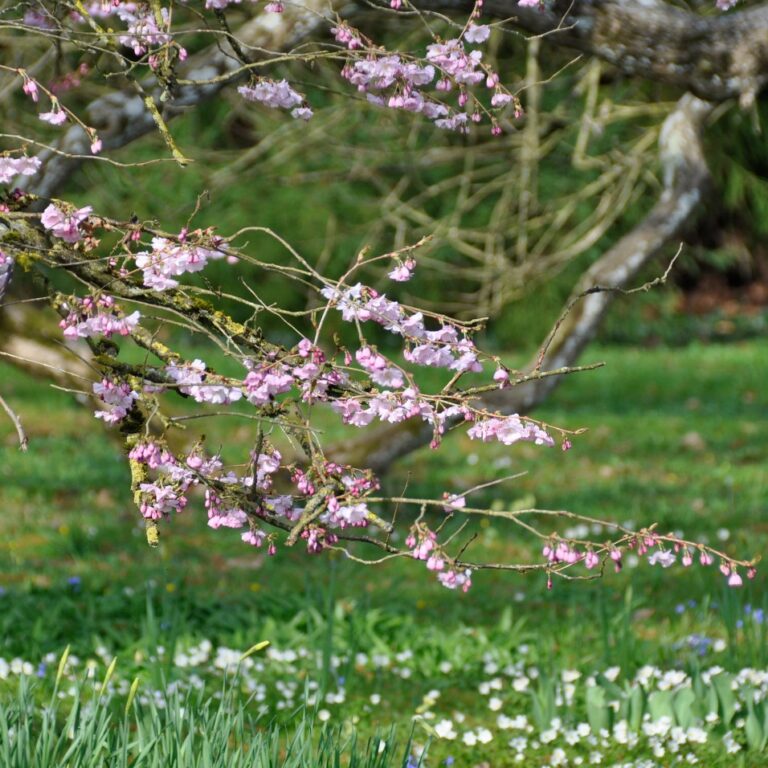
10 Best Small Crabapple Tree Varieties: (Identification and Pictures)
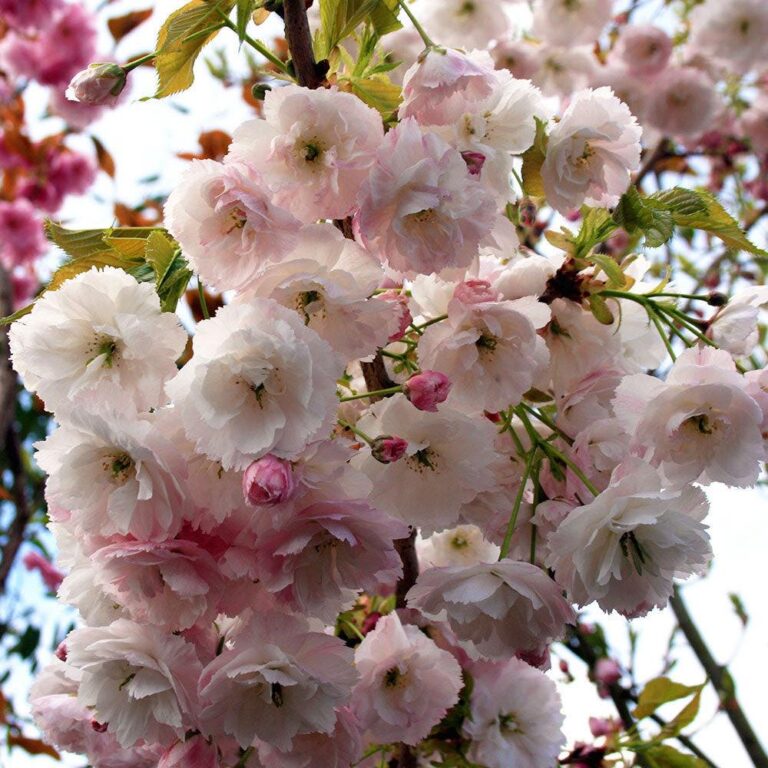
Few trees deliver as much visual reward across all seasons as crabapples. In early spring, they explode into bloom with fragrant flowers ranging from pure white to deep rose-red. In summer, their dense canopies provide structure and, beautiful foliage in shades of burgundy, bronze, or deep green.
As autumn arrives, the branches become laden with small, jewel-like fruits in red, orange, gold, or purple — often lasting well into winter, feeding birds and providing color long after most other trees have gone bare.
And here is the best part: you do not need a large property to enjoy them.
Today, there is a wide selection of compact and small-statured crabapple varieties that mature at 20 feet or less — some as small as 4 to 5 feet — making them perfectly suited to urban gardens, small suburban yards, courtyard plantings, and even large containers.
This guide covers the best small crabapple tree varieties available, what makes each one special, how to grow them successfully, and what to consider before making your selection.
The 10 Best Small Crabapple Tree Varieties
1. Sargent Crabapple (Malus sargentii)
- Hardiness: Zones 4–8
- Disease resistance: Excellent (highly resistant to scab, fire blight, and rust)
- Best use: Foundation planting, specimen in small gardens, naturalized areas
The Sargent Crabapple is the gold standard of dwarf crabapples. Originating in Japan and introduced to Western horticulture in the late 1800s, it remains one of the most widely recommended compact crabapples by university extension programs across North America.
At maturity, it reaches only 6–8 feet in height with a spreading canopy of 10–12 feet. The growth habit is distinctly low and mounding — almost shrub-like — which gives it a layered, architectural quality in the landscape.
In spring, it produces a profuse display of pure white flowers with yellow stamens, opening from pink buds. The contrast is charming. By late summer and autumn, the branches carry small, dark red fruit — barely 3/8 inch in diameter — that are enormously attractive to birds.
2. Louisa Crabapple (Malus ‘Louisa’)
- Hardiness: Zones 4–8
- Disease resistance: Very good (good resistance to scab and rust; moderate fire blight resistance)
- Best use: Weeping specimen, near water, lawn focal point
‘Louisa’ is a weeping crabapple with gracefully arching branches that cascade downward like a floral fountain in bloom. This is one of the most elegant small crabapples available.
Flowers are a true, clear pink — not fading toward white or deepening toward red — making it one of the more color-stable weeping crabapples. The fruit is small and yellow, persisting into winter.
Mature size is approximately 10–15 feet tall and wide, though the weeping habit makes it appear more compact and contained. It fits exceptionally well near water features, along property edges, or as a focal specimen in a lawn.
3. Royal Raindrops (Malus‘JFS-KW5’)
- Hardiness: Zones 4–8
- Disease resistance: Excellent
- Best use: Street tree, narrow border specimen, contrast planting against light-colored structures
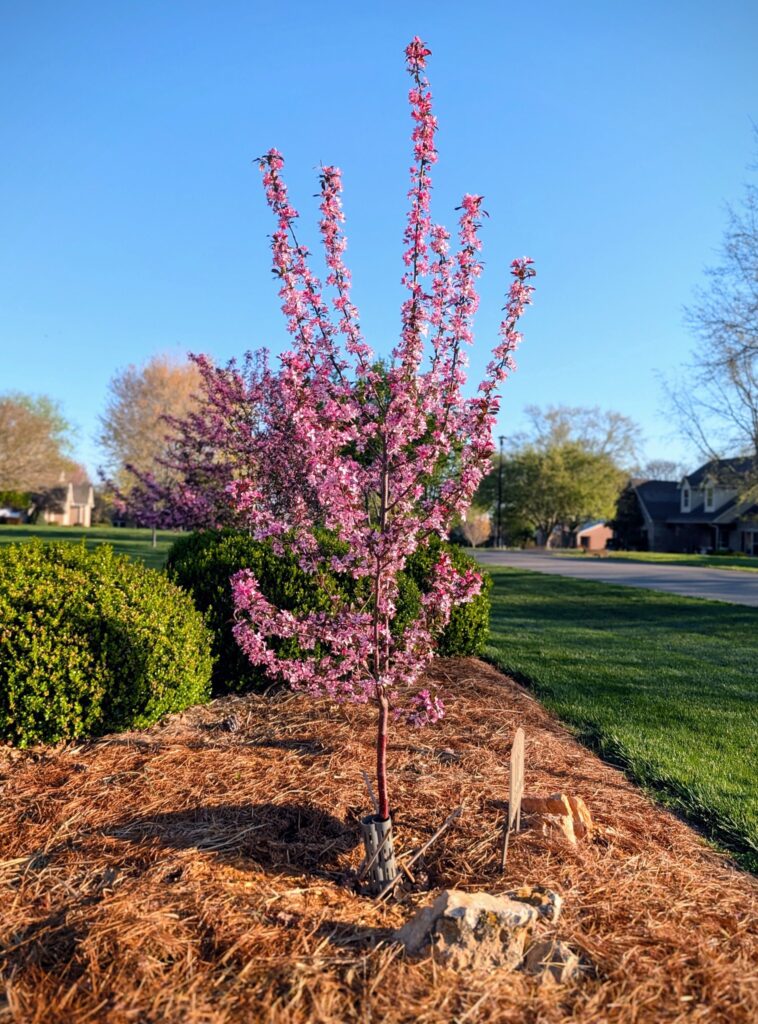
If you want drama in the landscape, Royal Raindrops delivers it. This cultivar features deeply cut, burgundy-purple foliage throughout the entire growing season — not just in spring. The leaf shape is also unusual for crabapples: lobed and incised, almost like a hawthorn leaf, which adds interesting textural variety.
The spring flower color is deep pink to magenta, making it one of the most vivid-blooming crabapples available. In autumn, small red-purple fruits appear and persist well into winter.
Reaching 15–20 feet in height with a spread of 12–15 feet, it is at the larger end of “small,” but its narrow, upright form keeps it well-suited to restricted planting spaces.
Royal Raindrops was introduced by J. Frank Schmidt & Son Nursery and has earned strong performance ratings across the Midwest and Northeast United States.
4. Tina Dwarf Crabapple (Malus sargentii ‘Tina’)
- Hardiness: Zones 4–7
- Disease resistance: Good
- Best use: Container planting, rock gardens, very small urban gardens, bonsai
‘Tina’ is a selection of the Sargent Crabapple and is considered one of the smallest named crabapple cultivars in cultivation. At maturity, it typically reaches only 4–5 feet tall with a spread of 6–7 feet — small enough to grow in a large container or as a bonsai-style specimen on a patio.
Despite its small stature, it puts on a generous spring display of white flowers opening from pink buds. The dark red fruit is tiny but appealing, and the tree is reliably floriferous — meaning it blooms well year after year without the biennial bearing problem that affects some crabapple varieties.
5. Cinnamon Spice Crabapple (Malus ‘Cinnamon Spice’)
- Hardiness: Zones 4–8
- Disease resistance: Excellent
- Best use: Autumn focal point, mixed border backdrop, suburban front yard
Introduced by the University of California cooperative extension network, Cinnamon Spice is something of an underrated gem. It produces pink-tinged white flowers in spring that give way to standout orange-gold fruit — a color not commonly seen in crabapples, which tend toward red and purple.
This warm-toned fruit is enormously decorative in autumn, particularly against a blue sky or against dark evergreen backgrounds.
The tree reaches 12–15 feet with a rounded, well-branched form that requires very little pruning to maintain a clean shape. Its disease resistance record is excellent across diverse climates.
6. Purple Prince Crabapple (Malus ‘Purple Prince’)
- Hardiness: Zones 4–8
- Disease resistance: Very good
- Best use: Landscape backdrop, specimen tree, wildlife garden
Purple Prince is a vigorous, upright-to-rounded crabapple with reddish-purple foliage that holds its color reasonably well through summer — a characteristic that not all purple-leaved crabapples share. Some fade to green by midsummer; Purple Prince maintains better color retention.
In spring, it produces rose-red to deep pink flowers that are showy and fragrant. The small, dark purple fruit that follows in late summer is heavily produced and persists well into winter, providing wildlife food and visual interest.
It grows to 15–20 feet, making it one of the larger selections in this guide. However, its strong vertical form makes it easier to fit into narrower spaces than its spread measurements suggest.
7. Camelot Crabapple (Malus ‘Camzam’)
- Hardiness: Zones 4–8
- Disease resistance: Excellent
- Best use: Small gardens, foundation planting, urban courtyards
‘Camelot’ is part of the Excalibur Series of crabapples developed for superior disease resistance and compact growth. It matures at a tidy 8–10 feet tall and wide — a size that fits comfortably in most suburban settings without requiring regular corrective pruning.
Flowers emerge deep pink to rosy, then open to reveal lighter centers. The foliage is a rich burgundy-purple, giving the tree strong seasonal presence even when not in bloom. Small dark red fruits follow in autumn.
What sets Camelot apart is its consistently clean foliage throughout the summer — a testament to its disease resistance. Many gardeners in the Midwest and Mid-Atlantic have noted that Camelot keeps its leaves looking fresh and healthy even in humid summers when other crabapples are showing scab symptoms.
8. Lancelot Crabapple (Malus ‘Lancelot’)
- Hardiness: Zones 4–8
- Disease resistance: Excellent
- Best use: Narrow borders, entranceway framing, small urban gardens
Another member of the Excalibur Series, Lancelot is notable for two characteristics: its narrow, upright growth habit and its golden-yellow fruit — a color that provides a warm autumn display quite different from the more common red-fruited varieties.
At 8–10 feet tall and 6–8 feet wide, it is one of the more columnar small crabapples available, making it an excellent choice for tight planting spaces, narrow borders, or framing entryways.
Spring flowers are white, which provides a classic, clean look. The yellow fruit persists well through autumn and into early winter.
9. Sugar Tyme Crabapple (Malus ‘Sutyzam’)
- Hardiness: Zones 4–8
- Disease resistance: Excellent
- Best use: Residential specimen, formal garden settings, wildlife-friendly landscapes
Sugar Tyme is consistently ranked as one of the top-performing crabapple cultivars in university evaluation trials, including those conducted by the Morton Arboretum and Michigan State University.
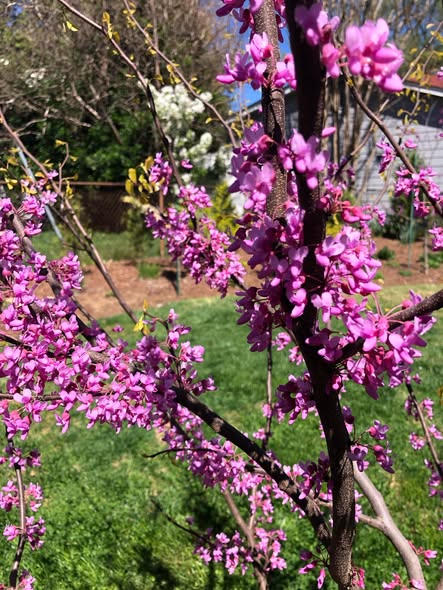
It produces an exceptional abundance of white flowers with pale pink buds — the floral display is among the heaviest of any small crabapple variety. The common name “Sugar Tyme” refers to the almost sugary sweetness of the fragrant blooms.
After flowering, small, persistent red fruits appear in autumn and often last through winter, providing reliable food for overwintering birds.
The tree grows to 12–15 feet with a symmetrical, oval to rounded crown. Its uniformly excellent disease resistance and heavy annual blooming (it avoids the biennial bearing problem) make it a top choice for gardeners who want reliable, low-maintenance performance.
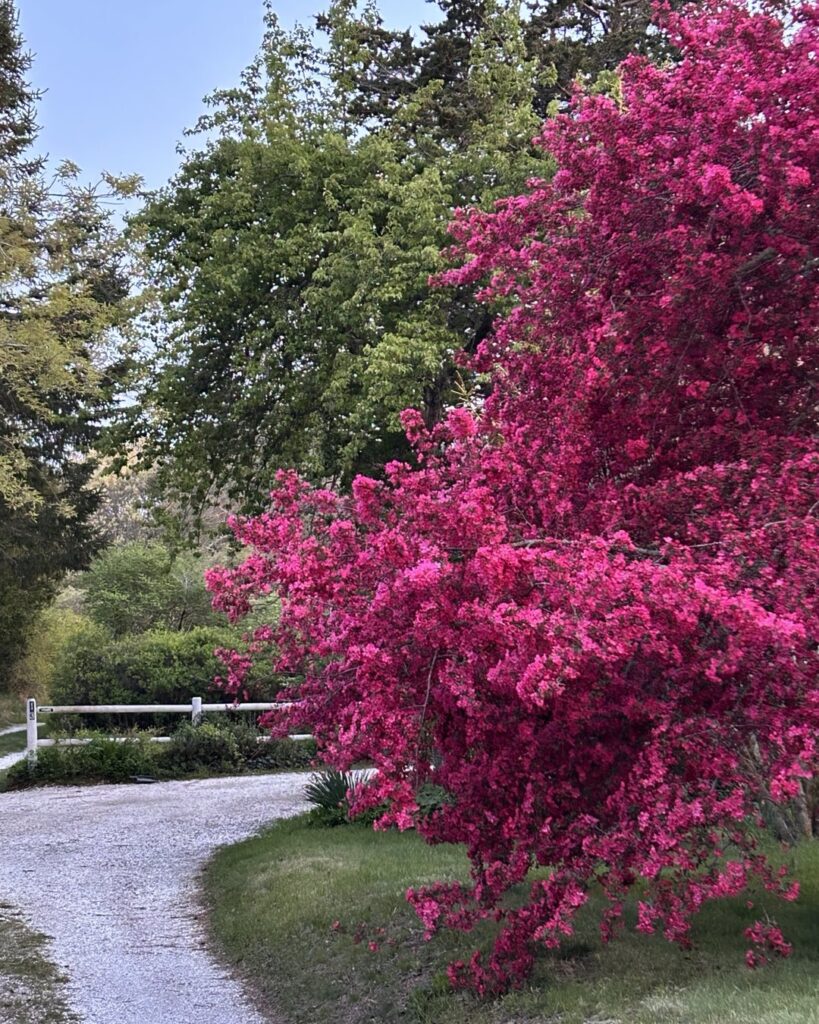
10. Prairiefire Crabapple (Malus‘Prairiefire’)
- Hardiness: Zones 4–8
- Disease resistance: Excellent
- Best use: All-purpose landscape specimen, four-season gardens, parks and public spaces
Prairiefire was developed at the University of Illinois and has remained one of the most celebrated crabapple cultivars ever since its introduction. It consistently tops the lists of recommended crabapples in university extension guides across the country.
Spring brings deep pink to red flowers — among the most intensely colored of any crabapple — set against emerging reddish-purple foliage. The foliage transitions to a dark bronzy-green in summer, then returns to reddish tones in autumn. Small, dark red, persistent fruit follow through winter.
It grows to 15–20 feet — at the upper limit of “small” — with a rounded, well-balanced canopy. What it lacks in compactness it more than compensates for with unparalleled all-season ornamental value and disease resistance.
What Defines a “Small” Crabapple Tree?
In the world of ornamental horticulture, crabapple trees (Malus species and cultivars) are generally classified by mature height:
- Dwarf crabapples: Under 8 feet at maturity
- Semi-dwarf or compact crabapples: 8–15 feet at maturity
- Standard small crabapples: 15–20 feet at maturity
Before listing the best varieties, this point deserves emphasis: always choose a disease-resistant crabapple cultivar.
Older crabapple varieties — many still sold at garden centers today — are highly susceptible to four major diseases:
- Apple scab (Venturia inaequalis) — the most common; causes dark, scabby spots on leaves and fruit, leading to premature defoliation
- Fire blight (Erwinia amylovora) — a bacterial disease that causes shoots to blacken as if scorched
- Cedar-apple rust — an orange, gelatinous fungal disease that requires both cedar and apple/crabapple hosts to complete its lifecycle
- Powdery mildew — a fungal coating that distorts and weakens new growth
The good news is that modern disease-resistant cultivars have largely solved this problem. All varieties recommended in this article have strong resistance ratings from reputable horticultural institutions.
How to Choose the Right Small Crabapple for Your Garden
With so many excellent options, the decision can feel overwhelming. Here is a simple framework:
Consider Your Available Space First
- Under 6 feet of height available: Choose ‘Tina’ or ‘Sargent’
- 6–10 feet: Choose ‘Camelot’ or ‘Lancelot’
- 10–15 feet: Choose ‘Sugar Tyme’, ‘Louisa’, or ‘Cinnamon Spice’
- Up to 20 feet: Consider ‘Prairiefire’, ‘Royal Raindrops’, or ‘Purple Prince’
Consider Your Aesthetic Priorities
- White flowers: Sugar Tyme, Sargent, Lancelot
- Pink flowers: Louisa, Cinnamon Spice, Camelot
- Deep pink/magenta flowers: Royal Raindrops, Prairiefire
- Purple foliage: Royal Raindrops, Purple Prince, Camelot
- Unusual fruit color (yellow/orange): Lancelot, Cinnamon Spice
- Weeping form: Louisa
Consider Your Climate Zone
All varieties listed are hardy in Zones 4–8. If you garden in Zone 3 (very cold winters), look for extra-hardy varieties such as ‘Rescue’, ‘Royalty’, or ‘Kelsey’ — specifically bred for northern climates.
If you are in Zones 9–10, crabapples generally struggle due to insufficient winter chilling hours.
Planting Guide for Small Crabapple Trees
When to Plant
- Spring (after the last hard frost) is ideal in Zones 4–6
- Fall (6–8 weeks before the first expected frost) works well in Zones 6–8, allowing root establishment before winter dormancy
Site Selection
Choose a location with:
- Full sun: Minimum 6 hours of direct sunlight daily. Crabapples in shade bloom poorly and are significantly more disease-prone.
- Good air circulation: Avoid planting in enclosed corners or against walls where airflow is restricted — stagnant air promotes fungal disease.
- Well-drained soil: Crabapples do not tolerate waterlogged conditions. They prefer slightly acidic to neutral soil (pH 6.0–7.0).
Planting Steps
1. Dig a wide, shallow hole. The hole should be 2–3 times wider than the root ball but no deeper. Planting too deep is a leading cause of early decline.
2. Position the tree correctly. The graft union (a slight swelling near the base of the trunk) should sit 2 inches above soil level — never buried.
3. Backfill with native soil. Minimal amendment is needed; excessive organic matter in the backfill can actually discourage roots from spreading into surrounding soil.
4. Water deeply at planting, then water once or twice per week for the first growing season. After establishment, most crabapples are moderately drought-tolerant.
5. Mulch generously. Apply 3–4 inches of wood chip or shredded bark mulch in a circle extending to the drip line. Keep mulch 4–6 inches away from the trunk to prevent rot and rodent damage.
Ongoing Care and Maintenance
Watering
Established crabapples need supplemental watering only during prolonged drought — generally defined as more than 3–4 weeks without significant rain. Deep, infrequent watering is far preferable to frequent shallow watering.
Fertilization
Light annual fertilization in early spring — before new growth begins — supports good flowering and overall vigor. A balanced, slow-release fertilizer (10-10-10) applied according to package directions is sufficient.
Avoid over-fertilization with high-nitrogen formulas. Excess nitrogen promotes lush, disease-susceptible growth and can reduce flowering.
Pruning
Crabapples require minimal routine pruning when a disease-resistant, well-suited variety is planted in the right location.
- Prune in late winter or very early spring, while the tree is dormant and before buds swell
- Never prune in wet weather or during active growth — open cuts during these periods invite disease
- Remove dead, diseased, or crossing branches
- Remove any water sprouts (vigorous upright shoots from the interior of the canopy) and suckers from the rootstock at the base
Do not attempt to drastically reshape an established crabapple through heavy pruning — it stimulates excessive water sprout production and opens large wounds.
Crabapples and Wildlife: An Underappreciated Benefit
One of the most compelling arguments for planting small crabapple trees — beyond their beauty — is their exceptional ecological value.
The persistent fruit of most crabapple varieties is a critical winter food source for numerous bird species, including:
- Cedar waxwings
- American robins
- Northern mockingbirds
- Bohemian waxwings
- Wild turkeys and ring-necked pheasants
The spring flowers provide nectar and pollen for native bees, honeybees, and early butterflies. In fact, crabapples are considered one of the most important early-season pollinator plants in temperate North American gardens, often blooming when few other nectar sources are available.
Planting a crabapple in your garden is not merely an aesthetic decision — it is an investment in local biodiversity.
Common Problems and How to Prevent Them
Even with disease-resistant varieties, good cultural practices matter.
Apple Scab
Symptoms: Olive-green to black scabby spots on leaves and fruit; premature leaf drop by midsummer. Prevention: Choose resistant varieties; avoid overhead watering; rake and remove fallen leaves in autumn.
Fire Blight
Symptoms: Shoot tips blacken and curve downward (“shepherd’s crook”); infected wood has orange-red streaking inside. Prevention: Choose resistant varieties; avoid heavy nitrogen fertilization; prune out infected shoots well below the visible symptoms (at least 12 inches into healthy wood), sterilizing tools between cuts with a 10% bleach solution.
Cedar-Apple Rust
Symptoms: Orange, gelatinous galls on branches; yellow-orange spots on leaves. Prevention: Choose resistant varieties; if possible, remove nearby eastern red cedar (Juniperus virginiana) trees, which serve as alternate hosts.
Aphids
Symptoms: Curled, distorted new growth; sticky honeydew residue on leaves below. Management: A strong spray of water dislodges colonies. Insecticidal soap or neem oil if infestations are severe.
Frequently Asked Questions
Do small crabapple trees have invasive roots?
No. Crabapple roots are generally non-invasive. They do not seek out drains or foundations aggressively. However, like all trees, they should not be planted directly against structures.
Are crabapple fruits edible?
Yes. All crabapple fruits are edible, though most are too tart and astringent to eat raw. They are excellent for making jelly, preserves, cider, and sauces. The smaller the fruit (under 2 inches), the higher the pectin content, which makes for better preserves.
How long does a crabapple tree live?
Most crabapple trees live 30–70 years under good conditions — significantly longer than many ornamental trees. Properly sited and disease-resistant varieties at the upper end of this range.
Do I need two crabapple trees for fruit production?
Most crabapple varieties are self-fertile and will produce fruit without a second tree. However, cross-pollination from another crabapple (or a nearby apple tree) often improves fruit set. Since most gardens have neighbors with other apple family trees, this is rarely a practical concern.
How far should a crabapple be planted from a house?
As a general guideline, plant at least 10–15 feet from any structure. For larger varieties that spread to 20 feet, plant at least 15–20 feet from buildings to allow full canopy development without interference.
Final Thoughts
The best small crabapple tree varieties offer something genuinely rare in the plant world — a single tree that earns its place in every season.
Spring brings clouds of fragrant blossom. Summer provides clean, healthy foliage and graceful garden structure. Autumn reveals glistening fruit in colors from gold to burgundy. And winter offers the continued beauty of persistent fruit and elegant bare branch architecture against a gray sky.
The varieties covered in this guide — from the ground-hugging ‘Tina’ to the elegant weeping ‘Louisa’ to the all-season powerhouse ‘Prairiefire’ — represent the finest small crabapples available today, selected by horticultural professionals and proven in evaluation trials across diverse climates.
Choose a disease-resistant variety. Plant it in full sun with good drainage. Give it room to breathe. Do those three things, and your crabapple will reward you for decades.
If you have not yet added a crabapple to your garden, this may be the year to do it. Few ornamental trees offer this level of return on a single planting decision.
Further Reading: North Carolina State University Extension — Plant Toolbox: Malus Species and Cultivars https://plants.ces.ncsu.edu/plants/malus/

Tim M Dave is a gardening expert with a passion for houseplants, particularly cacti and succulents. With a degree in plant biology from the University of California, Berkeley, he has vast experience in gardening. Over the years, he has cultivated a vast collection of desert plants and learned a great deal about how to grow and care for these unique companions.