Understanding Silver Birch (Betula pendula): Identification, History, Uses, Problems, and Cultivation Details
I once stood at the edge of a silver birch woodland in the Scottish Highlands in early April. The trees were bare, but their white trunks caught the pale morning light in a way that made the whole hillside seem to shimmer.
There was no dramatic spectacle — just a quiet, elegant beauty that stayed with me long after I left. That moment is why I believe Betula pendula, the silver birch, deserves far more attention than it typically receives.
It is one of the most widely recognised trees in the world. Yet most people know surprisingly little about it.
If you have space in your garden, orchard, or land — and you live within its suitable climate range — planting a silver birch is one of the simplest and most effective things you can do for local biodiversity.
- It establishes quickly and provides ecological value within just a few years
- It supports hundreds of species of insects, birds, and fungi
- It requires minimal maintenance once established in a suitable site
- It offers four seasons of beauty: spring catkins, summer shimmer, autumn gold, winter bark
- It connects your land to the deep natural and cultural heritage of the temperate world
Choose a sunny, open spot with well-drained soil. Give it room. And in ten years, you will have a tree that enriches every living thing around it.
Before we dive into the world of Betula pendula, here is a quick summary about this beloved tree.
| Scientific name | Betula pendula |
| Common names | Silver birch, European white birch, warty birch |
| Family | Betulaceae |
| Native range | Europe, Western Siberia, Central Asia |
| Hardiness zones | USDA Zones 2–7 |
| Mature height | 15–25 metres (up to 30 m) |
| Bark | Silver-white with black diamond markings |
| Leaf colour (autumn) | Bright golden yellow |
| Sun requirement | Full sun |
| Soil preference | Well-drained, slightly acidic |
| Lifespan | 80–120 years (up to 150 in ideal conditions) |
| Wildlife value | Very high (300+ invertebrate species) |
| Cultural significance | National symbol of Russia; central to Nordic and Celtic tradition |
What Is the Silver Birch?
The silver birch (Betula pendula), also known as the European white birch, warty birch, or weeping birch, is a medium-sized, deciduous tree native to Europe and parts of Asia. It belongs to the family Betulaceae and is one of the most ecologically and culturally significant trees in the temperate world.
Its defining features are its silvery-white bark, slender drooping branches, and diamond-shaped, sharply toothed leaves. It is fast-growing, hardy, and capable of thriving in some of the most difficult soils on the continent. It is also, by almost any measure, one of the most beautiful trees in the Northern Hemisphere.
Understanding the silver birch means understanding the forests, folklore, and landscapes of an entire hemisphere.
Scientific Classification
| Category | Detail |
| Kingdom | Plantae |
| Order | Fagales |
| Family | Betulaceae |
| Genus | Betula |
| Species | B. pendula |
| Common names | Silver birch, European white birch, warty birch |
| Chromosome number | 2n = 28 |
The species name pendula is Latin for “hanging” or “drooping,” a direct reference to the tree’s characteristic weeping branch habit.
Geographic Range and Natural Habitat
The silver birch is native to a vast geographic range, stretching from Ireland and the United Kingdom in the west across the whole of continental Europe, through Russia and Siberia, and into Central Asia, Turkey, and the Caucasus. It is one of the most widely distributed trees in the temperate world.
Its natural range covers key regions including:
- The British Isles, where it is one of the most common native trees, especially in Scotland, northern England, and Wales
- Scandinavia, including Norway, Sweden, and Finland, where it thrives in boreal and sub-boreal forests
- Germany, Poland, the Czech Republic, and the Baltic States, where it forms extensive woodland
- Russia, where silver birch forests (birchwoods or bereznyaks) cover millions of hectares across the taiga
- Turkey, Iran, and the Caucasus region, where it grows at altitude in montane forests
- It has also been widely naturalised in North America, New Zealand, and Australia, where it is planted as an ornamental tree
In terms of habitat, the silver birch is extraordinarily adaptable. It colonises heathlands, moorlands, forest clearings, rocky slopes, riverbanks, and disturbed ground. It can grow in acidic, infertile, sandy, or stony soils where most other trees cannot survive.
This tree tolerates both drought and moderate waterlogging, though it prefers well-drained, slightly acidic to neutral soils.
Altitude is no obstacle either. Silver birch grows from sea level to over 2,000 metres in alpine zones across Europe, making it among the most vertically adaptable broadleaf trees on the continent.
Physical Description and Key Identifying Features
Bark
The bark is the tree’s most iconic feature. In young trees, the bark is red-brown and somewhat rough. As the tree matures — usually by the time it is 8 to 10 years old — it transforms into the striking silver-white colour it is famous for.
The surface is smooth but marked with characteristic black diamond-shaped fissures at the base and along the lower trunk.
Unlike the paper birch of North America, the bark of Betula pendula does not peel in large papery sheets. It may flake slightly at the edges, but it is generally more adherent. The black markings are caused by lenticels — pores in the bark that allow gas exchange.
Leaves
The leaves are 2 to 7 cm long, roughly triangular to rhombic (diamond-shaped), with a pointed tip and doubly serrated edges. They emerge in spring as a fresh, bright green, deepen to a mid-green in summer, and turn a luminous golden yellow in autumn.
The leaf stalks (petioles) are slender and flexible, causing leaves to tremble in even a gentle breeze. This gives birch groves a characteristic shimmering, rustling quality on windy days that is unmistakeable.
Growth Habit and Size
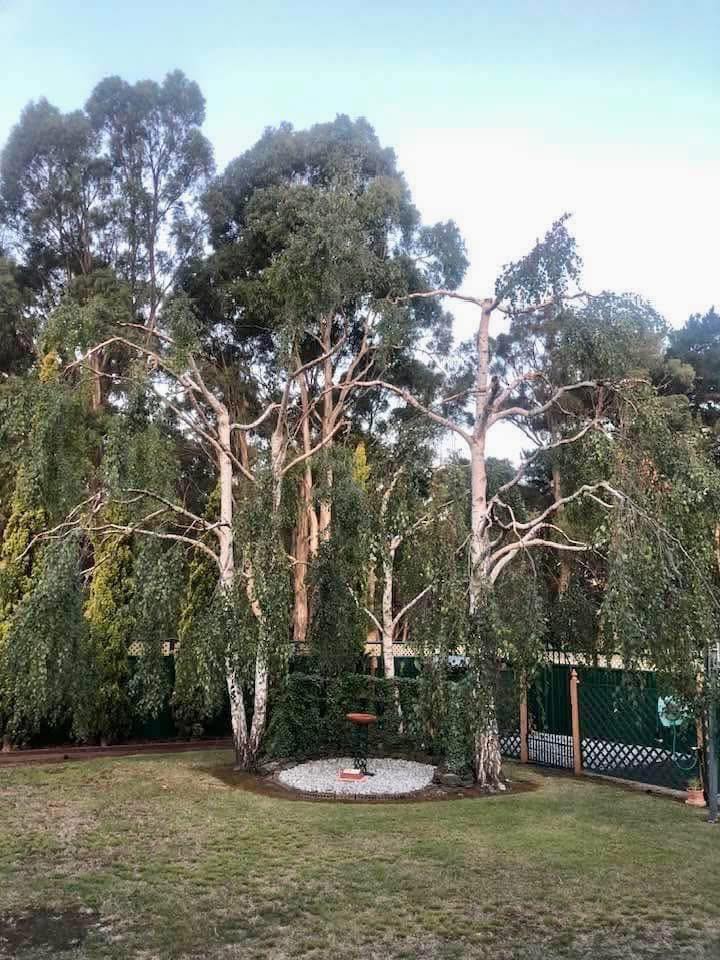
Silver birch is a slender, graceful tree with a conical to irregular crown when young, becoming more open and airy with age. The branches are notably pendulous — they hang downward in long, sweeping arcs — giving the tree its weeping appearance.
A mature silver birch reaches 15 to 25 metres in height, with some specimens in favourable conditions approaching 30 metres. The trunk is usually straight but slender, rarely exceeding 40 cm in diameter even in old trees.
Catkins and Seeds
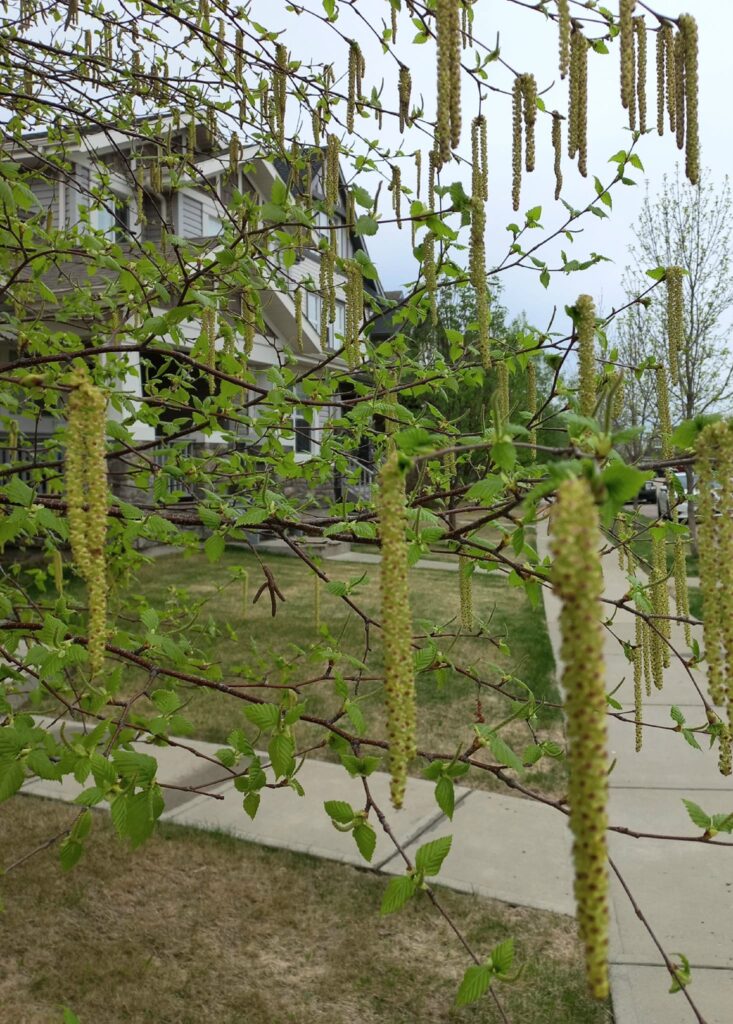
Silver birch is monoecious, producing both male and female catkins on the same tree.
- Male catkins appear in autumn and overwinter in tight clusters, opening in April to release pollen. They are long, pendulous, and yellowish, measuring 3–6 cm.
- Female catkins are shorter and more upright when fresh, developing into cylindrical fruiting structures (strobiles) by late summer. Each strobile releases hundreds of tiny winged seeds (samaras), which are dispersed over great distances by wind.
A single tree can produce over a million seeds per year, which is a key reason the silver birch is such a successful coloniser.
Root System
The root system is shallow and wide-spreading, radiating outward just below the soil surface. This means the tree is sensitive to soil compaction and drought. It also means planting silver birch close to drains, paths, or building foundations requires care.
Ecological Importance
The silver birch is one of the most ecologically rich trees in European and Asian forests. Its value to wildlife is exceptional.
Support for Invertebrates
Silver birch supports over 300 species of insects and other invertebrates in the UK alone, according to research compiled by the Woodland Trust. These include numerous moths, beetles, and aphid species. The caterpillar of the Kentish glory moth (Endromis versicolora) is almost entirely dependent on birch leaves in Britain.
The birch bark beetle, various wood-boring beetles, and the weevil community associated with birch bark and wood are critical food sources for cavity-nesting birds such as woodpeckers.
Fungi and Mycorrhizal Networks
Silver birch is one of the most important hosts for mycorrhizal fungi in temperate forests. It forms associations with dozens of fungal species, including fly agaric (Amanita muscaria), birch milk cap (Lactarius torminosus), birch bolete (Leccinum scabrum), and *Paxillus involutus.
These fungi are not just aesthetically interesting — they are functionally critical. The mycorrhizal network connecting birch roots to surrounding soil fungi helps the tree access water and nutrients, and the same fungi support the establishment of surrounding plant communities. Birch is often a founding tree in these underground networks.
Birds and Mammals
- Redpolls and siskins feed heavily on birch catkins and seeds through winter, making birch woodland a critical winter feeding ground
- Long-tailed tits glean insects and spiders from the fine branches
- Treecreepers and nuthatches probe the bark for hidden invertebrates
- Roe deer and rabbits browse young birch shoots, particularly in spring
- Red squirrels feed on birch seeds and use the tree canopy for movement corridors
Role as a Pioneer Species
Like its North American cousin, the silver birch is a classic pioneer species. It is one of the first trees to colonise bare ground following disturbance — whether from fire, flooding, landslide, or human activity.
By growing quickly and creating light shade, it modifies the microclimate of the ground beneath it, making conditions suitable for shade-tolerant species like oak, ash, rowan, and hazel to germinate and grow. In time, these species may overtop and replace the birch — but the forest would never have established without it.
This is why ecologists call birch a nurse tree. It nurses the forest into being.
Cultural and Historical Significance
Few trees have a richer symbolic and practical history in human culture than the silver birch.
European Folklore and Mythology
Across much of northern Europe, the birch is a tree of renewal, purification, and new beginnings. In Celtic tradition, birch was the first tree of the Ogham alphabet (Beith), associated with the start of the year and the clearing of the old.
In Norse and Germanic folk belief, birch branches were hung over doorways at Midsummer to bring good fortune.
In Russian culture, the birch (beryoza) holds near-sacred status. It is a national symbol of Russia, appearing in poetry, painting, folk song, and literature as an emblem of the Russian landscape and the Russian soul.
Writers from Pushkin to Pasternak referenced birch trees to evoke home, memory, and longing.
Traditional and Medicinal Uses
Indigenous and traditional communities across Europe and Asia found extensive practical uses for every part of the silver birch:
- Birch sap: Tapped in early spring, the sap was drunk fresh as a tonic, fermented into a mild wine or beer, or reduced to a syrup. In Finland, Russia, Poland, and the Baltic states, birch sap tapping remains a living tradition to this day.
- Bark: Used to make containers, baskets, torches (birch bark is highly flammable due to its natural oils), and roof shingles. The tar distilled from birch bark was used as a waterproofing agent and adhesive — one of the oldest manufactured substances in human history, with evidence of use going back 50,000 years to Neanderthal-era sites in Europe.
- Leaves and inner bark: Used in folk medicine as a diuretic, anti-inflammatory, and treatment for urinary infections, gout, and rheumatism. Birch leaf tea remains popular in herbal medicine traditions across Central and Eastern Europe.
- Birch twigs (besoms): Bound bundles of birch twigs were used as besom brooms for sweeping. In the sauna tradition of Finland and Russia, birch whisks (vihta or venik) are used to gently beat the skin, stimulating circulation and releasing the fresh, aromatic scent of birch leaves — a practice still enjoyed by millions today.
Timber Uses
The wood of the silver birch is pale, fine-grained, and hard. It has been used for furniture, flooring, plywood, wooden spools, and tool handles.
In Finland and Scandinavia, birch plywood is considered among the finest quality available and is widely used in furniture manufacturing, including by well-known design houses.
Birch is also an excellent firewood, burning hot and clean, and is commonly used for charcoal production.
Growing Conditions and Landscape Use
Climate and Hardiness
Silver birch is exceptionally cold-hardy, tolerating temperatures as low as -40°C in continental climates. It grows well across USDA Hardiness Zones 2 to 7 and the equivalent European hardiness zones. It is suited to cool-temperate to subarctic climates and does not thrive in hot, humid subtropical conditions.
In the United Kingdom, it is perfectly at home across all regions, including Scotland, where it is a defining feature of the native woodland landscape.
Soil Requirements
- pH: Tolerates pH 4.5 to 7.0 (performs best in slightly acid conditions, pH 5.0–6.5)
- Texture: Prefers sandy, loamy, or stony soils; tolerates poor, infertile ground
- Drainage: Prefers well-drained soils but tolerates brief waterlogging
- Avoid: Heavy clay, compacted ground, and waterlogged sites
Sun Requirements
Silver birch requires full sun. It is not shade-tolerant and will not thrive or grow well under a canopy of other trees. It performs best in open, exposed positions where it receives direct sunlight for the majority of the day.
Planting Tips
- Best time to plant: Autumn or early spring (bare root trees) or any time from containers
- Spacing: Allow 8 to 10 metres between trees in natural plantings; 3 to 5 metres for ornamental groups
- Avoid: Planting near water pipes, drainage systems, or building foundations due to the wide, shallow root system
- Mulch: Apply a 5–8 cm layer of organic mulch around the base to retain moisture and suppress weeds, keeping mulch clear of the trunk
Ornamental Cultivars
Several cultivated varieties of silver birch are widely planted in gardens and parks:
- Betula pendula ‘Youngii’ (Young’s weeping birch): A strongly weeping, dome-shaped small tree, ideal for smaller gardens
- Betula pendula ‘Purpurea’ (purple-leafed birch): Dark purple foliage providing striking contrast in the landscape
- Betula pendula ‘Tristis’: A tall, narrow, elegantly weeping form with a more vertical habit
- Betula pendula ‘Laciniata’ (cut-leaf birch): Deeply cut, lacy leaves giving a more delicate appearance
These cultivars retain all the ecological value of the species while offering additional design flexibility.
Common Pests and Diseases
Birch Aphids (Euceraphis spp.)
Dense colonies of birch aphids are common in summer and produce sticky honeydew that may coat lower leaves and garden furniture beneath the tree. However, they are rarely damaging to a healthy tree and are an important food source for ladybirds, hoverflies, and birds.
Rust Fungi (Melampsoridium betulinum)
Birch rust causes orange or yellow powdery spots on the underside of leaves, leading to early leaf fall in late summer. It is more of a cosmetic issue than a serious health threat for established trees.
Birch Polypore (Fomitopsis betulina)
This distinctive bracket fungus appears on the trunks of ageing or dead birch trees. While it accelerates decay in the wood, it is also a keystone species for a range of rare insects and has been used medicinally for thousands of years — evidence of its use was found on Ötzi the Iceman, the 5,000-year-old glacier mummy.
Bronze Birch Borer (Agrilus anxius)
In North America, where silver birch has been introduced as an ornamental, it is highly susceptible to the bronze birch borer. This pest is far more damaging to B. pendula than to native American birch species, which have developed some resistance.
Gardeners in North America should be cautious about planting silver birch in areas where this borer is prevalent.
Silver Birch vs. Downy Birch: How to Tell Them Apart
The silver birch is frequently confused with the downy birch (Betula pubescens), its closest relative, which shares much of the same range. Here is how to distinguish them:
| Feature | Silver Birch (B. pendula) | Downy Birch (B. pubescens) |
| Bark | White with black diamond markings | White to grey-brown, fewer black markings |
| Twigs | Hairless, rough with small warts | Covered in fine, downy hairs |
| Leaves | Triangular, sharply double-toothed | More rounded, singly toothed, softly hairy |
| Branch habit | Strongly pendulous (drooping) | Less pendulous, more upright |
| Preferred habitat | Dry, well-drained soils | Wetter, boggy, peaty ground |
The easiest check: run your fingers along a fresh twig. If it is rough and warty, it is silver birch. If it is softly hairy, it is downy birch.
Conservation Status and Environmental Value
Betula pendula is listed as Least Concern by the IUCN Red List, and its global populations are stable and widespread. However, several local or regional populations face pressure from changes in land use, overgrazing by deer, and suppression of natural regeneration in managed woodlands.
In the United Kingdom, rewilding initiatives led by organisations such as Trees for Life and the Woodland Trust actively encourage birch regeneration as a foundation for native woodland restoration.
Birch is often the first planting choice in upland restoration projects precisely because of its tolerance for poor soils and its role in facilitating the establishment of other native species.
In an era of biodiversity loss and climate pressure, the silver birch is increasingly recognised as a keystone species for ecological restoration across temperate Eurasia.
Final Thoughts
The silver birch is one of those trees that rewards every kind of attention. The botanist sees a textbook pioneer species. The ecologist sees a keystone of forest networks. The forager sees sap and medicine. The woodworker sees fine-grained timber. The poet sees light, movement, and memory.
What strikes me most, though, is its generosity. This is a tree that gives freely — to the insects that feed on its leaves, to the fungi that wrap around its roots, to the birds that nest in its canopy, to the humans who have drawn sustenance from its bark and sap for tens of thousands of years.
To plant a silver birch is to give something back. And in a world that is losing its trees far too quickly, that gesture matters more than it ever has.
References
- Royal Botanic Gardens Kew — Betula pendula Roth (Silver Birch) Species Profile https://powo.science.kew.org/taxon/urn:lsid:ipni.org:names:314688-2
- Woodland Trust (UK) — Silver Birch: Identification, Uses and Ecology https://www.woodlandtrust.org.uk/trees-woods-and-wildlife/british-trees/a-z-of-british-trees/silver-birch/
- University of Edinburgh — Birch Genome Project and Betula Research https://www.research.ed.ac.uk/en/organisations/institute-of-ecology-and-evolution
- USDA Forest Service — Fire Effects Information System (FEIS): Betula pendula https://www.fs.usda.gov/database/feis/plants/tree/betpen/all.html
- Natural History Museum, London — Birch Trees and Biodiversity https://www.nhm.ac.uk/discover/what-lives-in-a-birch-tree.html

Tim M Dave is a gardening expert with a passion for houseplants, particularly cacti and succulents. With a degree in plant biology from the University of California, Berkeley, he has vast experience in gardening. Over the years, he has cultivated a vast collection of desert plants and learned a great deal about how to grow and care for these unique companions.