Understanding Sassafras (Sassafras albidum): Uses, Problems, Cultivation, and More
Some trees are beautiful. Some are useful. And some carry centuries of history, medicine, folklore, and fragrance all within a single trunk.
Sassafras (Sassafras albidum) is all of these things at once.
I remember the first time someone handed me a fresh sassafras leaf and told me to crush it between my fingers. The scent that followed — warm, spicy, unmistakably rootbeer-like — was unlike anything I had encountered in a forest before.
That moment alone was enough to make me want to learn everything about this tree.
And there is a great deal to learn.
From its remarkable multi-lobed leaves to its culinary, medicinal, and ecological roles, Sassafras is one of the most distinctive and fascinating native trees in North America. This guide explains what makes this tree so special.
What Is Sassafras?
Sassafras (Sassafras albidum) is a deciduous tree native to eastern North America. It belongs to the laurel family (Lauraceae) — a family that also includes cinnamon, avocado, and bay laurel — which already hints at its aromatic qualities.
The tree is famous for several things:
- Its three distinct leaf shapes, all present on the same tree
- Its intensely aromatic bark, roots, and leaves
- Its deep roots in Native American and colonial American culture
- Its striking autumn colour display
- Its historical use as a flavouring agent in root beer and Creole cooking
Sassafras is not a rare or delicate tree. It is vigorous, adaptable, and often forms dense thickets through root sprouting. In the right landscape, it is one of the most rewarding native trees you can grow.
Botanical Classification and Background
Understanding Sassafras begins with knowing its place in the plant kingdom.
- Family: Lauraceae
- Genus: Sassafras
- Species: Sassafras albidum (Nutt.) Nees
- Common Names: Sassafras, White Sassafras, Red Sassafras, Mitten Tree, Ague Tree
- Native Range: Eastern North America — from southern Ontario and Maine south to Florida, and west to Kansas, Oklahoma, and Texas
The genus Sassafras contains only three living species worldwide: S. albidum in North America, S. tzumu in central China, and S. randaiense in Taiwan.
This disjunct distribution — species on opposite sides of the Pacific — reflects an ancient biogeographic connection between North American and Asian temperate forests that dates back to the Tertiary period.
Fossils of Sassafras have been found in Cretaceous deposits, making it one of the older surviving angiosperm genera. That alone gives this tree a certain gravitas.
Physical Characteristics
Leaves — The Tree’s Most Recognisable Feature
Sassafras is perhaps most famous for having leaves of three different shapes on the same tree — a feature botanists call heterophylly.
The three forms are:
- Unlobed oval leaves — simple, egg-shaped
- Two-lobed mitten-shaped leaves — with one rounded lobe extending to one side, resembling a thumb
- Three-lobed leaves — with lobes extending from both sides of the central lobe, creating a trident or ghost shape
All three forms may appear simultaneously on a single branch. This variation is particularly common in younger shoots and juvenile growth.
The leaves are medium to dark green on the upper surface and paler beneath, with a smooth texture. They are 5–15 cm long and release a pleasant spicy fragrance when bruised or crushed — the same warm, root-beer scent that has made Sassafras famous.
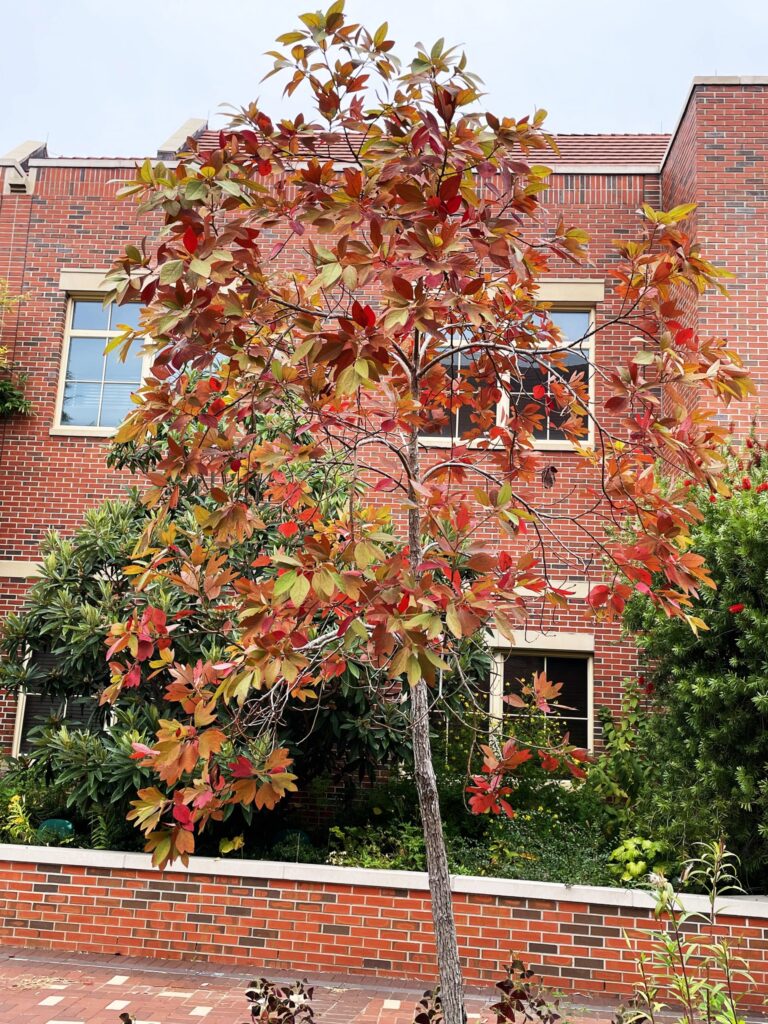
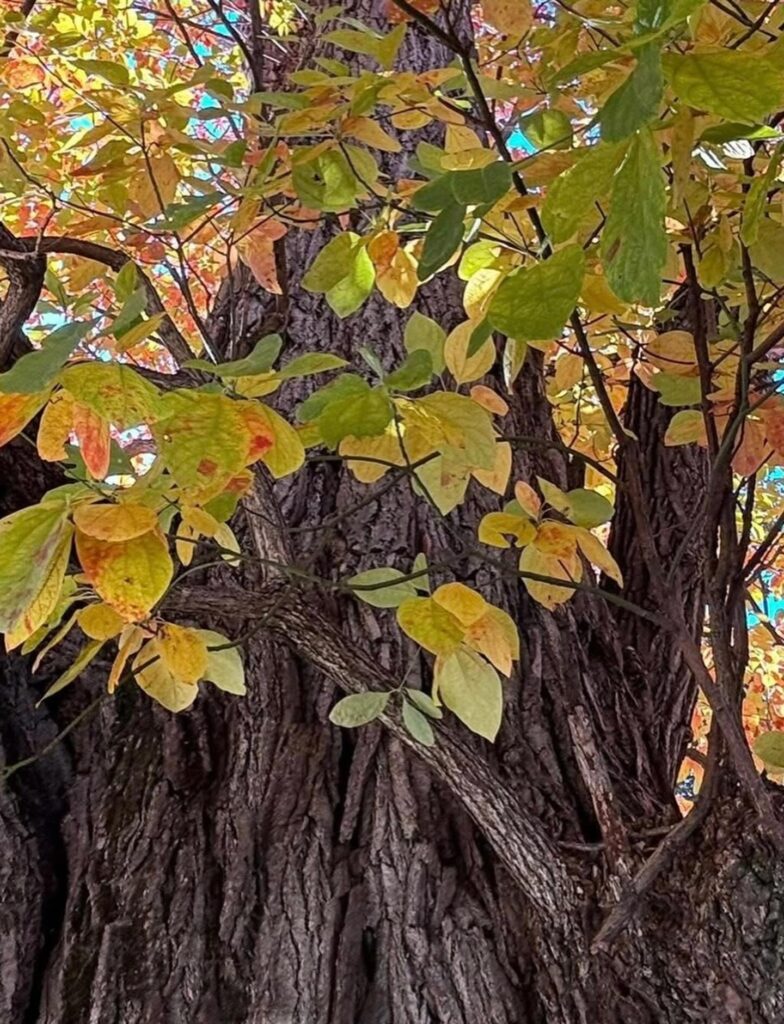
Autumn colour is genuinely spectacular. Sassafras produces some of the richest and most varied fall foliage of any native tree — displaying shades of yellow, orange, scarlet, and deep purple, often on the same tree or even the same branch.
Bark and Trunk
Young Sassafras trees have smooth, green-tinged bark that is often quite attractive. As the tree matures, the bark becomes deeply furrowed and orange-brown to grey, developing a rugged, almost corky texture on older specimens.
The inner bark, roots, and rootbark are intensely aromatic — spicy, warm, and distinctively fragrant. This is where the tree’s most historically significant compounds are concentrated.
Size and Form
Sassafras is variable in size, depending on site conditions.
- Typical height: 9–18 metres (30–60 feet) in cultivation; some specimens in optimal conditions reach 25+ metres (80 feet)
- Trunk diameter: Up to 60 cm (2 feet) on large, mature trees
- Crown form: Broadly irregular and flat-topped at maturity, with horizontal branching that creates a layered, architectural silhouette
In open-grown conditions, Sassafras develops a broad, spreading canopy that is particularly attractive. In forest settings, it grows taller and narrower in competition for light.
Flowers
Sassafras is dioecious — individual trees are either male or female, and both are needed for fruit production.
Flowers appear in early spring, just before or alongside the emerging leaves — a timing that makes them particularly noticeable. They are small, yellow-green, and fragrant, borne in loose clusters (racemes).
While not dramatic on an individual scale, the collective effect of a flowering Sassafras in early April is genuinely lovely, especially when the emerging chartreuse foliage accompanies it.
Fruit
Female trees produce small, dark blue drupes (single-seeded fleshy fruits) about 1 cm in diameter, borne on bright red, club-shaped stalks. The combination of deep blue fruit and vivid red stalk is one of the most striking fruit displays among native trees.
Fruits ripen in late summer to early autumn and are quickly consumed by birds — a fact that makes Sassafras an extremely valuable wildlife plant.
Natural Habitat and Range
Sassafras is native to eastern North America, where it grows across a wide range of habitats.
It is most commonly found in:
- Dry to moist upland forests and forest edges
- Old fields and disturbed areas — it is one of the first trees to colonise abandoned farmland
- Roadsides, thickets, and woodland margins
- Sandy, well-drained soils in coastal plain regions
It is a highly adaptable, pioneer species. Because it reproduces vigorously through root sprouts, Sassafras often forms dense thickets in open areas. This quality makes it ecologically valuable for erosion control and habitat creation, but it is worth understanding if you are planning to use it in a managed garden setting.
Its native range extends from southern Maine and southern Ontario in the north, through the Appalachian Mountains, across the Ozarks, and south to central Florida and eastern Texas — a range that speaks to its adaptability across a wide spectrum of climates and soils.
Growing Requirements
Climate and Hardiness
Sassafras is cold-hardy to USDA Zone 4 (tolerating temperatures down to approximately -34°C / -30°F in dormancy), and is adapted to Zones 4–9 across its natural range.
It is well-suited to humid continental and humid subtropical climates, and performs well across most of the eastern United States and Canada within its native range.
Sunlight
Full sun to partial shade suits Sassafras well. It grows fastest and produces the best autumn colour in full sun positions.
In woodland settings, it tolerates considerable shade when young, but typically “escapes” toward light as it grows.
Soil
Sassafras is remarkably tolerant of poor soils — arguably one of its greatest landscape virtues.
It grows best in:
- Well-drained, sandy to loamy soils
- Slightly acidic to neutral pH (5.5–7.0)
- Dry to moderately moist conditions
It does not tolerate waterlogged or consistently saturated soils. Root rot is a real risk in heavy, poorly drained clay. That said, Sassafras is more drought-tolerant than many similarly sized trees once established, making it particularly useful in dry, challenging sites.
Watering
During establishment (the first 1–2 years after planting), consistent moisture is important. Water deeply during dry spells rather than frequent shallow irrigation.
Once established, Sassafras is genuinely drought-resilient and typically requires no supplemental watering in average years.
Fertilisation
Sassafras requires very little fertilisation, particularly once it has settled into a suitable site. Over-fertilisation encourages rank, soft growth.
In very poor soils, a light application of balanced, slow-release fertiliser in early spring can support establishment, but this is rarely necessary in reasonably healthy garden soils.
Planting and Establishment
Sourcing Sassafras
Sourcing Sassafras for garden planting can be challenging. The tree has a long taproot that develops early and makes transplanting of wild or nursery-grown specimens difficult. For this reason, container-grown specimens from specialist native plant nurseries are the most reliable choice.
Alternatively, growing from seed is very possible, though seeds require a period of cold, moist stratification (typically 90–120 days) to break dormancy.
Planting Guidelines
- Select the right site — full sun preferred, well-drained soil essential, adequate space for suckering if a thicket effect is not desired.
- Dig a generous planting hole, approximately twice the width of the container.
- Plant at the correct depth, ensuring the root collar sits at ground level.
- Water thoroughly after planting and mulch generously to conserve moisture during establishment.
- Avoid disturbing the roots once planted — Sassafras dislikes root disturbance and may sulk or fail to thrive if roots are damaged during establishment.
Managing Root Sprouting
Be aware that Sassafras spreads freely by root suckers. If you want a single specimen tree, suckers should be removed promptly as they appear. If you are establishing a wildlife thicket or naturalised area, allowing the suckering to proceed will produce a dense, ecologically valuable grove over time.
Landscape Uses
As a Specimen Tree
A single, well-grown Sassafras in open ground is a remarkable landscape specimen — particularly in autumn. The irregular, layered branching structure, the varied leaf shapes, and the spectacularly colourful fall foliage make it a genuine focal point.
It is most effective when positioned where its autumn colour can be appreciated — against an evergreen backdrop, near a garden seating area, or as a lawn specimen in a large garden.
In Native Plant Gardens
Sassafras is one of the cornerstone species of a native plant or wildlife garden in the eastern United States. It is ecologically productive, regionally appropriate, and provides multi-season interest.
It combines naturally with other native trees and shrubs:
- Serviceberry (Amelanchier spp.)
- Redbud (Cercis canadensis)
- Spicebush (Lindera benzoin)
- Blueberries (Vaccinium spp.)
- Native oaks (Quercus spp.)
For Erosion Control and Naturalisation
Because Sassafras spreads readily through root sprouting, it is highly effective for stabilising slopes, disturbed areas, and eroded banks. In large-scale landscape or ecological restoration projects, it can be used to rapidly establish woodland cover and stabilise soils.
In Woodland Edge Plantings
The woodland edge is where Sassafras truly shines. At the transition between open lawn or meadow and established woodland, Sassafras creates a naturalistic, multi-season layered planting that provides habitat, visual interest, and ecological function simultaneously.
Ecological Importance
Sassafras is one of the most ecologically valuable native trees in the eastern United States.
Wildlife Support
The fruits are eagerly consumed by a wide range of birds, including:
- Eastern Kingbirds
- Great Crested Flycatchers
- Pileated Woodpeckers
- Wild Turkeys
- Various thrushes and warblers
White-tailed deer browse the foliage and twigs, and black bears have been recorded seeking out the aromatic roots.
As a Host Plant
Sassafras is a critical host plant for the Spicebush Swallowtail butterfly (Papilio troilus), one of the most beautiful and widespread swallowtail butterflies in eastern North America. The caterpillars feed exclusively on plants in the laurel family, of which Sassafras is a primary host.
It also supports the Promethea Moth (Callosamia promethea), a spectacular large silk moth, and several other specialist Lepidoptera species.
Planting Sassafras is one of the most direct ways to support Spicebush Swallowtail populations in garden settings.
Historical, Culinary, and Medicinal Uses
A Tree That Shaped History
Few North American trees have had as significant a cultural footprint as Sassafras. When European explorers first arrived on the eastern coast of North America, Sassafras was one of the first plants they noted and valued.
By the late 16th and early 17th centuries, Sassafras bark and roots were being exported to Europe as a prized medicinal commodity — at times exceeding the value of most other colonial exports. It was widely believed to cure syphilis, fever, and a range of other ailments.
The Spanish established one of the earliest permanent settlements in what is now the United States — on Parris Island, South Carolina — partly to protect the Sassafras trade. That is a remarkable footnote in botanical history.
Native American Uses
Indigenous peoples of eastern North America used Sassafras extensively:
- The Cherokee used sassafras root tea to treat fevers, skin diseases, and rheumatism
- The Chippewa used it as a blood purifier
- The Meskwaki used root bark in steam baths
- Various nations used the leaves as a thickening agent in soups and stews — a use that continues today in Louisiana Creole cooking
Culinary Uses
Sassafras is the source of two important culinary products:
1. Filé Powder (Gumbo Filé) The dried and ground leaves of Sassafras produce filé powder, an essential seasoning and thickening agent in Louisiana Creole cooking — most famously in gumbo. Filé is still widely used today and remains commercially available.
2. Root Beer Flavouring Sassafras root bark was the original flavouring agent in root beer. The warm, spicy, vanilla-tinged flavour of traditional root beer comes directly from safrole, the main aromatic compound in sassafras oil.
However, in 1960, the U.S. Food and Drug Administration (FDA) banned the use of safrole — the primary aromatic compound in sassafras oil — as a food additive, following studies suggesting it was a weak carcinogen in laboratory animals. Modern commercial root beer is flavoured with artificial or alternative botanical flavourings.
It is worth noting that the risk from occasional consumption of sassafras tea or moderate culinary use is debated. Powder made from leaves (which contain far less safrole than the root bark) remains in common use. However, concentrated sassafras root oil should not be consumed.
Medicinal History
Historically, sassafras was used medicinally for a remarkable range of conditions, including fevers, blood disorders, skin conditions, rheumatism, and as a general tonic. The roots and bark were prepared as teas, poultices, and infusions.
In modern herbalism, sassafras is used cautiously due to the safrole content of the root bark. External uses — such as sassafras wood used in furniture or as a natural insect repellent — remain uncontroversial.
Pest and Disease Management
Sassafras is generally a robust and low-maintenance tree, particularly when grown within its native range. However, it is not entirely without challenges.
Common Pests
- Sassafras weevil (Odontopus calceatus) — feeds on leaf buds and young foliage; typically causes cosmetic damage rather than serious harm
- Japanese Beetle — feeds on foliage during summer; rarely fatal but can cause significant defoliation in years of high beetle pressure
- Various caterpillars — including the beautiful Spicebush Swallowtail and Promethea Moth, both desirable from a wildlife perspective
Common Diseases
- Root rot — most commonly an issue in poorly drained soils; the best prevention is appropriate siting
- Cankers and wood decay — can develop on stressed or damaged trees; maintaining tree health and avoiding trunk injury are the best preventive measures
- Yellows (phytoplasma disease) — occasionally affects Sassafras, causing yellowing and decline; infected trees should be removed
The best overall disease management strategy is preventive: choose a well-drained site, provide adequate space, avoid mechanical injury to the trunk, and allow the tree to grow in conditions suited to its natural preferences.
Pruning and Maintenance
Sassafras requires very little pruning in naturalistic settings.
If grown as a specimen tree, light pruning to:
- Remove dead or crossing branches
- Improve the overall crown structure
- Manage root suckers around the base
…is typically all that is needed.
Pruning is best done in late winter or early spring before growth begins. Avoid heavy pruning in summer, as Sassafras can be slow to compartmentalise wounds in active growth.
As noted, managing root suckers is the primary ongoing maintenance task for Sassafras grown as a single specimen. If suckering is allowed, a naturalistic grove will establish itself over time — which, in the right setting, is a feature rather than a problem.
Frequently Asked Questions
Is Sassafras safe to consume? Filé powder (dried, ground leaves) is considered safe for culinary use and is widely sold commercially. Sassafras root bark tea contains safrole and is not recommended for regular consumption following FDA rulings. Occasional moderate use is a matter of ongoing discussion in herbal medicine circles.
Does Sassafras spread aggressively? Yes — through root sprouting. This is a natural and valuable characteristic for ecological purposes, but gardeners should be aware and manage suckers if a single-stem form is desired.
When does Sassafras show its best autumn colour? Typically mid-October through early November across much of its range, depending on latitude and elevation. Trees in full sun generally produce the most vivid colour.
Is Sassafras a good tree for wildlife gardens? Exceptionally so. It is a host plant for the Spicebush Swallowtail butterfly, supports multiple moth species, and produces fruit consumed by dozens of bird species. Few native trees match its combined ecological value.
How long does Sassafras live? Under good conditions, Sassafras can live for several hundred years. Old-growth specimens in undisturbed forests can be genuinely ancient, though managed or landscape trees typically live 80–150 years.
Final Thoughts
Sassafras is one of North America’s great botanical treasures. It is aromatic, historically rich, ecologically vital, visually distinctive, and surprisingly easy to grow in appropriate conditions.
Its three-lobed leaves. Its root-beer fragrance. Its fiery autumn colours. Its blue fruits on red stalks. Its centuries of human relationship. Every element of this tree is remarkable.
For gardeners committed to native planting, ecological restoration, or simply growing something genuinely interesting and beautiful — Sassafras belongs on your planting list. Give it a well-drained site in full sun, stand back, and let it do what it has been doing for millions of years.
References
- North Carolina State Extension Plant Toolbox — Sassafras albidum Species Profile https://plants.ces.ncsu.edu/plants/sassafras-albidum/
- University of Florida IFAS Extension — Native Trees for Florida Landscapes https://edis.ifas.ufl.edu/publication/EP380
- Virginia Tech — Dendrology Fact Sheet: Sassafras albidum https://dendro.cnre.vt.edu/dendrology/syllabus/factsheet.cfm?ID=27
- University of Kentucky College of Agriculture — Native Trees of Kentucky: Sassafras https://www.uky.edu/hort/
- Purdue University Extension — Hardwood Tree Identification and Ecology https://www.purdue.edu/fnr/extension/

Tim M Dave is a gardening expert with a passion for houseplants, particularly cacti and succulents. With a degree in plant biology from the University of California, Berkeley, he has vast experience in gardening. Over the years, he has cultivated a vast collection of desert plants and learned a great deal about how to grow and care for these unique companions.