Understanding River Birch (Betula nigra): Identification, History, Problems, and Cultivation Details
There is a particular kind of beauty that belongs to riverbanks. The shimmer of moving water, the tangle of exposed roots gripping the bank, the dappled light filtering through a canopy of overhanging branches. In the eastern United States, one tree defines that scene more than any other.
The river birch — Betula nigra — is the birch of the American South and Midwest. It grows where no other birch would dare: along flood-prone rivers, in seasonally waterlogged bottomlands, and in the humid heat of Georgia summers.
River birch does all of this while maintaining a genuine elegance — peeling, cinnamon-coloured bark, graceful arching branches, and dancing leaves that catch every movement of air.
I have walked river corridors in the Carolinas where river birch grew so densely along the water’s edge that the trunks formed a near-continuous palisade of warm, exfoliating bark. It is one of those landscapes that stays with you.
This guide is for everyone who wants to understand this remarkable tree — whether you are planting one, studying it, or simply trying to put a name to something beautiful you have already noticed.
But before we dive in, lets quickly understand what this tree is all about.
| Scientific name | Betula nigra |
| Common names | River birch, black birch, water birch, red birch |
| Family | Betulaceae |
| Native range | Eastern and central United States |
| Hardiness zones | USDA Zones 4–9 |
| Mature height | 10–24 metres (landscape: 10–15 m) |
| Bark | Cinnamon, salmon, cream — exfoliating year-round |
| Leaf colour (autumn) | Clear golden yellow |
| Sun requirement | Full sun to partial shade |
| Soil preference | Moist, acidic; tolerates flooding |
| Best cultivar | ‘Heritage’ (most widely available) |
| Borer resistance | Good relative to other birches |
| Wildlife value | Exceptionally high |
| Best landscape use | Streambanks, rain gardens, specimen planting |
What Is the River Birch?
The river birch (Betula nigra), also called the black birch, water birch, or red birch, is a medium to large native deciduous tree belonging to the family Betulaceae. It is the only birch species native to the southeastern United States, and the most heat-tolerant birch in North America.
The species name nigra is Latin for “black,” a reference to the dark, furrowed bark that develops on the lower trunks of older specimens — though the tree is arguably better known for the warm cinnamon, salmon, and cream tones of its exfoliating upper bark, which peels in papery, curling sheets throughout the year.
Unlike the white-barked birches of the North — paper birch, silver birch, Japanese white birch — the river birch occupies a completely different ecological niche. It is a tree of warmth, water, and the southern forest. And in the right setting, it is utterly irreplaceable.
Scientific Classification
| Category | Detail |
| Kingdom | Plantae |
| Order | Fagales |
| Family | Betulaceae |
| Genus | Betula |
| Species | B. nigra |
| Common names | River birch, black birch, water birch, red birch |
| Native range | Eastern and central United States |
| Chromosome number | 2n = 28 |
Geographic Range and Natural Habitat
The river birch has a native range that stretches across much of the eastern half of the United States — one of the broadest distributions of any birch species on the continent.
States and regions within its natural range include:
- The Southeast: Georgia, Alabama, Mississippi, Louisiana, Florida (northern panhandle), South Carolina, North Carolina, Virginia, and Tennessee — where it thrives in the warm, humid conditions that eliminate most other birch species
- The Mid-Atlantic: Maryland, Delaware, and southern Pennsylvania, where it grows along major river systems including the Susquehanna, Potomac, and Delaware
- The Midwest: Ohio, Indiana, Illinois, Missouri, Iowa, Kansas, and Nebraska — where it follows river corridors across the interior plains
- The Upper South and Border States: Kentucky, West Virginia, Arkansas, and Oklahoma
- The Northeast: Portions of Connecticut, New York, and New Jersey along major river systems
- Texas: Eastern Texas, particularly along the Sabine, Neches, and Trinity river systems
The northern limit of its range reaches into Minnesota and Wisconsin, where it grows along river systems despite cold winters, though it is far less common there than in the South.
Its natural habitat is defined by water. In the wild, river birch grows almost exclusively along streambanks, river floodplains, lake edges, swamp margins, and low-lying wet woodlands.
This tree tolerates — and in many cases requires — seasonally flooded soils, and it is one of the few trees that can survive prolonged inundation of its root system without significant damage.
River birch tree typically grows at low to moderate elevations, rarely ascending above 500 metres, and is most abundant in the coastal plains, piedmont regions, and river bottomlands of the South and Midwest.
Physical Description and Identifying Features
Bark — The Defining Character
The bark of Betula nigra is its most recognisable and most celebrated feature. It is unlike any other native tree in the American landscape.
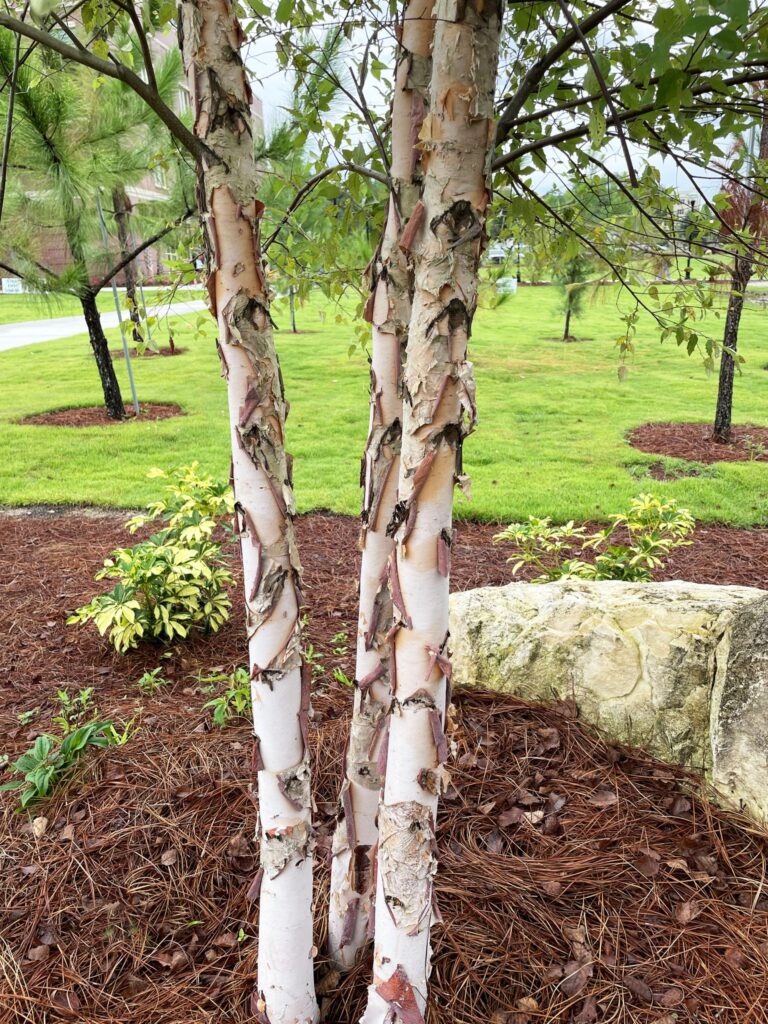
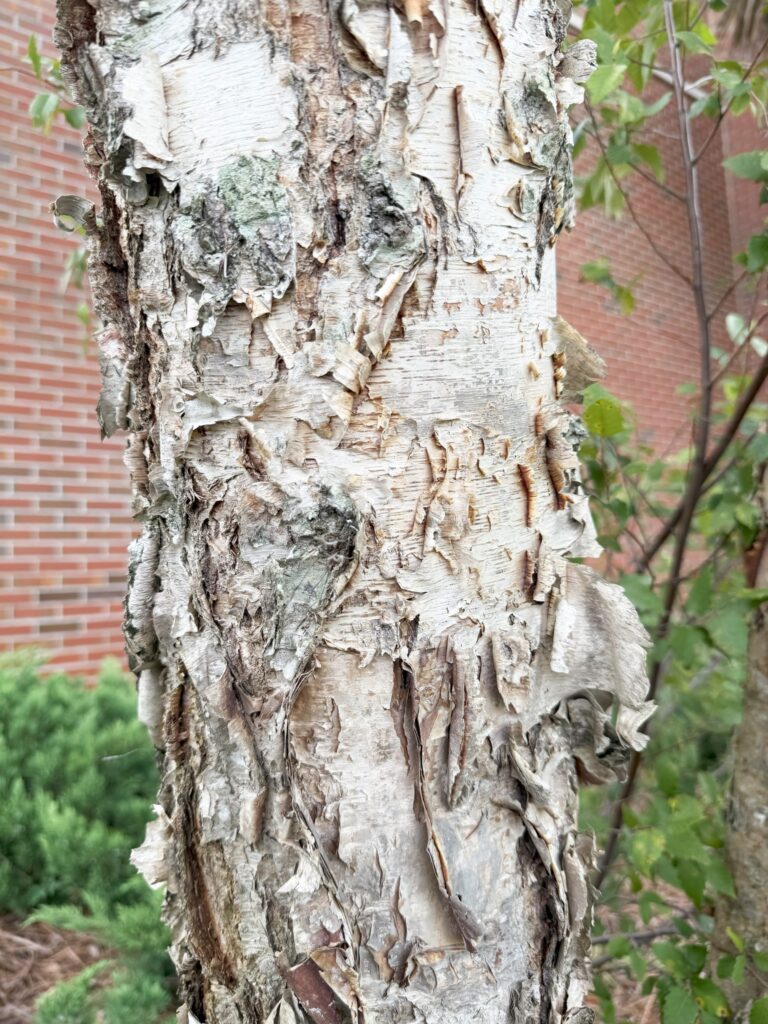
On young trees and upper branches, the bark is a warm, rich mixture of cinnamon-brown, salmon-pink, cream, and orange-tan, peeling continuously in thin, papery, curling sheets. The layers overlap and separate loosely, catching the light at different angles and creating a textured, almost three-dimensional surface that is visually dynamic in every season.
As the tree ages, the lower trunk develops a darker, rough, deeply furrowed bark — grey to near-black — which provides a striking contrast to the lighter, peeling bark of the upper crown. This contrast between the rugged base and the delicate upper bark is part of what makes mature river birch specimens so visually compelling.
The bark exfoliates year-round, which means the tree always looks fresh and interesting — not just in flowering season or autumn.
Leaves
The leaves are 3 to 8 cm long, broadly rhombic to ovate with a wedge-shaped base and a pointed tip. The margins are doubly serrated — toothed, with smaller teeth on the larger teeth — a characteristic shared with most members of the birch genus.
The upper surface is glossy, dark green; the underside is paler and slightly hairy, particularly along the veins. Leaves emerge in spring as a fresh yellow-green, deepen to mid-green through summer, and turn clear golden yellow in autumn before falling.
The autumn display is attractive but relatively brief and less dramatic than some other birch species. The tree’s primary ornamental value lies in its bark and form, rather than its autumn colour.
Size and Form
River birch is a medium to large tree, typically reaching 18 to 24 metres in height in natural forest settings, though landscape specimens are usually 10 to 15 metres. The spread can reach 12 to 18 metres in open-grown trees.
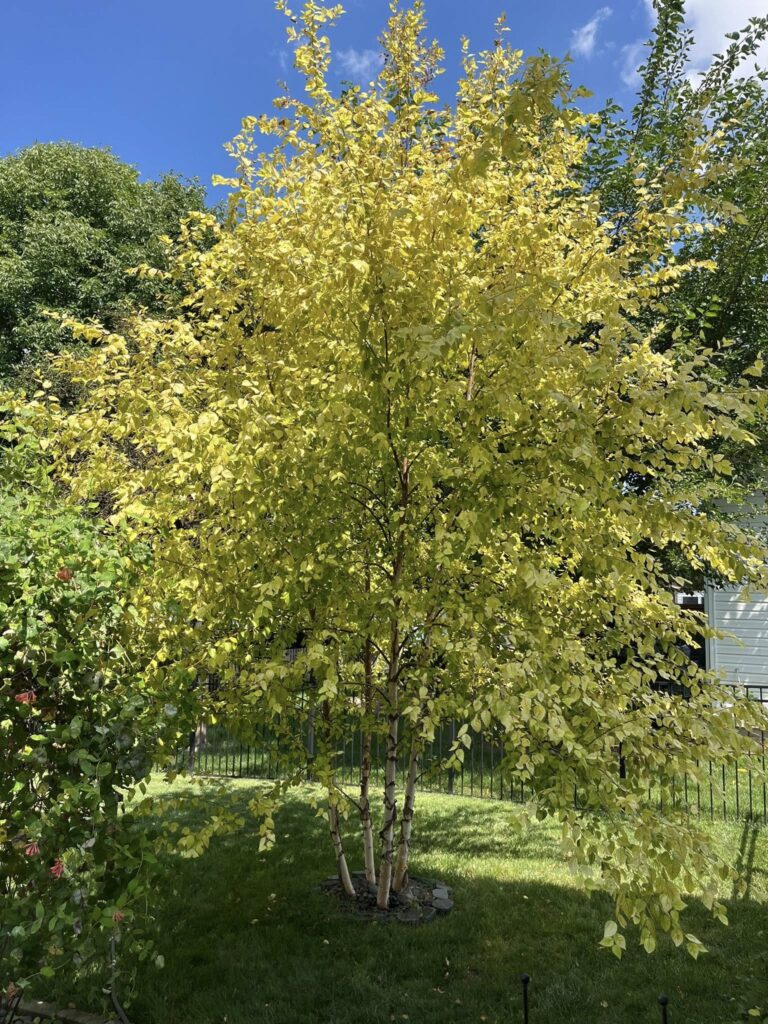
The natural form is broadly pyramidal when young, becoming irregular and spreading with age. It frequently grows in multi-stem clumps — either naturally from a single root system or when planted as multi-stem nursery stock — and these clumped forms are among the most popular choices in landscape planting.
The branches are ascending to arching, with slender, slightly pendulous secondary shoots. The overall impression of a mature river birch in the landscape is one of movement and grace — the leaves flutter in the lightest breeze, the peeling bark catches the eye, and the arching canopy creates a sense of sheltered space beneath.
Catkins and Seeds
Like all birches, Betula nigra is monoecious — both male and female flowers appear on the same tree.
Male catkins are slender and pendulous, 5 to 8 cm long, forming in autumn and overwintering on the tree before releasing pollen in early spring — typically March to April across most of its range.
Female catkins are shorter and upright at first, maturing by late spring into small, cylindrical strobiles packed with tiny winged seeds. River birch has one notable distinction among North American birches: its seeds mature and are released in late spring to early summer — earlier than any other birch species on the continent.
This early seed release is a direct adaptation to its floodplain habitat: seeds dispersed in late spring land on moist, freshly deposited alluvial soils exposed as floodwaters recede — ideal germination conditions.
Root System
The root system is shallow and wide-spreading, which is characteristic of birches. In its natural floodplain habitat, river birch develops extensive lateral roots that help anchor it in unstable riverbank soils.
In landscapes, this means the tree should be given adequate surface area and that planting near pavements, foundations, or drainage systems requires careful consideration.
Ecological Importance
A Pillar of Riparian Ecosystems
In the river corridors and floodplain forests of the eastern United States, the river birch is a structurally and ecologically critical species.
Streambank stabilisation is one of its most important functions. The tree’s spreading root system binds streambank soils, reducing erosion during floods. When river birch is removed from streambanks — through development, clearing, or disease — erosion rates increase significantly. Many stream restoration projects across the Southeast and Midwest include river birch as a primary planting species precisely for this reason.
Wildlife Value
Betula nigra provides exceptional wildlife habitat at every stage of its life cycle:
- Seeds: The abundant small seeds are a critical food source for American goldfinches, pine siskins, common redpolls, and various sparrows through late spring and summer. In natural settings, seed falls from river birch coincide with peak demand from nesting songbirds.
- Catkins: The male catkins provide early pollen for bees in late winter and early spring — a valuable resource when few other trees are in bloom.
- Bark and branches: Yellow-bellied sapsuckers drill characteristic rows of sap wells in river birch bark. These wells attract insects and hummingbirds as well as the sapsucker itself.
- Insects and larvae: River birch supports a diverse community of native caterpillars, including those of several moth and butterfly species. Research by entomologist Doug Tallamy has identified birch species as among the most ecologically connected trees in the eastern US, supporting hundreds of insect species.
- Cavity nesting: Older river birch trees, particularly those affected by decay, provide nesting cavities for wood ducks, screech owls, and woodpeckers — species of particular conservation concern in managed landscapes.
- Aquatic habitat: Where river birch overhangs water, it shades streams, moderating water temperature and creating habitat for fish, amphibians, and aquatic invertebrates. Leaf litter falling into the water becomes part of the stream food web, supporting macroinvertebrates that in turn feed fish and birds.
Fungi and Mycorrhizal Networks
River birch, like all birches, forms mycorrhizal associations with soil fungi. In riparian soils, these fungal networks play an important role in the tree’s ability to access nutrients in what are often nutrient-poor, frequently disturbed floodplain substrates.
Heat and Drought Tolerance: What Makes River Birch Unique
This is the quality that sets Betula nigra apart from every other birch in North America.
Most birch trees are cool-climate specialists. Paper birch, yellow birch, and silver birch all struggle — and eventually die — in hot, dry summer conditions. Bronze birch borer, the most destructive pest of birch trees, exploits heat-stressed trees aggressively, and most birch species in warm climates are in a near-constant state of stress.
River birch is different. It evolved in the hot, humid summers of the American South and is genuinely adapted to heat. It grows vigorously in Georgia, Alabama, and Texas — states where other birches would be dead within a decade.
It handles the temperature extremes of the continental Midwest, the humid summers of the Ohio Valley, and the subtropical conditions of the Gulf Coast piedmont with equal composure.
This heat tolerance, combined with its tolerance for wet and periodically flooded soils, makes it the only birch suitable for a large portion of the eastern United States landscape.
One caveat on drought: while river birch handles heat well, it does require adequate soil moisture. It is not a drought-tolerant tree in the way that some prairie species are.
In unusually dry summers, particularly in urban settings with limited soil volume, supplemental irrigation keeps the tree in good health and maintains leaf appearance through late summer.
Growing Conditions and Landscape Use
Climate and Hardiness
River birch is hardy across USDA Hardiness Zones 4 to 9 — one of the widest hardiness ranges of any birch species available to North American gardeners. This spans from the cold winters of Minnesota, Wisconsin, and Ontario in the north to the warm winters of central Florida, Louisiana, and Texas in the south.
It is the go-to birch for gardeners in Zones 6 to 9 — the warm-temperate and subtropical regions where other birches fail. For anyone in the American South who has ever tried and failed to grow a white-barked birch, river birch is the answer.
Soil Requirements
This is one of the most soil-adaptable trees available for landscape use:
- Moisture: Prefers consistently moist to wet soils; tolerates periodic flooding; performs best near water features, rain gardens, and bioswales
- pH: Strongly prefers acidic soils (pH 4.5 to 6.5); may develop chlorosis (yellowing leaves) in alkaline soils above pH 7.0
- Texture: Performs well in clay, loam, sandy loam, or alluvial soils
- Drainage: Uniquely tolerant of poor drainage and seasonal waterlogging — a major asset in landscape situations where other trees struggle
Soil pH is the most critical factor to monitor in landscape plantings. If leaves develop interveinal chlorosis — a yellowing between the veins while veins remain green — soil alkalinity is almost certainly the cause. Acidifying treatments or soil amendment with sulphur can correct this.
Sun Requirements
River birch requires full sun to partial shade. It performs best with 6 or more hours of direct sunlight daily but tolerates dappled shade, particularly in hot southern climates where afternoon shade can actually reduce heat stress.
Planting Tips
- Best time to plant: Early spring or autumn, when temperatures are moderate and rainfall is reliable
- Spacing: Allow 9 to 12 metres for single-stem specimens; 6 to 9 metres for multi-stem clumps in landscape settings
- Mulching: Apply 8 to 10 cm of organic mulch over the root zone to retain moisture, moderate soil temperature, and acidify the soil as it decomposes — keep mulch clear of the trunk
- Watering: Water regularly for the first two to three growing seasons to ensure establishment; once established, river birch is relatively self-sufficient in average rainfall climates
- Near water features: River birch is an ideal planting at pond edges, streambanks, rain gardens, and retention basins — environments that suit its natural preferences and show off its form to best advantage
Best Landscape Uses
- Streambank and pond edge planting — its most natural and effective role
- Specimen tree in large lawns and open spaces
- Rain garden anchor — its tolerance for wet conditions makes it ideal in stormwater management planting schemes
- Multi-stem grove planting — three or five trees planted in a loose cluster create a naturalistic, forest-edge effect with year-round bark interest
- Erosion control on slopes near water
- Naturalistic and native plant gardens across the eastern and southern United States
Notable River Birch Cultivars
Several cultivated forms of Betula nigra are widely available in the nursery trade:
- ‘Heritage’: The most widely planted cultivar by a significant margin. Selected for superior bark colour — lighter, more cream and salmon than typical wild-type trees — and larger leaves. More heat and drought tolerant than the species. Received the Pennsylvania Horticultural Society Gold Medal Award. The standard choice for most landscape applications.
- ‘Little King’ (sold as Fox Valley): A compact, dwarf form reaching only 3 to 4 metres tall and wide — ideal for smaller gardens, courtyard planting, and residential landscapes with limited space. Retains all the bark beauty of the species in a manageable size.
- ‘Summer Cascade’: A weeping form with strongly pendulous branches; best grown as a single-stem standard to show off the cascading habit; excellent near water features.
- ‘Cully’ (also sold under the name ‘Heritage’): In some nursery catalogues, ‘Cully’ and ‘Heritage’ are used interchangeably or as synonyms; both refer to the same superior-bark selection.
- ‘BNMTF’ (Dura-Heat): Selected specifically for superior heat tolerance and reduced leaf scorch in the hottest parts of the South; a good choice for Zone 8 and 9 gardens.
Common Pests and Diseases
Bronze Birch Borer (Agrilus anxius)
The most serious pest of most birch species in North America. River birch shows notably better resistance to bronze birch borer than white-barked birches — one of the significant practical advantages of planting this species. However, severely stressed trees can still be attacked. Maintaining adequate soil moisture and avoiding compaction is the best preventive strategy.
Birch Leaf Miner (Fenusa pusilla)
Leaf miners cause brown, papery blotches on leaves in summer, most noticeably from June onwards. Cosmetically unattractive but rarely fatal. Natural predator populations usually keep infestations manageable without treatment.
Aphids
Various aphid species colonise river birch foliage, producing honeydew that may cause sooty mould on lower leaves and surfaces beneath the tree. Rarely harmful to tree health; natural enemies — ladybirds, hoverflies, lacewings — typically control populations without intervention.
Chlorosis
As noted above, iron and manganese chlorosis caused by high soil pH is the most common cultural problem of river birch in landscape settings. It is not a pest or pathogen but a soil chemistry issue corrected by soil acidification.
Leaf Spot and Canker Fungi
Several fungal diseases including Marssonina leaf spot and various canker fungi can affect river birch, particularly in wet summers or where trees are stressed. Good air circulation, appropriate siting, and avoidance of overhead irrigation reduce fungal disease risk.
River Birch vs. Other North American Birches
| Feature | River Birch (B. nigra) | Paper Birch (B. papyrifera) | Yellow Birch (B. alleghaniensis) |
| Bark colour | Cinnamon, salmon, cream, peeling | Brilliant white, large-sheet peeling | Yellowish-bronze, thin peeling |
| Preferred habitat | Wet floodplains, streambanks | Cool, well-drained upland soils | Moist, cool montane forests |
| Heat tolerance | Excellent — Zones 4–9 | Poor — Zones 2–6 | Moderate — Zones 3–7 |
| Flood tolerance | Very high | Low | Low |
| Borer resistance | Moderate to good | Poor | Moderate |
| Autumn colour | Golden yellow | Rich yellow | Soft yellow-gold |
| Best use region | Southeast, Midwest, South | Northeast, Great Lakes, Canada | Appalachians, Northeast, Great Lakes |
Conservation Value and Native Planting
In an era of growing awareness about the importance of native plant landscaping, river birch holds a particularly strong position. It is:
- Native across a vast range of the eastern United States, meaning it has co-evolved with the insects, birds, and fungi of those landscapes for thousands of years
- One of the highest-value trees for caterpillar diversity in eastern North American research — a critical metric for bird habitat quality, as most songbirds depend on caterpillars to raise their young
- Available from native plant nurseries across its entire range, including Georgia, South Carolina, North Carolina, Virginia, Maryland, Ohio, Missouri, and Texas
- Recommended by native plant organisations across the South and Midwest as a first-choice riparian and garden tree
If you are gardening in the eastern United States and looking for a tree that is beautiful, durable, wildlife-rich, and ecologically responsible, river birch is one of the strongest choices available to you — regardless of whether you are in Minnesota or Mississippi.
Final Thoughts
What I find most admirable about Betula nigra is its commitment to difficult places. Most trees avoid the floodplain. River birch chose it, thrived in it, and became irreplaceable within it. There is something worth admiring in a tree that does not ask for perfect conditions — that takes the heat, the flooding, the unstable bank, and turns all of it into something beautiful.
In a landscape context, that translates directly. River birch goes where other trees cannot. It solves problems — erosion, drainage, heat — while providing genuine beauty year-round. Its bark alone is worth the planting.
But beyond aesthetics, it is an act of ecological generosity to plant a native tree. Every river birch in a garden or along a restored streambank is a small piece of the ecological fabric of the eastern United States, re-woven into a landscape that desperately needs it.
Plant one near water if you can. Watch what arrives.
References
- USDA Forest Service — Silvics of North America: Betula nigra L. (River Birch) https://www.srs.fs.usda.gov/pubs/misc/ag_654/volume_2/betula/nigra.htm
- University of Florida IFAS Extension — River Birch (Betula nigra) https://edis.ifas.ufl.edu/publication/ST091
- North Carolina State University Cooperative Extension — Betula nigra Plant Profile https://plants.ces.ncsu.edu/plants/betula-nigra/
- Virginia Tech Dendrology — Betula nigra (River Birch) Fact Sheet https://dendro.cnre.vt.edu/dendrology/syllabus/factsheet.cfm?ID=14
- University of Kentucky Cooperative Extension — Native Trees of Kentucky: River Birch https://www.uky.edu/hort/river-birch-betula-nigra

Tim M Dave is a gardening expert with a passion for houseplants, particularly cacti and succulents. With a degree in plant biology from the University of California, Berkeley, he has vast experience in gardening. Over the years, he has cultivated a vast collection of desert plants and learned a great deal about how to grow and care for these unique companions.