Understanding Okame Cherry (Prunus incisa × campanulata): History, Features, Cultivation, Problems and More
The Okame Cherry is a hybrid ornamental flowering tree, created by crossing two species: Prunus incisa (the Fuji Cherry, native to Japan) and Prunus campanulata (the Taiwan Cherry or Bell-Flowered Cherry, native to Taiwan and southern Japan).
The hybrid was developed in England in the 1940s by the legendary cherry breeder Collingwood “Cherry” Ingram — a man so devoted to ornamental cherries that his nickname became the fruit itself.
Ingram selected this hybrid for its extraordinary early-blooming habit and its vivid flower colour, and named it ‘Okame’ after a Japanese deity associated with happiness and good fortune.
The name is fitting. Few trees bring as much early-season joy to a garden as this one.
It is not a large tree. Okame Cherry is compact and upright in habit, making it one of the most practical ornamental cherries for modern gardens where space is a genuine constraint.
Key Characteristics at a Glance
Mature Height: 15 to 25 feet (4.5 to 7.5 metres).
Mature Spread: 15 to 20 feet (4.5 to 6 metres), forming an upright, rounded to vase-shaped canopy.
Growth Rate: Moderate to fast — typically 13 to 24 inches per year.
Bloom Time: Very early spring — often late February to late March, depending on location. It is consistently one of the first ornamental cherries to bloom each year.
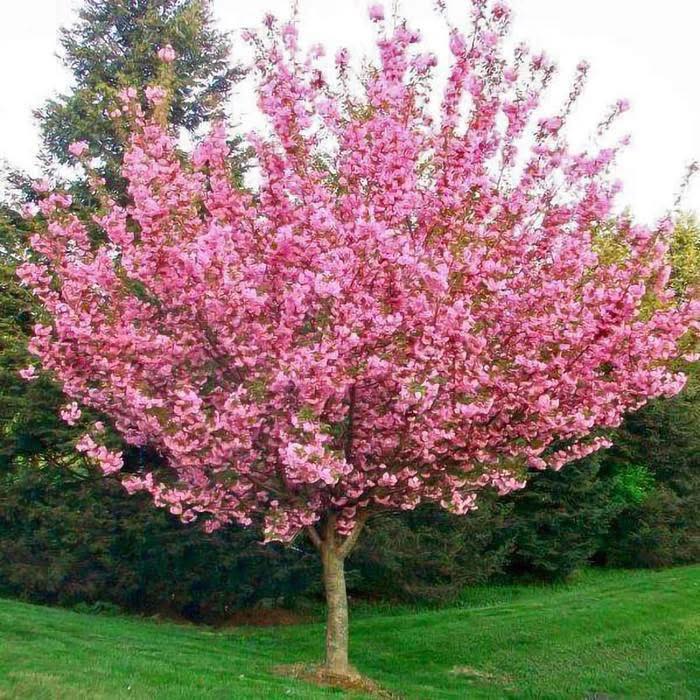
Flower Colour: Deep carmine-rose to rosy-pink, with darker pink calyxes (the outer floral structure) that remain decorative after petals fall.
Foliage: Small, finely toothed, ovate leaves. Young foliage emerges with a bronze tint before maturing to green. Autumn colour ranges from orange to bronze-red.
Bark: Smooth, grey-brown with the characteristic horizontal lenticels of the cherry family.
USDA Hardiness Zones: 6 to 8, with some sources citing Zone 5b tolerance in sheltered positions.
Lifespan: Typically 15 to 25 years in landscape settings.
Origins: A Hybrid with a Story
Understanding where a plant comes from helps explain why it behaves the way it does.
Prunus incisa, one of Okame’s parents, is a small, cold-hardy Japanese cherry that blooms early and grows at altitude on the slopes of Mount Fuji. It contributes cold-hardiness and early blooming to the hybrid.
Prunus campanulata, the other parent, is a sub-tropical cherry from Taiwan with vivid, intensely coloured tubular-bell flowers and a very early bloom period — sometimes blooming in mid-winter in warm climates. It contributes flower colour and earliness to the cross.
The resulting hybrid inherits the best of both: earlier and more vivid blooms than incisa, with better cold hardiness than campanulata. Collingwood Ingram, who made this cross at his garden in Kent, England, understood exactly what he was doing. The Okame Cherry remains one of the finest ornamental cherry hybrids ever produced.
Why Choose Okame Cherry?
With dozens of ornamental cherries available, it is worth being clear about what makes Okame Cherry the right choice in specific situations.
1. It blooms earlier than any other common ornamental cherry. In most temperate gardens, Okame Cherry blooms two to four weeks before Yoshino Cherry, Sargent Cherry, or Kwanzan Cherry. For gardeners who want the first flower colour of spring, nothing comparable matches it.
2. The flower colour is unusually vivid. Most ornamental cherries bloom in pale or blush pink. Okame’s deep carmine-rose is bold and saturated — a proper statement of colour rather than a soft suggestion.
3. It is compact and manageable. At 15 to 25 feet tall, it fits comfortably in the kinds of spaces where larger ornamental trees would be overwhelming. Small urban gardens, front yards, narrow streetside strips — Okame works where many other cherries cannot.
4. The calyxes extend ornamental value. After the petals fall, the reddish-purple calyxes persist on the branches for an additional week or two, extending the tree’s ornamental season beyond what most flowering trees offer.
5. Autumn colour adds a second season of interest. The foliage turns warm shades of orange and bronze-red in autumn, providing a secondary ornamental display that many flowering cherry trees fail to deliver.
Ideal Growing Conditions
Okame Cherry is not difficult to grow. Like most ornamental cherries, it has clear preferences — and meeting them leads to a healthy, floriferous tree.
Sunlight
Full sun is essential. Okame Cherry performs best with six or more hours of direct sunlight daily. Partial shade reduces flowering, weakens the branch structure, and increases disease susceptibility.
Choose an open, sunny position with good sky exposure. Avoid sites shaded by large buildings or existing trees, especially to the south and west.
Soil
This tree performs well in moist, well-drained, moderately fertile soil with a pH of 5.5 to 7.0. It tolerates a range of soil textures — loam, sandy loam, and well-drained clay-loam — but struggles in waterlogged or compacted soils.
Drainage is the critical factor. Wet roots are the most common cause of decline and death in ornamental cherries. If your site holds water after rain, either improve drainage before planting or choose a different location.
Water
Regular moisture is important during establishment — typically the first two growing seasons after planting. Water deeply once or twice per week during dry periods, ensuring the entire root zone is moistened, not just the surface.
Once established, Okame Cherry has moderate drought tolerance. However, prolonged summer drought will stress the tree and increase susceptibility to pests and diseases. Supplemental irrigation during extended dry spells is worthwhile.
Climate and Frost Risk
Zone 6 to 8 is the standard recommendation, though sheltered Zone 5b plantings have succeeded. The critical vulnerability is the tree’s early bloom period. Because it flowers in late winter or very early spring, late frosts can destroy the flower display in colder years.
This is not a threat to the tree’s long-term health — it will simply produce fewer or no flowers in a frost-damaged year and bloom normally the following season. But it is worth noting if consistent early spring colour is the primary reason for planting.
Choosing a slightly protected microclimate — the south-facing side of a building, or a position sheltered from northerly cold winds — can reduce frost damage to flowers significantly.
Planting Instructions
A well-planted tree establishes quickly and requires far less remedial care in subsequent years.
Best planting time: Early spring before bud break, or autumn after leaf drop. Container-grown trees can be planted any time during the growing season with adequate irrigation.
Planting hole: Dig a hole two to three times the width of the root ball and only as deep as its height. Set the tree so the root flare — where the trunk widens at the base — is level with or very slightly above the surrounding soil. Never bury the root flare.
Backfill: Use the original excavated soil. Do not add fertiliser or compost to the planting hole, as this can discourage roots from expanding outward.
Mulch: Apply a 2 to 3 inch layer of organic mulch (shredded bark, wood chips) over the root zone. Keep mulch at least 6 inches away from the trunk — piling mulch against bark creates moisture and pest problems.
Water thoroughly after planting and maintain consistent moisture through the first growing season.
Fertilisation
Okame Cherry does not need heavy feeding. In most garden soils, a single spring application of a balanced slow-release fertiliser is sufficient to support healthy growth. Use a 10-10-10 formulation or a dedicated tree and shrub product, following label rates based on trunk diameter or canopy spread.
Avoid fertilisers with excessive nitrogen. High nitrogen promotes soft, leafy growth at the cost of flower production and can increase aphid pressure on new shoots.
If the tree shows yellowing leaves (chlorosis), a soil pH test will identify whether nutrient availability is being restricted by alkaline conditions. Adjusting pH or applying chelated micronutrients addresses the cause rather than masking the symptom.
Pruning
Okame Cherry has a naturally attractive, upright form and generally requires minimal pruning when given adequate space.
Prune immediately after flowering — late spring is ideal. Pruning in late summer, autumn, or winter removes next season’s flower buds and leaves wounds exposed during the most disease-prone periods.
Remove dead, damaged, or diseased wood first, cutting cleanly just outside the branch collar. Then, thin any crossing or rubbing branches to maintain an open canopy and good airflow.
Do not hard-prune or top the tree. Large wounds on cherries are slow to compartmentalise and are common entry points for fungal wood-rotting pathogens and borers. If size control is a concern at planting time, choose an appropriately sized tree for the space rather than relying on heavy pruning after the fact.
Pests and Diseases
Okame Cherry shares the pest and disease challenges common to most Prunus species, though its hybrid vigour gives it reasonable resilience under good growing conditions.
Common Pests
Aphids are the most frequent nuisance, clustering on new spring growth and causing distorted, sticky foliage. Natural predators — ladybirds and lacewings — usually manage small populations. Insecticidal soap or a strong water jet controls heavier infestations.
Tent caterpillars build silky communal nests in branch forks in spring and can defoliate large sections of the canopy quickly. Remove nests manually in early morning, or apply Bacillus thuringiensis (Bt) while caterpillars are still small and actively feeding.
Peach tree borers (Synanthedon exitiosa) attack the base of the trunk, particularly in stressed trees. Prevention through tree vigour is the best control — a well-watered, healthy tree resists borer attack far more effectively than a stressed one.
Common Diseases
Brown rot blossom blight (Monilinia spp.) is a real concern given how early Okame blooms — cool, wet late-winter conditions are ideal for this fungus. It causes rapid browning and blighting of flowers and young shoots. Good air circulation and avoiding overhead watering reduce risk. Fungicide applications at the pink bud stage can help in high-pressure years.
Black knot (Apiosporina morbosa) produces hard, elongated black galls on branches. Prune and destroy infected wood promptly, cutting at least 4 inches below visible galls. Do not compost infected material.
Bacterial canker (Pseudomonas syringae) causes sunken, dark bark lesions and branch dieback, particularly after cold, wet springs. Prune out affected branches and sterilise tools between cuts to avoid spreading the pathogen.
Landscape Uses and Design Roles
Despite its compact size, Okame Cherry punches well above its weight in the landscape.
As a specimen tree, it is one of the finest choices for a small to medium garden. A single tree in a lawn or at a corner of the house creates a dramatic early-spring focal point without overwhelming the space.
In streetscape and urban plantings, Okame Cherry is increasingly popular as a small street tree. Its compact size, strong upright habit, and tolerance of urban conditions make it well-suited to tree pits and narrow planting strips.
In mixed borders, underplant with early-blooming bulbs — snowdrops, crocuses, scilla, and early species tulips — to create a layered spring display at ground level that complements the tree’s overhead bloom. Later in the season, the emerging green canopy provides a soft backdrop for summer-flowering perennials.
Near entrances, Okame Cherry’s early, vivid bloom makes it an excellent choice at gateways, along driveways, or framing a front door. It provides a welcoming burst of colour at the most dormant moment of the gardening year.
In groups, multiple Okame Cherries planted in a row or informal cluster along a path or boundary create a spectacular early-spring allée — a tunnel or corridor of blossoms that is genuinely memorable.
Autumn and Off-Season Interest
Spring is the headline act, but the Okame Cherry contributes in other seasons too.
The bronze-tinted young foliage in spring, as it emerges just after or alongside the last flowers, provides a warm transitional effect before the leaves mature to green.
In autumn, the foliage turns orange to bronze-red — not the most dramatic autumn display in the garden, but a pleasant contribution to the broader seasonal palette.
In winter, after leaf fall, the smooth grey-brown bark and fine branching structure are visible. The tree lacks the dramatic mahogany bark of Sargent Cherry or the weeping architecture of Prunus subhirtella ‘Pendula’, but its winter silhouette is clean and graceful.
The persistent reddish calyxes that remain after petal drop — sometimes for two weeks or more — are a distinctive feature that extends the decorative season and adds an unusual detail that rewards close observation.
Frequently Asked Questions
How early does Okame Cherry really bloom? In most temperate gardens (Zones 6–8), Okame Cherry blooms in late February to late March. In warmer microclimates or mild years, it may flower as early as mid-February. In colder gardens or cold years, it may push into early April. It is consistently two to four weeks earlier than the main ornamental cherry season.
Will late frost kill the tree? No. A late frost may destroy the open flowers, but it will not harm the tree itself. The tree will resume normal flowering the following spring.
How does Okame Cherry compare to Yoshino Cherry? Yoshino Cherry (Prunus × yedoensis) is larger (30–40 feet), pale blush-white to pale pink, and blooms after Okame. Okame is smaller, significantly deeper pink, and blooms earlier. They complement each other beautifully if space allows for both.
Does it need a pollinator? No. Okame Cherry is grown as an ornamental, and fruit production is not the goal. It does not require a companion tree for ornamental performance.
Can I grow Okame Cherry in a container? Young trees can be maintained in large containers for several years, but they are ultimately ground-planting trees. Container culture significantly limits growth and longevity and requires much more attentive watering and fertilisation.
Buying and Selection Tips
When purchasing an Okame Cherry, look for a tree with a straight, clear trunk and a well-branched, symmetrical canopy. The bark should be smooth and blemish-free, with no visible sunken cankers, cracks, or pest damage.
Avoid container-grown trees with circling or kinked roots visible at the container rim — these can develop into girdling roots that strangle the tree over time.
Buy from a reputable nursery that can confirm the plant is a true Okame cultivar. Unlabelled “pink flowering cherry” stock of uncertain origin is widely available and may not deliver the early-blooming, vivid-coloured performance that Okame is known for.
Final Thoughts
The Okame Cherry occupies a special place in the ornamental cherry world — not because it is the largest, the hardiest, or the longest-lived, but because it arrives first, and it arrives with genuine force.
When February or March delivers its blooms against still-bare wood and a late-winter sky, the effect is striking in a way that no other tree in the temperate garden can quite replicate. There is an emotional dimension to that earliness — a sense of relief, of reassurance, of the season finally turning — that makes this tree more than just another flowering cherry.
For any garden where early spring colour matters, where space is limited, and where a bold rather than subtle statement is welcome, the Okame Cherry is an outstanding choice. Plant it where you will see it from indoors in late winter. You will not regret it.
References
- North Carolina State University Extension – Prunus ‘Okame’ Plant Profile https://plants.ces.ncsu.edu/plants/prunus-okame/
- University of Connecticut Plant Database – Prunus ‘Okame’ https://hort.uconn.edu/detail.php?pid=294
- University of Florida IFAS Extension – Prunus campanulata and Ornamental Cherry Culture https://edis.ifas.ufl.edu/publication/ST491
- Virginia Tech Dendrology – Prunus incisa (Fuji Cherry) Fact Sheet https://dendro.cnre.vt.edu/dendrology/syllabus/factsheet.cfm?ID=105
- Arnold Arboretum of Harvard University – Ornamental Cherry Collections and Research https://arboretum.harvard.edu/plants/highlighted-plants-and-collections/cherry-collection/

Tim M Dave is a gardening expert with a passion for houseplants, particularly cacti and succulents. With a degree in plant biology from the University of California, Berkeley, he has vast experience in gardening. Over the years, he has cultivated a vast collection of desert plants and learned a great deal about how to grow and care for these unique companions.