Understanding Montezuma Cypress (Taxodium mucronatum): Identification, Uses, and Cultivation Details
There are trees, and then there are monuments. The Montezuma cypress belongs firmly in the second category.
Known in Mexico as ahuehuete — a Nahuatl word meaning “old man of the water” — this extraordinary tree has stood beside rivers and lakeshores for thousands of years. It watched the rise and fall of the Aztec Empire. It was already ancient when Spanish conquistadors arrived in the 16th century.
Today, it remains alive, still growing, still standing. Few trees command that kind of reverence.
The Montezuma cypress (Taxodium mucronatum) is the national tree of Mexico and one of the most botanically significant conifers in the Western Hemisphere. It is celebrated not only for its staggering age and size, but also for its ecological value, cultural heritage, and remarkable adaptability.
This guide covers everything you need to know — from its biology and native habitat to its cultivation, uses, and conservation status.
| Common Name | Montezuma Cypress, Mexican Cypress, Ahuehuete |
| Scientific Name | Taxodium mucronatum Ten. |
| Family | Cupressaceae |
| Native Range | Mexico, Guatemala, extreme southern Texas (USA) |
| Type | Evergreen to semi-evergreen deciduous conifer |
| Average Height | 18 – 40 metres (60 – 130 ft) |
| Trunk Diameter | Up to 14 metres (46 ft) — world’s widest known trunk |
| Lifespan | 1,000 – 3,000+ years |
| USDA Hardiness Zones | 8b – 11 |
| Soil Preference | Moist, well-drained; tolerates wet and dry soils |
| Water Needs | Moderate to high; thrives near streams and rivers |
| Sun Requirement | Full sun |
| Growth Rate | Moderate to fast (up to 60 cm/year when young) |
| Foliage | Feathery, linear, bright green; semi-persistent |
| Bark | Grey-brown, fibrous, deeply furrowed |
| Cones | Small, rounded, 1.5 – 3.5 cm in diameter |
| Cultural Significance | National Tree of Mexico; symbol of longevity and strength |
| Conservation Status | Least Concern (IUCN) |
Botanical Identity and Taxonomy
The Montezuma cypress belongs to the family Cupressaceae and the genus Taxodium, which also includes the bald cypress (Taxodium distichum) of the southeastern United States. The species was formally described by the Italian botanist Lorenzo Tenore in 1838.
Its full scientific name is Taxodium mucronatum Tenore, where mucronatum refers to the pointed or mucronate leaf tips — a subtle but distinguishing feature.
While it is often grouped with its close relative, the bald cypress, the two are distinct species. The Montezuma cypress is predominantly evergreen, retaining most of its foliage year-round in warm climates, whereas the bald cypress is fully deciduous.
In cooler conditions, the Montezuma cypress may shed its leaves seasonally, making it “semi-evergreen” rather than strictly deciduous.
The genus Taxodium is ancient. Fossil evidence suggests these trees have existed for over 90 million years, surviving mass extinctions that wiped out the dinosaurs.
Native Range and Natural Habitat
The Montezuma cypress is native to Mexico and Guatemala, with a small population documented in the Rio Grande region of extreme southern Texas, USA. Within Mexico, it grows across a wide band from the northern highlands to the tropical south.
Its preferred habitat is riparian — meaning it naturally grows along riverbanks, stream margins, lake edges, and in seasonally flooded valleys. You will often find it with its roots directly in or beside slow-moving water.
However, this tree is more adaptable than its nickname (“old man of the water”) suggests. Mature specimens have been observed thriving in:
- High-altitude plateaus above 2,000 metres in central Mexico
- Arid and semi-arid regions, where it tolerates drought once established
- Subtropical lowlands with high humidity and rainfall
- Urban parks and avenues across Mexico, Central America, and beyond
This ecological flexibility is one reason the species has survived so long and spread so widely as an ornamental tree around the world.
The Most Famous Tree on Earth: El Árbol del Tule
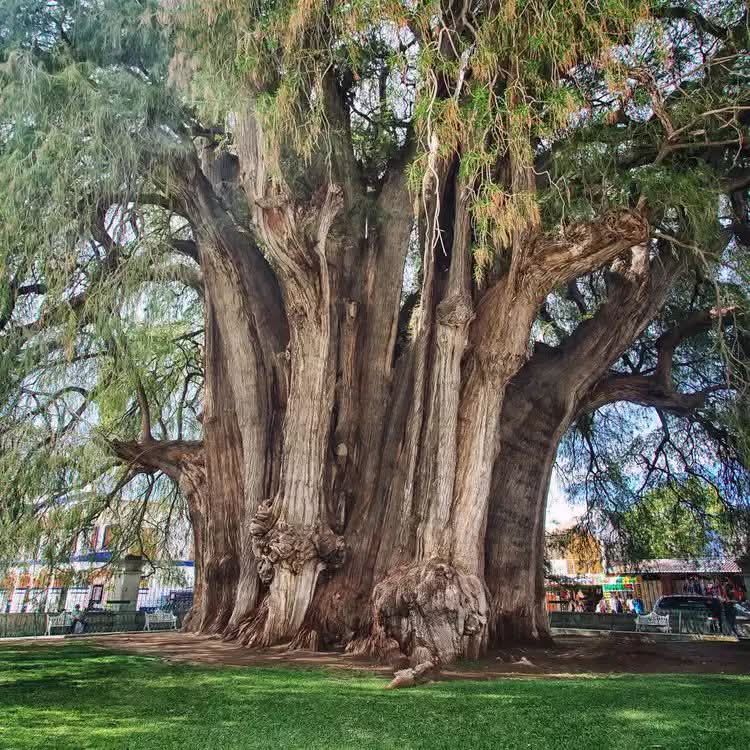
If any single tree defines the Montezuma cypress, it is El Árbol del Tule in Santa María del Tule, Oaxaca, Mexico.
This colossal specimen holds the Guinness World Record for the largest trunk circumference of any tree on Earth — approximately 58 metres (190 feet). Its trunk diameter measures around 14.05 metres (46.1 feet).
Even more astonishing, the trunk is so wide and so deeply ridged that early observers once believed it was actually multiple fused trees. DNA testing has since confirmed it is a single individual.
Its age is debated, but estimates range from 1,400 to over 3,000 years. Local Zapotec tradition holds that it was planted by the wind deity Ehecatl over 2,000 years ago.
El Árbol del Tule is not just a natural wonder. It is a UNESCO World Heritage site candidate and draws hundreds of thousands of visitors each year. It remains healthy, well-monitored, and continues to grow.
I have seen photographs of people standing at its base, and the scale is genuinely difficult to process. It does not look real.
Physical Description: What the Tree Looks Like
Understanding the Montezuma cypress begins with observation of its distinctive features.
Trunk and Bark
The trunk is massive, buttressed at the base, and deeply furrowed. On mature trees, the bark is grey-brown to reddish-brown, fibrous, and peels in vertical strips. The basal flutes and ridges give the trunk an almost sculpted, organic appearance — which is part of what makes El Árbol del Tule so visually dramatic.
Unlike the bald cypress, the Montezuma cypress does not typically form “knees” (pneumatophores) protruding from the soil, though occasional specimens near water may produce them.
Crown and Branching
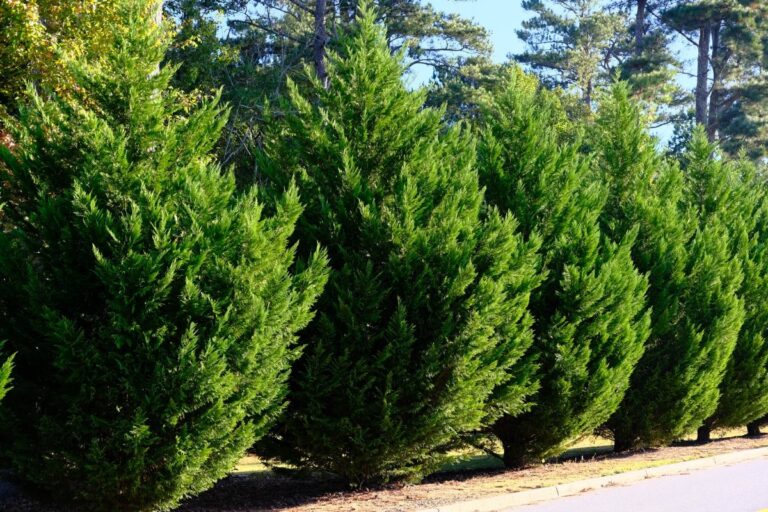
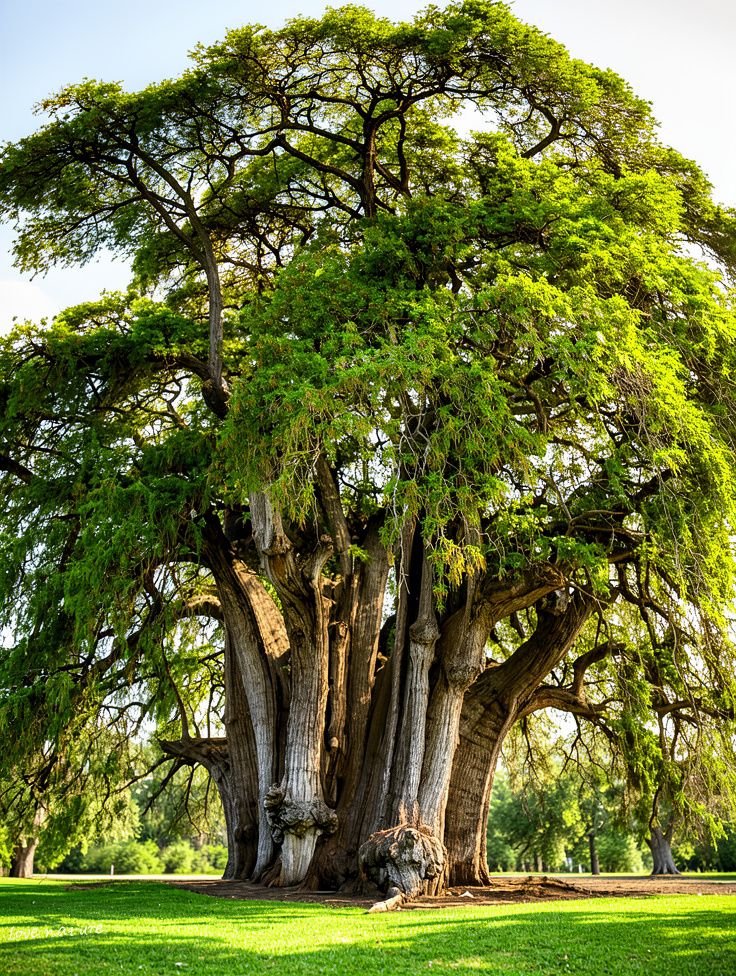
The crown is broad, spreading, and irregular on old trees. Young trees tend toward a pyramidal or conical form before broadening with age. Major limbs are thick and often horizontal, sweeping outward to create an expansive canopy.
In landscape settings, the tree often develops a weeping quality — long, drooping branchlets that sway gracefully in the wind.
Foliage
The leaves are needle-like and feathery, arranged alternately in two ranks along slender branchlets. Each leaf is typically 5–15 mm long, flat, and a bright, fresh green in the growing season. In semi-deciduous conditions, the foliage turns bronze-gold before falling.
The overall effect of the foliage is soft and airy — quite different from many conifers, which appear stiff and dense.
Cones
Male and female cones occur on the same tree (monoecious). Male cones are small and catkin-like, appearing in drooping clusters. Female cones are rounded, 1.5–3.5 cm in diameter, and mature from green to brown. Each cone contains a small number of irregularly shaped seeds.
Seed dispersal is primarily by water — another adaptation to its riparian lifestyle.
Growth Rate and Longevity
Young Montezuma cypresses are surprisingly vigorous. Under ideal conditions — full sun, adequate moisture, and fertile soil — they can grow 50–90 cm per year in their early decades.
Growth slows considerably as the tree ages, but it never truly stops. Even specimens over 1,000 years old show measurable annual growth, adding rings to their already enormous girth.
Longevity is a defining trait of the species. Most references cite lifespans of 1,000 to 2,000 years as common, with exceptional individuals such as El Árbol del Tule potentially exceeding 3,000 years.
This extraordinary longevity makes the Montezuma cypress one of the longest-lived trees in the world, comparable to the giant sequoias of California and the bristlecone pines of the Great Basin.
Cultural and Historical Significance
For the indigenous peoples of Mesoamerica, the ahuehuete was far more than a tree.
To the Aztecs, it was a sacred symbol of strength, wisdom, and permanence. Aztec rulers, including the emperor Moctezuma I (for whom the tree is named), planted ahuehuetes in royal gardens. The famous gardens of Chapultepec in Mexico City still contain ancient specimens.
In Zapotec culture, the tree is seen as a living ancestor — a being that transcends ordinary time. The village of Santa María del Tule has grown around its great tree for generations, and locals regard it with deep spiritual respect.
Mexico declared the Montezuma cypress its national tree in 1910, and it appears in regional emblems, literature, and art. The word ahuehuete has become a metaphor in Spanish for something ancient, powerful, and enduring.
Even today, large specimens are focal points of public plazas, cemeteries, and church courtyards across Mexico and Central America — living witnesses to centuries of human history.
Ecological Role and Importance
The Montezuma cypress plays a critical ecological role in the riparian ecosystems it inhabits.
Its deep root system stabilises riverbanks and prevents erosion. Its canopy shades stream margins, keeping water temperatures cool enough to support fish and aquatic invertebrates. Fallen leaves and woody debris enrich aquatic food webs.
The tree also provides habitat for a wide range of wildlife. Birds nest in its broad crown. Insects colonise its deeply furrowed bark. Bats roost in cavities of ancient specimens. Epiphytic plants, including orchids and bromeliads, often grow on its limbs in humid regions.
In arid and degraded landscapes, the Montezuma cypress has been used in reforestation and riparian restoration projects. Its drought tolerance once established, combined with its ability to improve soil structure, makes it a valuable tool in ecosystem rehabilitation.
Cultivation and Landscape Use
The Montezuma cypress has been cultivated far beyond its native range for centuries, and its horticultural appeal is easy to understand.
Climate and Hardiness
It is best suited to USDA Hardiness Zones 8b through 11. Young trees are sensitive to hard frosts, but established specimens can tolerate brief periods of cold. It is widely grown in:
- Southern and central Mexico
- The American Southwest (Texas, Arizona, California)
- The Mediterranean basin (Spain, Italy, Portugal)
- South Africa and Australia
- Subtropical Asia
Soil and Water
The tree is remarkably tolerant of soil conditions. It grows in clay, loam, sandy loam, and even compacted urban soils. It prefers slightly acidic to neutral pH.
Moisture is important, especially in the first three to five years. Once the root system is established, it becomes drought-tolerant — a trait that makes it attractive for low-water landscaping in warm climates.
Planting and Care
Key cultivation guidelines include:
- Plant in full sun — the tree performs poorly in shade.
- Water deeply and infrequently once established; avoid waterlogging in heavy clay.
- Avoid heavy pruning — the natural form is the tree’s greatest asset.
- Stake young trees in exposed or windy locations to prevent lean.
- Mulch the root zone to conserve moisture and moderate soil temperature.
The tree is largely pest and disease resistant, though it may occasionally be affected by cypress canker (Seiridium spp.) in humid conditions, or by spider mites during dry spells.
Ornamental Value
Few trees match the visual drama of a mature Montezuma cypress. Its massive form, weeping foliage, and textured bark make it a signature specimen for large parks, estates, avenues, and civic spaces.
It is also effective as a windbreak or screen when planted in rows. In the right setting — near a pond or stream — it creates a landscape of genuine grandeur.
Montezuma Cypress vs. Bald Cypress
| Feature | Montezuma Cypress | Bald Cypress |
| Scientific Name | Taxodium mucronatum | Taxodium distichum |
| Foliage Habit | Semi-evergreen | Fully deciduous |
| Native Range | Mexico, Guatemala | SE United States |
| Knees (Pneumatophores) | Rarely produced | Commonly produced |
| Cold Hardiness | Zones 8b–11 | Zones 4–10 |
| Max Height | ~40 m | ~35 m |
| Trunk Girth Potential | Extraordinary (largest known) | Large but smaller |
| Landscape Use | Warm/subtropical regions | Temperate and humid regions |
Both trees are beautiful and ecologically important. The choice between them largely depends on climate: bald cypress for cooler regions, Montezuma cypress for warmer ones.
Notable Specimens Around the World
Beyond El Árbol del Tule, several other Montezuma cypresses stand out for their size, age, or cultural significance.
- El Árbol de la Noche Triste, Mexico City — This ancient specimen in Tacuba allegedly marks the spot where Hernán Cortés wept after his forces suffered a devastating defeat in 1520. It is one of the oldest documented trees in Mexico City.
- Chapultepec Park, Mexico City — The park contains a grove of ahuehuetes believed to date to the Aztec period. These trees are protected as national heritage.
- Parque Nacional Desierto de los Leones — Several large specimens grow here, among the oldest and tallest remaining in the Mexico City region.
- San Luis Potosí and Hidalgo, Mexico — Rural churchyards in these states often contain 300–600 year old specimens planted during the colonial period.
In each of these locations, the tree functions as a living archive — a biological record of everything that has happened in that place across centuries.
Conservation and Threats
Despite its longevity and resilience, the Montezuma cypress faces genuine threats in the modern era.
Habitat loss is the most significant. The riparian zones where the tree thrives — river margins, floodplains, and lake shores — are among the most intensively developed landscapes in Mexico. Urbanisation, agriculture, and dam construction have fragmented and reduced these habitats dramatically.
Water extraction threatens the tree indirectly. In semi-arid regions, groundwater depletion reduces the soil moisture that large specimens depend on. El Árbol del Tule itself has faced water stress in recent decades, prompting an irrigation programme to maintain its health.
Pollution and soil compaction in urban areas affect trees in plazas and historic sites, reducing root health over time.
Climate change introduces new uncertainties. Longer droughts, shifting rainfall patterns, and increased temperatures could alter the suitability of current habitats.
The IUCN currently lists the species as Least Concern, reflecting its widespread distribution and large global population. However, conservation of large, ancient specimens — which represent irreplaceable genetic and cultural heritage — requires specific and sustained effort.
Several Mexican states have enacted legal protections for heritage trees, designating the largest specimens as natural monuments. This is encouraging, but enforcement and funding for stewardship remain inconsistent.
Propagation Methods
Montezuma cypress can be propagated by both seeds and cuttings.
Seed propagation is the most common method. Seeds should be collected from ripe cones in autumn and stratified (cold-moist treatment for 30–60 days) before sowing. Germination rates are variable but generally adequate for nursery production.
Semi-hardwood cuttings taken in late summer can root successfully with the use of rooting hormone and bottom heat. Cuttings preserve the genetic identity of a specific parent tree — important when propagating heritage specimens.
Tissue culture has been used experimentally for conservation of rare or heritage trees, though it is not yet standard practice in commercial nurseries.
Young trees should be grown in containers or nursery beds for one to two years before transplanting, ensuring a well-developed root system.
Uses Beyond Ornament
The Montezuma cypress is not only beautiful — it is also practically useful.
- Timber: The wood is moderately durable, light, and resistant to decay. It has been used historically for construction, furniture, and carving, though large-scale timber use is rare given the tree’s protected status in many areas.
- Water conservation: In some communities, large cypresses are deliberately preserved or planted near water sources because of their role in bank stabilisation and groundwater recharge.
- Traditional medicine: Bark and leaf preparations have been used in Mexican folk medicine for various purposes, including as diuretics and wound treatments. Scientific validation of these uses remains limited.
- Agroforestry: The tree has been incorporated into agroforestry systems in southern Mexico, providing shade, windbreak, and biomass while improving soil conditions for adjacent crops.
- Carbon sequestration: Given its size and longevity, the Montezuma cypress is a significant long-term carbon store. A single large specimen can lock up many tonnes of carbon over its multi-century lifespan.
Final Thoughts
The Montezuma cypress is, in every meaningful sense, one of the great trees of the world.
It is not the tallest tree, nor the lightest, nor the most commercially valuable. But it may be the most enduring — and in a time when much of the natural world is disappearing faster than we can record it, endurance matters deeply.
To stand beneath an old ahuehuete — its spreading canopy filtering the light, its bark telling centuries of weather in its every groove — is to feel the weight of time in a way that very few natural experiences can match.
Protecting these trees is not sentimentality. It is an acknowledgement that some things cannot be replaced, and that a culture willing to destroy a 2,000-year-old tree for a road or a car park has lost something essential in its relationship with the living world.
The Montezuma cypress has survived empires, droughts, floods, and centuries of human history. Whether it survives us may depend on the choices we make right now.
References
- University of Florida IFAS Extension — Environmental Horticulture Tree and Shrub Fact Sheets — Taxodium species overview and cultivation guidance. https://edis.ifas.ufl.edu/
- Texas A&M AgriLife Extension — Aggie Horticulture Native and adapted trees of Texas and Mexico, including riparian conifers. https://aggie-horticulture.tamu.edu/
- NC State Extension — Plants Database (Taxodium mucronatum) Botanical description, habitat, landscape use, and regional cultivation notes. https://plants.ces.ncsu.edu/
- University of Arizona Cooperative Extension — Tree & Shrub Resources Landscape trees for the arid and semi-arid Southwest, including Taxodium species. https://extension.arizona.edu/
- UC Davis Arboretum and Public Garden — Plant Collections Living collections and cultivation research on heritage trees including Montezuma cypress. https://arboretum.ucdavis.edu/

Tim M Dave is a gardening expert with a passion for houseplants, particularly cacti and succulents. With a degree in plant biology from the University of California, Berkeley, he has vast experience in gardening. Over the years, he has cultivated a vast collection of desert plants and learned a great deal about how to grow and care for these unique companions.