Understanding London Plane Tree (Platanus × acerifolia): Identification, History, Problems, and Growing Details
There is a tree that holds cities together. Not literally — though its roots come close — but visually, ecologically, and historically. Walk through the streets of London, Paris, Barcelona, or New York, and you will almost certainly be standing beneath it.
Its dappled, camouflage-patterned trunk is one of the most recognisable sights in the urban world.
That tree is the London plane (Platanus × acerifolia). And it deserves far more attention than most people give it.
Before dive into the world of this tough giant, here is a quick summary of everything:
| Common Name | London Plane Tree |
| Scientific Name | Platanus × acerifolia (also written P. × hispanica) |
| Family | Platanaceae |
| Origin | Hybrid — American sycamore × Oriental plane |
| Native Habitat | Not naturally occurring; cultivated hybrid |
| Type | Deciduous broadleaf tree |
| Average Height | 20 – 35 metres (65 – 115 ft) |
| Trunk Diameter | Up to 3 metres on very old specimens |
| Crown Spread | 15 – 25 metres |
| Lifespan | 300 – 500+ years |
| USDA Hardiness Zones | 5 – 9 |
| Soil Preference | Deep, moist, well-drained; tolerates compacted soils |
| pH Range | 4.5 – 8.0 (adaptable) |
| Water Needs | Moderate; drought-tolerant once established |
| Sun Requirement | Full sun |
| Growth Rate | Fast — up to 60 cm/year when young |
| Bark | Mottled grey, cream, olive-green — exfoliating in irregular plates |
| Leaves | Maple-like, 5-lobed, 15 – 25 cm across |
| Fruit | Spiky brown seed balls in clusters of 2 – 6 |
| Autumn Colour | Yellow-brown to golden |
| Pollution Tolerance | Exceptionally high — one of the most tolerant trees known |
What Is the London Plane Tree?
The London plane is a hybrid tree — the offspring of two distinct species: the American sycamore (Platanus occidentalis) from eastern North America, and the Oriental plane (Platanus orientalis) from southeastern Europe and western Asia.
This cross likely occurred in Spain or southern France during the 17th century, possibly in the garden of the botanist John Tradescant the Younger, though the exact origin remains debated. The hybrid proved to be extraordinarily vigorous.
The result was a tree that could thrive almost anywhere humans tried to grow it. It perfectly thrived in the smoke-choked streets of 19th-century industrial cities where almost nothing else survived.
It is not a naturally occurring species. You will not find it in any wild forest. Every London plane in the world is the product of deliberate cultivation — a tree shaped by human selection over centuries.
The Science of the Name
The scientific name Platanus × acerifolia reflects its hybrid origin — the “×” symbol denotes a cultivated hybrid. The species epithet acerifolia means “maple-leaved,” referring to the distinctive lobed leaf shape that resembles the foliage of a maple tree.
An alternative name, Platanus × hispanica, appears in some references, reflecting the Spanish origin theory. Both names are in use, though acerifolia is more widely accepted in current botanical literature.
The genus Platanus is ancient. Fossil evidence places it in the Northern Hemisphere over 100 million years ago, making it one of the oldest surviving flowering plant lineages on Earth.
Identifying the London Plane: Key Features
Bark — The Signature Feature
The bark is the London plane’s most celebrated characteristic. As the outer bark ages, it sheds in irregular plates, revealing inner bark in contrasting shades of cream, pale grey, olive-green, and ochre. The result is a mottled, patchwork pattern that resembles military camouflage — or, some say, a giraffe’s coat.
The exfoliation is not merely decorative. It is one reason the tree survives urban pollution so effectively. The shedding process removes accumulated dust, particulate matter, and surface pollutants that would otherwise clog the bark’s breathing pores (lenticels). In effect, the tree cleans itself.
On older specimens, the lower trunk develops rougher, more persistent bark, while the upper trunk and major branches continue to display the characteristic smooth, mottled appearance.
Leaves
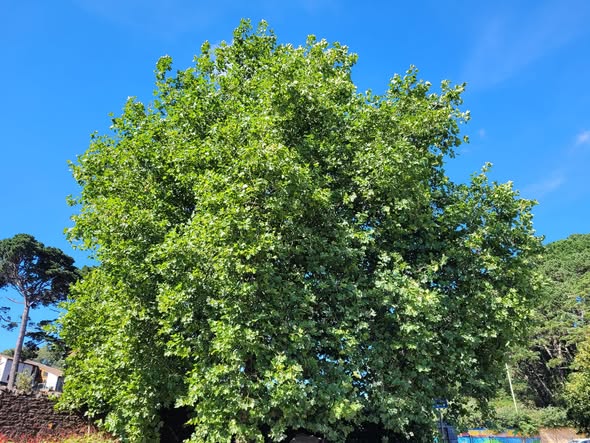
The leaves are large, palmate, and five-lobed — resembling a maple leaf in general outline, though coarser in texture. A typical leaf measures 15 – 25 cm across. The upper surface is bright to mid-green; the underside is paler and slightly hairy on the veins.
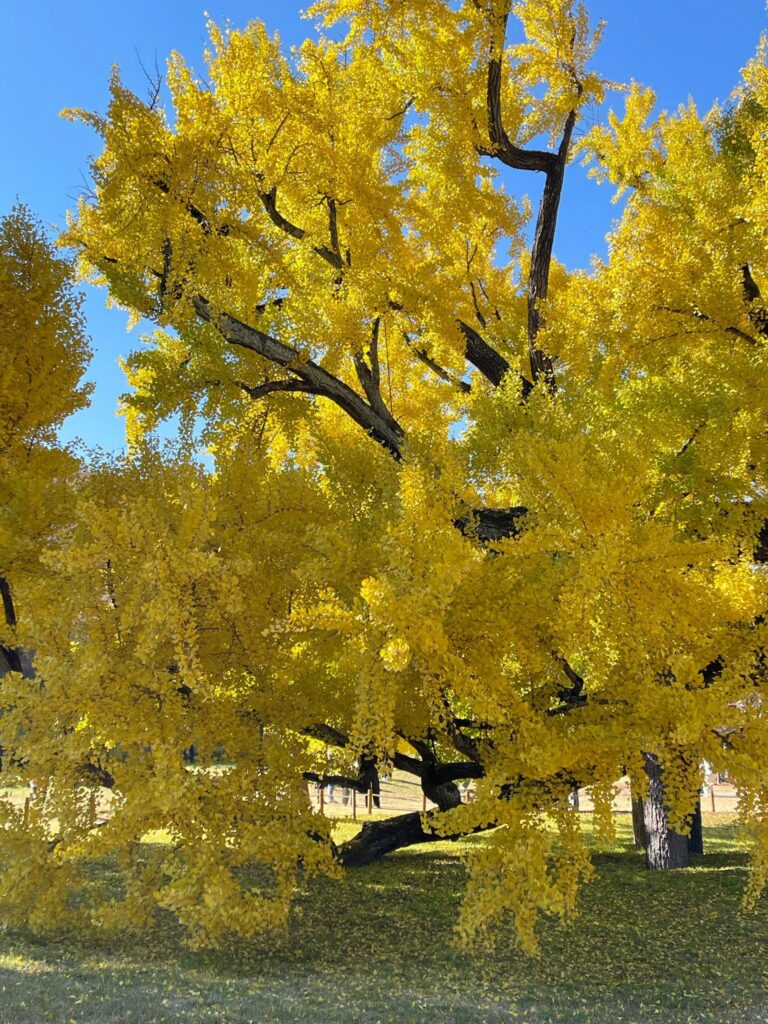
In autumn, the foliage turns yellow-brown to golden before falling — not the most spectacular autumn colour, but pleasant and warm in tone.
One notable feature: the leaves produce fine hairs as they emerge in spring. These hairs can cause respiratory irritation in sensitive individuals, particularly those with hay fever or asthma. This is worth knowing if you are planting near outdoor seating areas or open windows.
Fruit
The fruit is one of the tree’s most distinctive features. Dense, spiky spherical seed heads — about 2.5 – 3 cm in diameter — form in hanging clusters of two to six on long, flexible stalks. They ripen from green to brown in autumn and often persist through winter before breaking apart to release their seeds in spring.
These seed balls are the source of another irritant concern: the fine fibres released when the seed balls disintegrate can irritate eyes, throat, and airways in some people. London planes shed large quantities of seed material each spring.
Form and Size
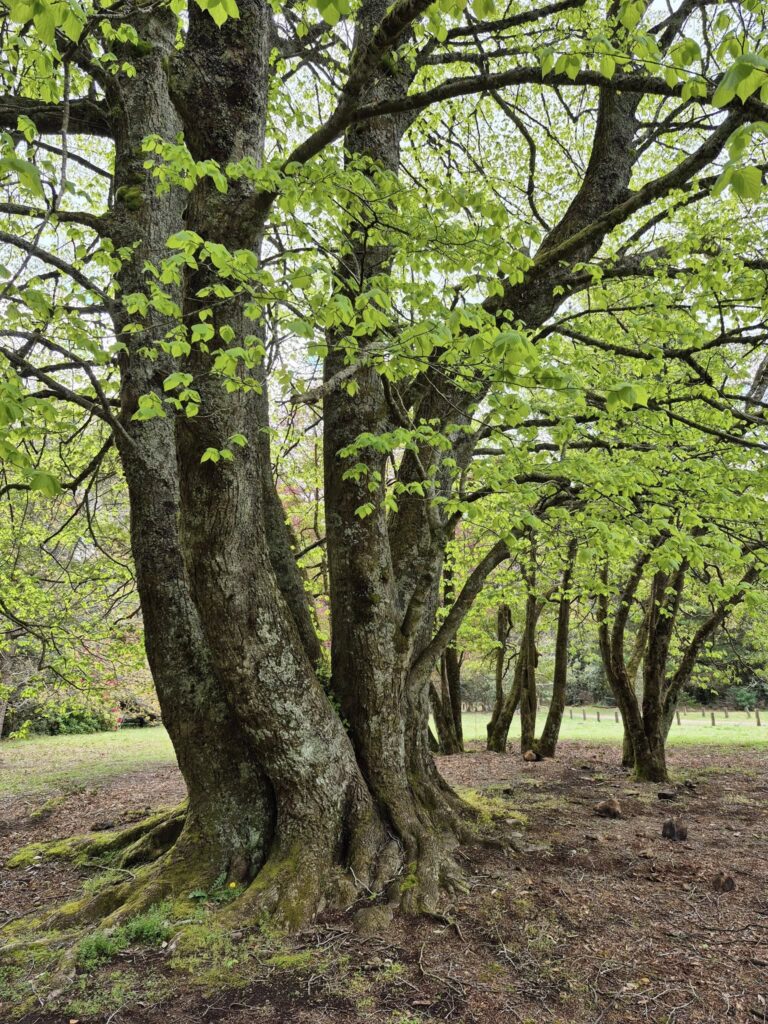
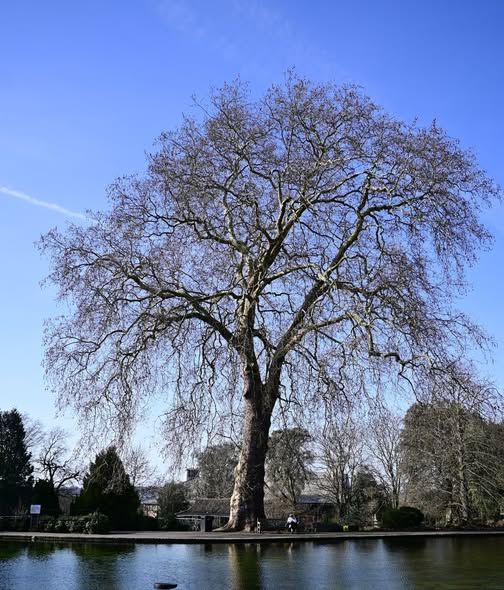
Young trees are broadly columnar or pyramidal. With age, the crown becomes wide-spreading and domed — often with massive horizontal limbs that give the tree tremendous visual presence. On old specimens in open situations, the crown can spread 20 metres or more.
The trunk is typically straight and well-formed, supporting a high canopy that allows good light penetration beneath — one reason it works so well as a street tree.
Origins and History
The Hybrid Crosses
The first recorded mention of the London plane as a distinct tree dates to the late 17th century in England. John Tradescant the Younger, who collected plants from across the known world, is often credited with its introduction or early cultivation in Britain. However, documentary evidence is incomplete.
What is clear is that by the mid-18th century, the London plane was being widely planted in British urban landscapes. It was recognised early on as something special — faster-growing than either parent, more adaptable, and visually impressive.
London’s Great Planes
The tree became synonymous with London for a reason. As the city expanded rapidly during the Industrial Revolution, its air filled with coal smoke and its soils became compacted, polluted, and poorly aerated. Most trees struggled or died.
The London plane thrived. Parks, squares, and streets were planted systematically from the late 18th century onward. Berkeley Square, Bloomsbury Square, and the Embankment Gardens all gained their distinctive character from rows of maturing planes.
By the 20th century, London planes represented an estimated 50 to 60 percent of all street and park trees in central London. Many of these original plantings survive today — living links to Georgian and Victorian London.
Global Spread
From Britain, the London plane spread to cities worldwide. Paris introduced it along the grand boulevards created under Baron Haussmann in the 1860s. Barcelona, Madrid, Buenos Aires, and Sydney all adopted it for major avenues.
In the United States, it became widely planted in New York, Philadelphia, and other east coast cities.
Today it is, by many measures, the most widely planted urban tree on the planet.
Why the London Plane Dominates Urban Landscapes
The London plane’s dominance in cities is not accidental. It is the result of a combination of traits that make it almost uniquely suited to the urban environment.
Pollution Tolerance
This is the tree’s superpower. In studies of urban tree performance, the London plane consistently ranks at or near the top for tolerance of air pollution, soil compaction, and road salt. Its bark-shedding mechanism helps clear surface pollutants.
Also, its root system is robust enough to push through difficult urban soils.
In the 19th century, London planes were observed growing healthily in streets where the air was visibly black with soot — an environment that killed most other tree species outright.
Drought Tolerance
Once established, the London plane is remarkably drought-tolerant. Its deep root system allows it to access soil moisture far below the surface, making it resilient during dry summers. This trait is becoming increasingly valuable as urban heat islands intensify and summer droughts become more frequent in temperate cities.
Longevity
London planes planted in the 18th and early 19th centuries are still alive and thriving today. Individual specimens regularly live 300 to 500 years under good conditions. This long lifespan makes each tree a multi-generational asset — an infrastructure investment that returns value for centuries.
Tolerance of Pruning
Few large trees respond to pruning as well as the London plane. It tolerates severe cutting back — a technique called “pollarding” — remarkably well, regenerating vigorously from cut points.
This adaptability is essential for managing trees in constrained urban spaces, beneath power lines, or where regular size control is needed.
Pollarding also has an aesthetic dimension: the swollen, knuckled pollard heads developed over decades create their own distinctive sculptural form.
Canopy and Shade
A mature London plane provides exceptional shade — its wide-spreading canopy and large leaves block significant solar radiation. This is increasingly valued in cities facing rising summer temperatures.
Studies consistently show that mature street trees like the London plane can reduce street-level temperatures by several degrees Celsius.
Cultivation and Growing Guide
Climate and Hardiness
The London plane is hardy in USDA Zones 5 through 9 — a remarkably wide range that covers most of the temperate world. It tolerates both cold winters and hot summers better than either of its parent species.
It is less suited to tropical or subtropical climates with high year-round humidity, and struggles in areas with poorly drained soils that remain waterlogged for extended periods.
Soil Requirements
The London plane is one of the least fussy large trees in cultivation when it comes to soil. It grows in clay, loam, sandy loam, and compacted urban substrates. It tolerates both acidic and alkaline conditions across a pH range of approximately 4.5 to 8.0.
For best results, deep, moisture-retentive but well-drained soil is ideal. But this tree will perform in conditions that would challenge most other large trees.
Planting
Plant in full sun. The London plane does not perform well in shade and should never be positioned where it will be overshadowed by taller structures or trees for the long term.
Plant with a planting hole at least twice the width of the root ball and at the correct depth — the root flare (where trunk meets roots) should sit at or just above the final soil surface. Stake young trees for the first two years in exposed positions.
Give the tree space. This is a large tree. It should not be planted within 8 – 10 metres of buildings, underground services, or other large trees unless trained and managed from the outset.
Watering
Water deeply and regularly for the first two to three years after planting. Deep, infrequent watering encourages downward root growth — creating a more stable and drought-resilient tree. Once established, supplemental irrigation is rarely needed in temperate climates.
Fertilisation
In most urban situations, additional fertilisation is not necessary. If a tree appears pale, slow-growing, or is performing in severely nutrient-poor soil, a balanced slow-release fertiliser applied in early spring can help.
Pruning and Pollarding
The London plane tolerates pruning at almost any time of year, though late winter to early spring is generally preferred to avoid excessive sap flow.
Pollarding — the regular removal of branches back to the same point year after year — must be started while the tree is young and continued consistently. Attempting to pollard a previously unpruned mature tree is likely to cause serious decline or death.
For street trees requiring a clear trunk and high canopy, formative pruning in the first 10 – 15 years is essential. This involves removing lower branches gradually as the tree grows, to establish the desired crown clearance.
Pests, Diseases, and Common Problems
The London plane is robust but not invincible. The following issues are worth knowing.
Massaria Disease (Splanchnonema platani)
This is currently the most serious disease concern for London planes in Europe. The fungus causes rapid dieback of large branches, which can fail and fall without visible warning signs from below. First confirmed in UK urban trees in 2011, it has spread to many city street trees.
Regular inspection by qualified arborists is now considered essential for London planes in public spaces. Infected branches must be removed promptly.
Anthracnose (Apiognomonia veneta)
A fungal disease that causes leaf scorch, shoot dieback, and premature defoliation in wet spring conditions. It is rarely fatal but can cause significant annual leaf loss and disfigurement. Warm, dry summers typically allow full recovery.
Plane Wilt (Ceratocystis platani)
A serious vascular wilt disease present primarily in southern Europe and parts of North America. It kills infected trees within a few years and spreads through root contact and contaminated tools. Strict biosecurity during pruning is essential in affected regions.
Sycamore Scale (Stomacoccus platani)
An insect pest that feeds on bark and can cause sooty mould and dieback in heavy infestations. Management is difficult on large street trees. Monitoring and targeted treatment are recommended where infestations are confirmed.
Allergenic Hairs
As mentioned above, the fine trichomes produced by emerging leaves in spring can cause respiratory and eye irritation. This is not a disease, but it is a genuine public health concern where trees are planted in dense concentrations near schools, hospitals, or outdoor public spaces.
Ecological Value
The London plane’s ecological value in cities is real, though sometimes debated in specialist literature.
Air quality: The large leaf surface area of mature specimens captures significant quantities of particulate pollution. Studies in UK cities have calculated meaningful annual pollution removal figures for mature plane trees in dense urban settings.
Carbon storage: A mature London plane stores substantial quantities of carbon in its large woody biomass — far more per tree than smaller ornamental species.
Urban cooling: The canopy provides significant evaporative cooling, reducing the urban heat island effect around the tree.
Wildlife: The tree supports a moderate range of insects, including several moth species and aphid species that in turn support insectivorous birds. The seed balls provide food for some small bird species through winter. However, it supports fewer invertebrate species than native oak or willow, reflecting its hybrid, non-native origin.
In my observation, no single tree species does more work in a modern city. Whether that work is enough to justify the dominance of a single hybrid species in many urban forests — at the expense of greater diversity — is a legitimate question being actively discussed among urban forestry professionals.
Notable Specimens and Famous Plantings
- Berkeley Square, London — The planes of Berkeley Square are among the oldest surviving street trees in London, believed to date from around 1789. They have outlasted buildings, wars, and generations of Londoners.
- The Embankment, London — Rows of London planes line the Thames Embankment, planted in the Victorian era and now among the most photographed trees in Britain.
- Las Ramblas, Barcelona — The famous pedestrian boulevard is lined with London planes that create one of the great tree-canopied urban walkways in the world.
- Place de la Concorde, Paris — Mature planes frame the great square, contributing to the formal grandeur of the French capital’s most monumental public space.
- Vauxhall Park, London — Contains what may be the oldest surviving London plane in Britain, estimated to have been planted in the 17th century.
Is the London Plane Right for Your Site?
If you have the space, the London plane is one of the most rewarding large trees you can plant. It will outlive you, provide exceptional shade, improve air quality, and develop into a genuinely monumental feature over decades.
If your site is small, it is not the right choice. This tree needs space — for its canopy, its roots, and its physical presence. Planting it in a confined garden or close to a building is a decision that will cause problems within 20 to 30 years.
For street and civic planting, it remains a strong option where biodiversity and native planting concerns are not the primary driver. Urban foresters increasingly advocate for greater species diversity in city tree planting, reducing over-reliance on the London plane.
But for sheer resilience in the most challenging urban conditions, no tree has yet replaced it.
Final Thoughts
The London plane is not a glamorous tree in the way that a flowering cherry or a weeping willow is glamorous. It does not produce spectacular blossom or brilliant autumn colour. What it does — and what it has done for hundreds of years — is simply endure.
It endures pollution, drought, compaction, pruning, and the full weight of urban life. It provides shade and clean air to millions of people who never notice it. It outlives the buildings beside it. And its bark — quietly, steadily — peels away the dirt of the city to reveal something clean and pale beneath.
There is something quietly admirable about a tree like that.
References
- University of Florida IFAS Extension — Environmental Horticulture Urban tree profiles, landscape use, and species tolerance data including Platanus species. https://edis.ifas.ufl.edu/
- NC State Extension — Plants Database Platanus × acerifolia species profile: identification, growth habits, landscape use, and regional suitability. https://plants.ces.ncsu.edu/
- Cornell University Cooperative Extension — Horticulture Urban tree selection, structural pruning, and street tree management guidance. https://cals.cornell.edu/cornell-cooperative-extension
- University of California Agriculture and Natural Resources — UC IPM Pest and disease management for Platanus species in urban and landscape settings. https://ipm.ucanr.edu/
- University of Minnesota Extension — Forestry and Horticulture Shade tree selection, planting, and long-term care in temperate urban environments. https://extension.umn.edu/

Tim M Dave is a gardening expert with a passion for houseplants, particularly cacti and succulents. With a degree in plant biology from the University of California, Berkeley, he has vast experience in gardening. Over the years, he has cultivated a vast collection of desert plants and learned a great deal about how to grow and care for these unique companions.