Little Devil Ninebark (Physocarpus opulifolius ‘Donna May’): History and Cultivation Details
The Little Devil ninebark is one of the most popular compact shrubs on the market today. When I first saw it in full burgundy glory at a local nursery a few years ago, I instantly understood why gardeners call it “the little black dress of the landscape.”
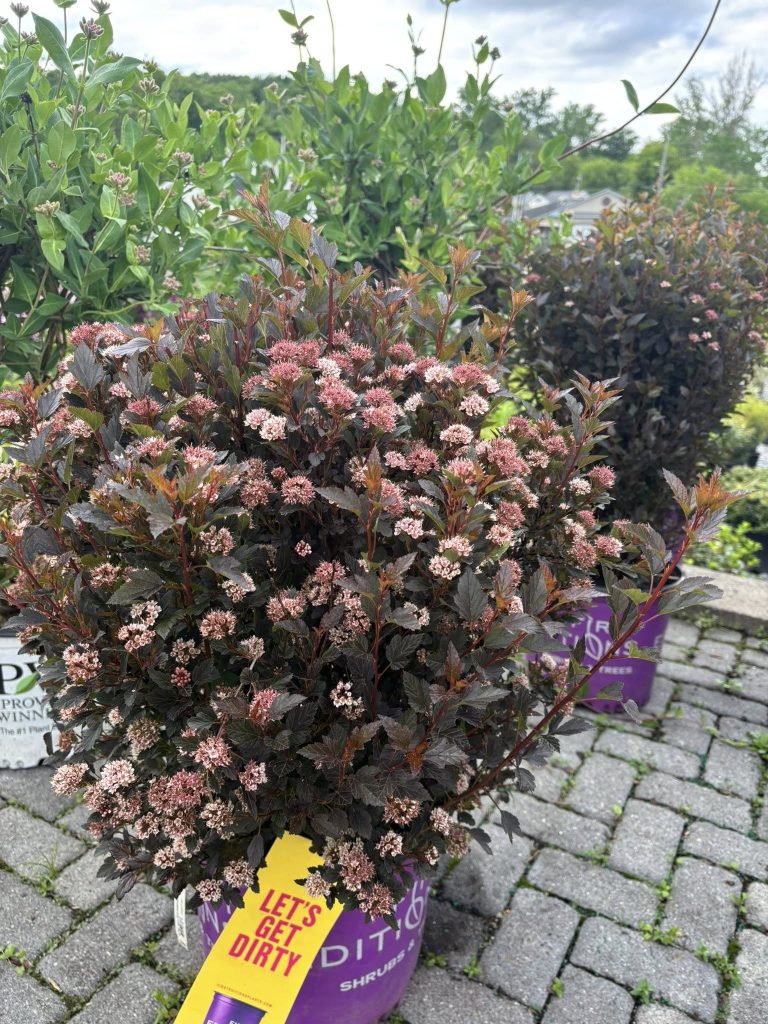
This dark foliage plant looks good with everything and never goes out of style. It stays naturally small (3–4 ft / 90–120 cm tall and wide) and keeps rich, deep burgundy-purple foliage from spring until frost.
Add exfoliating bark, white-to-pinkish early-summer flowers, and bright red seed capsules in autumn, and you have a four-season shrub that looks expensive but is actually tough as nails. In this guide, I’ll walk you through everything you need to know about the Little Devil Ninebark, including its history, care, and cultivation.
Brief History and Classification
Physocarpus opulifolius ‘Donna May’, marketed as Little Devil, was introduced in 2007 by First Editions (Bailey Nurseries). It quickly became a bestseller because it solved two major complaints about traditional ninebarks:
- Older varieties grow 8–10 ft (2.4–3 m) tall and wide – too big for modern lots.
- Most have plain green leaves that disappear in the border.
The dark-leaved revolution in ninebarks started in the 1990s with ‘Diabolo (also called ‘Monlo’). While gorgeous, Diabolo can reach 8–10 ft and often reverts with green shoots. Bailey Nurseries in Minnesota wanted a truly dwarf version with the same color intensity.
After years of crossing and selection, David Zlesak discovered a superior seedling in 2002. It was patented in 2011 as PP 22,634 and trademarked Little Devil. Today, it is propagated vegetatively by softwood cuttings to keep every plant identical.
Taxonomic Classification
- Kingdom: Plantae
- Order: Rosales
- Family: Rosaceae
- Genus: Physocarpus
- Species: opulifolius
- Cultivar: ‘Donna May’ (Little Devil)
Key Features of the Little Devil ninebark at a Glance
| Feature | Details |
| Scientific name | Physocarpus opulifolius ‘Donna May’ |
| Common names | Little Devil ninebark, Dwarf Diabolo |
| USDA Hardiness Zones | 3–7 (survives -40 °F / -40 °C) |
| Foliage color | Deep burgundy-purple (best in full sun) |
| Flower color | White flushed pink, early June |
| Fall color | Burgundy with bronze tones |
| Mature size | 3–4 ft tall × 3–4 ft wide (90–120 cm) |
| Growth rate | Moderate (12–18 in / 30–45 cm per year) |
| Lifespan | 20–30 years with proper pruning |
| Sun exposure | Full sun to part shade (color best in sun) |
| Soil tolerance | Clay, loam, sand; pH 5.0–8.0 |
| Drought tolerance | Excellent once established |
| Deer resistance | High |
| Toxicity | Non-toxic to humans, dogs, cats |
| Pollinator friendly | Yes – bees love the flowers |
Detailed Physical Characteristics
Foliage
The leaves emerge wine-red in spring, deepen to near-black purple in summer, and hold color reliably until frost in zones 3–7. Each leaf is 3-lobed, maple-like, 1½–3 in (4–8 cm) long. New growth is brightest; older leaves darken.
Flowers and fruit
In early June (zone 5 timing), hundreds of button-like clusters appear along the stems. Individual flowers are white with pink stamens, giving a soft pink cast from a distance. After pollination, attractive red seed capsules form and persist into winter – great for dried arrangements.
Bark
Even young plants show the characteristic ninebark peeling bark in tan and cinnamon layers. On a 5-year-old plant, the stems become quite ornamental in winter.
Habit and form
Naturally dense and rounded. No staking, no flopping. I have never seen a Little Devil look “leggy” the way some Diabolo plants do.
Ideal Growing Conditions – Care Details
To grow the Little Devil ninebark, you need to provide the following conditions:
Light
Full sun (6+ hours direct) = deepest purple foliage. In part shade, the color shifts toward dark green, and growth becomes looser. Four hours of direct sun is the absolute minimum.
Soil
One of the most adaptable shrubs I’ve ever grown. It thrives in heavy clay in my Minnesota test garden and sandy soil in Texas trial reports. Only requirement: decent drainage. Standing water in winter will cause crown rot.
Watering
First season: water deeply once a week.
Years 2+: drought-tolerant. I water mine only during prolonged 3–4 week dry spells in summer.
Fertilizer
Feeding the Little Devil ninebark is almost unnecessary. If you want faster growth, one application of balanced slow-release granules in early spring is plenty. Too much nitrogen will lead to greener foliage and weaker color.
Temperature and hardiness
Tested to -40 °F without damage. In zone 7b–8 this shrub remains evergreen in some winters, but foliage may bleach if temperatures fluctuate wildly.
Planting Instructions Step-by-Step
- Dig a hole twice as wide as the pot and exactly as deep.
- Mix 20–30 % compost into the backfill (skip if soil is already rich).
- Remove plant from pot, score roots lightly if circling.
- Plant so the original soil line is level with the ground.
- Water thoroughly and mulch 2–3 in (5–8 cm) deep, keeping mulch away from the stems.
- Stake only if planting in an extremely windy site (rarely needed).
Best planting times: early spring or early fall.
Pruning and Maintenance
Every 4 years I remove about ⅓ of the oldest stems all the way to the ground. This keeps the plant dense and forces bright new burgundy canes. I never “hedge” mine into meatballs – the natural mounded shape is far more attractive.
Deadheading is unnecessary; the red seed capsules are ornamental.
When to Prune
- Renewal pruning: Late winter/early spring before buds swell (every 3–5 years).
- Light shaping: Right after flowering, if desired.
Common Problems and Solutions
| Problem | Symptoms | Cause | Fix |
| Powdery mildew | White coating on leaves late summer | Poor air circulation | Thin interior stems, avoid overhead watering |
| Leaf spot | Green shoots on a purple plant | Wet foliage overnight | Clean up fallen leaves, copper fungicide early if severe |
| Chlorosis (yellow leaves) | Interveinal yellowing | Alkaline soil (pH >7.5) | Cut green shoots immediately at the base – Little Devil rarely reverts |
| Reversion | Apply sulfur or iron chelate in the spring | Genetic instability | Tips black after a harsh winter |
| Aphids | Curled new growth | Spring infestation | Hose off or insecticidal soap |
| Winter stem die-back | Tips black after harsh winter | Extreme cold/desiccation | Normal in zone 3; prune out in spring |
In ten years of growing Little Devil across zones 4–7, I have seen powdery mildew only twice – both times on plants crammed too close to a fence with no airflow.
Landscape Uses – Where Little Devil Shines
- Foundation plantings (finally a dark shrub that doesn’t swallow the house)
- Mixed borders with gold or chartreuse companions (e.g., Spiraea ‘Double Play Gold’, Weigela ‘Wine & Roses’)
- Low hedges (plant 2–3 ft apart)
- Containers (thrives for 3–5 years in 18–24 in pots)
- Mass plantings on slopes for erosion control
- Pollinator gardens (bees go crazy in June)
Personal favorite combo I designed last year: Little Devil in the middle ground, Limelight hydrangea behind, and Allium ‘Millenium’ in front. The color echo is stunning.
Companion Plants That Make Little Devil Pop
Purple foliage is a neutral – it pairs with almost anything. My top proven partners:
Hot colors
- Orange: Lantana ‘Miss Huff’, Crocosmia ‘Lucifer’
- Yellow/gold: Coreopsis ‘Jethro Tull’, Rudbeckia ‘Goldsturm’
Cool colors
- Blue: Catmint ‘Walker’s Low’, Salvia ‘May Night’
- Silver: Artemisia ‘Powis Castle’, Stachys byzantina
White accents
- Hydrangea ‘Little Lime’, Astilbe ‘Rheinland’
Evergreen structure
- Boxwood ‘Green Velvet’, Dwarf Alberta spruce
Propagation (For Sharing or expanding your collection)
Little Devil is patented (PP 22,634). Therefore, commercial propagation without a license is illegal. Home gardeners may take softwood cuttings in June for personal use:
- Take 4–6 in tip cuttings.
- Dip in 3000–8000 ppm IBA rooting hormone.
- Stick in moist perlite/peat under mist or in a humidity dome.
- Roots in 3–4 weeks.
Seed propagation is not true-to-type; seedlings will be green and tall.
Toxicity and Safety
Confirmed non-toxic to humans, dogs, cats, and horses (ASPCA and Poison Control databases). The foliage has a slightly bitter taste, so pets usually leave it alone.
Frequently Asked Questions (FAQs)
Q: Will Little Devil burn in full southern sun?
A: No. In zones 7–8, it holds color beautifully. Afternoon shade is helpful only in zone 9 experimental plantings.
Q: My plant is only 2 ft tall after three years. What’s wrong?
A: Usually too much shade or over-fertilizing. Move to full sun and withhold nitrogen.
Q: Can I grow Little Devil in a pot permanently?
A: Yes, for 4–6 years. Use a 24-inch (60 cm) container and repot or root-prune when it becomes root-bound.
Q: Does it really resist deer?
A: In my experience, yes – 95 % deer-proof. They nibble only during starvation winters.
Q: When do the leaves turn green instead of purple?
A: Low light, excess nitrogen, or late-season shade. Normal in October as chlorophyll breaks down.
Q: Is Little Devil the same as ‘Little Joker’?
A: No. Little Joker is a different Bailey introduction – even smaller (2–3 ft) with more bronzy new growth.
Final Thoughts
I own seven Little Devil ninebarks planted between 2015 and 2024. Every single one has been essentially maintenance-free except for the renewal pruning I do every four years. The color impact is incredible from April to November, and the winter bark adds interest when almost everything else is brown.
If you need a compact, colorful, ultra-hardy shrub that makes you look like a pro designer, this is it.
References
- Bailey Nurseries – First Editions® Little Devil™ Ninebark official page
- Missouri Botanical Garden Plant Finder – Physocarpus opulifolius ‘Donna May’
- University of Minnesota Extension – Ninebark cultivars trial 2008–2023
- Dirr, Michael A. Manual of Woody Landscape Plants, 6th edition, Stipes Publishing, 2009
- United States Patent PP22634 – Physocarpus ‘Donna May’ (original patent document)
- Royal Horticultural Society – Physocarpus trial reports 2015–2020

Tim M Dave is a gardening expert with a passion for houseplants, particularly cacti and succulents. With a degree in plant biology from the University of California, Berkeley, he has vast experience in gardening. Over the years, he has cultivated a vast collection of desert plants and learned a great deal about how to grow and care for these unique companions.