Understanding Kousa Dogwood (Cornus kousa): Identification, Cultivation, Problems and More
If you could design the perfect ornamental tree from scratch — one that offered spectacular spring flowers, edible summer fruit, brilliant autumn color, exfoliating winter bark, and disease resistance all in a single package — you would end up with something very close to the Kousa Dogwood.
Cornus kousa is one of those rare garden plants that genuinely over-delivers. It blooms magnificently. It fruits generously. It colors brilliantly in autumn. It reveals extraordinary bark in winter.
And unlike its native American counterpart, the Flowering Dogwood (Cornus florida), it does all of this with remarkable resistance to the diseases and pests that have devastated dogwood populations for years across the eastern United States.
The Kousa Dogwood has earned its place as one of the most widely planted ornamental trees in temperate horticulture — not through fashion or novelty, but through consistent, multi-season performance that few other trees in its size class can match.
| Feature | Detail |
| Scientific Name | Cornus kousa |
| Family | Cornaceae |
| Common Names | Kousa Dogwood, Japanese Dogwood, Korean Dogwood |
| Native Range | Japan, Korea, China |
| Mature Height | 15–25 feet |
| Crown Form | Horizontal, tiered, layered |
| Bloom Time | Late May–June |
| Bract Color | White (aging pink); pink cultivars available |
| Fruit | Edible, round, raspberry-like; ripens August–October |
| Fall Color | Red to reddish-purple |
| Bark | Exfoliating, mottled gray-tan-orange |
| Hardiness Zones | USDA Zones 5–8 |
| Soil | Moist, well-drained, slightly acidic (pH 5.5–7.5) |
| Disease Resistance | High — resistant to Dogwood Anthracnose |
| Best All-Purpose Cultivar | ‘Milky Way’ (white); ‘Satomi’ (pink) |
What Is the Kousa Dogwood?
The Kousa Dogwood belongs to the family Cornaceae — the dogwood family — and to the genus Cornus, which includes approximately 50 species of trees, shrubs, and ground covers distributed across the temperate Northern Hemisphere.
Its full scientific name is Cornus kousa, with the species epithet kousa derived directly from a Japanese vernacular name for the plant — kousa or kusa, meaning roughly “plant” or “herb” in regional Japanese usage.
The species was formally described to Western science in the mid-nineteenth century from Japanese specimens.
Cornus kousa has three recognized subspecies, which together define the species’ broad natural distribution:
- Cornus kousa subsp. kousa — the Japanese and Korean form; the most commonly cultivated subspecies in Western horticulture
- Cornus kousa subsp. chinensis — the Chinese form; generally more vigorous, often larger-flowered; hardier in some conditions; widely used in breeding programs
- Cornus kousa subsp. elsburgensis — a form from specific localities in Korea; less commonly encountered in cultivation
Most Kousa Dogwoods sold in North American and European nurseries are either the Japanese subspecies, the Chinese subspecies, or hybrids between the two. The differences between subspecies are subtle in the garden — the Chinese form tends to bloom a week or two later and often has slightly larger bracts.
Named cultivars may derive from either subspecies or from deliberate crosses between them. Common names reflect the tree’s Asian origins and ornamental character:
- Kousa Dogwood — the universal standard in North American horticulture
- Japanese Dogwood — used in some older texts and in European horticulture
- Korean Dogwood — occasionally used, referencing the Korean native range
- Chinese Dogwood — used specifically for subsp. chinensis
- Kousa — often used alone as a common name, particularly in the U.S. nursery trade
Native Range and Natural Habitat
Kousa Dogwood is native to Japan, Korea, and China — a broad swath of East Asia where it grows as an understory and forest-margin tree in mixed deciduous and mixed broadleaf-conifer forests. It was introduced to the United States in 1875 where it’s widely spread.
In Japan, it is found across Honshu, Shikoku, and Kyushu, typically on well-drained slopes and forest edges at low to moderate elevations. In Korea, it grows in similar forest margin habitats throughout the peninsula.
In China, the subspecies chinensis has a wide distribution across central and eastern provinces, often at somewhat higher elevations and in slightly cooler conditions.
In all native habitats, Kousa Dogwood occupies the woodland edge and understory position — it is adapted to filtered light and the dappled shade conditions found beneath taller deciduous trees.
This ecological background directly informs its landscape preferences: it performs beautifully in partial shade, though it flowers and colors best with more direct sunlight.
Physical Characteristics
Size and Form
The Kousa Dogwood is a small to medium-sized deciduous tree, typically reaching 15 to 25 feet (4.5–7.5 meters) in height with a spread often equaling or slightly exceeding the height at maturity. Growth rate is moderate — approximately 13 to 24 inches per year under good conditions.
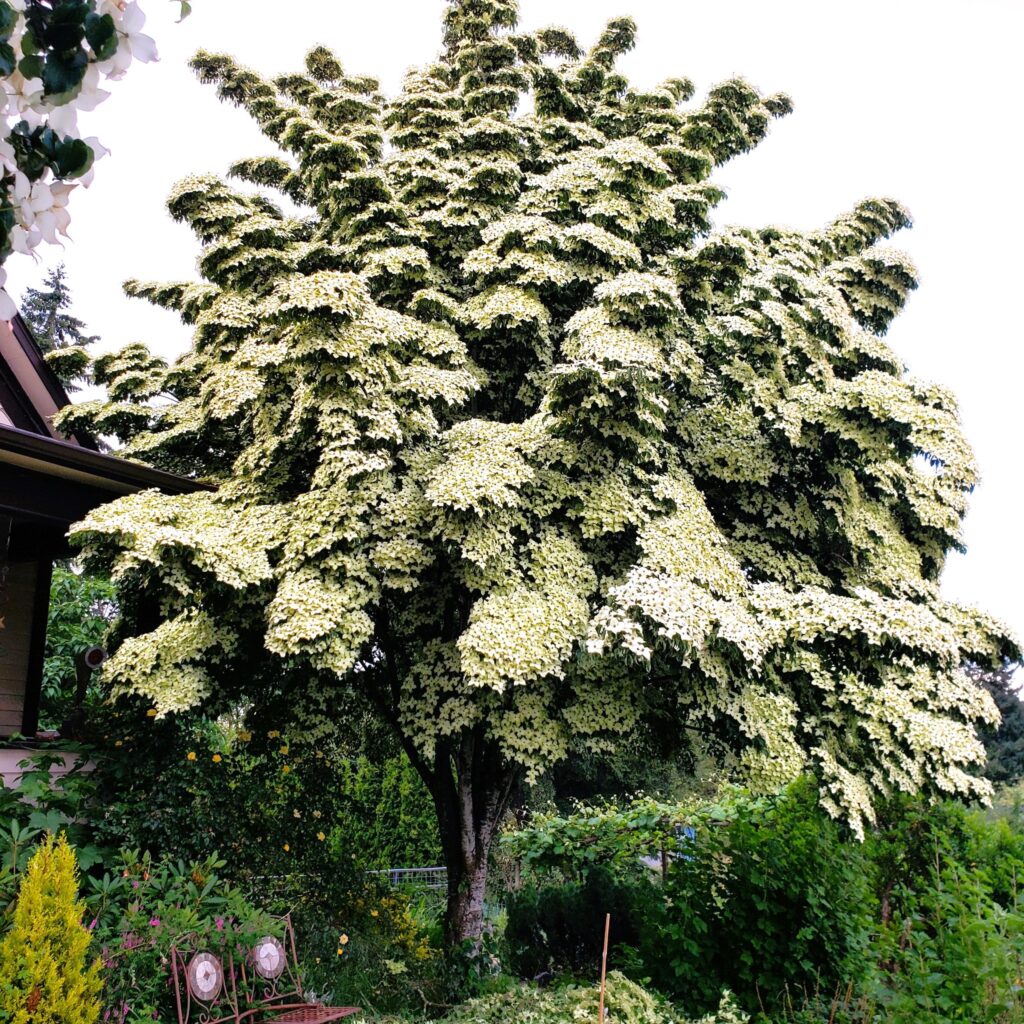
The form evolves distinctively through the tree’s life. Young trees are vase-shaped or upright, with ascending branches. As the tree matures, the branching becomes increasingly horizontal and layered — developing a spreading crown that gives older Kousa Dogwoods such a refined, architectural quality.
A mature specimen has a strongly horizontal branching pattern that landscape architects describe as one of the most elegant silhouettes in the ornamental tree palette.
This layered, pagoda-like crown structure is one of the Kousa Dogwood’s finest ornamental assets — it is as beautiful in winter, when the horizontal branches are bare against the sky, as it is in bloom.
Bark — The Winter Revelation
The bark of the Kousa Dogwood is a genuine four-season ornamental feature — something that cannot be said of most flowering trees.
On young trunks, the bark is smooth and gray. As the tree matures — typically from about fifteen years of age — it develops a striking exfoliating pattern, with irregular patches of bark peeling away to reveal a mosaic of gray, tan, cream, and warm orange-brown beneath.
This camouflage-like patchwork bark becomes increasingly pronounced with age, creating a trunk that resembles puzzle-piece stone or the bark of a sycamore — distinctive, beautiful, and completely unlike any other common ornamental tree.
In winter, when the leaves have dropped and the horizontal branches are bare, the exfoliating bark trunk becomes the tree’s primary ornamental feature. Positioned where winter light catches it — particularly morning or late afternoon light — the mottled bark glows with remarkable warmth.
This is the ornamental quality that consistently surprises gardeners who planted the tree for its flowers and later discover that they have also acquired one of the finest winter-interest bark specimens available.
Leaves
The leaves are simple, opposite, and ovate to elliptical — the characteristic leaf arrangement of the dogwood family. They measure 3 to 5 inches (7–13 cm) in length, with the strongly curved veining pattern typical of Cornus — veins that curve from midrib to leaf margin following the leaf edge, rather than running straight to it.
In summer, the leaves are medium to dark green, somewhat glossy, and create a clean, well-organized canopy. The leaf surface has a slightly rough texture.
In autumn, the foliage turns rich shades of red, reddish-purple, and scarlet — among the finest fall color of any ornamental tree in its size class. Color develops in October and typically holds for two to three weeks before leaf drop.
The combination of summer green and autumn red means the Kousa Dogwood contributes meaningfully to the garden in both of its non-flowering seasons.
The Flowers — The Tree’s Most Celebrated Season
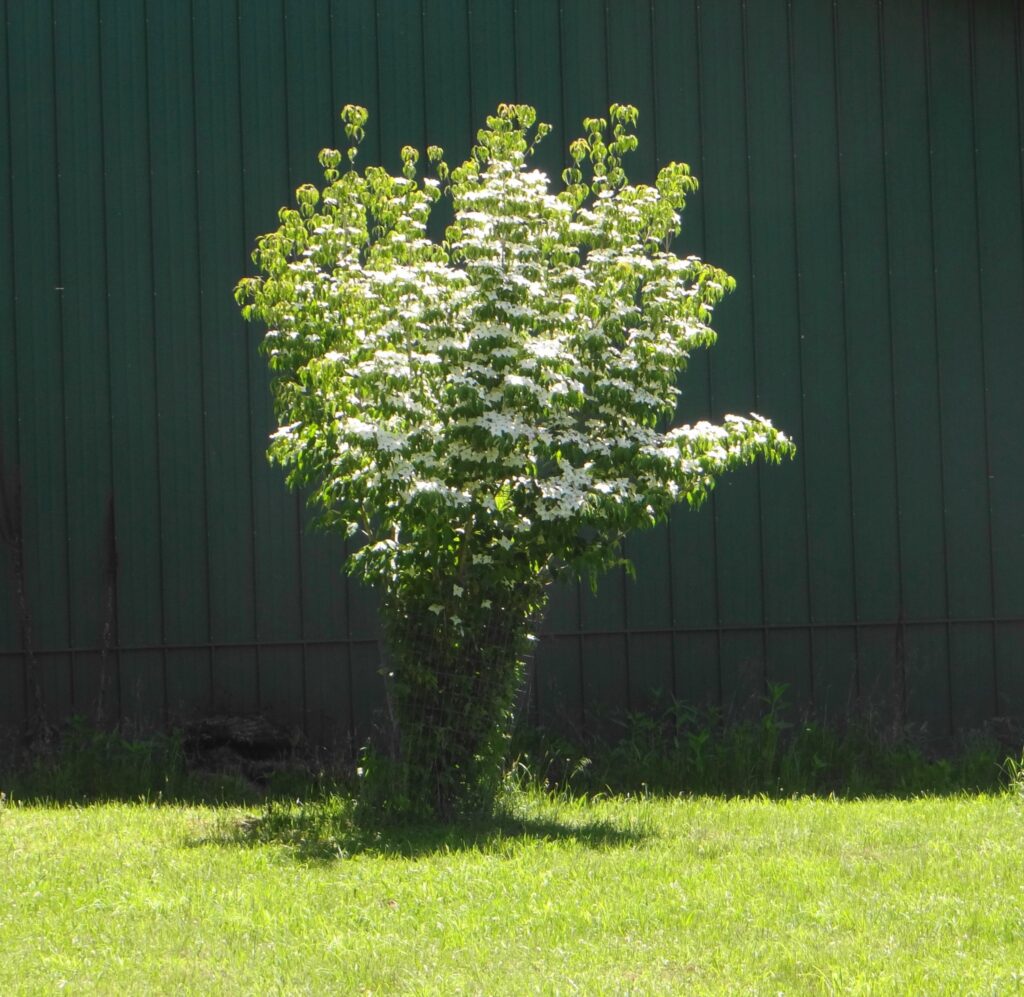
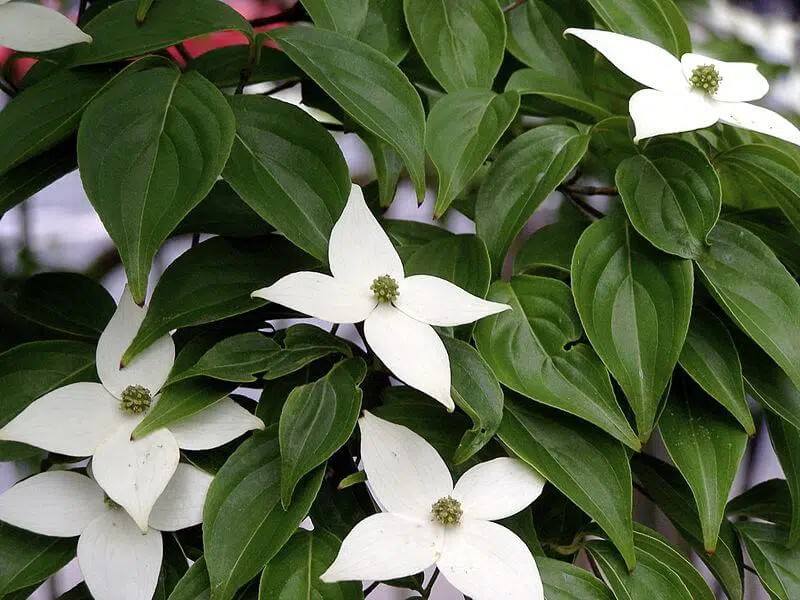
Strictly speaking, the Kousa Dogwood does not produce large flowers. What appears to be a four-petaled white or pink bloom — the feature that makes this tree so visually arresting — is actually four petal-like bracts surrounding a cluster of small, inconspicuous true flowers at the center.
This is the same floral structure found in the American Flowering Dogwood (Cornus florida) and in the poinsettia — modified leaves (bracts) that have evolved to attract pollinators by mimicking petals far more effectively than the actual small flowers could do on their own.
Each “flower” consists of four pointed bracts, each 1.5 to 2.5 inches (4–6 cm) long, tapering to a distinctive pointed tip — unlike the notched tips of Cornus florida bracts. This pointed tip is one of the reliable visual identification characters that distinguishes Kousa Dogwood from its American relative.
The bracts open pure white and gradually age to pinkish-white as the bloom period progresses, then to light green as the flower head transitions to fruit. This progression means the tree shows different color tones across the flowering season — a subtle but attractive quality.
Flowering occurs in late spring — May to June across most of the temperate United States — which is significantly later than the American Flowering Dogwood (C. florida), which blooms in April. This later bloom time is ecologically and horticulturally significant:
Later bloom means dramatically reduced frost vulnerability. A tree flowering in late May faces virtually no risk of the late frost damage that can destroy early April flowering. This timing advantage, combined with superior disease resistance, is one of the primary practical reasons Kousa Dogwood has gained ground on its American relatives in landscape planting programs.
Bloom is extraordinarily abundant on healthy specimens — trees can be literally covered with hundreds of four-bract flower heads simultaneously, with blossoms held above the horizontal foliage like dozens of white stars resting on a green table. The effect is spectacular and unambiguous even from a distance.
Bloom persists for 4 to 6 weeks — significantly longer than most spring-flowering trees — providing a sustained display that is particularly valuable in garden design.
The Fruit — Edible, Beautiful, and Wildlife-Valuable
One of the Kousa Dogwood’s most distinctive and least commonly known features is its fruit — and what edible, attractive, and wildlife-valuable fruit it produces.
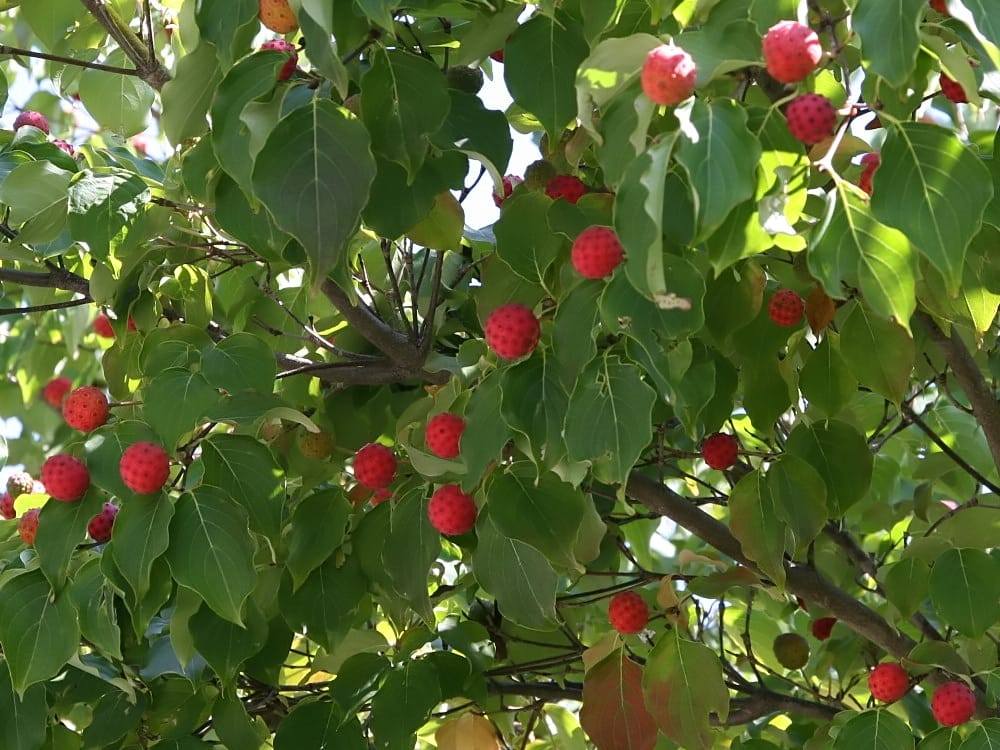
Following the flowers, round, raspberry-like composite fruits develop through summer. They ripen from hard green spheres to soft, rosy-pink to red globes approximately 1 to 1.5 inches (2.5–4 cm) in diameter by late August through October. They hang on long, pendulous stalks, often in such numbers that the tree’s canopy appears studded with red ornaments.
The fruit is edible by humans — a fact that surprises most gardeners. The flesh has a custard-like, sweet-tart flavor with tropical undertones — sometimes compared to a combination of papaya, fig, and sweet melon. The texture is soft and somewhat granular around the central seeds.
The skin is slightly tough and many people discard it, consuming only the inner pulp. Fully ripe fruit — soft to the touch and deeply colored — is at its most flavorful. Slightly under-ripe fruit is mealy and bland.
Culinary uses include:
- Eating fresh from the tree
- Jam and preserves
- Fruit leather
- Incorporated into baked goods
- Strained as a sauce or coulis
Fruit drop can be messy on paved surfaces — a practical consideration when siting the tree near walkways, driveways, or patios.
Wildlife enthusiastically consume the fruit. Species documented feeding on Kousa Dogwood fruit include white-tailed deer, foxes, raccoons, opossums, wild turkeys, and numerous songbird species including robins, cedar waxwings, and mockingbirds.
The fruit’s late summer to autumn ripening fills a critical nutritional window for wildlife preparing for winter.
Kousa vs. Flowering Dogwood: An Essential Comparison
The most common question facing gardeners considering a dogwood tree is whether to plant the Kousa Dogwood (Cornus kousa) or the native Flowering Dogwood (Cornus florida). Both are outstanding ornamental trees — but they are not interchangeable.
| Feature | Kousa Dogwood | Flowering Dogwood |
| Origin | Japan, Korea, China | Eastern North America |
| Bloom time | Late May–June | April |
| Bract tips | Pointed | Notched |
| Bract color | White (aging pink) | White or pink |
| Fruit | Round, raspberry-like; edible | Oval drupes; red clusters |
| Fall color | Red to reddish-purple | Red-purple |
| Bark | Exfoliating, mottled | Blocky, alligator-hide |
| Dogwood Anthracnose | Highly resistant | Highly susceptible |
| Powdery Mildew | Moderate resistance | Susceptible |
| Frost risk | Low (late bloom) | Higher (early bloom) |
| Native wildlife value | Good | Exceptional |
| Form at maturity | Horizontal, tiered | Rounded, spreading |
For gardeners in areas where Dogwood Anthracnose (Discula destructiva) is prevalent — particularly the Mid-Atlantic states, New England, and Pacific Northwest — the Kousa Dogwood’s disease resistance makes it the more practical choice for long-term success.
For gardeners prioritizing native ecological value — particularly supporting native bee species, birds, and Lepidoptera — Cornus florida provides more substantial benefits to North American wildlife communities, as it has co-evolved with local fauna over millions of years.
The ideal solution, where space allows, is to plant both. The staggered bloom times, complementary ecological roles, and different ornamental characters create a dogwood garden that delivers maximum beauty and ecological value across the full growing season.
Ecological Value in Cultivation
While the Kousa Dogwood does not carry the same depth of ecological relationships with North American wildlife as native dogwoods, it provides genuine and meaningful ecological services wherever it is planted.
Pollinators
The small true flowers at the center of each bract cluster are accessible to a wide range of native bees and other pollinators.
The open flower structure, combined with the tree’s extended bloom period of four to six weeks, provides a sustained nectar and pollen source in late May and June when many spring-flowering plants have finished.
Honeybees, native bumblebees, small native bees, and various fly species work Kousa Dogwood flowers consistently during bloom.
Birds and Mammals
As noted, the fruit is consumed by a wide range of birds and mammals. The dense, low-branching crown provides excellent nesting and roosting cover for songbirds. The horizontal branching structure creates natural platforms that many bird species favor for nest construction.
Lepidoptera
The Kousa Dogwood supports several moth and butterfly species as a larval host plant — though the list is less extensive than native dogwoods, which support significantly more North American Lepidoptera.
Notable species include certain Promethea Silkmoth populations and various native moth species that utilize dogwoods broadly.
Landscape and Garden Uses
The Kousa Dogwood’s combination of four-season ornamental value, manageable size, and disease resistance makes it one of the most versatile and reliably rewarding ornamental trees available to temperate gardeners.
Specimen Tree
As a single specimen in a lawn, border, or garden focal position, the Kousa Dogwood provides more sustained visual interest across more months than almost any other tree of comparable size. Spring flowers, summer fruit, autumn color, winter bark — each season presents a different reason to admire the same tree.
Position it where the winter bark will be seen. Many gardeners plant Kousa Dogwoods primarily for their flowers and only later discover the extraordinary bark — position the tree where it will be viewed in winter and the discovery will be immediate.
Woodland Garden Understory
In shade gardens, woodland gardens, and naturalistic landscapes, the Kousa Dogwood’s tolerance for dappled shade makes it an ideal layer beneath taller deciduous trees. Its horizontal form creates structural interest at the mid-story level — filling the visual and ecological gap between ground-level plantings and the canopy above.
Patio and Courtyard Tree
The modest ultimate size of most Kousa Dogwood cultivars makes it suitable for enclosed courtyard gardens, patio edges, and terraced landscapes where a larger tree would overwhelm the space. Its non-aggressive root system is compatible with paved surfaces at reasonable distances.
Foundation and Border Planting
Several compact cultivars are appropriate for foundation planting at building corners or as anchors for large mixed borders. The slow-to-moderate growth rate and predictable size of named cultivars reduce the long-term management burden.
Street and Urban Tree
Kousa Dogwood has shown good tolerance for urban conditions — air pollution, reflective heat, and urban soils — and is used in municipal planting programs in North America, Europe, and Asia. Its moderate size keeps it out of conflict with overhead utilities in many street tree scenarios.
Best Cultivars
The diversity of Kousa Dogwood cultivars available in commerce is extraordinary — dozens of selections offering variation in flower size, fruit abundance, growth form, and leaf color. The following represent the most reliably outstanding choices for general garden use.
White-Bracted Cultivars
- ‘Milky Way’ — profuse flowering; heavy fruit set; vigorous; one of the most reliable and widely tested cultivars; excellent general-purpose choice
- ‘Satomi’ × white — the species standard remains outstanding for many applications
- ‘National’ — selected by the U.S. National Arboretum; upright form; large bracts; excellent performance in mid-Atlantic conditions
- ‘Greensleeves’ — very large bracts; impressive floral display; good vigor
- ‘Summer Stars’ — extended bloom period; flowers persist into July; excellent midsummer display
- ‘Big Apple’ — selected for exceptionally large, abundant fruit; ornamental and edible fruit production outstanding
Pink-Bracted Cultivars
- ‘Satomi’ (syn. ‘Rosabella’) — the definitive pink Kousa; deep rose-pink bracts; excellent fall color; widely available; the standard against which all pink Kousa cultivars are measured
- ‘Miss Satomi’ — similar to ‘Satomi’ but slightly more compact; good choice for smaller spaces
- ‘Beni Fuji’ — deep pink bracts; vigorous; strong performer
Variegated Foliage Cultivars
- ‘Wolf Eyes’ — cream-margined leaves with green centers; fine-textured appearance; reliable fall color; compact habit; one of the finest variegated ornamental shrub-trees available
- ‘Snowboy’ — gray-green leaves with white margins; smaller habit; attractive foliage interest through the growing season
Weeping and Unusual Forms
- ‘Elizabeth Lustgarten’ — strongly weeping habit; excellent for accent planting; white flowers; moderate vigor
Soil, Light, and Growing Requirements
Soil
Kousa Dogwood performs best in deep, moist, well-drained, organically rich soils with a slightly acidic to neutral pH (5.5 to 7.5). Like many members of the dogwood family, it is sensitive to:
- Waterlogged soils — root rot is a serious risk in heavy, poorly drained conditions
- Highly alkaline soils — causes iron chlorosis and chronic decline
- Severely compacted soils — limits root expansion and reduces vigor
The ideal soil preparation involves generous incorporation of compost across the entire planting zone before planting — not just in the planting hole. Kousa Dogwood roots spread wide and shallow, and the quality of the broader soil zone significantly influences long-term performance.
Light
Full sun to partial shade. Maximum flowering, fruit set, and fall color occur in full sun to light partial shade (6 or more hours of direct sun daily). Deep shade produces sparse flowering, poor fruit set, and reduced fall color intensity.
In the warmest parts of Zones 7 and 8, some afternoon shade reduces heat stress and extends the life of individual flowers during the bloom period — useful in hot summer climates.
Hardiness Zones
Kousa Dogwood is hardy in USDA Zones 5 through 8, with the Chinese subspecies often demonstrating slightly greater cold tolerance, reaching into Zone 5 reliably and Zone 4 in sheltered locations.
How to Plant and Grow Kousa Dogwood
Planting Instructions
- Select a site with appropriate sun exposure and excellent drainage. Confirm soil pH before planting — amend if necessary.
- Purchase container-grown or balled-and-burlapped stock from reputable nurseries. Named cultivar plants are vegetatively propagated and will perform as expected.
- Dig the hole two to three times wider than the root ball and no deeper than the root ball height.
- Plant at the correct grade — root flare at or slightly above soil level. Deep planting is the most common cause of long-term Kousa Dogwood decline.
- Backfill with native soil amended with compost. Avoid high-nitrogen fertilizers at planting time.
- Mulch generously — 3 to 4 inches of organic mulch extending at least 3 feet beyond the root ball in all directions. Mulch is one of the single most beneficial practices for establishing Kousa Dogwood successfully.
- Water thoroughly at planting and maintain consistent soil moisture through the first two growing seasons.
Pruning
Kousa Dogwood requires minimal pruning. The natural horizontal, layered form is the tree’s primary ornamental asset — do not prune it into an unnatural shape.
Remove dead, diseased, or crossing branches in late winter to early spring before bud break. Avoid summer pruning, which can stress the tree and reduce the following year’s flower bud development.
If size reduction is necessary, do so gradually over several seasons — never remove more than one-third of living wood in a single season.
Pests, Diseases, and Common Problems
Dogwood Anthracnose Resistance
The Kousa Dogwood’s resistance to Dogwood Anthracnose (Discula destructiva) is one of its most practically significant characteristics. This fungal disease has devastated populations of the native Flowering Dogwood (Cornus florida) across the eastern United States, killing thousands of wild trees and hundreds of thousands of cultivated specimens since its emergence in the 1970s.
Kousa Dogwood is not immune to the disease, but it is substantially resistant — infections are far less likely to become lethal, and healthy, well-sited Kousa trees in appropriate conditions rarely suffer significant anthracnose damage.
Powdery Mildew
Powdery mildew (Erysiphe pulchra and related species) causes white, dusty coatings on leaves in humid, shaded conditions. Kousa Dogwood has moderate resistance — better than C. florida but not immune. Providing adequate air circulation and avoiding overhead irrigation significantly reduces incidence.
Spot Anthracnose
Spot Anthracnose (Elsinoe corni) causes small, purple-edged spots on leaves and bracts. Typically cosmetic on healthy trees. Rarely requires treatment.
Borer Insects
Dogwood Borers (Synanthedon scitula) attack dogwood species broadly. Healthy, well-established trees with intact bark are significantly less vulnerable than stressed or mechanically damaged trees.
Protect bark from mower and string trimmer damage — wounds at the base of the trunk are primary borer entry points.
Iron Chlorosis
On alkaline soils, yellowing between leaf veins signals iron deficiency. Correct soil pH as the long-term solution. Chelated iron foliar applications provide temporary improvement.
Final thoughts
The Kousa Dogwood is a tree that earns its place in the garden through four full seasons — not through a single spectacular moment, but through consistent, multi-layered beauty that unfolds differently in every month of the year.
The late spring flowers are as fine as any flowering tree can offer. The summer fruit is genuinely edible and genuinely good. The autumn foliage burns red with quiet dignity. And the winter bark is one of the finest bark ornamentals in temperate horticulture.
Add to this the practical advantage of disease resistance and late-bloom frost safety, and the Kousa Dogwood becomes not merely a beautiful tree but a sound investment — one that will perform reliably for decades with relatively modest demands.
If you have the right conditions — reasonable drainage, slightly acidic soil, enough sun — and are considering a small specimen tree, the Kousa Dogwood belongs near the top of your list. It will reward every season you give it.
References
- North Carolina State University Cooperative Extension — Cornus kousa Plant Profile https://plants.ces.ncsu.edu/plants/cornus-kousa/
- University of Florida IFAS Extension — EDIS — Cornus kousa: Kousa Dogwood https://edis.ifas.ufl.edu/publication/ST181
- Virginia Tech Department of Forest Resources and Environmental Conservation — Dendrology Fact Sheet: Cornus kousa https://dendro.cnre.vt.edu/dendrology/syllabus/factsheet.cfm?ID=414
- University of Connecticut Plant Database — Cornus kousa — Kousa Dogwood https://hort.uconn.edu/detail.php?pid=96
- Missouri Botanical Garden — Plant Finder — Cornus kousa https://www.missouribotanicalgarden.org/PlantFinder/PlantFinderDetails.aspx?taxonid=276703

Tim M Dave is a gardening expert with a passion for houseplants, particularly cacti and succulents. With a degree in plant biology from the University of California, Berkeley, he has vast experience in gardening. Over the years, he has cultivated a vast collection of desert plants and learned a great deal about how to grow and care for these unique companions.