The Japanese Black Pine Bonsai (Pinus thunbergii): History, Styling, and Growth Requirements
There is a reason bonsai masters across Japan refer to the Japanese black pine as the “king of bonsai.” It is not simply tradition. It is earned. Of all the trees cultivated in the long and refined history of bonsai, Pinus thunbergii stands apart for its vigor, and its responsiveness to training.
The Japanese black pine, Pinus thunbergii, is a two-needled pine native to coastal regions of Japan and South Korea. Its natural range includes the rocky shorelines and sandy coastal dunes of Honshu, Shikoku, Kyushu, and the Korean Peninsula.
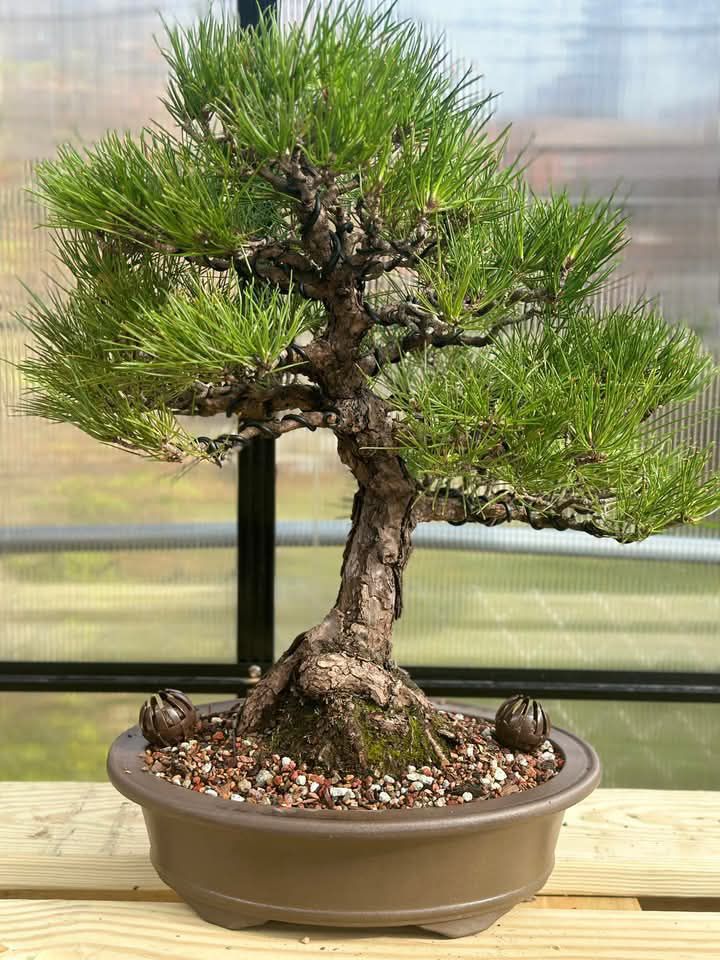
It belongs to the family Pinaceae. Its needles are 7 to 12 centimeters long, stiff, and sharply pointed, paired in tight clusters along the branches. The contrast between these bold, dark green needles and the rugged, almost black bark gives the tree a distinctive and forceful visual character.
In Japan, it is called Kuromatsu (黒松), meaning “black pine.” On mature trees, the bark becomes deeply fissured and almost charcoal-gray in color — a feature bonsai artists prize enormously.
Alongside Pinus parviflora, it is considered one of the two most important pine species in all of Japanese bonsai.
Natural Habitat and Wild Character
In the wild, Pinus thunbergii colonizes coastal cliffs, sand dunes, and rocky headlands where the soil is thin, salt-laden, and often waterlogged. It tolerates salt spray, high winds, poor drainage, and periodic drought.
Wild specimens develop dramatic, windswept forms — trunks that lean hard into the prevailing wind, branches that stretch horizontally as if reaching for calmer air. The bark is tortured and magnificent. These are not pretty trees in the conventional sense. They are powerful trees. And in bonsai, power is everything.
Japanese black pine is remarkably tolerant of heat, humidity, and full sun — far more so than many other bonsai species. It thrives in climates that would stress a Japanese maple or a juniper.
Why Japanese Black Pine Is the “King of Bonsai”
Responsiveness to Training
The Japanese black pine responds to horticultural techniques — particularly the two-flush technique — with a degree of precision that is almost unique in the bonsai world. You can control needle length, branching density, and vigor distribution with remarkable accuracy once you understand how the tree functions.
Vigor and Resilience
It is a fast-growing, vigorous tree that tolerates aggressive pruning and recovers quickly from mistakes. For practitioners learning advanced techniques, this resilience provides a kind of safety net.
Masculine Aesthetic
In Japanese aesthetics, the black pine is firmly masculine — bold, coarse, dramatic. Its thick trunk, heavy bark, and strong branching convey age and power. A well-developed black pine bonsai looks ancient even when it is relatively young.
Longevity and Legacy
Well-maintained specimens can live for hundreds of years in a bonsai pot. Some famous Japanese black pine bonsai are centuries old, representing a continuity of care across generations. To cultivate one is to participate in something much larger than a single lifetime.
Cultural Significance in Japan
The Japanese black pine is deeply embedded in Japanese culture, art, and spiritual tradition. It has been planted on temple grounds, castle gardens, and along coastlines for over a thousand years, both for its protective function against wind and salt and for its symbolic associations.
In Japanese tradition, pine trees represent strength, longevity, and steadfastness. In Noh theater, a painted pine tree is the traditional backdrop for the stage — one of the most enduring symbols in Japanese performing arts.
In the world of bonsai, the Japanese black pine has been cultivated in pot culture for at least 400 years, with evidence of highly developed techniques documented in Japanese horticultural texts from the Edo period (1603–1868).
Legendary masters like Saburo Kato devoted their careers specifically to refining techniques for this species.
Botanical Characteristics
Needles
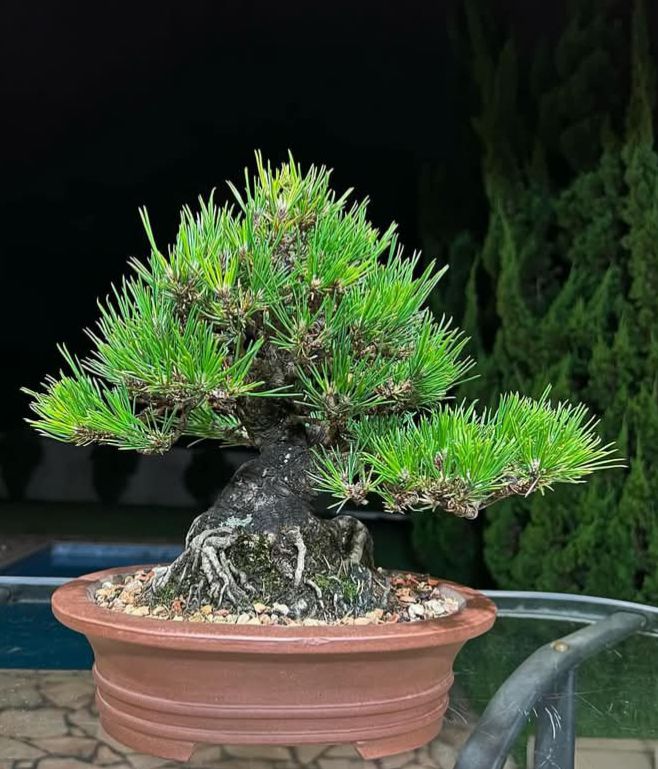
Needles are produced in pairs (fascicles of two), measuring 7 to 12 centimeters in length. They are dark green, stiff, and twisted, with sharp tips. New needles emerge in spring as elongated, cylindrical buds called candles, which extend rapidly before the needles fully open.
A primary goal in Japanese black pine bonsai is reducing needle length through controlled techniques — specifically, decandling — to create the compact, refined appearance associated with developed bonsai.
Bark
The bark of young trees is smooth and gray-green. As the tree matures, it becomes increasingly furrowed, scaly, and dark — eventually taking on the characteristic near-black appearance. This aging of the bark is one of the most visually satisfying aspects of growing a Japanese black pine over many years.
Buds
The tree produces prominent white-tipped buds in autumn, clearly visible against the dark bark and green needles. These white buds are a distinctive identification feature and are considered aesthetically desirable in bonsai.
Cones
Cones are 4 to 6 centimeters long, ovoid, and brown when mature. In bonsai, cones are often removed to prevent the tree from directing excessive energy into seed production.
Root System
Pinus thunbergii develops a vigorous, wide-spreading root system that responds well to root pruning. One of the key long-term goals in black pine bonsai is the development of strong nebari — the surface root spread visible at the base of the trunk — which contributes enormously to the impression of age and stability.
The Two-Flush Technique: The Heart of Japanese Black Pine Bonsai
If there is one concept that defines the cultivation of Japanese black pine as bonsai, it is the two-flush technique, also known as decandling. Understanding this technique is fundamental to growing this species at any serious level.
How Pine Growth Works
In most climates, Japanese black pine produces one flush of growth per year in spring. Left unmanaged, these shoots elongate significantly, producing long internodes and long needles — the opposite of what a refined bonsai requires.
However, Pinus thunbergii has the capacity to produce a second flush of growth in the same growing season if the first flush is removed at the right time. This is the foundation of the two-flush technique.
The Decandling Process
In mid-summer — typically June or July in the Northern Hemisphere — the elongated spring candles are cut off entirely with scissors. This removes all of the year’s new growth back to the previous year’s wood.
The tree responds by pushing new buds from the cut sites, which develop through late summer and early autumn into a second flush of growth. Because this second flush occurs later in the season with shorter days and lower temperatures, the new needles are significantly shorter and more compact. Internodes are tighter, branching is denser, and the overall result is far more refined foliage.
Over many years of repeated decandling, a Japanese black pine bonsai develops increasingly fine, compact branching — the hallmark of a developed specimen.
Timing Is Critical
The timing of decandling is one of the most important variables in this technique. In warm climates, decandling typically occurs earlier — late May to early June. In cooler climates, it may be as late as July. Decandling too late leaves insufficient time for the second flush to harden before winter, potentially causing dieback.
Differential Treatment by Branch Strength
Not all branches are treated equally. Strong, apex branches are decandled earlier than weaker, lower branches. By decandling strong branches first and weak branches last, a skilled practitioner can balance vigor across the entire tree over time. This level of refinement is what separates competent black pine growers from masters.
Seasonal Care Calendar
Spring (March–May)
Spring is the season of rapid growth. Candles elongate quickly and must be monitored closely. Note the relative vigor of each branch to plan summer decandling.
Repotting, if needed, is done in late winter to early spring, just before growth begins. Repot every two to four years for younger trees, and less frequently for older specimens.
Summer (June–August)
This is the most active intervention period. Decandling takes place in early-to-mid summer. After decandling, monitor water needs closely, as newly cut branches are more vulnerable to drying out.
Needle pulling — removing old needles from the previous year — may also be done in late summer on mature, healthy trees to improve light penetration. This encourages back-budding, which is essential for long-term ramification.
Summer is also the most demanding season for watering. Black pines in full sun can require watering two or even three times per day in peak heat.
Autumn (September–November)
The second flush hardens off and the tree prepares for dormancy. Structural pruning — removing unwanted branches and refining the silhouette — is best done in autumn when the tree’s growth energy has settled.
White buds become clearly visible in autumn, making it an excellent time to assess future branching and plan for the following year.
Winter (December–February)
Japanese black pine requires a period of cool dormancy. In climates with regular frosts, the tree handles this naturally outdoors. The pot is usually the most vulnerable element — the root ball in a bonsai pot can freeze solid. Moving the tree to an unheated shelter or wrapping the pot during hard freezes is wise in severe winter climates.
Soil, Potting, and Root Work
Soil Composition
Free-draining, inorganic soil is non-negotiable. Most experienced growers use a mixture dominated by Akadama — a fired Japanese clay aggregate — combined with pumice and coarse sand or grit. A typical mix is 60% Akadama, 20% pumice, and 20% coarse sand.
Avoid standard garden soil or potting compost in bonsai containers. These compact quickly, retain too much moisture, and do not support the mycorrhizal fungi that pines depend on for efficient nutrient uptake.
Repotting
When repotting, prune the roots by no more than one-third at a time. Root work and heavy branch pruning should not be done simultaneously. Mycorrhizal inoculant can be added when repotting to help establish the beneficial fungal network around new roots.
Pot Selection
During development, Japanese black pine bonsai are often kept in training pots — larger, unglazed containers that allow maximum root development. For display, the classic pairing is an unglazed, earthy-toned pot in brown, gray, or dark red that complements the rugged character of the tree.
Styling and Aesthetic Principles
Classic Bonsai Styles
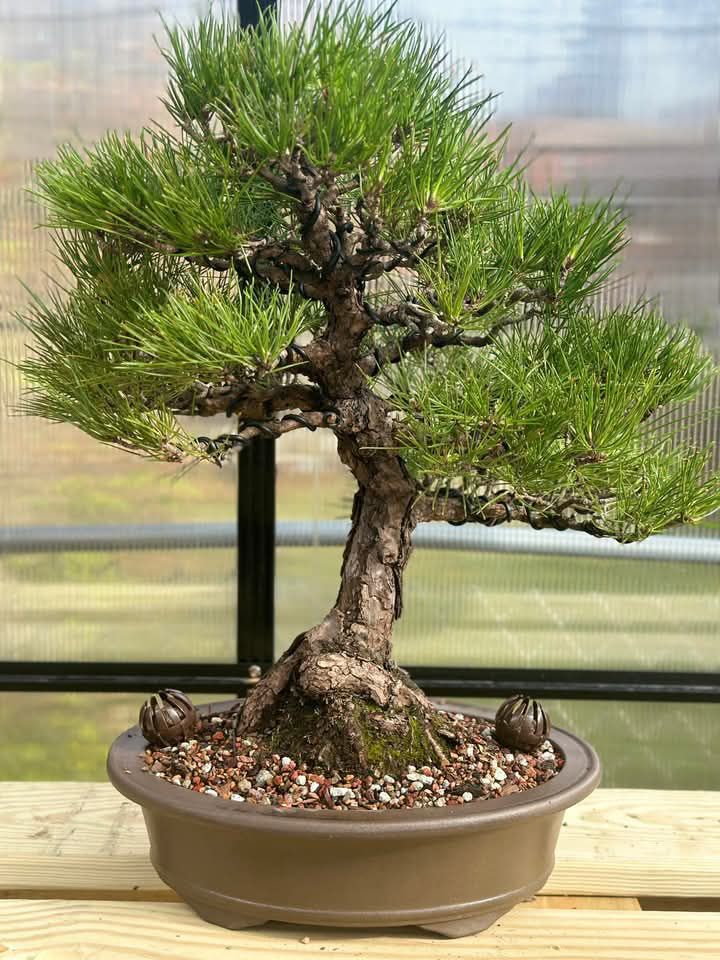
The informal upright (moyogi) is the most common style, reflecting the tree’s natural coastal growth — upright in general form, but with gentle movement in the trunk line.
Slanting (shakan) and windswept (fukinagashi) styles capture the tree’s coastal character, with the trunk and branches leaning dramatically as if shaped by prevailing wind.
Literati (bunjin) style — a tall, thin trunk with sparse, high branching — can be powerful with this species for trees with dramatic bark and trunk movement.
Driftwood styles, incorporating significant areas of deadwood (jin and shari), create striking contrast between the bleached, carved deadwood and the living bark and dark green foliage.
Trunk Development
Trunk development is the foundation of all bonsai work and is especially critical for Japanese black pine. A thin trunk on a well-refined bonsai looks unconvincing. A thick, aged trunk changes everything.
Many growers allow their trees to grow freely in the ground or in large containers for years — sometimes decades — to build trunk girth before beginning formal bonsai training. This patience is one of the true tests of the serious bonsai grower.
Apex and Branch Arrangement
The apex should be the most refined part of the bonsai, with the shortest internodes, the smallest needles, and the finest branching. The lower branches are typically heavier and more massive, creating the visual impression of a mature, stable tree.
Negative space between branches is just as important as the branches themselves in creating an elegant, readable silhouette.
Fertilizing
Japanese black pine is a heavy feeder compared to many other bonsai species. Regular, consistent fertilization is essential for maintaining health and supporting the demands of decandling.
Spring feeding should begin as soon as growth starts, using a balanced fertilizer. Some growers use a slightly higher-nitrogen formula in spring to support vigorous growth.
In summer, after decandling, fertilization continues with a balanced formula to support second-flush development. Autumn feeding shifts toward lower nitrogen and higher phosphorus and potassium to harden the tree for winter.
Organic fertilizers in cake or pellet form are widely used for their slow, steady nutrient release and support of soil biology.
Common Problems and How to Address Them
Pine Needle Scale
Armored scale insects appear as small, flat, waxy discs on the needles and branches. Heavy infestations cause yellowing and dieback. Horticultural oil sprays in late winter or early spring, before growth begins, are effective.
Root Rot
Root rot is almost always the result of poor drainage or overwatering. Prevention is the only real solution — ensure your soil mix drains freely and never allow the pot to sit in standing water.
Needle Cast
Fungal diseases that cause premature needle drop affect trees kept in poor airflow. Improve air circulation, avoid overhead watering, and apply appropriate fungicides preventively if the condition has been recurring.
Vigor Imbalance
Uneven vigor — where some branches grow very strongly while others become weak — is a common issue. If not corrected through differential decandling, needle pulling, and fertilization management, weak branches can eventually die back.
Learning to read the tree and respond branch by branch is central to mastering this species. This skill takes longer to develop than almost any other in bonsai.
Pine Pitch Moth
Larvae of the pine pitch moth bore into the wood, creating resinous masses. Physical removal of larvae and prompt wound care are the main responses. Healthy, vigorously growing trees are generally more resistant to infestation.
Wiring and Branch Placement
Wiring is used to guide branches into desired positions and is a fundamental bonsai technique. For Japanese black pine, copper wire is typically preferred over aluminum for its greater holding strength, which is needed to bend the often-stiff branches of this species.
Wire is applied in late autumn or early winter, when the tree is dormant and branches are slightly more pliable. It must be monitored closely in spring, as the rapidly thickening branches can grow into the wire within weeks if left unattended.
Jin and shari — deadwood on branches and trunk respectively — are particularly effective on Japanese black pine. The natural white color of dried pine wood contrasts dramatically with the dark, living bark and green needles, adding powerful visual tension to a design.
Developing a Japanese Black Pine Over Time
It is worth being honest about the timeline involved in developing a fine Japanese black pine bonsai.
The first five years are largely about establishing the tree, building root health, and making early structural decisions.
Years five to fifteen are typically focused on primary and secondary branch development, consistent decandling to begin reducing needle length, and the gradual articulation of the tree’s overall design.
Years fifteen and beyond are when refinement work begins in earnest — developing fine tertiary branching, achieving consistently short needles and compact foliage pads, and allowing the bark to develop its full aged character.
A genuinely mature, developed Japanese black pine bonsai is rarely less than twenty to thirty years in the making. The most extraordinary specimens represent fifty, one hundred, or more years of continuous care. Every year of good work is a year of progress — and the process itself is the reward.
Starting Your First Japanese Black Pine Bonsai
Choosing Material
Nursery-grown landscape trees are one of the best sources for beginners — they are relatively affordable, often have good trunk bases, and have been growing vigorously. Look for trees with trunk movement, interesting bark, and a root base that sits well.
Pre-bonsai from specialist nurseries offer trees that have already had initial training. These cost more but give a meaningful head start.
Growing from seed is deeply satisfying but requires years of patience before any meaningful training begins.
First Steps
After acquiring your tree, resist the urge to do everything at once. Begin with basic care — correct soil, adequate sun, consistent watering, and fertilization. Observe the tree through one full growing season before making significant styling decisions.
Build a healthy, vigorous tree first. Without vigor, none of the refinement techniques will work. Vigor comes first. Everything else follows.
Suggested For You:
The Japanese White Pine (Pinus parviflora): History, Features and Growth Requirements
10 Common Japanese Blueberry Tree Problems: Identification and Fix
20 Fast-Growing Trees That Won’t Clutter Your Yard — Beautiful, Tidy, and Built to Impress
Acer Palmatum Bloodgood Growth Rate: How Fast Does a Bloodgood Japanese Maple Grow?
15 Stunning Trees with Red Flowers: Identification, History and Care Tips
Final Thoughts
There is something genuinely different about the Japanese black pine. It asks more of you than most trees. The techniques are more demanding. The seasonal commitments are stricter. The timeline is longer.
But it gives back in equal measure. When decandling is timed correctly and the second flush comes in dense and compact, when the bark on a developing trunk shows its first deep furrows, when a tree you have worked on for years finally begins to look like something real — those moments carry a satisfaction that few other horticultural pursuits can match.
The Japanese black pine is not a beginner’s shortcut. It is a practitioner’s reward. If you are willing to learn its language — and it does have a language, one that takes time and seasons to understand — it will show you what bonsai is truly capable of.
References
- North Carolina State University Extension – Pinus thunbergii Plant Profile: https://plants.ces.ncsu.edu/plants/pinus-thunbergii/
- University of Florida IFAS Extension – Pine Tree Culture and Management: https://edis.ifas.ufl.edu/publication/ST441
- Missouri Botanical Garden – Pinus thunbergii Plant Finder: https://www.missouribotanicalgarden.org/PlantFinder/PlantFinderDetails.aspx?taxonid=277641
- University of Connecticut Plant Database – Pinus thunbergii: https://hort.uconn.edu/plants/p/pinthu/pinthu1.html
- Penn State Extension – Bonsai Plant Care and Cultural Practices: https://extension.psu.edu/bonsai

Tim M Dave is a gardening expert with a passion for houseplants, particularly cacti and succulents. With a degree in plant biology from the University of California, Berkeley, he has vast experience in gardening. Over the years, he has cultivated a vast collection of desert plants and learned a great deal about how to grow and care for these unique companions.