Month-by-Month Timeline: How Long Does Garlic Take to Grow?
If you have ever planted a garlic clove and then stood in your garden wondering when something is supposed to happen, you are not alone. Garlic is one of the slower crops in the home garden, and that patience-testing timeline is one of the first things new growers want to understand.
The short answer is this: garlic typically takes seven to nine months to grow from a planted clove to a harvest-ready bulb. But that number alone tells only part of the story. The actual timeline depends on the variety you plant, the climate you grow in, and how well the soil and care conditions support the plant through each stage.
This guide breaks down the full garlic-growing timeline — month by month, stage by stage — so you know exactly what to expect from the moment you put a clove in the ground to the day you lift a mature bulb from the soil.
Why Garlic Takes So Long to Grow
Garlic is not a quick-turnaround crop. Unlike radishes, which can be ready in three weeks, or lettuce, which you can harvest in six, garlic demands a long, slow season that mirrors the natural rhythm of the year.
The reason comes down to biology. Garlic needs a period of cold temperatures — called vernalisation — to trigger bulb formation. Without sufficient cold exposure, a garlic clove will grow green tops but fail to develop into a proper multi-cloved bulb.
This biological requirement means garlic is almost always planted in autumn, spends winter quietly underground, and only begins its visible growth surge in spring.
This long growing season is not a flaw. It is precisely what gives garlic its concentrated flavour, its impressive bulb size, and its remarkable storage life. Good things, as it turns out, do take time.
The Full Garlic Growing Timeline at a Glance
Before going into detail, here is a broad overview of the typical growing calendar for garlic planted in autumn in a temperate Northern Hemisphere climate:
| Growth Stage | Approximate Timing |
| Planting | September – November |
| Root establishment | October – December |
| Winter dormancy | December – February |
| Spring emergence | February – March |
| Active leaf growth | March – May |
| Scape formation (hardneck) | May – June |
| Bulb swelling | May – July |
| Harvest | June – August |
| Curing and storage | July – September |
For Southern Hemisphere growers, shift these dates by approximately six months: plant in March to May, and harvest in December to February.
These ranges are approximate. Actual timing varies meaningfully by variety, location, and annual weather patterns.
Month-by-Month Breakdown of the Garlic Growing Season
Autumn: Planting and Root Establishment (September – November)
The garlic calendar begins in autumn. This is when cloves are planted into prepared soil, ideally several weeks before the ground freezes hard.
During the first few weeks after planting, nothing visible happens above ground. Do not be alarmed. Below the surface, the clove is sending out roots, anchoring itself, and beginning to absorb nutrients. This early root development is crucial — a well-rooted plant in autumn will emerge more vigorously in spring than one that was planted too late.
In milder climates, green shoots may appear above the soil surface within two to four weeks of planting. In colder climates, the shoot may barely emerge — or not at all — before temperatures drop and the plant enters dormancy.
Plant garlic four to six weeks before the ground is expected to freeze. This window gives the roots enough time to establish without pushing the shoot into growth that would be damaged by hard frost.
Winter: Dormancy and Underground Development (December – February)
Above the soil, the garden looks still. Below it, garlic is doing important, invisible work.
During winter dormancy, the clove is undergoing the cold treatment it needs to form a proper bulb. This period of sustained cold — ideally below 10°C (50°F) for at least one to two months — is what triggers the hormonal changes that will eventually tell the plant to divide into multiple cloves rather than forming a single round bulb called a “round” or “rond.”
Skipping this cold period — whether by planting in spring in a warm climate or by using untreated seed — often results in a disappointing harvest of undivided rounds.
In areas with harsh winters, a good layer of mulch (straw, leaves, or shredded bark) over the planting bed will protect the cloves from the most damaging freeze-thaw cycles. The goal is not to keep the soil warm — it is to keep the temperature stable.
Most growers do very little in winter except wait, which is genuinely difficult when you are eager to see progress.
Early Spring: Green Shoots Emerge (February – March)
The return of longer days and slowly warming temperatures signals garlic to wake up. Green shoots push through the soil — and sometimes through the mulch layer — typically in late February or March, depending on your location.
This emergence is one of the most satisfying moments in the growing year. A clean row of bright green shoots in an otherwise bare spring garden feels like a real promise of what is coming.
As soon as growth resumes, it is time to start light fertilisation. A top-dressing of a balanced fertiliser or a nitrogen-rich amendment such as blood meal, composted chicken manure, or a diluted liquid feed will support the surge of leafy growth that the plant needs to build a large bulb.
Remove or thin the mulch layer slightly at this stage to allow the soil to warm more quickly around the emerging plants, but leave some mulch in place to continue suppressing weeds.
Mid-Spring: Rapid Leaf Growth (March – May)
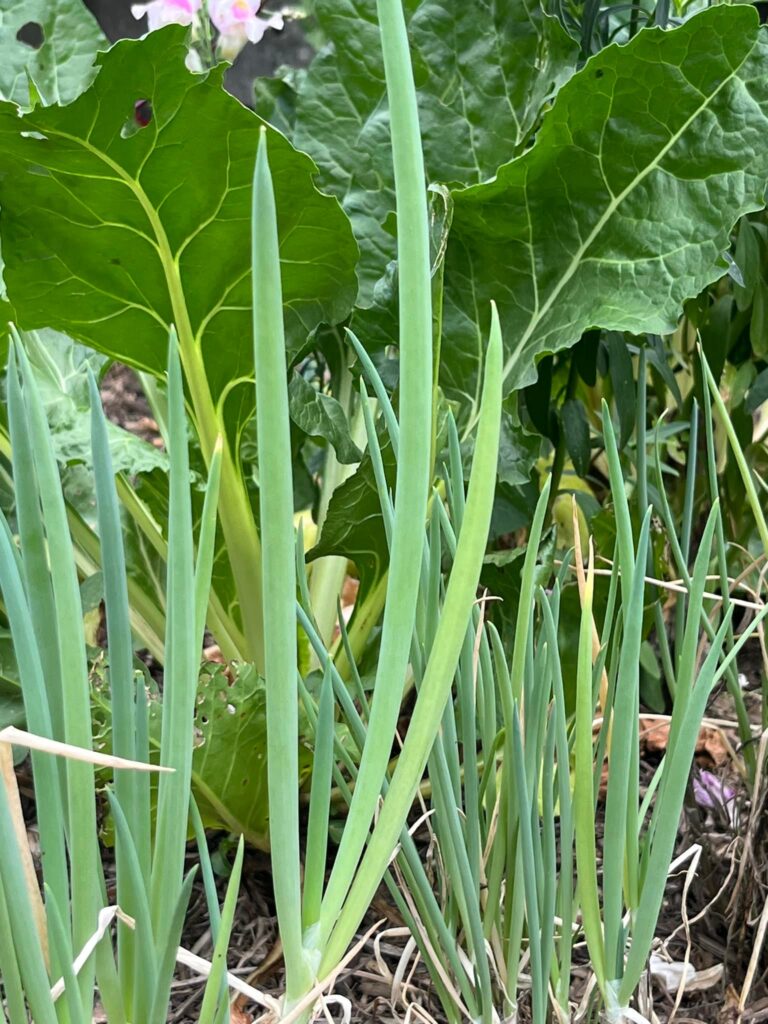
This is the most visibly active phase of the garlic season. The plants grow quickly, putting on height and producing new leaves every week or two.
Here is a detail worth understanding: each leaf that the garlic plant produces corresponds to one wrapper layer around the developing bulb. More leaves mean more wrapper layers — and that means better protection for the bulb in storage. This is why strong, healthy leaf growth in spring directly translates to a better harvest in summer.
A healthy garlic plant in mid-spring should be producing tall, upright, deep-green leaves. Yellowing lower leaves, stunted growth, or pale colouration are signs that the plant may need more nutrients — usually nitrogen — or that it is experiencing waterlogging or disease.
Keep the bed consistently moist during this period, providing about 2.5 cm (1 inch) of water per week either through rainfall or supplemental irrigation. Continue pulling or suppressing any weeds, which will compete aggressively with the garlic during this critical growth window.
Late Spring: Scapes Appear (May – June, Hardneck Varieties Only)
If you are growing hardneck garlic, one of the season’s most distinctive events occurs in late spring: the scape emerges.
A scape is the flower stalk of the garlic plant. It grows from the centre of the plant and curls upward in a graceful spiral before beginning to straighten. Left on the plant, it will eventually flower and set seed — a process that draws significant energy away from bulb development.
Remove the scape by snapping or cutting it off once it has made one full curl. This simple act redirects the plant’s energy into bulb swelling, which can increase the final bulb weight by ten to thirty percent compared to plants whose scapes are left intact.
Do not discard the scapes. They are genuinely delicious — mild, fresh, and versatile in the kitchen. Sauté them in butter, blend them into pesto, or grill them lightly with a drizzle of olive oil. They are one of the quiet rewards of growing hardneck garlic, available only for a brief window in early summer.
Softneck varieties do not produce scapes. Their bulb development in late spring is less dramatic but equally important, continuing to swell quietly beneath the soil surface.
Early Summer: Bulb Swelling and Final Development (June – July)
This is when the garlic bulb does the bulk of its work. Having built a full canopy of leaves in spring, the plant now redirects its photosynthetic output downward into the developing bulb.
The cloves that will eventually become your harvest are forming and expanding during this period. You will not see this process — it is entirely underground — but you can support it by ensuring the plants have adequate potassium (which supports bulb development), consistent but not excessive moisture, and no competition from weeds.
Reduce or stop nitrogen fertilisation at this stage. Excess nitrogen in summer encourages leaf growth at the expense of bulb formation, which is precisely the opposite of what you want in the final weeks before harvest.
If the weather is dry, continue watering until about two to three weeks before your expected harvest date. Then stop. Dry soil in the final weeks firms up the bulb, tightens the wrapper layers, and significantly improves storage quality.
Mid to Late Summer: Harvest (July – August)
The moment the garden has been building toward for seven to nine months finally arrives.
The signal for harvest is the condition of the leaves, not a calendar date. When approximately half of the leaves have turned yellow and begun to dry while the other half remain green and upright, the garlic is ready to harvest.
This usually occurs in July in most of the United Kingdom and northern Europe, and in June or July across much of North America, though southern states may harvest earlier and northern states or Canada may harvest in August.
Do not wait until all the leaves are brown. At that point, the wrapper layers around the bulb will have deteriorated, leaving the cloves poorly protected and difficult to cure for storage.
Use a garden fork to loosen the soil alongside each plant before lifting it free. Handle the bulbs gently — necks that are bruised or broken will not store as long as undamaged ones.
How Long Does Garlic Take to Grow from a Clove? — Variety Matters
The seven-to-nine-month estimate applies broadly, but variety plays a significant role in refining that window.
Softneck Varieties: 7–8 Months
Softneck garlic tends to mature slightly faster than hardneck types. Artichoke softnecks, one of the most widely grown types worldwide, typically reach harvest in seven to eight months from autumn planting. They are also more tolerant of warmer winters, which makes them slightly more predictable in mild climates.
Softneck varieties are the type most commonly found in supermarkets — chosen partly for their fast maturation and exceptionally long storage life, which can reach twelve months in ideal conditions.
Hardneck Varieties: 8–9 Months
Hardneck garlic generally takes a week or two longer to reach full maturity. Rocambole and Porcelain types, two popular hardneck families, often reach harvest in late July to early August in most northern temperate climates.
The extra time is worth it for many growers. Hardneck garlic typically produces larger individual cloves with more complex flavour, and the scape — available uniquely from hardneck plants — is a bonus harvest in its own right.
Elephant Garlic: 9–10 Months
Elephant garlic (Allium ampeloprasum), technically a leek relative rather than true garlic, takes the longest of the commonly grown types — typically nine to ten months from planting to harvest. Its exceptionally large bulbs require more time to develop fully.
The flavour is noticeably milder than either softneck or hardneck true garlic, which suits some culinary applications very well.
Can You Grow Garlic Faster? Spring Planting and Shortcuts
A common question from impatient gardeners is whether garlic can be planted in spring for a faster summer harvest.
The answer is yes, but with significant caveats.
Spring-planted garlic skips the vernalisation period, which means it is very likely to produce “rounds” — single, undivided bulbs without separate cloves — rather than the full multi-cloved heads most people want. The bulbs are also typically much smaller.
Some gardeners deliberately plant a portion of their garlic in spring specifically to harvest these rounds as “spring garlic” or “green garlic” — pulling the whole plant while the leaves are still green for a fresh, mild garlic flavour in cooking.
This is a legitimate and useful crop in its own right. But if a full, divided, storable bulb is your goal, autumn planting remains the only reliable approach in most climates.
That said, gardeners in certain climates — particularly those with very mild, frost-free winters — can sometimes plant in late autumn or early winter and achieve reasonable bulb formation without the deep cold that hardneck varieties require.
Local agricultural extension services are the best source of climate-specific guidance.
Factors That Affect How Long Garlic Takes to Grow
Beyond variety, several other factors can shorten or lengthen the growing timeline.
Soil Quality
Garlic grown in poor, compacted, or nutrient-depleted soil grows more slowly and produces smaller bulbs. Well-prepared, fertile, well-draining soil consistently produces earlier and more abundant harvests. Investing in soil preparation before planting pays measurable dividends at harvest time.
Climate and Weather
An unusually warm winter can reduce vernalisation and delay or impair bulb formation. A late cold snap in spring can set back shoot emergence by several weeks. A warm, dry early summer can accelerate bulb swelling and bring the harvest forward.
Weather variability is the main reason harvest timing can shift by two to four weeks from one year to the next, even on the same plot with the same variety.
Planting Depth and Spacing
Cloves planted too shallowly are more vulnerable to frost heave and temperature fluctuation, which can delay or disrupt development. The recommended depth of 5–7 cm (2–3 inches) provides the right balance of insulation and soil warmth to support consistent growth.
Overcrowded plants compete for nutrients and moisture, which can extend the time needed to reach full maturity or reduce final bulb size.
Watering Consistency
Both underwatering and overwatering slow garlic growth. Drought stress in spring causes stunted leaf development; waterlogged roots rot. Consistent, moderate moisture — particularly during the active leaf growth phase in spring — is strongly correlated with faster, fuller bulb development.
What Happens If You Harvest Too Early or Too Late?
Getting harvest timing right matters more than many new growers realise.
Harvesting too early means the cloves have not reached their full size. The wrapper layers are still wet and fragile. The bulb will not store well and may begin to dry out or develop off-flavours within a few weeks.
Harvesting too late means the wrapper layers have broken down. The bulb may begin to separate or the cloves may push through the outer skin. Stored bulbs from a late harvest are prone to mould and premature drying.
The ideal harvest window — when half the leaves are brown — is often only one to two weeks wide. Checking your plants every few days once you expect harvest to be approaching is a worthwhile habit. Mark the planting date in a notebook and count forward, but always let the plant, not the calendar, have the final say.
After Harvest: Curing Time Adds to the Total Timeline
The growing period does not technically end at harvest. For the garlic to be ready for kitchen use and long-term storage, it must be properly cured.
Curing typically takes three to eight weeks, depending on humidity, airflow, and the variety. During this period, the outer skin dries and hardens, the neck seals, and the moisture content of the inner cloves stabilises.
If you factor curing into the full timeline, garlic is not truly “finished” until roughly eight to eleven months after planting — one of the longest cycles of any common vegetable crop.
That sounds like a long commitment. In practice, though, most of that time requires very little from the grower. The bulk of the work is done by the plant, the seasons, and the soil.
A Final Word on Patience
Seven to nine months is a long time to wait for a harvest. I will not pretend otherwise. But garlic growers often describe a particular kind of satisfaction that comes with the long cycle — the way autumn planting connects to spring emergence connects to summer harvest in a continuous seasonal rhythm.
There is nothing quite like pulling your first bulb of the season, brushing off the soil, and knowing that the clove you planted in October has become this. It is a transformation that shorter-season crops rarely match in terms of the sense of achievement it produces.
Plant in autumn. Tend through winter and spring. Harvest in summer. Cure in the shade. The timeline is long, but every stage has its own small rewards.
References
- University of California Cooperative Extension – Garlic Production in California https://anrcatalog.ucanr.edu/pdf/7231.pdf
- Cornell University College of Agriculture and Life Sciences – Garlic Production Guide https://gardening.cornell.edu/homegardening/scene819d.html
- Penn State Extension – Growing Garlic in the Home Garden https://extension.psu.edu/growing-garlic-in-the-home-garden
- University of Minnesota Extension – Garlic https://extension.umn.edu/vegetables/garlic
- Washington State University Extension – Garlic in the Home Garden
Understanding how long garlic takes to grow is the first step toward planning your garden around it — and once you do, you will find it is one of the most dependable, rewarding crops the growing year has to offer.

Tim M Dave is a gardening expert with a passion for houseplants, particularly cacti and succulents. With a degree in plant biology from the University of California, Berkeley, he has vast experience in gardening. Over the years, he has cultivated a vast collection of desert plants and learned a great deal about how to grow and care for these unique companions.