Understanding Himalayan Birch (Betula utilis var. jacquemontii): Identification, Uses, Problems, and Cultivation Details
There is a particular quality of light in a winter garden that only one tree can create. It happens when low January sun hits the bark of a Himalayan birch and the whole tree seems to radiate rather than simply reflect.
I have seen it in gardens from Yorkshire to Vancouver, and the effect is always the same: people stop walking and simply stare.
That tree is Betula utilis var. jacquemontii, the West Himalayan birch or Jacquemont’s birch. And if you have never grown one, read on. This might be the most rewarding tree you ever plant.
But before we dive in, lets quickly get to know what Himalayan Birch is all about:
| Scientific name | Betula utilis var. jacquemontii |
| Common names | Himalayan birch, Jacquemont’s birch, West Himalayan birch |
| Family | Betulaceae |
| Native range | Western Himalayas (India, Nepal, Pakistan, Afghanistan) |
| Native altitude | 3,000–4,500 metres above sea level |
| Hardiness zones | USDA Zones 5–7 |
| Mature height | 8–18 metres (in cultivation typically 8–12 m) |
| Bark | Brilliant pure white, peeling in papery strips |
| Leaf colour (autumn) | Warm golden yellow |
| Sun requirement | Full sun (minimum 6 hours daily) |
| Soil preference | Well-drained, slightly acidic to neutral |
| Best cultivars | ‘Grayswood Ghost’, ‘Doorenbos’, ‘Silver Shadow’ |
| Lifespan | 60–100 years in cultivation |
| Wildlife value | Moderate in cultivation; high in native range |
| Cultural significance | Sacred writing material (bhojpatra) in ancient South Asia |
What Is the Himalayan Birch?
The Himalayan birch (Betula utilis) is a species of birch native to the mountain forests of the Himalayas and Hindu Kush. Within this species, the variety jacquemontii is the form most widely cultivated in gardens across the world.
The tree is named after the French botanist Victor Jacquemont, who studied the flora of the Indian subcontinent in the 1830s
What sets jacquemontii apart from the broader Betula utilis species is the extraordinary whiteness of its bark. jacquemontii consistently produces the brightest, most gleaming white bark of any birch in cultivation — and arguably of any tree, anywhere.
It is deciduous, medium-sized, and remarkably adaptable to garden and landscape conditions well outside its native Himalayan range. This combination of spectacular ornamental value and practical garden reliability has made it one of the most sought-after ornamental trees in the world.
Scientific Classification
| Kingdom | Plantae |
| Order | Fagales |
| Family | Betulaceae |
| Genus | Betula |
| Species | Betula utilis D.Don |
| Variety | jacquemontii (Spach) H.J.P.Winkl. |
| Common names | Himalayan birch, West Himalayan birch, Jacquemont’s birch, white-barked Himalayan birch |
The species name utilis means “useful” in Latin — a reference to the many traditional uses the tree has supported across the Himalayan region for centuries.
Geographic Range and Natural Habitat
Native Range
Betula utilis var. jacquemontii is native to the western Himalayan region, primarily found in:
- Northern India, particularly the states of Himachal Pradesh, Uttarakhand, and Jammu & Kashmir
- Nepal, in the high-altitude forests of the western and central zones
- Pakistan, across the forests of Khyber Pakhtunkhwa and Gilgit-Baltistan
- Afghanistan, in the mountain forests of the northeastern Hindu Kush
- Parts of western China bordering the Himalayas
Within these regions, it occupies a very specific ecological niche: the subalpine forest zone, growing at altitudes between 3,000 and 4,500 metres above sea level. This places it well above most other broadleaf trees and just below the permanent snowline.
At these elevations, the climate is harsh and seasonal — cold, snowy winters; short, cool summers; high UV radiation; and rocky, thin soils. The tree’s extraordinary adaptation to these conditions explains much of its toughness in cultivation.
Landscape and Forest Context
In its native habitat, Himalayan birch grows in open, airy subalpine forests alongside species such as silver fir (Abies spectabilis), blue pine (Pinus wallichiana), and various rhododendron species.
It is often the dominant tree at the upper edge of the treeline, where conditions become too extreme for most other woody plants.
These birch-rhododendron forests are among the most visually dramatic ecosystems in the world — white-barked trees rising against steep rocky slopes, snowfields, and the immense peaks of the Himalayan range.
The tree’s white bark serves a functional purpose at altitude: it reflects intense UV and infrared radiation, protecting the photosynthetic tissues beneath from thermal damage during bright winter days.
Physical Description and Identifying Features
Bark — The Defining Feature
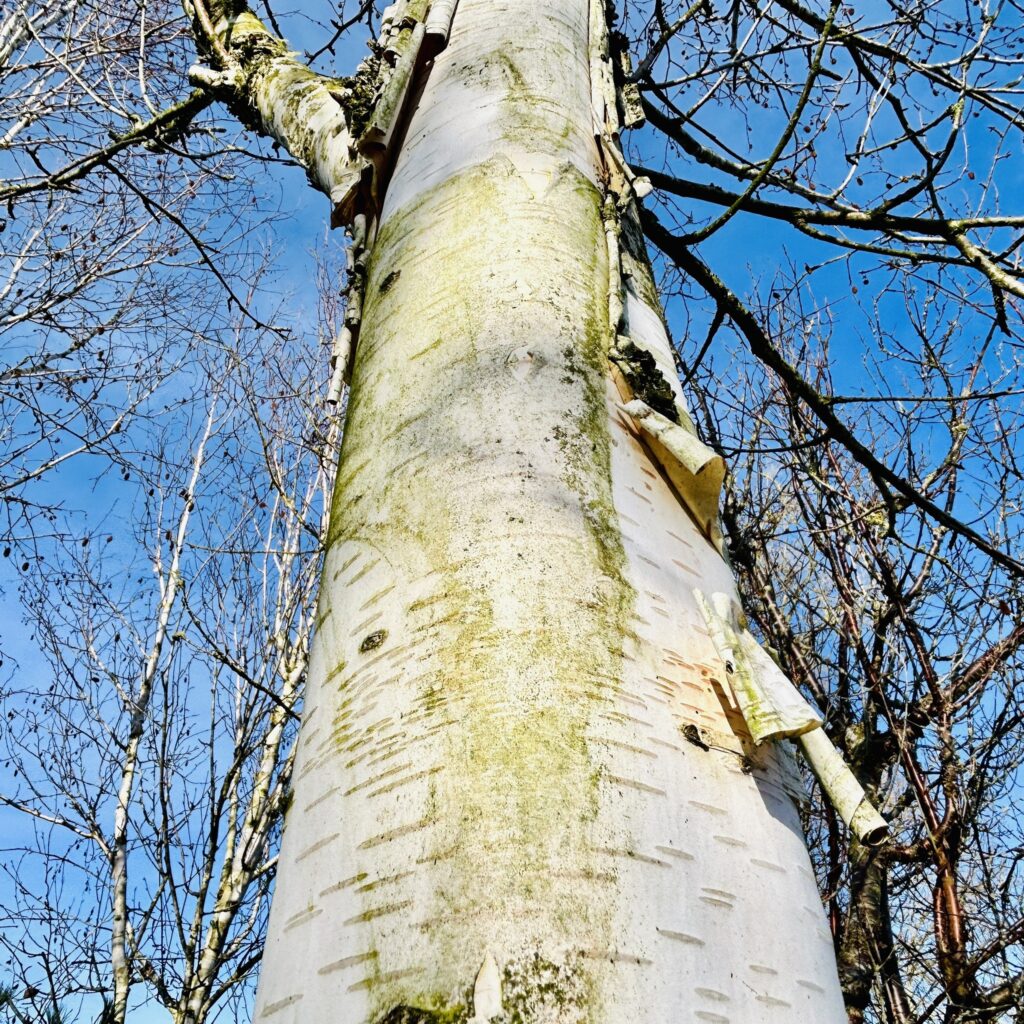
The bark of Betula utilis var. jacquemontii is, without question, one of the most visually striking features of any tree in the temperate world. It is pure white to chalky white, smooth, and peels in thin, papery horizontal strips much like the American paper birch, but typically whiter and more brilliant.
The peeling is natural and should not be disturbed. As it peels, it reveals fresh white bark beneath. The surface is marked with pale grey horizontal lenticels, giving the trunk a subtle texture.
The contrast between the white trunk and dark, fissured bark near the base of older trees adds further visual interest.
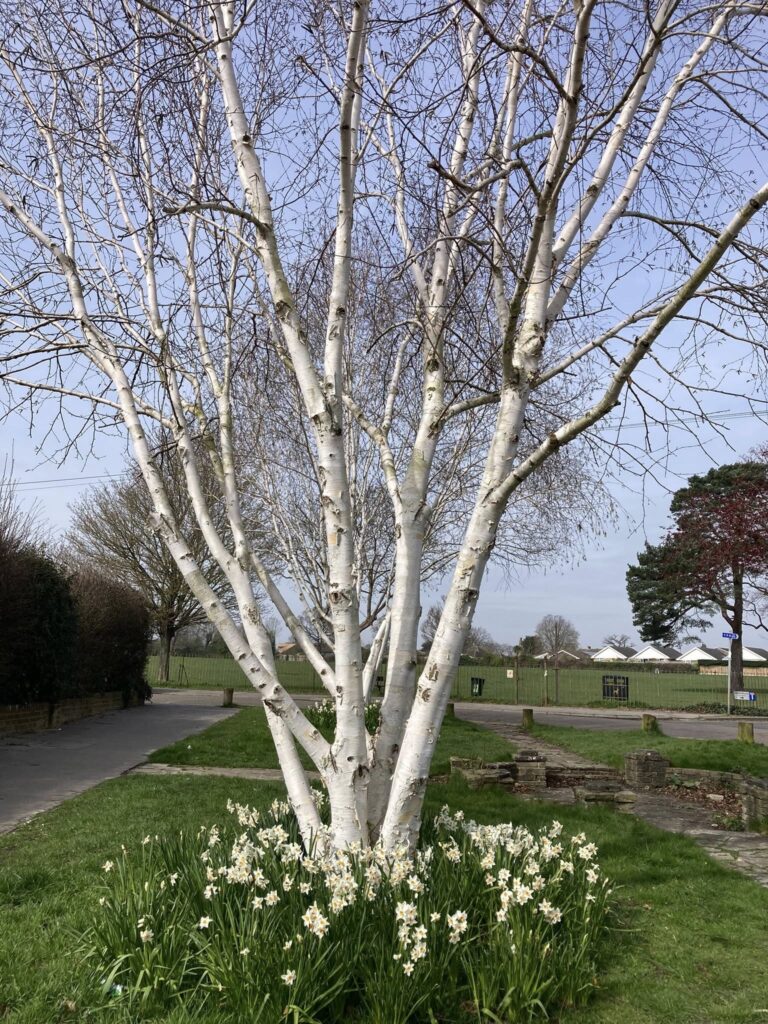
In multi-stem forms — three or more trunks emerging from near the base — the visual impact is multiplied dramatically. A clump of three white trunks in a winter garden, lit by low sun, is genuinely breathtaking.
Leaves
The leaves are ovate to elliptic, measuring 5 to 10 cm long, with a pointed tip and finely doubly-serrated margins. They emerge in spring as a fresh lime-green, mature to mid-green through summer, and turn a warm, clear yellow in autumn.
The autumn colour is attractive rather than spectacular — it lacks the fiery reds of some maples — but the combination of golden leaves against white bark in October and November is a visual pairing of considerable elegance.
The underside of the leaf carries small tufts of hair in the vein axils, a minor but useful identification feature when comparing with related species.
Height and Form
In cultivation, jacquemontii typically reaches 8 to 12 metres, though in ideal conditions it may approach 18 metres. In its native Himalayan habitat, trees of 15 to 20 metres are not unusual.
The form is broadly conical when young, becoming more open and irregular with age, with a characteristic upright central leader and ascending secondary branches that may weep slightly at the tips. The overall silhouette is airy and graceful rather than dense.
Catkins and Seeds
Like all birches, jacquemontii is monoecious, carrying both male and female catkins on the same tree.
- Male catkins are long (4–6 cm), yellowish, and hang in clusters of two or three. They open in April, releasing pollen before or alongside the emerging leaves.
- Female catkins develop through summer into small, cylindrical strobiles, releasing hundreds of tiny winged seeds (samaras) in late summer and autumn.
Seed production is generous, and seedlings may appear around the base of the tree — though cultivated named varieties do not come true from seed.
Ecological Importance
In the Wild
In its native Himalayan range, Betula utilis plays a critical ecological role in subalpine forest ecosystems:
- It stabilises steep mountain slopes, preventing erosion in areas of heavy snowfall and spring melt
- It provides canopy cover for an understorey of rhododendrons, juniper, and alpine herbs
- It supports specialist high-altitude invertebrates adapted to subalpine birch forest
- It is an important nurse tree, facilitating regeneration of fir and other species beneath its light canopy
- Snow leopards, Himalayan black bears, musk deer, and red pandas all use birch forest habitat for shelter, movement, and foraging
The deforestation of Himalayan birch forests — driven by fuelwood collection, overgrazing, and land conversion — is a serious conservation concern in Nepal, India, and Pakistan, with consequences for watershed stability, biodiversity, and local communities.
In Cultivation
In temperate gardens across Europe and North America, jacquemontii provides genuine ecological value despite being outside its native range:
- The leaves support moth and butterfly larvae, including several polyphagous species common to British and European birch woodlands
- Catkins provide early pollen for bees and other emerging spring insects
- The seeds feed finches and tits through winter
- The bark and dead wood support specialist fungi, beetles, and other invertebrates as the tree ages
It is worth noting that native birch species will always provide greater local wildlife value than introduced varieties. However, jacquemontii is far from ecologically sterile, and its ornamental virtues are unmatched by any native species in cool-temperate gardens.
Cultural and Historical Significance
Sacred and Practical Uses in the Himalayas
For the peoples of the Himalayan region — including Tibetan, Nepali, Kashmiri, and Pahari communities — the birch tree (bhojpatra in Sanskrit and Hindi; bhurja in many local languages) has been central to daily life for thousands of years.
- Bhojpatra (birch bark) was one of the primary writing materials of ancient South Asia. Buddhist scriptures, Sanskrit manuscripts, and royal documents were written on thin sheets of peeled birch bark, some of which have survived for over 2,000 years. Collections of these manuscripts are held in institutions including the Bodleian Library in Oxford and the Schoyen Collection in Norway.
- The bark was also used to make waterproof roofing material for mountain huts and shelters — laid in overlapping sheets and weighted with stones, it created effective insulation against Himalayan winters.
- Birch wood was used as fuel and for making agricultural tools, household utensils, and temporary structures.
- In Ayurvedic medicine, various parts of the tree were used to treat skin conditions, fevers, and inflammatory disorders. Birch bark extracts containing betulin and betulinic acid have attracted significant scientific attention for their potential pharmacological properties.
The Name — Victor Jacquemont
The variety name jacquemontii honours Victor Jacquemont (1801–1832), a French botanist and naturalist who travelled extensively across India, Kashmir, and the Himalayas in the service of the Natural History Museum in Paris.
His botanical collections from this journey were enormously valuable to European plant science, and the naming of this birch variety after him is a fitting tribute to his work in the region.
Jacquemont died of illness in Bombay (now Mumbai) at just 31 years old — a reminder of the extraordinary personal sacrifice that botanical exploration often demanded in the 19th century.
Growing Conditions and Garden Use
Climate and Hardiness
Betula utilis var. jacquemontii is fully cold-hardy across most of northern Europe and North America. It performs well in USDA Hardiness Zones 5 to 7 and the equivalent European hardiness zones, tolerating winter temperatures of -20°C or lower without damage.
Notably, it is more tolerant of moderate heat and drier conditions than the American paper birch or the European silver birch — a reflection of its adaptation to the seasonal extremes of the Himalayan climate.
This makes it a better choice for gardens in warmer parts of the UK, Central Europe, and the Pacific Northwest of North America where paper birch may struggle.
It is also more resistant to the bronze birch borer than European silver birch, making it a safer ornamental choice in North American gardens where this pest is present.
Soil Requirements
- pH: Tolerates pH 5.0 to 7.0; performs best in slightly acidic to neutral soils
- Texture: Thrives in well-drained, loamy, or sandy soils; tolerates stony, thin ground
- Drainage: Prefers good drainage; dislikes prolonged waterlogging
- Fertility: Does not require rich soil — in fact, overly fertile, nitrogen-rich soils encourage lush growth at the expense of bark whiteness
Sunlight
Full sun is essential. A minimum of 6 hours of direct sunlight daily is required for healthy growth and, crucially, for the bark to develop and maintain its characteristic maximum whiteness. Trees grown in shade develop greener, less striking bark.
Planting Recommendations
- Best planting time: Autumn or early spring for bare-root specimens; any time for container-grown trees
- Positioning: Plant where the white bark can be appreciated in winter light — against a dark background (yew hedge, fence, or evergreen shrubs) maximises the visual contrast dramatically
- Multi-stem forms: For maximum ornamental impact, choose a multi-stem specimen with three or more trunks
- Spacing: Allow 5 to 8 metres between trees in naturalistic plantings; 3 to 4 metres for ornamental groupings
- Mulching: Apply a 5–10 cm organic mulch around the base to retain moisture, regulate temperature, and suppress competing vegetation — keep mulch clear of the trunk
- Avoid: Planting near drains, paths, or building foundations; avoid waterlogged or heavily compacted sites
Garden Design Applications
Jacquemontii is one of the most versatile ornamental trees available to gardeners in temperate climates. Its applications include:
- Specimen tree: A single multi-stem clump placed on a lawn or in a border creates a dramatic focal point in all seasons
- Winter garden plantings: Combined with red- and yellow-stemmed Cornus, coloured-bark willows, and evergreen ground cover, birch forms the centrepiece of a spectacular winter display
- Naturalistic woodland planting: Used alongside native understorey shrubs to create semi-wild woodland edges
- Formal and contemporary gardens: The clean white trunks work equally well in minimalist and modernist garden designs — particularly effective when planted in rows or groves against clipped hedging or architectural structures
- Seasonal rhythm: Few trees provide such a clear, satisfying seasonal progression — spring catkins, summer foliage, autumn gold, and winter bark — making it a true four-season tree
Named Cultivars Worth Knowing
Several selected clones of Betula utilis var. jacquemontii are available in the nursery trade, each chosen for particular qualities of bark, form, or size:
- ‘Doorenbos’: One of the oldest and most widely grown clones. Exceptionally white bark, good form, and reliable performance. Named after S.G.A. Doorenbos, the Dutch city horticulturalist who selected it.
- ‘Grayswood Ghost’: Widely considered to have the whitest bark of any cultivar — a luminous, almost supernatural white that becomes even more striking as the tree matures. Highly sought-after by gardeners and plantspeople.
- ‘Silver Shadow’: A vigorous clone with large, handsome dark-green leaves and outstanding bark whiteness. Selected for its strong, single-stem growth habit.
- ‘Jermyns’: A form with particularly large leaves and good autumn colour, selected at the Sir Harold Hillier Gardens in Hampshire, UK.
- ‘Snow Queen’: A newer selection with consistently excellent bark and a tidy, upright form suitable for smaller gardens.
When purchasing, always buy named clones from reputable nurseries. Seed-grown plants sold simply as Betula utilis jacquemontii can be highly variable in bark colour and may not achieve the brilliant white of selected cultivars.
Common Pests and Diseases
Bronze Birch Borer (Agrilus anxius)
In North America, this is the primary pest concern for birch trees. Himalayan birch shows greater resistance than European silver birch, but is not entirely immune, particularly when trees are stressed by drought or heat. Good cultural care — adequate moisture, correct siting, and avoiding injury to roots and bark — is the best prevention.
Aphids
Birch aphids (Euceraphis spp.) may colonise the undersides of leaves in summer. As discussed in our earlier birch profiles, they are rarely harmful to a healthy, established tree and are an important food source for beneficial insects. Avoid blanket insecticide use, which disrupts this ecological relationship.
Leaf Rust and Fungal Spots
Melampsoridium betulinum (birch rust) can cause orange, powdery patches on leaves in humid summers. It is cosmetically unpleasant but rarely serious for a well-established tree. Good airflow around the canopy reduces risk.
Root Problems
Like all birches, jacquemontii is sensitive to waterlogged or compacted soils, which restrict root oxygen and can lead to decline. In urban environments, protection of the root zone from compaction during construction is critical for tree survival.
Conservation and the Importance of Native Himalayan Forests
While jacquemontii is thriving in gardens worldwide, its native Himalayan forests face real pressure.
In the states of Uttarakhand and Himachal Pradesh in India, birch forests at high altitude have been significantly reduced by fuelwood collection, livestock grazing, and encroachment. In Nepal, unsustainable harvesting of birch bark for traditional uses has depleted populations in accessible areas.
Climate change is an additional and growing threat. Rising temperatures are causing the treeline to shift upward, compressing the subalpine zone in which Betula utilis thrives. Models suggest that continued warming could reduce viable birch habitat significantly across the western Himalayas by the end of this century.
Organisations including the Wildlife Institute of India, the International Centre for Integrated Mountain Development (ICIMOD), and various NGOs operating in Nepal and Pakistan are working to document, protect, and restore high-altitude birch forests.
The intrinsic value of these forests — for watershed protection, soil stability, biodiversity, and human livelihoods — cannot be overstated.
Final Thoughts
There are trees you plant for the birds and the bees. There are trees you plant for shade and shelter. And then there are trees you plant for sheer, unashamed beauty — the kind that makes a winter morning feel like a gift rather than an endurance.
The Himalayan birch is that tree.
It asks little of you: a sunny spot, decent drainage, enough space to breathe. In return, it gives you bark so white it stops people in their tracks, autumn colour that warms the late garden. So, if you plant only one ornamental tree in your lifetime, let it be this one.
References
- Royal Botanic Gardens Kew — Plants of the World Online: Betula utilis D.Don https://powo.science.kew.org/taxon/urn:lsid:ipni.org:names:314710-2
- Woodland Trust (UK) — Himalayan Birch: Betula utilis var. jacquemontii https://www.woodlandtrust.org.uk/trees-woods-and-wildlife/british-trees/a-z-of-british-trees/himalayan-birch/
- USDA Forest Service — Fire Effects Information System (FEIS): Betula Species Ecology https://www.fs.usda.gov/database/feis/plants/tree/betspp/all.html
- University of Oxford — Bodleian Library: Birch Bark Manuscripts Collection https://www.bodleian.ox.ac.uk/collections-and-resources/special-collections/south-asian
- International Centre for Integrated Mountain Development (ICIMOD) — Hindu Kush Himalaya Forest Ecosystems https://www.icimod.org/theme/mountain-environment/forests-and-ecosystem-services/

Tim M Dave is a gardening expert with a passion for houseplants, particularly cacti and succulents. With a degree in plant biology from the University of California, Berkeley, he has vast experience in gardening. Over the years, he has cultivated a vast collection of desert plants and learned a great deal about how to grow and care for these unique companions.