Understanding Halesia Carolina: History, Features, Care and Uses
There are trees that demand attention — loud, showy, impossible to ignore. And then there are trees like Halesia carolina. Quiet. Graceful. Modest in the best possible way. And yet, when it blooms in spring, draping itself in thousands of small white bell-shaped flowers, it turns heads.
I have seen grown adults pause mid-step to stare at a Carolina silverbell in full bloom. That says everything.
Halesia carolina — commonly known as the Carolina silverbell, the silverbell tree, or the snowdrop tree — is a native North American flowering tree that has been quietly earning admirers for centuries.
It is well-loved by botanists, native plant enthusiasts, and landscape designers who understand its value. Yet outside those circles, it remains surprisingly underused.
This guide covers everything you need to know about Halesia carolina: its identity, natural history, ornamental features, growing requirements, landscape uses, wildlife value, and how to care for it successfully.
What Is Halesia Carolina?
Halesia carolina is a deciduous flowering tree belonging to the family Styracaceae — the storax family. It is native to the southeastern United States, where it grows naturally in moist, wooded valleys, along stream banks, and on the slopes of the Appalachian Mountains.
The name Halesia honors Stephen Hales, an eighteenth-century English botanist and clergyman. The species name carolina refers to its native range in the Carolinas, though the tree grows across a much wider area.
In terms of taxonomy, there has been some scientific debate over the years. Some botanists treat Halesia carolina and Halesia tetraptera as the same species, with Halesia tetraptera being the accepted name in certain classifications. You may encounter both names in nursery catalogs and horticultural literature — for practical purposes, they refer to the same plant.
Common names include:
- Carolina silverbell
- Snowdrop tree
- Silverbell tree
- Wild olive (used historically in some regions, though unrelated to true olives)
It is a tree that carries its names well. The “silverbell” refers to the shape and color of the flowers. The “snowdrop tree” describes how the pendant white blooms resemble snowdrops hanging from the branches. Both names are accurate, and both are evocative.
Natural Range and Native Habitat
Halesia carolina is indigenous to a broad swath of the eastern and southeastern United States. Its native range extends from West Virginia and Virginia south through the Carolinas, Georgia, Tennessee, Alabama, and into parts of Florida and Texas.
In the wild, it grows most commonly in moist, shaded understory environments — beneath the canopy of larger hardwoods like oaks, hickories, tulip poplars, and beech trees. It thrives along stream banks, in rich woodland coves, and on the sheltered lower slopes of mountain ridges where moisture is consistent and soils are deep, acidic, and well-drained.
Understanding this native habitat is enormously useful when growing the tree in a garden. It tells you what conditions it naturally prefers: partial shade, consistent moisture, acidic soil, and protection from harsh winds and direct afternoon sun.
That said, Halesia carolina is more adaptable than its habitat preference might suggest. With good soil preparation and appropriate siting, it performs well in a range of garden conditions — including more open sunny locations, provided moisture is adequate.
Physical Description: What Does Halesia Carolina Look Like?
Size and Form
In the wild, Halesia carolina typically reaches 20 to 40 feet in height with a spread of 15 to 35 feet. In cultivated garden settings, it tends to be somewhat smaller — often 15 to 25 feet tall at maturity — depending on growing conditions and available space.
Its natural form is multi-stemmed or low-branched, forming a graceful, rounded to broadly oval canopy. Some specimens develop a more tree-like single trunk with age, while others remain shrubby and multi-stemmed at the base.
The branching pattern is attractively layered and horizontal, giving the tree a tiered, architectural quality similar to dogwood — another spring-blooming native it pairs beautifully with in the landscape.
Bark
The bark of Halesia carolina is one of its underappreciated features. On young trees, it is smooth and light grayish-brown. As the tree matures, the bark becomes scaly and furrowed in interlocking ridges, developing a rugged, handsome texture that provides winter interest when the tree is leafless.
Leaves
The leaves are simple, alternate, and elliptical to ovate — roughly 3 to 5 inches long with a finely toothed margin and a pointed tip. They emerge with the flowers in spring, unfurling in a soft, fresh green that deepens through summer.
Fall color is not the tree’s strong suit — the leaves typically turn pale yellow before dropping, which is pleasant but not dramatic. The tree’s seasonal value comes from spring, not autumn.
Flowers
This is where Halesia carolina truly shines. The flowers appear in April and May, just as the leaves are beginning to emerge — or sometimes slightly before leaf-out, which maximizes their visibility.
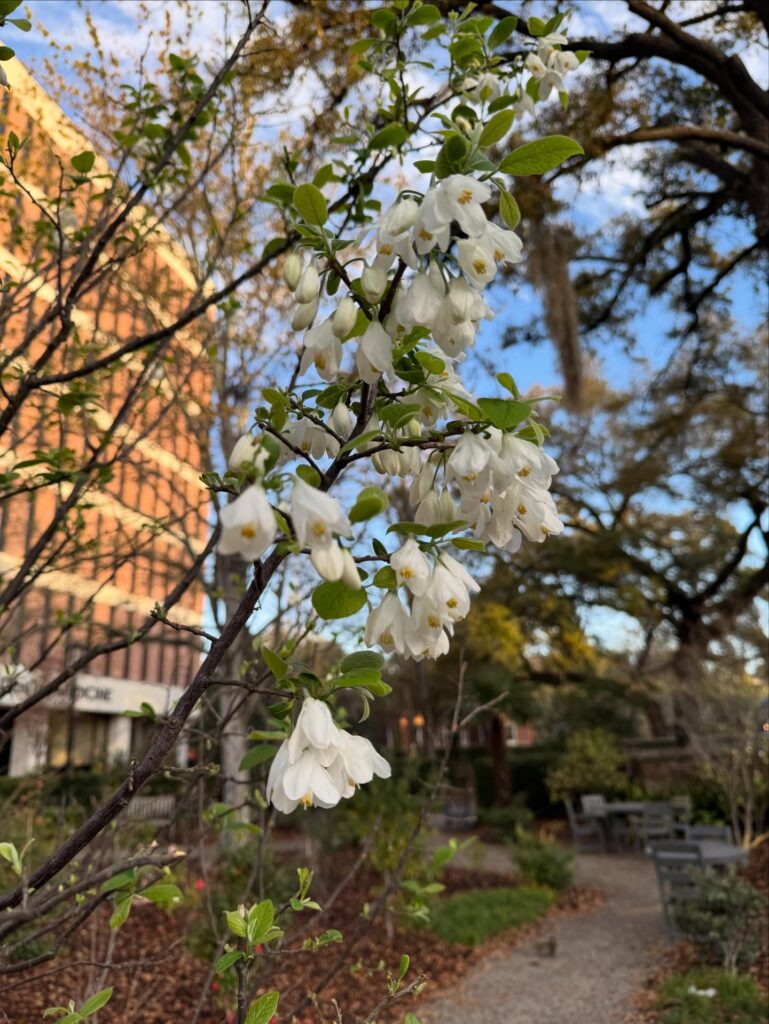
Each flower is small, nodding, and bell-shaped, with four white petals fused at the base into a tube approximately 3/4 to 1 inch long. They hang in clusters of two to five along the previous year’s branches, so the entire tree appears draped in pendulous white bells.
The visual effect is ethereal. Against a backdrop of spring sky or spring greenery, a silverbell in full bloom is genuinely one of the most beautiful sights in the native plant world.
The flowers have a faint, pleasant fragrance — not overwhelming, but noticeable up close.
Some cultivated varieties produce flowers with a pale pink blush, adding additional color variation to the standard white form.
Fruit
After flowering, Halesia carolina produces distinctive four-winged, dry fruits — called samaras — that ripen from green to tan through summer and fall. Each fruit is roughly 1 to 2 inches long with four prominent longitudinal wings.
The fruits are ornamentally interesting when they are green and plentiful in summer, and they persist into winter on some trees, providing minor seasonal interest. They also serve as a valuable food source for wildlife, particularly squirrels and small birds that feed on the seed inside.
Growing Requirements
Hardiness and Climate
Halesia carolina is hardy in USDA Zones 4 through 8, making it suitable for a broad range of climates — from the upper Midwest and New England south to the Gulf Coast regions. This wide hardiness range is one of its great strengths as a landscape tree.
In Zone 4 and colder parts of Zone 5, some tip dieback may occur in severe winters, but the tree typically recovers without lasting harm.
In Zones 9 and above, heat and drought stress become limiting factors, and the tree generally performs poorly outside its natural range.
Sunlight
Halesia carolina performs best in partial shade to full sun. In its native woodland habitat, it grows under light to moderate canopy shade, which is why it tolerates — and even prefers — filtered light.
In garden settings, it grows and blooms well in both partial shade and full sun, provided moisture is adequate. In hotter climates (Zone 7 and above), afternoon shade is beneficial — it reduces heat stress and prevents leaf scorch during summer.
In northern gardens where summer heat is less intense, full sun is perfectly acceptable and can produce a more compact, floriferous form.
Soil
This is perhaps the most important factor for success. Halesia carolina performs best in moist, humus-rich, well-drained soils with an acidic to slightly acidic pH — ideally between 4.5 and 6.5.
It performs poorly in alkaline soils, heavy clay with poor drainage, or dry, compacted conditions. These are the conditions that cause the most common cultural problems with this tree.
Ideal soil characteristics:
- Loose, well-drained loam or sandy loam
- High organic matter content
- Consistent moisture — never waterlogged, but never completely dry
- Acidic pH (4.5 to 6.5)
When planting in average garden soil, amending the backfill with compost, peat moss, or pine bark fines significantly improves establishment and long-term health.
Watering
Consistent moisture is important, particularly during the first two to three years while the tree is establishing its root system. Established trees are moderately drought tolerant — more so than their woodland habitat might suggest — but they grow faster and look better with regular water during dry periods.
Water deeply and infrequently rather than shallowly and often. Deep watering encourages deep root development, which improves long-term drought tolerance.
Apply a generous layer of organic mulch to retain soil moisture, moderate soil temperature, and gradually acidify the soil as it decomposes.
Fertilization
Halesia carolina does not require heavy fertilization. In good, organically rich soil, it may need no supplemental feeding at all.
If growth is slow or foliage is pale, apply a balanced slow-release fertilizer formulated for acid-loving plants (such as those designed for azaleas, camellias, or rhododendrons) in early spring. Avoid high-nitrogen formulas that push weak, pest-attracting growth at the expense of root development.
Landscape Uses
As a Specimen Tree
Halesia carolina makes an outstanding specimen planting in any garden large enough to accommodate its mature size. Give it space to develop its full natural form — a wide, layered canopy — and it will be a focal point for every spring of its life.
It is particularly striking when planted where it can be viewed at eye level or slightly below — at the edge of a slope, above a retaining wall, or beside a path where the hanging flowers can be admired up close.
In Naturalistic and Woodland Gardens
This is arguably where Halesia carolina is most at home. In a woodland garden or naturalistic planting, it occupies the role it plays in the wild: a beautiful mid-story tree beneath larger canopy trees, providing spring color, summer shade, and wildlife habitat.
It associates beautifully with other native woodland plants: rhododendrons, mountain laurel, trilliums, wild ginger, ferns, and Virginia bluebells beneath it; dogwoods, serviceberries, and redbuds around it at the same canopy level.
Along Water Features
Given its preference for moist soils, Halesia carolina is an excellent choice for planting along streams, ponds, or other water features. Reflected in still water, a silverbell in bloom is an unforgettable garden moment.
As a Multi-Stem Shrub Form
In smaller gardens where a full-sized tree is not appropriate, Halesia carolina can be grown or selected in a multi-stemmed shrub form that tops out at 12 to 15 feet. This is a highly useful size for foundation areas, property corners, and mixed shrub borders.
Street and Urban Planting
While not typically used as a street tree, Halesia carolina has potential in urban and suburban landscapes in sites with adequate moisture and appropriate soil conditions. Its moderate size, clean habit, and native wildlife value make it worth considering in urban forestry programs in suitable climates.
Wildlife Value
Halesia carolina is an excellent native plant for wildlife support — a quality that makes it increasingly valuable in an era of habitat loss.
Pollinators visit the flowers extensively in spring. Bumblebees are among the most enthusiastic visitors, entering the bell-shaped flowers to reach nectar. The flowers also attract mining bees and other native bee species.
Birds and small mammals consume the seeds from the winged fruits in fall and winter. The tree’s structure provides nesting opportunities and shelter for a range of bird species.
As a native plant, Halesia carolina supports the specialized insects and ecological relationships that purely ornamental non-native trees cannot. Caterpillars of several moth and butterfly species feed on the foliage, which in turn supports nesting birds that depend on caterpillars as a protein source for their young.
Notable Cultivars
Several named cultivars offer specific improvements in size, flower character, or adaptability:
- ‘Arnold Pink’ — produces flowers flushed with pink rather than pure white; a particularly attractive form
- ‘Rosea’ — similar to ‘Arnold Pink’, with pink-tinged flowers
- ‘UConn Wedding Bells’ — a selection made for heavier flowering and a more compact habit; highly regarded by horticulturists
- ‘Wedding Bells’ — known for very large, showy white flowers in generous clusters; one of the most ornamentally impressive cultivars
When purchasing from a nursery, asking specifically for a flowering-age grafted or selected cultivar will ensure you get a plant with known ornamental characteristics rather than a seedling of variable quality.
Common Problems and How to Prevent Them
Halesia carolina is generally a low-maintenance, disease-resistant tree when grown in appropriate conditions. Most problems that occur trace back to cultural issues rather than serious pathogens or pests.
Leaf scorch: Brown leaf edges during summer heat typically indicate inadequate moisture or too much direct afternoon sun in hot climates. Improve irrigation and consider providing afternoon shade.
Chlorosis: Yellow leaves with green veins indicate iron deficiency, usually caused by soil pH that is too high. Test the soil and acidify if needed; apply chelated iron as a temporary correction.
Failure to bloom: Trees grown in too much shade or still establishing after transplanting may bloom poorly for the first few years. Patience is usually rewarded; improving light conditions helps where shade is excessive.
Root rot: Caused by planting in heavy, poorly drained soils or overwatering. Ensure good drainage before planting and avoid constantly saturated conditions.
Scale insects and borers: Occasional pests in stressed trees; a healthy, well-sited tree is rarely seriously affected. Monitor periodically and treat early if populations are building.
How Halesia Carolina Compares to Similar Trees
Compared to Flowering Dogwood (Cornus florida)
Both are native spring-blooming understory trees of similar size and habitat. Dogwood is more widely planted and has showier bracts (the white “petals” are actually modified leaves). Silverbell has more delicate, pendulous flowers and generally tolerates slightly more shade. They make excellent companion plantings, as they share habitat preferences and bloom at a similar time.
Compared to Serviceberry (Amelanchier species)
Serviceberries bloom slightly earlier and in a different color — white to blush pink. They produce edible berries, which silverbell does not. Both are excellent native choices for similar conditions.
Compared to Japanese Snowbell (Styrax japonicus)
Japanese snowbell is a non-native relative with very similar flower form — pendulous white bells in late spring. It is arguably more widely available in nurseries. Halesia carolina offers the advantage of being a native species that supports local wildlife and ecological relationships in North American gardens.
Planting Tips for Best Results
- Plant in fall or early spring — both are good planting times; fall planting allows root establishment before summer heat
- Dig a wide, shallow hole — three times the diameter of the root ball and no deeper than the root flare
- Keep the root flare at grade — never bury the trunk
- Mulch generously — a 3- to 4-inch layer of pine bark or wood chip mulch in a wide ring around the base conserves moisture and moderates temperature
- Water deeply after planting and maintain consistent moisture through the first two growing seasons
- Be patient with establishment — silverbell may grow slowly for the first year or two while building its root system; strong above-ground growth follows
Suggested For You:
10 Fragrant Trees with Sweet Scents to Elevate Your Landscape
15 Stunning Trees for Vibrant Fall Color: Your Guide to Autumn Beauty
Understanding Moonglow Sweetbay Magnolia: History, Features and Full Care Details
8 Common Little Gem Magnolia: Problems, Causes, and Solutions
Final Thoughts
Halesia carolina is, in my view, one of the most underrated native trees in North American horticulture. It has the flowers of a dream, the adaptability of a practical garden plant, and the ecological value of a tree that genuinely belongs in this landscape.
It asks for relatively little: reasonable soil, consistent moisture, and a spot where its spring display can be appreciated. In return, it gives you decades of bloom, seasonal interest across three seasons, and a garden ecosystem that supports bees, birds, and butterflies in ways that a non-native ornamental simply cannot.
If you have been looking for a native flowering tree that is beautiful, well-behaved, and genuinely good for the environment, the Carolina silverbell deserves serious consideration. Plant one, give it time, and it will become the tree you stop to look at every single spring.
References
- University of Florida IFAS Extension — Halesia tetraptera: Carolina Silverbell https://edis.ifas.ufl.edu/publication/ST286
- NC State Extension — Plants — Halesia carolina (Carolina Silverbell) https://plants.ces.ncsu.edu/plants/halesia-carolina/
- University of Kentucky Cooperative Extension — Native Trees for Kentucky Landscapes: Carolina Silverbell https://www.uky.edu/hort/Carolina-Silverbell
- Virginia Tech — College of Natural Resources and Environment — Halesia carolina: Silverbell Tree Fact Sheet https://dendro.cnre.vt.edu/dendrology/syllabus/factsheet.cfm?ID=89
- University of Connecticut Plant Database — Halesia tetraptera (Carolina Silverbell) https://hort.uconn.edu/detail.php?pid=164

Tim M Dave is a gardening expert with a passion for houseplants, particularly cacti and succulents. With a degree in plant biology from the University of California, Berkeley, he has vast experience in gardening. Over the years, he has cultivated a vast collection of desert plants and learned a great deal about how to grow and care for these unique companions.