Understanding Gardenia (Gardenia jasminoides): History, Features, Uses, Problems, and Full Cultivation Details
There are plants you admire from a distance. And then there is Gardenia. The moment this shrub blooms, it announces itself. The fragrance is rich, creamy, and almost overwhelmingly sweet — the kind of scent that stops a conversation mid-sentence and turns heads across a garden.
If you have ever walked past a flowering Gardenia on a warm evening and felt momentarily transported, you already understand why this plant has been treasured across cultures and centuries.
Gardenia jasminoides — commonly called Gardenia, Cape Jasmine, or simply “the white gardenia” — is one of the most beloved flowering shrubs in the world. It is a staple of Southern American gardens, a fixture in East Asian floral tradition, a key ingredient in the global perfume industry, and one of the most challenging — yet most rewarding — houseplants a person can grow.
This guide covers everything: taxonomy, physical description, native origins, growing requirements, common problems, cultivar selection, medicinal and cultural uses, and the secrets to keeping Gardenia healthy and flowering.
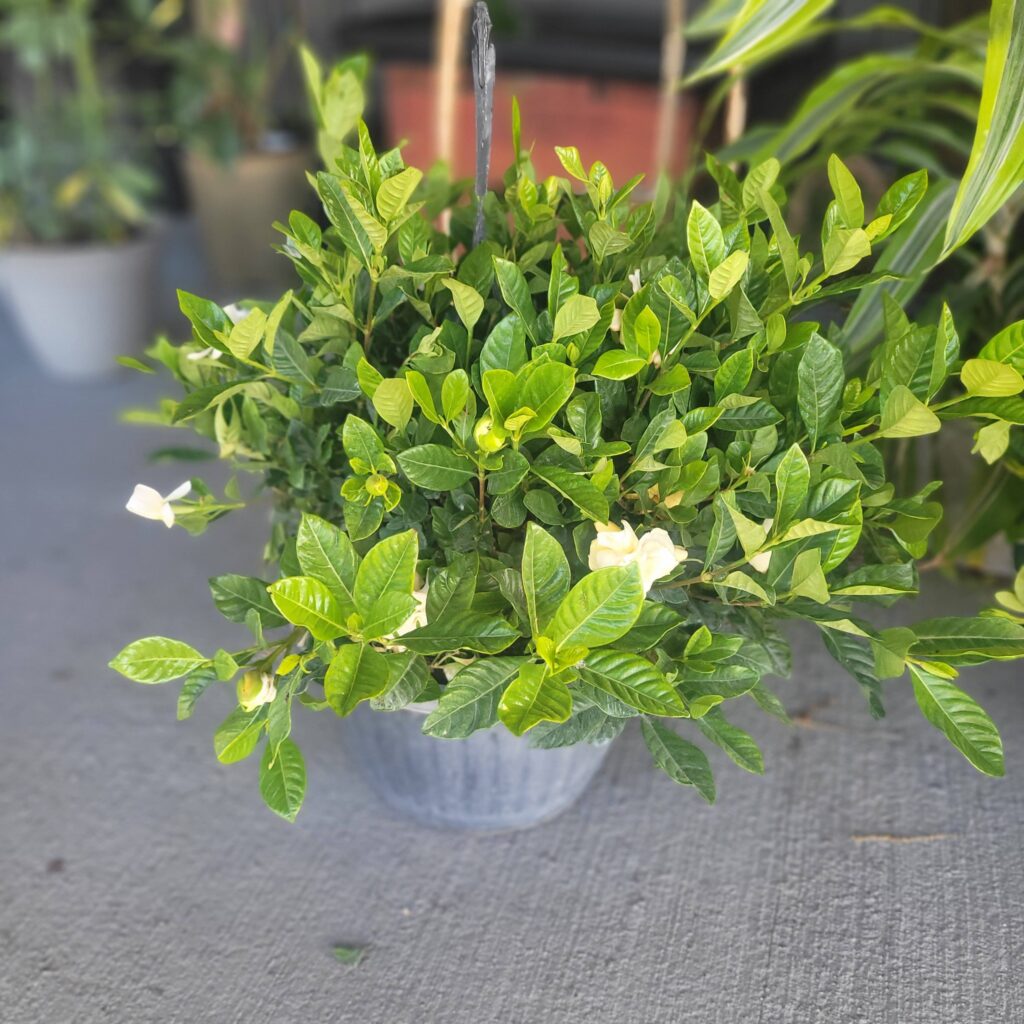
Taxonomy and Classification
Gardenia jasminoides belongs to the coffee family (Rubiaceae) — the same botanical family as coffee (Coffea spp.) and cinchona (the source of quinine). This relationship surprises most people, but the shared family traits become visible under closer examination: opposite leaves, tubular flowers, and a preference for acidic soils.
Scientific classification:
- Kingdom: Plantae
- Order: Gentianales
- Family: Rubiaceae
- Genus: Gardenia J. Ellis
- Species: G. jasminoides
- Full name: Gardenia jasminoides J. Ellis (syn. Gardenia augusta, Gardenia florida)
- Common names: Gardenia, Cape Jasmine, Cape Jessamine, Common Gardenia
The genus Gardenia was named in honour of Dr. Alexander Garden (1730–1791), a Scottish-American physician and naturalist based in Charleston, South Carolina, who corresponded extensively with the botanist John Ellis.
It is a fitting tribute — South Carolina remains one of the regions most associated with Gardenia in American horticulture.
The species name jasminoides means “resembling jasmine” — a reference to the flower’s scent and appearance, though Gardenia and true jasmines are not closely related.
The genus contains approximately 140–200 species, distributed across tropical and subtropical Africa, Asia, and the Pacific. Gardenia jasminoides is by far the most widely cultivated species.
Native Range and Natural Habitat
Despite its deep association with the American South, Gardenia jasminoides is not native to North America.
The species is native to southern China, Japan, Taiwan, and parts of Southeast Asia, where it grows in warm, humid, subtropical forests and scrublands. It has been cultivated in China and Japan for at least 1,000 years, and was introduced to European horticulture in the mid-18th century.
Natural habitat preferences include:
- Warm, humid subtropical and tropical lowland environments
- Forest margins and scrubland edges
- Moist, well-drained, slightly acidic soils
- Partial shade to full sun in humid climates
In its native range, Gardenia can grow into a large shrub or small tree reaching 2–3 metres. In cooler climates, it is typically grown as a smaller, more contained shrub or as a container plant brought indoors for winter.
The plant naturalised readily in parts of the southeastern United States after introduction, and is now deeply embedded in the horticultural identity of the American South — from Georgia and South Carolina to Louisiana and Texas. In USDA Hardiness Zones 8–11, it thrives outdoors year-round.
Physical Description: What Makes Gardenia So Recognisable
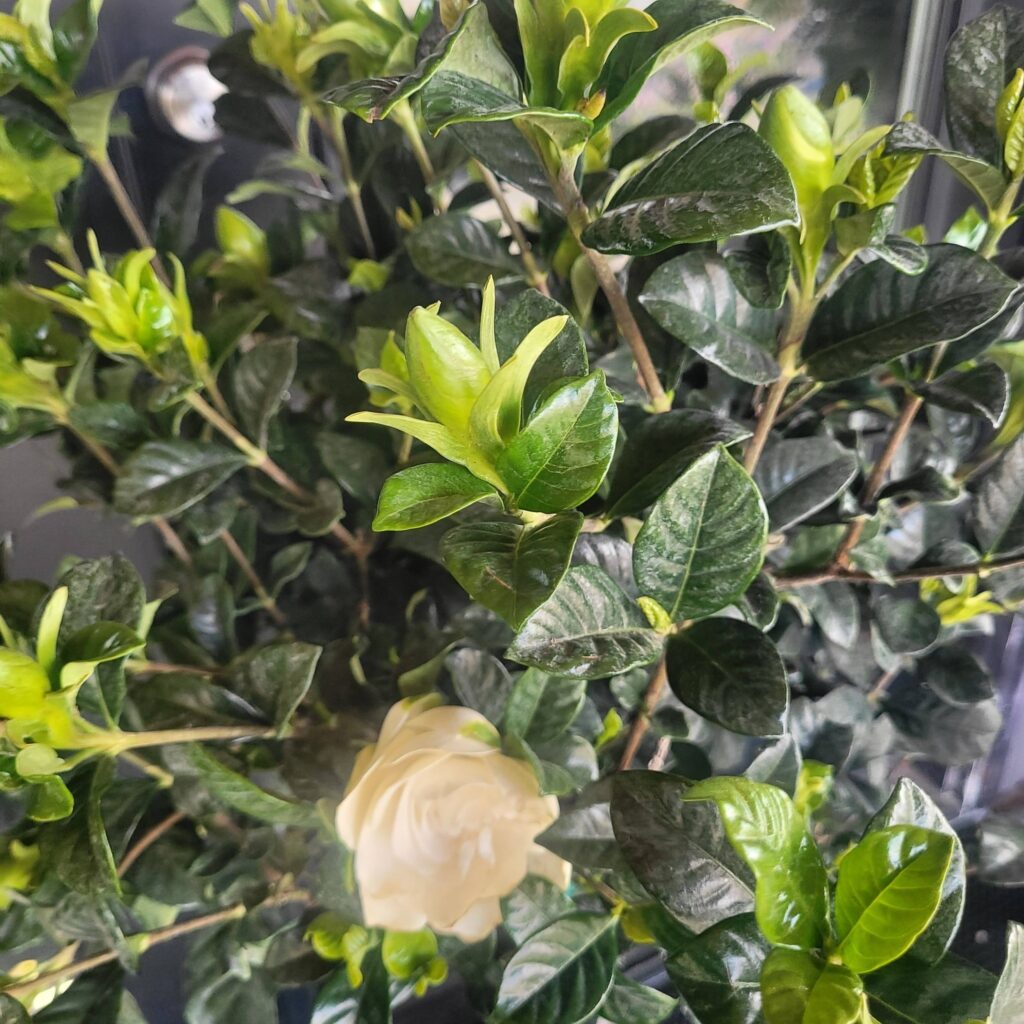
Gardenia is a broadleaf evergreen shrub — it retains its glossy foliage throughout the year, which makes it visually appealing even when not in flower.
Leaves
The leaves are simple, opposite (or in whorls of three), oblong to elliptical, typically 5–12 cm long. The surface is deep, lustrous green — almost lacquered in appearance — with a smooth texture. This glossy foliage is one of the plant’s most attractive features and provides year-round ornamental value.
Flowers
The flowers are what define Gardenia’s reputation. They are typically white to creamy ivory, waxy, and multi-petalled, produced singly at the tips of branches or in the leaf axils.
In wild forms, flowers have 5–7 petals arranged in a single row. In most cultivated varieties, the flowers are fully double, resembling a camellia or a small white rose. These double forms do not produce seeds but are prized for their appearance and fragrance.
Flower size varies by cultivar: from small blooms of 5 cm in dwarf varieties to large, showy flowers of 10–12 cm in vigorous forms.
As flowers age, they turn from white to creamy yellow — a natural process that many growers find equally beautiful, though it signals the bloom is past its peak.
Fragrance
The fragrance of Gardenia deserves its own acknowledgement. It is intense, sweet, and complex — dominated by compounds including linalool, benzyl acetate, cis-linalool oxide, and methyl anthranilate.
The scent has warm, creamy, slightly spicy undertones. It is stronger in the evening and night, which has historically made Gardenia a popular choice for evening gardens.
It is, by any measure, one of the most powerful floral fragrances produced by any cultivated plant.
Fruit
When pollinated (in single-flowered forms or in wild plants), Gardenia produces an oval, orange-yellow berry, 1.5–4 cm long, with prominent longitudinal ribs. The fruit is ornamentally attractive and has significant culinary and medicinal uses in East Asian traditions.
Flowering Season and Bloom Cycle
In outdoor gardens in warm climates, Gardenia typically blooms from late spring through summer — May to August across most of its cultivated range. In ideal conditions or in specific cultivars, a secondary flush of bloom may occur in autumn.
Indoors, the flowering period is heavily influenced by light exposure, temperature, and humidity management.
Flower bud formation in Gardenia is triggered by a period of cooler temperatures (around 15–16°C / 59–61°F) combined with bright light. This is one reason why gardeners who keep Gardenia indoors year-round often find the plant fails to bloom — it never receives the temperature differential it needs to set buds.
The Fragrance Industry: Gardenia in Perfumery
Gardenia is one of the most commercially important floral fragrances in the perfume industry — and one of the most technically challenging to work with.
The flowers do not yield essential oil through steam distillation. The delicate molecular compounds responsible for Gardenia’s scent break down under heat.
For this reason, traditional extraction used enfleurage (cold-fat absorption), though modern perfumery relies on solvent extraction to produce a concrete or absolute, or on headspace technology to capture and synthetically reconstruct the scent profile.
True Gardenia absolute — extracted directly from the flowers — is extraordinarily expensive and rare. Most commercial “Gardenia” perfumes use a synthetic reconstruction of the scent profile rather than a direct floral extract.
Despite this, the market for Gardenia fragrance remains enormous. Gardenia-inspired notes appear in hundreds of high-profile perfume compositions worldwide, and the flower is one of the defining reference points for the “white floral” category in modern perfumery.
Cultural and Symbolic Significance
Gardenia carries rich symbolic meaning across multiple cultures.
In East Asia
In China, Gardenia (Zhi Zi, 栀子) has been cultivated and revered for over a thousand years. The flower symbolises purity, love, and refinement.
Gardenia flowers are used in tea-scenting — dried flowers are layered with tea leaves (particularly green and white teas) to produce jasmine-style floral teas with a distinctive creamy sweetness. Gardenia-scented tea remains popular across southern China.
The fruit (zhi zi fruit) is one of the most commonly used herbs in Traditional Chinese Medicine and has been documented in the Shennong Bencao Jing — one of the oldest Chinese pharmacopoeias, dating back approximately 2,000 years.
In Japan, Gardenia (Kuchinashi, 梔子) is associated with secret love — the name alludes to the plant’s lack of a “mouth” (opening) in the fruit, evoking silent affection. Gardenia flowers appear in Japanese poetry, kimono patterns, and traditional floral arrangement (ikebana).
In the American South
Gardenia became deeply embedded in Southern American culture from the 19th century onward. A Gardenia bloom worn in the hair or pinned to a lapel was a gesture of elegance and welcome. The flower’s association with Southern hospitality, debutante balls, and garden parties made it a cultural fixture.
Billie Holiday, the American jazz singer, famously wore Gardenias in her hair as a signature element of her stage presence — a visual identity that became inseparable from her image and is one of the most iconic uses of a specific flower in music history.
Medicinal and Practical Uses
Traditional Chinese Medicine
The Gardenia fruit (Fructus Gardeniae, Zhi Zi) is a primary ingredient in Traditional Chinese Medicine (TCM). Its documented traditional uses include:
- Anti-inflammatory effects: Used to reduce inflammation and “clear heat” in TCM terminology
- Liver support: Used in formulas addressing liver and gallbladder conditions
- Bleeding: Applied in formulas for conditions involving bleeding
- Wound healing: Topically applied as a poultice for bruising, sprains, and swelling
Modern pharmacological research has confirmed several bioactive compounds in Gardenia fruit, including genipin, geniposide, gardenoside, and crocin (the same pigment compound found in saffron).
Genipin: A Remarkable Compound
Genipin, derived from the Gardenia fruit, has attracted significant scientific interest. Research has found it possesses anti-inflammatory, antioxidant, and anti-tumour properties in laboratory studies. It is also used commercially as a natural blue dye, used in food colouring, textiles, and biomedical research.
Natural Yellow Dye
The Gardenia fruit is the source of gardenia yellow (crocin) — one of the most widely used natural yellow food dyes in East Asia. It is used to colour rice, desserts, noodles, and traditional sweets. The same compounds give Gardenia fruit its characteristic orange-yellow colour.
Growing Gardenia: The Complete Cultivation Guide
Gardenia has a well-deserved reputation for being demanding. It is not a forgiving plant for neglect. However, once you understand its preferences — which are specific but not unreasonable — it rewards you generously.
Climate and Hardiness
- USDA Hardiness Zones: 8–11 for outdoor growing
- Ideal temperature range: 18–24°C (65–75°F) during the day; 15–16°C (59–61°F) at night for bud set
- Frost tolerance: Very limited; temperatures below −5°C (23°F) will damage or kill unprotected plants
- In colder zones (4–7), Gardenia is grown as a container plant, brought indoors before the first frost
Soil Requirements
Soil is the foundation of Gardenia success, and this cannot be overstated.
Gardenia requires acidic soil — pH 5.0 to 6.0. Outside this range, the plant cannot absorb iron and other micronutrients effectively, leading to chlorosis (yellowing leaves) even in nutrient-rich soil.
Use an acidic, well-draining growing medium. Recommended blends include:
- Ericaceous compost (sold specifically for acid-loving plants)
- A mix of peat or coir, pine bark, and perlite for container growing
- In-ground: amend with composted pine bark and sulphur to lower pH in alkaline soils
Test your soil pH before planting and retest annually. Soil pH can shift over time, particularly in containers.
Sunlight
- Outdoors: Full sun to light partial shade. In very hot climates (Zone 9–11), afternoon shade prevents flower burn and extends bloom life.
- Indoors: Bright, indirect light or a south-facing window with some direct sun. Insufficient light is the most common reason indoor Gardenias fail to bloom.
Watering
Gardenia prefers consistently moist but never waterlogged soil. The key word is consistency.
- Water when the top 2–3 cm of soil feels slightly dry
- Use rainwater or distilled water when possible — tap water in many regions is too alkaline and can raise soil pH over time
- Never allow the plant to sit in standing water — root rot develops quickly in waterlogged conditions
- In containers, ensure drainage holes are clear and functioning
Humidity: The Critical Variable
This is where most indoor Gardenia growers fail.
Gardenia is native to humid subtropical environments. It requires relative humidity of at least 50–60%, and ideally higher. The dry air of heated or air-conditioned interiors — which often runs at 30–40% humidity — causes bud drop, leaf browning, and poor growth.
How to increase humidity:
- Place the pot on a tray of pebbles filled with water (the pot sits above the water, not in it)
- Group Gardenia with other humidity-loving plants
- Use a cool-mist humidifier nearby
- Do not mist the leaves or flowers directly — wet petals develop brown spots, and wet foliage encourages fungal disease
Fertilising
Feed Gardenia with an acidic, slow-release fertiliser formulated for acid-loving plants (azalea or camellia fertilisers work well). Key guidelines:
- Fertilise from early spring through late summer — not in autumn or winter
- Do not over-fertilise — excess nitrogen promotes leafy growth at the expense of flowers
- Apply chelated iron or iron sulphate if chlorosis (yellowing between leaf veins) appears — this is almost always a pH or iron-availability issue
Temperature Management
Temperature consistency matters enormously for Gardenia.
- Keep indoor plants away from heating vents, radiators, and cold draughts
- Sudden temperature drops are a primary trigger for bud drop
- A drop of more than 5°C in a short period — such as moving a plant from a warm room to a cold car — can cause all developing buds to drop within days
The Dreaded Bud Drop: Why It Happens and How to Stop It
Bud drop is the most common and frustrating Gardenia problem. You see dozens of buds forming, begin anticipating a spectacular display — and then the buds turn yellow and fall, one by one, before opening.
Primary causes of bud drop:
- Low humidity — the most frequent cause in indoor settings
- Inconsistent watering — allowing the soil to dry out completely between waterings
- Sudden temperature changes — draughts, cold windows, heating vents
- Insufficient light — buds need bright light to develop to opening
- Root disturbance — repotting or moving the plant while buds are forming
- Dry indoor air — particularly in winter with central heating
The solution is consistency: consistent moisture, consistent temperature, consistent humidity, and consistent light. Gardenia rewards stability.
Common Pests and Diseases
Pests
- Aphids: Cluster on new growth; treat with insecticidal soap or a strong jet of water
- Scale insects: Brown or waxy bumps on stems; treat with horticultural oil
- Mealybugs: White, cottony masses in leaf axils; treat with isopropyl alcohol on a cotton swab or systemic insecticide
- Spider mites: Fine webbing on undersides of leaves; caused by dry air; increase humidity and treat with miticide or insecticidal soap
- Whitefly: Small white insects that fly up when disturbed; yellow sticky traps and insecticidal soap are effective
Diseases
- Sooty mould: Black fungal coating on leaves, caused by honeydew from aphids or scale; treat the pest infestation first and wipe leaves clean
- Root rot (Phytophthora spp.): Caused by overwatering or poor drainage; wilting despite moist soil is a key symptom; improve drainage and reduce watering
- Powdery mildew: White, powdery coating on leaves in humid, low-airflow conditions; improve ventilation and treat with a fungicide if severe
- Leaf spot: Brown or yellow spots caused by various fungi; avoid overhead watering and remove affected foliage
Selected Gardenia Cultivars
Gardenia breeding has produced a wide range of cultivars suited to different climates, spaces, and uses.
- ‘August Beauty’: One of the most popular landscape varieties; large double flowers; repeat blooms spring and autumn; reaches 1.5–2 m
- ‘Veitchii’: Classic Victorian double-flowered cultivar; profuse blooms; popular as a cut flower and corsage variety; compact form
- ‘Kleim’s Hardy’: Single-flowered; one of the most cold-tolerant cultivars (Zone 7); good for cooler climates where other varieties fail
- ‘Radicans’ / ‘Prostrata’: Dwarf, spreading groundcover form reaching 30–60 cm; excellent for containers, borders, and slopes; small single flowers
- ‘Chuck Hayes’: Double-flowered; good cold tolerance (Zone 7); reliable rebloomer; disease-resistant
- ‘Crown Jewel’: Cold-hardy (Zone 6b in sheltered sites); compact form; double flowers; one of the hardiest double-flowered selections available
Gardenia as a Cut Flower and in Floristry
The Gardenia flower has a distinguished history in floristry and special occasions.
Its waxy, long-lasting blooms make it a choice cut flower for corsages, boutonnieres, wedding arrangements, and table centrepieces. The flower must be handled carefully — touching the petals with bare hands leaves brown fingerprints from skin oils.
Corsage and boutonniere tradition in the United States gave Gardenia its association with graduation, prom, and formal occasions throughout the 20th century. The scent made it unforgettable in enclosed spaces — a ballroom with Gardenia corsages in bloom was an experience remembered for years.
In floristry, wire and tape wrapping protects the stem end and extends vase life. Gardenias cut in the morning and placed immediately in cool water with the stem end recut can last 5–7 days.
Final Thoughts
Gardenia jasminoides is not the easiest plant to grow. It has opinions about soil pH, humidity, temperature, and water quality. It will drop its buds if you move it at the wrong moment. It sulks in low humidity and protests against alkaline water.
And yet — when it is right, and the conditions are met, and the first creamy white flower opens on a warm evening — the fragrance that fills the air is unlike anything else a garden can produce.
That is the bargain Gardenia offers. Give it what it needs, and it gives back something genuinely extraordinary.
For gardeners willing to learn its requirements, few plants are more satisfying. For those who have already tried and struggled, the answer is almost always the same: check the pH, raise the humidity, and be consistent.
This is a plant that has earned its place in gardens, temples, perfume bottles, and love stories across a thousand years of human cultivation. It is worth the effort.
References
- University of Florida, Institute of Food and Agricultural Sciences (UF/IFAS) — Edis Gardenia jasminoides: Gardenia — Landscape Profile, Pest Management, and Cultivation https://edis.ifas.ufl.edu/publication/FP233
- North Carolina State University — Extension Gardener Plant Toolbox Gardenia jasminoides — Full Horticultural Profile: Cultivars, Diseases, Soils, and Landscape Use https://plants.ces.ncsu.edu/plants/gardenia-jasminoides/
- Clemson University Cooperative Extension — Home and Garden Information Center Gardenia: Growing and Problem-Solving Guide for South Carolina and the Southeast https://hgic.clemson.edu/factsheet/gardenia/
- University of Wisconsin–Madison — Wisconsin Horticulture Division of Extension Growing Gardenia Indoors: Light, Humidity, and Bud Drop Management https://hort.extension.wisc.edu/articles/gardenia-gardenia-jasminoides/
- USDA Natural Resources Conservation Service (NRCS) — PLANTS Database Gardenia jasminoides J. Ellis — Classification, Introduced Distribution, and Ecological Data https://plants.usda.gov/home/plantProfile?symbol=GAJA3

Tim M Dave is a gardening expert with a passion for houseplants, particularly cacti and succulents. With a degree in plant biology from the University of California, Berkeley, he has vast experience in gardening. Over the years, he has cultivated a vast collection of desert plants and learned a great deal about how to grow and care for these unique companions.