Understanding The Frizzle Sizzle Plant: History, Care, and Common Problems
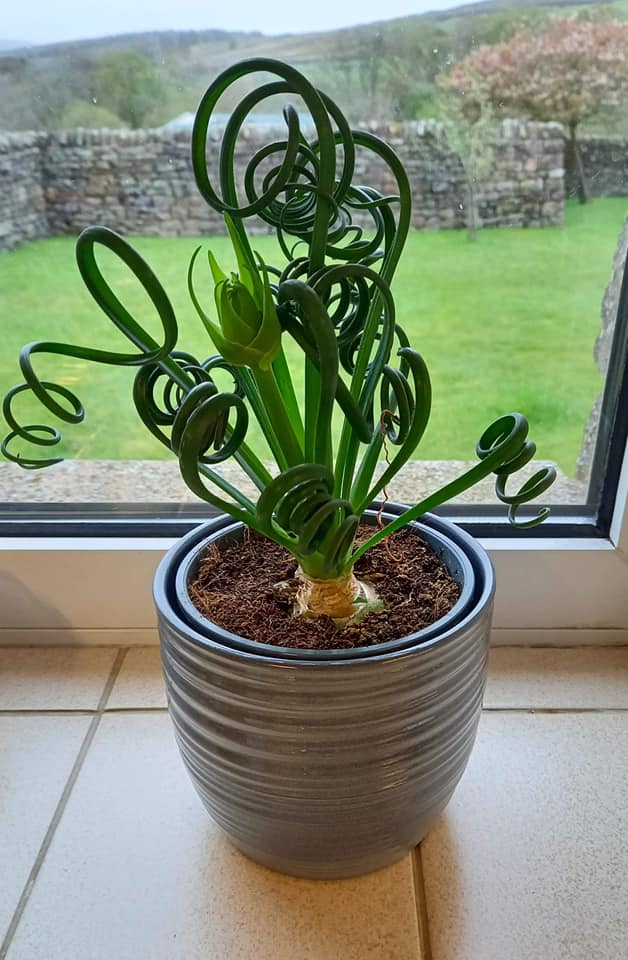
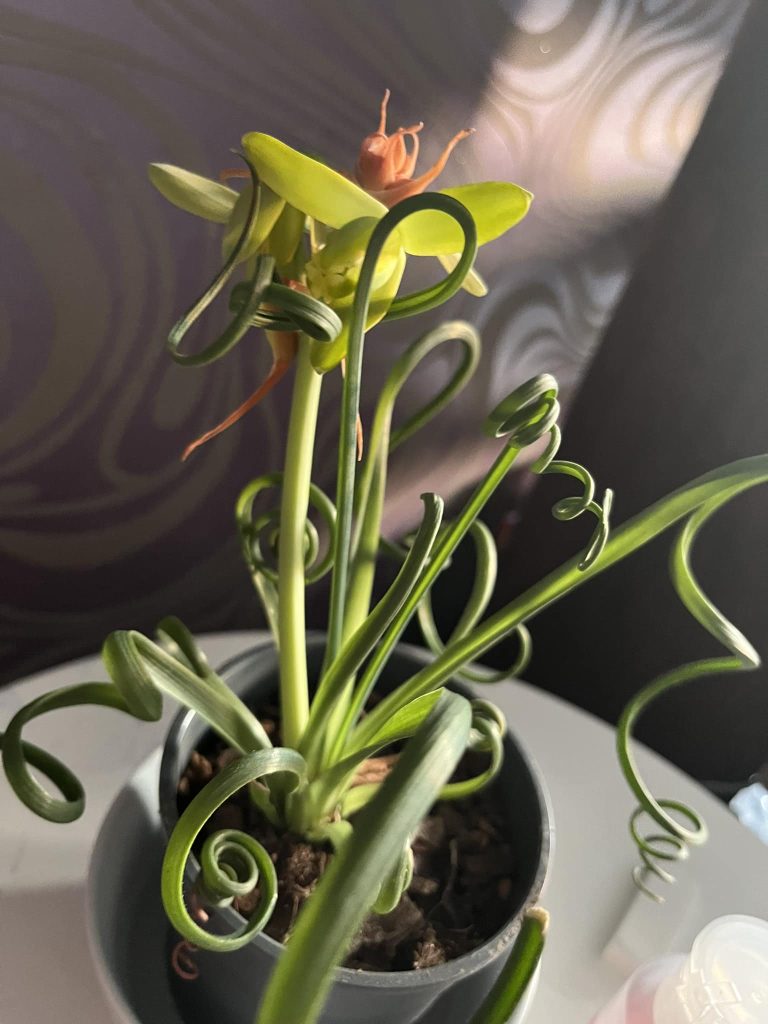
In the ever-expanding world of houseplants, few specimens capture the imagination quite like the Frizzle Sizzle plant. With its whimsical, corkscrew-like leaves that twist and curl as if defying gravity, this bulbous wonder adds a touch of playful eccentricity to any collection.
As someone who’s spent years nurturing a menagerie of unusual plants, I can attest to the sheer delight of watching a Frizzle Sizzle unfurl its spirals in the cool light of winter. It’s not just a plant; it’s a companion that rewards patient gardeners with fragrant blooms and resilient charm.
But what exactly makes the Frizzle Sizzle plant (Albuca spiralis) stand out in the crowded realm of succulents? Native to the arid landscapes of South Africa, this bulbous perennial thrives on neglect during its summer dormancy and bursts into vibrant life during cooler months.
Before diving into the nitty-gritty of care, let’s spotlight the Frizzle Sizzle plant’s standout attributes. These features not only define its allure but also guide cultivation decisions
| Feature | Description |
| Scientific name | Albuca spiralis (cultivar: ‘Frizzle Sizzle’ PP22954) |
| Common names | Frizzle Sizzle, Corkscrew Albuca, Spiral Albuca, Helicopter Plant, Sticky Corkscrew Lily, Slime Lily, Curly Albuca |
| USDA Hardiness Zones | 8-11 (optimal 9-10); frost-sensitive below 20°F (-7°C) |
| Color variation | Leaves: Bright green with subtle glandular hairs; tips may brown during bloom. Flowers: Yellow-green with pale yellow margins, vanilla-scented |
| Sun exposure | Full sun to partial shade (5-7 hours direct light daily for tight curls); bright indirect indoors |
| Mature Size | 8-12 inches tall (20-30 cm); up to 24 inches with flower spike; bulb 2 inches (5 cm) diameter |
| Growth rate | Moderate to fast during active season (fall-winter); slow dormancy |
| Lifespan | Perennial; 5-10+ years with proper dormancy cycles; bulbs multiply over time |
| Toxicity | Mildly toxic to pets/humans if ingested (causes nausea, vomiting); non-toxic to touch |
These traits make the Frizzle Sizzle a versatile addition to rock gardens, succulent arrangements, or as a standalone potted curiosity. Its compact mature size suits small spaces, while the color variation—especially those fragrant, nodding blooms—adds seasonal drama.
In my experience, providing ample sun exposure is key to unlocking the full spectrum of its green hues and preventing etiolation (stretched, less curly growth).
Brief History and Classification
The story of the Frizzle Sizzle plant begins in the sun-baked soils of South Africa’s Western and Northern Cape Provinces, where it has evolved as a resilient geophyte—a bulbous plant adapted to seasonal extremes of wet winters and bone-dry summers.
First documented by the younger Carl Linnaeus (Carolus Linnaeus the Younger) in 1782, Albuca spiralis earned its species name from the Latin “spiralis,” a testimony to the plant’s distinctive coiled foliage that helps it capture scarce winter sunlight while minimizing wind damage.
The genus Albuca, penned by Linnaeus the Elder in the 1750s, derives from the Latin “albus” meaning “white,” referencing the pale, ivory-toned flowers common across the genus.
Classified within the Asparagaceae family (subfamily Scilloideae), the Frizzle Sizzle shares kinship with asparagus, orchids, and other bulbous wonders like hyacinths and ornithogalums. This placement reflects its monocotyledonous nature: a single seed leaf, parallel leaf venation, and a fibrous root system anchored by an underground bulb.
Botanically, it’s a bulbous perennial geophyte, meaning it stores nutrients in its bulb to survive dormancy.
The modern cultivar ‘Frizzle Sizzle’ (patent PP22954) emerged from a selective breeding program in the Netherlands by Gerardus Adrianus Maria Zuidgeest, amplifying the wild species’ spiraling traits for ornamental appeal.
Introduced to global markets in the early 2000s, it quickly became a favorite among succulent collectors for its compact form and exaggerated curls. Today, it’s propagated commercially in controlled environments mimicking its Mediterranean climate origins, ensuring year-round availability for gardeners worldwide.
From a historical point of view, Albuca species like spiralis have long been admired by indigenous Khoisan peoples for their medicinal mucilaginous sap—earning the colloquial “slime lily.” European botanists, arriving in the 18th century, marveled at its novelty, incorporating it into early botanical illustrations.
Characteristics of the Frizzle Sizzle Plant
What truly sets the Frizzle Sizzle plant apart is its morphology—a blend of succulent resilience and ornamental flair.
At its core lies a subterranean bulb, ovoid and papery-skinned, measuring up to 2 inches in diameter. This bulb serves as the plant’s lifeline, storing water and carbohydrates to fuel its winter vigor and endure summer aridity.
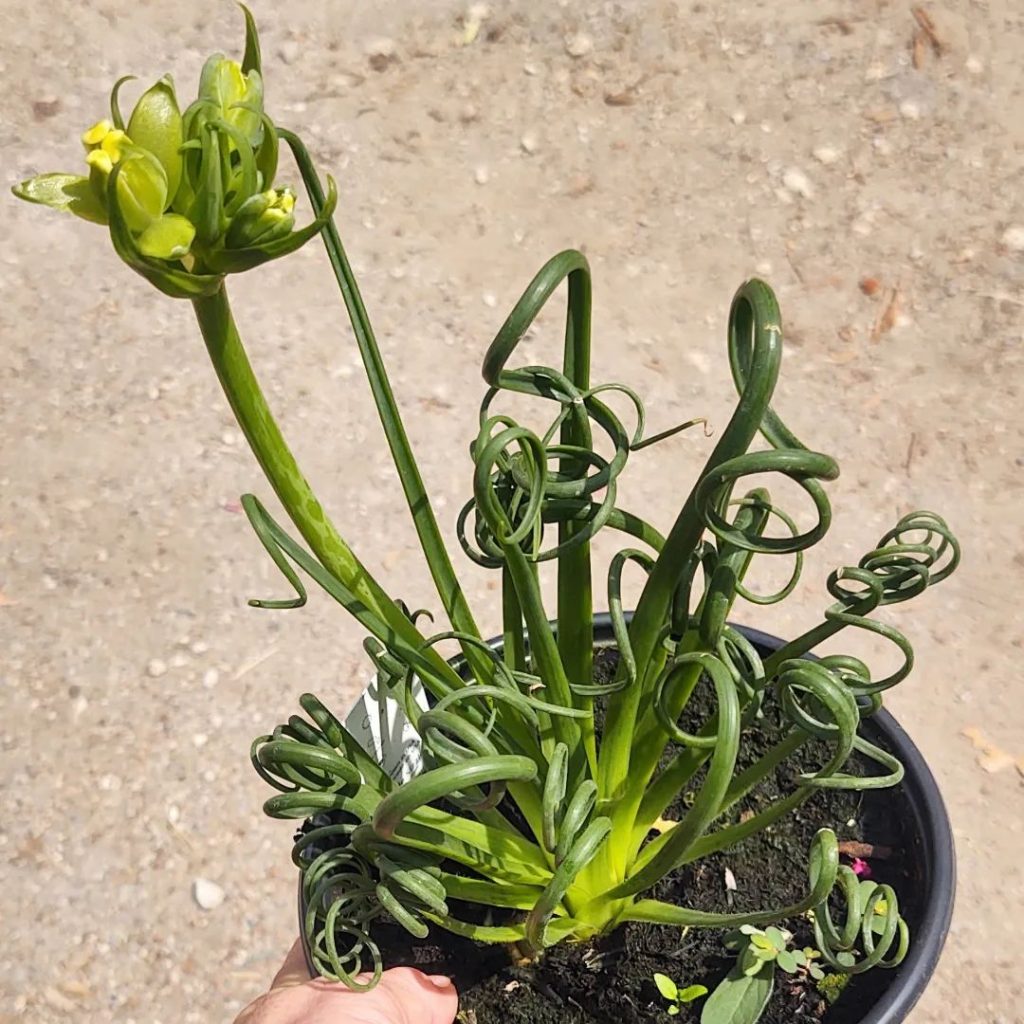
Emerging from this bulb is a basal rosette of 10-20 linear leaves, each 4-8 inches long and a mere millimeter wide, channelled down the face for water efficiency. The magic happens at the tips: as leaves mature in cool, bright conditions, they twist into tight spirals, resembling coiled springs or corkscrews.
This adaptation maximizes light absorption in low-angle winter sun while reducing transpiration in dry winds.
The leaves’ surface is adorned with glandular hairs, giving a subtle stickiness that’s more textural than adhesive (unlike its relative, Albuca viscosa). These trichomes not only deter herbivores but also trap morning dew, channeling it to the base.
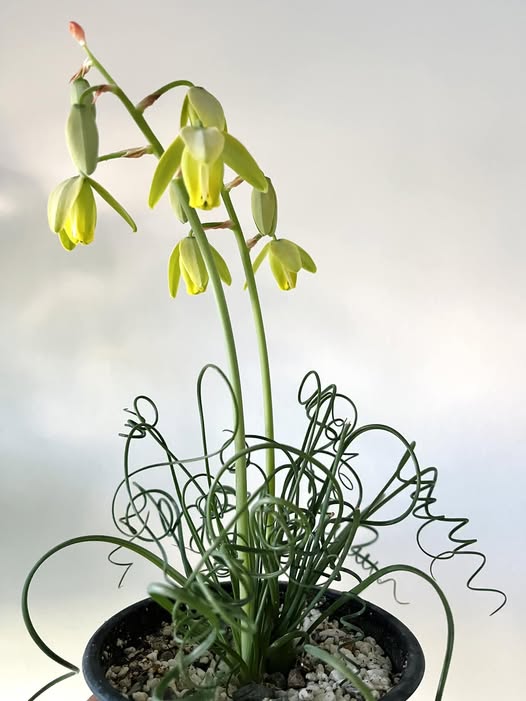
Foliage color is a vibrant lime green, occasionally flushing reddish at edges under stress or intense light, adding to the plant’s dynamic appeal. Come late winter to spring, a single, robust scape (flower stalk) rises 12-24 inches, bearing 10-20 pendulous blooms in a secund (one-sided) raceme.
Each flower is a 0.6-inch star of six tepals: outer ones green with yellow keels, inners pale yellow, exuding a sweet vanilla-butter aroma that perfuses the air on mild evenings. Pollination in the wild relies on native bees, but indoors, it’s often sterile without cross-pollination.
Root systems are fibrous and shallow, spreading laterally to anchor in sandy soils rather than delving deep for water—another explanation to its ephemeral winter growth. Overall, the Frizzle Sizzle’s characteristics embody compact elegance: low to the ground during the vegetative phase, soaring dramatically in bloom, then retreating to bulb form for rebirth.
Growing and Care Guide for the Frizzle Sizzle Plant
Caring for the Frizzle Sizzle plant revolves around mimicking its native cycle: active growth in cool, moist winters; dormancy in hot, dry summers. Get this rhythm right, and you’ll enjoy years of spiral spectacle.
Light Requirements: Sunlight for Spirals
Frizzle Sizzle thrives on bright light, demanding 5-7 hours of direct sun daily to maintain its signature curls. Indoors, position it near a south-facing window; insufficient light leads to etiolated, straight leaves—a common lament among new owners.
Outdoors in USDA zones 9-10, morning sun with afternoon shade prevents scorching, especially during bloom. Supplement with full-spectrum grow lights (12-14 hours daily) in low-light regions, rotating the pot weekly for even exposure.
In my setup, a 6500K LED panel positioned 12 inches above yields the tightest spirals, rivaling wild specimens. Avoid north-facing spots; they’re a recipe for leggy disappointment.
Watering and Humidity: Balance is Key
Watering is the Frizzle Sizzle’s Achilles’ heel—overdo it, and root rot ensues; neglect it, and growth stalls. During active growth (fall-winter), maintain moist but not soggy soil, allowing the top third to dry between waterings (every 7-10 days).
Use the “soak and dry” method: drench thoroughly, then let drain completely. In dormancy (spring-summer), reduce to once every 2-3 weeks or when bone-dry, mimicking Cape droughts.
Humidity hovers at 40-60%—average room levels suffice, but boost with a pebble tray in arid homes.
High humidity (>70%) risks fungal issues; I’ve lost a plant to powdery mildew from overzealous misting. Always use room-temperature water to avoid shocking the bulb.
Soil and Potting: Drainage First
Opt for a gritty, well-draining succulent mix: 50% potting soil, 30% perlite/pumice, 20% sand. pH neutral to slightly alkaline (6.5-7.5) suits its preferences. Plant with the bulb neck exposed—burying it fully invites rot. Choose terracotta pots with ample drainage holes; plastic retains too much moisture.
Repot every 2-3 years in early fall, dividing offsets for propagation. In my collection, amending with extra pumice has halved rot incidents, promoting healthier bulb clustering.
Temperature and Dormancy: Seasonal Rhythms
Ideal temperatures: 60-75°F (15-24°C) daytime, dipping to 50°F (10°C) nights during growth. Avoid below 40°F or above 85°F; heat triggers premature dormancy. As spring warms, leaves yellow and wither—normal!
Withhold water, store the pot in a cool, dry spot (garage or under-bed), and await fall’s chill to revive it. This dormancy, lasting 4-6 months, is crucial for longevity. One year, I skipped it for my plant, resulting in weak regrowth; now, I religiously enforce it, yielding stronger blooms annually.
Fertilizing and Pruning: Gentle Nourishment
Fertilize sparingly during growth with a diluted (half-strength) balanced liquid feed (10-10-10 NPK) every 4 weeks. Overfeeding burns roots; skip during dormancy. Prune dead leaves at the base with sterilized shears to prevent disease—snip browned tips post-bloom to tidy aesthetics.
Generally, Frizzle Sizzle care is low-fuss: prioritize drainage, light, and dormancy cycles. With these practices, your plant will reward you with robust spirals and perfumed spikes.
Propagation Techniques: Expanding Your Frizzle Sizzle Collection
Multiplying your Frizzle Sizzles is straightforward, leveraging its bulbous nature. Offsets (pups) form naturally around the mother bulb after 2-3 years; separate in fall, letting cuts callus 2-3 days before potting in moist mix. Plant shallowly, water lightly, and expect roots in 4-6 weeks.
Seed propagation suits the patient: harvest from spent blooms, sow on sandy surface (no burying), mist to keep damp at 65-70°F under lights. Germination takes 2-4 weeks; thin seedlings for vigor. Hybrids may vary in curliness.
I’ve propagated dozens via offsets, gifting “babies” to friends—each one a mini-me of the parent, spirals and all. Success rate? Near 100% with sterile tools and fresh medium.
Common Problems with the Frizzle Sizzle Plant and Solutions
Despite its toughness, Frizzle Sizzles face pitfalls, mostly cultural. Here’s a table of woes, causes, and fixes.
| Problem | Symptoms | Causes | Solutions |
| Straight or Leggy Leaves | Loose curls, elongated growth | Insufficient light | Increase to 5-7 hours direct sun; use grow lights |
| Browned Leaf Tips | Crispy edges, especially post-bloom | Natural during flowering; low humidity | Remove flower stalk early if undesired; humidity tray; trim affected tips |
| Yellowing/Wilting Leaves | Soft, floppy foliage | Overwatering/root rot | Repot in dry mix, trim rot; water only when top inch dry |
| No Blooms | Vegetative only | No chill period; poor nutrition | Enforce 50°F nights in fall; monthly dilute fertilizer |
| Pest Infestations | Webbing (mites), cottony spots (mealybugs) | Warm, dry air; overcrowding | Neem oil spray weekly; isolate; improve airflow |
| Fungal Diseases | Spots, powdery coating | Excess moisture, poor air circulation | Fungicide; better drainage; space plants |
| Basal Rot/Collapse | Bulb softening, plant toppling | Soggy soil | Discard if severe; preventive drainage; drier dormancy |
Pests are rare but target undersides; inspect weekly. Diseases stem from wet feet—prevention trumps cure.
Landscape and Container Ideas: Styling Your Frizzle Sizzle
Frizzle Sizzle’s compact form shines in mixed succulent bowls, fairy gardens, or as a thriller in thrifted teacups. Outdoors, pair with agaves in xeriscapes or under euphorbias for contrast. Indoors, cluster on etageres for textural drama.
In my sunroom, a trio in a zinc trough with sedums creates a “desert perm” vibe—curls peeking like playful antennae. For vertical interest, suspend in macrame with trailing strings of pearls.
Frequently Asked Questions
Why is my Frizzle Sizzle plant losing its curls?
Insufficient light is the culprit—aim for brighter exposure to encourage tight spirals. Overwatering can also loosen them; dry out between sessions.
How often should I water a Frizzle Sizzle during dormancy?
Sparingly—every 2-3 weeks or when fully dry. Overwatering risks bulb rot.
Is the Frizzle Sizzle plant pet-safe?
Mildly toxic if ingested (nausea possible); keep elevated from curious cats/dogs.
Can I grow Frizzle Sizzle outdoors year-round?
Yes, in zones 9-11; protect from frost elsewhere by overwintering indoors.
Why won’t my Frizzle Sizzle bloom?
Lack of cool dormancy or nutrients—chill at 50°F and fertilize monthly in growth.
How do I propagate Frizzle Sizzle from seeds?
Sow on surface, mist, and provide warmth/light; germinates in 2-4 weeks.
What soil is best for Frizzle Sizzle?
Well-draining succulent mix with perlite/sand for aeration.
Does Frizzle Sizzle need fertilizer?
Yes, half-strength balanced every 4 weeks in active season; skip dormancy.
How long does Frizzle Sizzle live?
5-10+ years as a perennial, with multiplying bulbs.
Why are the leaves of my Frizzle Sizzle turning brown?
Natural post-bloom, or low humidity/over-fertilizing—trim and adjust care.
Final thoughts
Years ago, a friend’s offhand gift of a potted Frizzle Sizzle changed my indoor jungle forever. Its initial spirals, like frozen question marks, sparked endless fascination. Through failed dormancies and successful blooms, I’ve grown as much as the plant. It’s a reminder: beauty blooms from cycles, and resilience from restraint.

Tim M Dave is a gardening expert with a passion for houseplants, particularly cacti and succulents. With a degree in plant biology from the University of California, Berkeley, he has vast experience in gardening. Over the years, he has cultivated a vast collection of desert plants and learned a great deal about how to grow and care for these unique companions.