Fragrant Olive (Osmanthus fragrans): History, Features, Problems, and Planting Details
There are plants you grow for colour. There are plants you grow for structure. And then there are plants you grow for something far less tangible — a fragrance so extraordinary that it stops you mid-step the moment you enter a garden. Fragrant olive (Osmanthus fragrans) belongs entirely to that last category.
The blooms are tiny. You can walk past the plant and not immediately notice them. But the scent — sweet, warm, apricot-like, with a depth that seems impossible from such small flowers — will reach you from ten metres away.
In its native range across China and Japan, this plant is so deeply loved that it has inspired poetry, festivals, and culinary traditions spanning more than two thousand years.
This guide covers everything you need to know about Osmanthus fragrans — its origins, growth habits, landscape uses, care requirements, and the best varieties to choose.
What Is Fragrant Olive? Botanical Identity and Overview
Osmanthus fragrans belongs to the family Oleaceae — the olive family — which also includes jasmine, lilac, and forsythia. Despite its common name, it is not a true olive (Olea europaea), though the two share a family and the plant does produce small, olive-like fruits.
Other common names include sweet olive, tea olive, gui hua (桂花) in Chinese, and kinmokusei (金木犀) in Japanese. All of these names reflect different aspects of the plant — its sweetness, its resemblance to the olive, its cultural use in teas and confectionery, and the golden colour of its most popular flowering form.
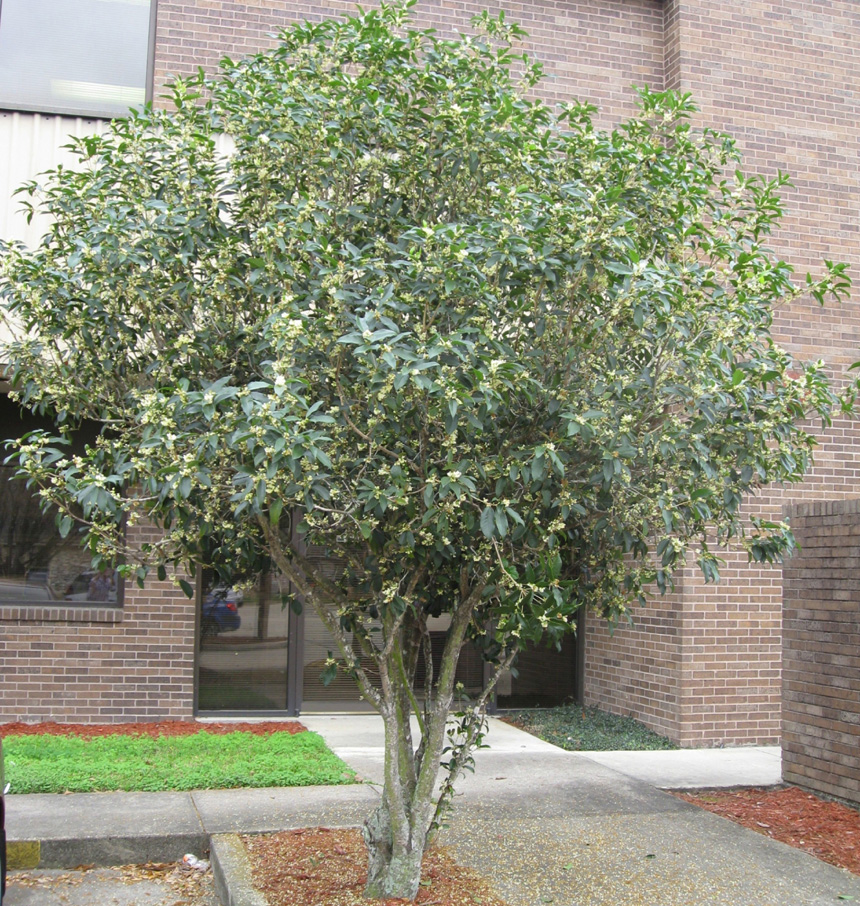
Osmanthus fragrans is native to southern China, Japan, Taiwan, and the eastern Himalayas, where it grows naturally in mixed forest margins and hillside scrub at elevations from sea level to about 2,900 metres. In its native habitat, it grows as a large shrub or small multi-stemmed tree, typically reaching 3 to 12 metres (10 to 40 feet) in height, depending on the variety and growing conditions.
In cultivation, most garden specimens are maintained at 2 to 4 metres (6 to 12 feet) through selective pruning, which also keeps the fragrance at a height where it can be fully appreciated by people walking nearby.
The plant is evergreen, with leathery, dark green leaves that are attractive year-round. It is the combination of handsome evergreen foliage, exceptional fragrance, and relative ease of cultivation that has made it one of the most widely grown ornamental shrubs in warm-temperate and subtropical gardens worldwide.
The Flowers: Small in Size, Immense in Impact
The flowers of Osmanthus fragrans are tiny — each individual bloom is only about 5 millimetres across, consisting of four small petals fused at the base. They are produced in small clusters (fascicles) tucked into the leaf axils along the stems, often partially hidden by the foliage.
What the flowers lack in size, they more than compensate for in fragrance. The scent compound primarily responsible is linalool oxide, along with beta-ionone, geraniol, and numerous other volatile aromatic compounds. The result is a fragrance described as apricot-like, peachy, honeyed, and sweet — complex but never overwhelming.
The flowering season varies by variety but is one of the most generous of any ornamental shrub:
- The standard orange-flowered variety (f. aurantiacus) blooms primarily in autumn, typically September through November in the Northern Hemisphere
- White and cream-flowered forms (f. latifolius, f. thunbergii) tend to be more repeat-flowering, producing flushes of bloom from late summer through winter and occasionally into early spring
- In warm climates, well-established plants may flower almost continuously from autumn through spring
It is this extended season — months of fragrance rather than weeks — that sets Osmanthus fragrans apart from most other fragrant plants in the garden.
Natural Range, Climate Adaptability, and Hardiness
Osmanthus fragrans is primarily adapted to warm-temperate to subtropical climates, corresponding to USDA Hardiness Zones 8 through 11. Within this range, it performs as a reliable, low-maintenance evergreen shrub.
Cold hardiness: Most cultivars tolerate minimum temperatures of approximately -8°C to -12°C (18°F to 10°F) — Zone 8 conditions — when established and in well-drained soil. Brief dips below these thresholds may cause dieback of soft growth without killing the plant outright, particularly if the cold is not accompanied by desiccating wind.
In Zone 7 conditions, fragrant olive can be grown successfully in sheltered, south-facing positions against a warm wall, or in a large container that is moved under protection in severe winters.
In Zone 6 and colder, container cultivation is the practical solution — growing the plant in a large pot that spends spring through autumn outdoors and winters in a frost-free greenhouse, cool conservatory, or unheated garage with adequate light.
Beyond cold hardiness, the plant’s key climate requirements are:
- Protection from desiccating winter winds, which cause leaf scorch even when temperatures are above the critical threshold
- Adequate summer warmth to initiate and sustain flower bud development
- Reasonable humidity — it performs poorly in very hot, arid environments without supplemental irrigation
Across the southeastern United States, the Pacific Coast, the Mediterranean basin, South Africa, New Zealand, and temperate parts of Asia and Australia, Osmanthus fragrans is grown extensively — a testament to its broad adaptability within its hardiness range.
Light Requirements: Sun to Partial Shade
One of the practical virtues of fragrant olive is its tolerance of a range of light conditions. This makes it genuinely useful in parts of the garden where more demanding shrubs would fail.
Full sun produces the most vigorous growth and the most abundant flowering. In cooler climates within its hardiness range, full sun is strongly preferred — it helps the plant build the energy and warmth needed for prolific blooming.
Partial shade — particularly morning sun with afternoon shade — is acceptable and often desirable in hotter climates where intense afternoon sun can stress the plant and cause leaf scorch. In USDA Zones 9 and 10, some afternoon protection is beneficial.
Heavy shade reduces flowering significantly and produces open, leggy growth. Osmanthus fragrans will survive in considerable shade but will not perform at its best.
For fragrance purposes, position matters as much as light. Planting near an entrance, along a frequently used path, beside a seating area, or beneath a window that is often open means the extraordinary scent can be enjoyed from inside and outside. In warm climates, the fragrance carries on still evening air for remarkable distances.
Soil Requirements: What Fragrant Olive Needs Underground
Fragrant olive is not a demanding plant in terms of soil, but it does have preferences that, when respected, make a significant difference to its long-term performance.
Ideal soil characteristics:
- Well-drained: this is the most important single factor; Osmanthus fragrans will not tolerate waterlogged or consistently boggy soil; root rot in poorly drained conditions is the primary cause of plant loss
- Slightly acidic to neutral pH: ideally pH 6.0 to 7.5; it tolerates mildly alkaline soils better than many evergreen shrubs, though very alkaline conditions (above pH 8.0) cause chlorosis
- Moderately fertile: it grows in average garden soils without excessive fertilisation; overly rich soils promote lush foliage at the expense of flowers
- Loamy or sandy-loamy texture: these drain reliably while retaining sufficient moisture between rainfall or watering events
Clay soils can be made workable by incorporating generous quantities of coarse grit and compost at planting to improve drainage. Raised planting — setting the root ball slightly above the surrounding soil level and mounding improved soil around it — is a useful technique in marginally drained sites.
Heavy clay that holds water for extended periods after rain is genuinely unsuitable without significant remediation.
Planting Fragrant Olive: Doing It Right From the Start
A well-planted fragrant olive establishes quickly and requires minimal intervention once settled. The investment of care at planting determines much of the plant’s future performance.
Step-by-step planting guide:
- Select the right site — assess light (preferably morning sun), drainage (critical), wind shelter, and proximity to where you will enjoy the fragrance most
- Test drainage before planting — dig a hole 30 centimetres deep and fill with water; if it drains within an hour, drainage is adequate; if water remains for several hours, improve drainage or choose a different site
- Prepare the planting hole — dig two to three times the width of the root ball and no deeper; incorporate compost and coarse grit if improving a clay soil
- Plant at the correct depth — the root flare (where the stem base widens) should sit at or just above soil level; deep planting is a common and damaging mistake
- Backfill and firm gently — avoid compacting the soil heavily
- Water thoroughly — saturate the root zone immediately after planting
- Mulch the root zone — apply 7 to 10 centimetres of organic mulch (shredded bark or composted wood chips) over the root zone, extending to at least the drip line and keeping mulch clear of the stem
- Protect from wind in the first winter — a temporary windbreak of hessian or horticultural fleece on the windward side helps newly planted specimens establish without desiccation
Best planting time: Spring, after the last frost, is generally preferred in cooler climates. In warmer regions (Zone 9 and above), autumn planting is also excellent, allowing the root system to develop during cool, moist months before summer heat arrives.
Watering: Establishment and Ongoing Needs
During the first two growing seasons, consistent, deep watering is essential. Fragrant olive establishes a substantial root system relatively quickly, but it needs consistent moisture during this period to do so.
- Water deeply once or twice a week during dry periods in the first year
- Reduce frequency in the second year, watering every 10 to 14 days during dry spells
- Established plants are moderately drought-tolerant once their root systems are well-developed, particularly in cooler climates
In hot, dry climates — Zones 9 and 10 with low summer rainfall — established plants benefit from deep irrigation every two to three weeks during summer to maintain health and sustain flowering. Prolonged drought stress in summer delays or reduces autumn blooming.
Container-grown plants require more frequent watering than those in the ground — typically every two to three days in summer, depending on pot size, temperature, and humidity. Allow the top few centimetres of compost to dry slightly between waterings, but do not allow the root ball to dry out completely.
Avoid overhead watering in the evening — wet foliage overnight promotes fungal disease, particularly in humid climates.
Fertilising: Supporting Vigour and Flowering
Fragrant olive is a moderate feeder. It does not demand heavy fertilisation, but benefits from annual supplemental nutrition to support consistent growth and flowering.
Recommended fertilising programme:
- Apply a slow-release, balanced granular fertiliser — such as one formulated for acid-loving shrubs (10-10-10 or similar) — in early spring as growth resumes
- A second, lighter application of a low-nitrogen, high-potassium fertiliser in early summer supports flower bud development for autumn blooming
- Avoid high-nitrogen fertilisers — these promote vigorous green growth at the direct expense of flower production; it is one of the most common causes of a fragrant olive that grows well but flowers poorly
For plants showing yellowing between leaf veins (chlorosis) in neutral to mildly alkaline soils, a supplement of chelated iron and manganese addresses the deficiency more effectively than general fertiliser alone.
Container plants benefit from a liquid balanced fertiliser applied every two to three weeks during the growing season (spring through summer), tapering off in autumn and stopping through winter.
Pruning: Shaping Without Sacrificing Flowers
Osmanthus fragrans responds well to pruning and can be maintained as a formal or informal shrub, trained as a small multi-stemmed tree, espaliered against a wall, or kept compact in a container. It is also used as a fragrant hedge — one of its most effective landscape applications.
When to prune:
- Immediately after the main flowering flush ends — in most climates, this means late autumn or early winter after the primary autumn bloom
- Pruning at this time allows the plant to set new growth that will carry the following year’s flower buds, without sacrificing the current season’s display
- Avoid heavy pruning in late summer — this removes developing flower buds before they open
What to prune:
- Thin out congested stems to improve air circulation through the canopy
- Remove crossing or rubbing branches
- Cut back any frost-damaged growth in spring, once the risk of hard frost has passed and new growth shows where the live wood ends
- Shape lightly to maintain desired form and size
For hedge use: clip lightly two to three times per year — once after the spring flush (if the plant re-blooms in spring) and once after the main autumn flowering. Keep hedge cuts light rather than hard to maintain a dense, productive surface.
Container Growing: Bringing the Fragrance to Smaller Spaces
Growing Osmanthus fragrans in a container is one of the most practical ways to enjoy this plant in climates beyond its outdoor hardiness range — and even in warm climates, a container specimen on a terrace or by a doorway brings the fragrance precisely where it can be appreciated most.
Container growing essentials:
- Choose a large pot — a minimum of 40 to 50 centimetres diameter for an established plant; too small a container restricts the root system and reduces vigour
- Use a well-draining, slightly acidic potting mix — a blend of high-quality potting compost, perlite (20% by volume), and coarse grit produces the drainage fragrant olive needs
- Ensure drainage holes are unobstructed — standing water in the base of a container is fatal
- Feed regularly during the growing season — container plants deplete nutrients faster than those in the ground
- Repot every two to three years into a slightly larger container in spring, refreshing the potting mix at the same time
For overwintering in cold climates: Move the container to a frost-free but cool position — an unheated greenhouse, cool conservatory, or frost-free garage — before temperatures drop below approximately -5°C (23°F).
The plant is semi-dormant in winter and does not need warmth; it needs light and protection from hard frost. A minimum temperature of 0°C to 5°C (32°F to 41°F) is ideal for winter storage.
Culinary and Cultural Uses
No article on Osmanthus fragrans is complete without acknowledging its extraordinary cultural and culinary significance in China, Japan, and across East Asia.
In China, gui hua (fragrant olive) has been cultivated for over 2,500 years. The flowers are used to produce:
- Osmanthus wine (gui hua jiu) — a traditional sweet wine flavoured with the dried flowers
- Osmanthus tea — dried flowers blended with green or black tea, producing a subtly sweet, aromatic blend that remains enormously popular
- Osmanthus cake and confectionery — flowers incorporated into glutinous rice cakes and pastries
- Osmanthus honey — bees foraging on Osmanthus fragrans produce a distinctively flavoured honey
- Osmanthus extract and essential oil — used in high-end perfumery; the absolute of Osmanthus fragrans is one of the most expensive natural fragrance materials in the world
The Mid-Autumn Festival in China — one of the most important traditional holidays — is deeply associated with osmanthus. The flowers bloom around the time of the festival, and the scent of gui hua is considered inseparable from the holiday’s atmosphere. The phrase “the osmanthus flowers are blooming” signals the arrival of both autumn and the festival season across southern China.
In Japan, kinmokusei — the orange-flowered form — is one of the most recognisable autumn fragrances, associated with school life, seasonal change, and a specific type of nostalgic longing called mono no aware.
Best Varieties of Osmanthus fragrans
The species has been in cultivation long enough to produce numerous named forms and cultivars, selected for flower colour, fragrance intensity, plant size, or blooming season.
| Variety / Cultivar | Flower Colour | Bloom Season | Notes |
| f. aurantiacus | Orange | Autumn | Most intensely fragrant; classic form |
| f. latifolius | White | Autumn–Spring | Large leaves; repeat-flowering |
| f. thunbergii | White/Cream | Autumn–Spring | Most cold-hardy; prolific repeat-bloomer |
| f. semperflorens | White | Nearly year-round | Outstanding repeat-flowering performance |
| ‘Conger Yellow’ | Pale yellow | Autumn | Compact; good for containers |
| ‘Fudingzhu’ | White | Repeat-flowering | Exceptionally fragrant; widely recommended |
| ‘Butter Yellow’ | Soft yellow | Autumn | Compact form; excellent fragrance |
For the home garden, ‘Fudingzhu’ is one of the most frequently recommended cultivars by horticulturalists — valued for its repeat-flowering habit, outstanding fragrance, and manageable size. The orange-flowered f. aurantiacus remains the most widely planted form in China and is considered by many to be the most intensely fragrant of all.
Common Problems and Solutions
Osmanthus fragrans is remarkably trouble-free in appropriate growing conditions. Most problems trace back to siting or watering issues rather than pest or disease pressure.
Yellowing leaves (chlorosis): Most commonly caused by alkaline soil or waterlogged roots. Test soil pH and drainage; treat with chelated iron if pH is the cause; improve drainage urgently if waterlogging is responsible.
Leaf scorch: Brown, crispy leaf margins, usually caused by desiccating cold wind in winter, drought stress in summer, or reflected heat from walls or paving. Improve shelter, irrigation, and mulching.
Poor or absent flowering: Most often caused by excessive nitrogen fertilisation, heavy pruning at the wrong time (removing developing flower buds), insufficient light, or summer drought stress. Reassess fertiliser programme and pruning timing.
Scale insects: Small, waxy or shell-like bumps on stems and the underside of leaves. Treat with horticultural oil in late winter or early spring before the new growing season begins.
Sooty mould: Black, soot-like coating on leaves, caused by honeydew excreted by aphids or scale insects beneath. Control the insect causing the honeydew; the sooty mould will weather away once the source is removed.
Root rot: Caused by persistently waterlogged soil. Improving drainage is the only lasting solution; in severe cases, replanting to a better-drained position may be necessary.
Landscape Uses: Where to Plant Fragrant Olive
The range of landscape applications for Osmanthus fragrans is broad, and it is this versatility — combined with the unmatched fragrance — that makes it so valuable.
As a specimen shrub: planted where the fragrance can be enjoyed — beside a seating area, near a door, along an entrance path — it becomes one of the most celebrated plants in the garden during its long flowering season.
As a fragrant hedge: closely planted and lightly maintained, it forms a dense, attractive, year-round evergreen hedge that also delivers months of extraordinary fragrance. Few hedging plants come close to matching this combination.
As a screen or privacy planting: its dense evergreen habit and medium to large size make it an effective year-round privacy screen for gardens and outdoor living areas.
Espaliered against a warm wall: in Zone 7 and borderline Zone 8 areas, training the plant flat against a south- or west-facing wall maximises warmth and protection, allowing it to survive where it would otherwise be marginal.
In containers on terraces and patios: bringing the plant close to outdoor living spaces ensures the fragrance is enjoyed at peak effect.
In wildlife gardens: while primarily known for its human appeal, the flowers provide nectar for late-season pollinators, including bees and butterflies, at a time when most other plants have finished blooming.
Frequently Asked Questions
How long does fragrant olive bloom? The duration depends on climate and variety. In warm climates, repeat-flowering varieties like f. thunbergii and ‘Fudingzhu’ can bloom for four to six months across the autumn-to-spring period. In cooler climates with a single autumn flush, flowering may last four to six weeks.
Is fragrant olive invasive? It is not considered invasive in most regions. It is widely planted across the southeastern United States, California, Australia, and New Zealand without significant naturalisation concerns. Always check current local guidelines, as classifications can change over time.
Can fragrant olive grow indoors? It can be grown as a houseplant in very bright indoor conditions — a sunroom or conservatory with full light exposure — but it rarely performs well in typical indoor environments with limited natural light. It is better suited to outdoor container growing with indoor overwintering in cold climates.
Why does my fragrant olive not smell? Fragrance intensity varies by variety, flower maturity, time of day, and temperature. The orange-flowered f. aurantiacus is generally the most intensely fragrant. Fragrance is strongest on warm, still days. Young plants with few flowers produce less perceptible fragrance than well-established specimens in full bloom.
Final Thoughts
Osmanthus fragrans is, in my experience, one of the most underused plants in gardens outside its native range — and one of the most loved wherever it is known well. Once you have experienced its fragrance on a warm autumn morning, you will understand why it has inspired poets and perfumers for millennia.
Choose a sunny, well-drained site, plant it with care, mulch generously, avoid overfeeding with nitrogen, and prune only after flowering. The result will be a plant that earns its place in your garden not with a brief, spectacular moment, but with months of quiet, extraordinary beauty — and a scent you will never forget.
References
- North Carolina State University Extension – Osmanthus fragrans: Fragrant Tea Olive https://plants.ces.ncsu.edu/plants/osmanthus-fragrans/
- University of Florida IFAS Extension – Osmanthus fragrans: Sweet Osmanthus https://edis.ifas.ufl.edu/publication/FP444
- Clemson University Cooperative Extension – Osmanthus https://hgic.clemson.edu/factsheet/osmanthus/
- University of California Agriculture and Natural Resources – Osmanthus fragrans Plant Profile https://ucanr.edu/sites/sacmg/files/109857.pdf
- Virginia Cooperative Extension, Virginia Tech – Osmanthus fragrans Fact Sheet https://dendro.cnre.vt.edu/dendrology/syllabus/factsheet.cfm?ID=581

Tim M Dave is a gardening expert with a passion for houseplants, particularly cacti and succulents. With a degree in plant biology from the University of California, Berkeley, he has vast experience in gardening. Over the years, he has cultivated a vast collection of desert plants and learned a great deal about how to grow and care for these unique companions.