20 Best Flowering Trees for Garden UK: A Complete Guide
There is something genuinely uplifting about a flowering tree in full bloom. Whether it is the first flush of cherry blossom in early spring or the late summer flowers of a crape myrtle catching the afternoon light, these trees do something that most plants simply cannot — they command the whole garden for a few glorious weeks, then quietly offer greenery, structure, and shelter for the rest of the year.
For UK gardeners, the choice of flowering trees has never been wider. Milder winters in much of England and Wales, combined with the cool, moist summers that most flowering trees genuinely appreciate, make Britain an exceptionally good place to grow them. From compact garden trees that fit a modest urban plot to larger specimens for sprawling country gardens, there is a flowering tree for almost every situation.
This guide covers 20 of the best flowering trees for UK gardens, with honest, practical information on size, growing conditions, seasonal interest, and suitability for different garden types. Whether you are a first-time planter or an experienced horticulturist looking for something new, this list is a reliable starting point.
What to Consider Before Choosing a Flowering Tree
Before selecting any tree, it is worth pausing to think through a few fundamental questions. How much space do you actually have — not just today, but in 20 years? What is your soil like: acidic, alkaline, wet, dry? Does the spot receive full sun, partial shade, or heavy shade?
These are not just formalities. A magnolia planted too close to a wall will eventually cause structural issues. A cherry planted in waterlogged clay soil will decline before it reaches its best. Getting the basics right before you plant means far fewer problems down the line and a far better display once the tree is established.
With that said, the UK’s temperate climate is genuinely forgiving. Most of the trees on this list are well-suited to British conditions and widely available from reputable UK nurseries.
20 Best Flowering Trees for Garden UK
1. Japanese Cherry (Prunus ‘Kanzan’)
Flowering season: April
Mature height: 8–10 metres
RHS Award of Garden Merit: Yes
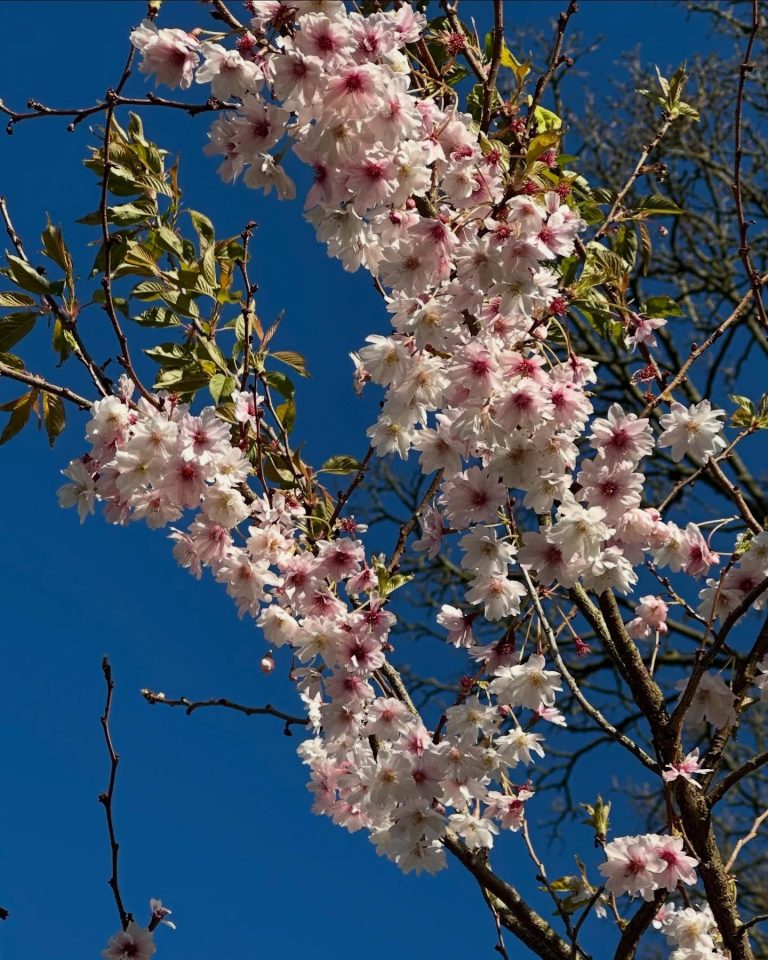
‘Kanzan’ is perhaps the most widely recognised flowering cherry in British gardens. In April, it erupts into a dense mass of double, deep pink-purple blossoms — an almost theatrical display that stops people in their tracks. The flowers are produced in hanging clusters along the full length of every branch, often before the leaves fully open.
It forms a vase-shaped crown that spreads with age, making it a statement tree for lawns or as a street-side specimen. It does best in full sun and well-drained soil. After flowering, the coppery young foliage matures to dark green, then turns orange and gold in autumn — providing a second season of interest.
2. Magnolia (Magnolia stellata)
Flowering season: March–April
Mature height: 2–3 metres
RHS Award of Garden Merit: Yes
The star magnolia is one of the most beloved flowering trees in UK gardens, partly because it is one of the few that genuinely thrives in a compact space. It grows slowly into a large, rounded shrub or small tree — rarely exceeding 3 metres — and produces an extraordinary quantity of delicate, star-shaped white flowers on bare branches in early spring.
It is a tree that genuinely causes people to stop walking. The flowers appear before any other leafy growth, which makes them all the more striking against a winter-tired garden. Plant it in a sheltered spot with full sun or light shade, in moist but well-drained, slightly acidic soil. Avoid frost pockets, as late frosts can damage the early blooms.
3. Crab Apple (Malus ‘Evereste’)
Flowering season: April–May
Mature height: 5–7 metres
RHS Award of Garden Merit: Yes
‘Evereste’ is widely considered the finest all-round crab apple for UK gardens. In spring, it produces masses of white flowers opening from red-pink buds — a bicolour effect that is particularly attractive. In autumn, these are followed by orange-red fruits that persist well into winter, providing food for birds and additional ornamental interest long after the blossom has passed.
It has a naturally neat, conical form that requires very little pruning and fits comfortably in small to medium gardens. It tolerates most soil types, including heavier clays, and is fully hardy across the UK. For four seasons of genuine interest — blossom, summer foliage, autumn fruit, and winter silhouette — few trees match it.
4. Ornamental Pear (Pyrus calleryana ‘Chanticleer’)
Flowering season: March–April
Mature height: 8–10 metres
RHS Award of Garden Merit: Yes
‘Chanticleer’ is a favourite among both residential gardeners and urban planners for good reason. Its narrowly columnar form makes it ideal for small gardens, narrow borders, driveways, and restricted urban spaces. In early spring, it becomes briefly smothered in white blossom, followed by small, glossy dark green leaves that colour brilliantly — red and purple — in autumn.
It is tolerant of a wide range of soils including compacted ground and urban pollution. It is fully hardy across most of the UK and requires minimal maintenance once established. Few flowering trees combine elegance, practicality, and multi-season interest so consistently.
5. Flowering Dogwood (Cornus kousa)
Flowering season: May–June
Mature height: 5–8 metres
RHS Award of Garden Merit: Yes
The flowering dogwood is a tree that rewards patience. It does not put on its best display for the first few years, but once established, it becomes one of the most spectacular flowering trees in any garden. The flowers — technically large, pointed white bracts surrounding small central blooms — cover the horizontal branches in late spring and early summer, long after most other flowering trees have finished.
In autumn, it produces strawberry-like red fruits and delivers rich, dark red leaf colour before the leaves fall. It prefers a slightly acidic, humus-rich soil in full sun or partial shade and does particularly well in woodland-edge settings.
6. Golden Chain Tree (Laburnum × watereri ‘Vossii’)
Flowering season: May–June
Mature height: 6–8 metres
RHS Award of Garden Merit: Yes
Laburnum ‘Vossii’ is arguably the most theatrical flowering tree native to British gardens. In May, it produces long, cascading racemes of brilliant yellow flowers — sometimes over 60 cm in length — that hang from every branch like golden curtains. The effect is genuinely breathtaking, especially when trees are trained over a pergola or arch to create a laburnum tunnel.
It is hardy throughout the UK and tolerates most soil types including shallow chalk. The one important caution is that all parts of the laburnum are poisonous, particularly the seed pods. This tree is not recommended for gardens frequented by young children who might be tempted to handle the pods.
7. Hawthorn (Crataegus monogyna)
Flowering season: May
Mature height: 5–15 metres
RHS Award of Garden Merit: Yes (selected cultivars)
The common hawthorn — or may tree — is one of Britain’s most quintessential native flowering trees. Its white or pale pink blossom in May is part of the British countryside in a way that few other plants can claim. It is extraordinarily hardy, tolerates almost any soil, and provides remarkable ecological value as a habitat and food source for birds and insects.
In a garden setting, hawthorn makes an excellent informal hedge or small multi-stemmed tree. Named cultivars such as Crataegus laevigata ‘Paul’s Scarlet’ offer deeper, double pink-red flowers for more ornamental effect. Its clusters of red berries in autumn attract thrushes, blackbirds, and fieldfares well into winter.
8. Tibetan Cherry (Prunus serrula)
Flowering season: April
Mature height: 6–8 metres
RHS Award of Garden Merit: Yes
The Tibetan cherry is grown as much for its extraordinary bark as for its flowers. The mahogany-red bark peels in horizontal strips to reveal a polished, burnished surface beneath — one of the most beautiful bark textures of any garden tree in winter. In April, it produces small white flowers that, while not as showy as other cherries, add delicacy and charm.
For a position where the tree will be seen close up — near a path, beside a garden bench, or at the corner of a terrace — the Tibetan cherry is unmatched. Its year-round contribution to garden aesthetics is exceptional, and it is fully hardy across the UK.
9. Elder (Sambucus nigra ‘Black Lace’)
Flowering season: June–July
Mature height: 3–4 metres
RHS Award of Garden Merit: Yes
‘Black Lace’ elder is a contemporary classic in UK garden design. Its deeply cut, almost black-purple foliage provides dramatic colour contrast throughout the growing season, and in June and July, it is topped with flat-headed clusters of tiny pink flowers — a striking combination of dark foliage and soft blossom that few other plants can replicate.
In autumn, the flowers give way to glossy black berries beloved by garden birds. It tolerates most soils and grows well in full sun, where the foliage colour is most intense. It responds well to hard annual pruning, which keeps it compact and stimulates larger, more colourful leaves.
10. Japanese Snowbell (Styrax japonicus)
Flowering season: June
Mature height: 5–7 metres
RHS Award of Garden Merit: Yes
The Japanese snowbell is one of the more underused flowering trees in UK gardens, which is a genuine shame. In June, it produces a profusion of small, white, bell-shaped flowers that hang from the undersides of horizontal branches — a display best appreciated from below, making it ideal for planting beside a seating area or over a garden path.
It requires a sheltered position in full sun to partial shade and well-drained, neutral to slightly acidic soil. Its horizontal branching habit gives it a distinctly architectural quality even when not in flower, and it colours well in autumn. Once gardeners discover it, it rarely goes unplanted again.
11. Foxglove Tree (Paulownia tomentosa)
Flowering season: April–May
Mature height: 8–12 metres
RHS Award of Garden Merit: Yes
The foxglove tree is nothing short of magnificent in flower. In April and May — on bare branches, before the enormous leaves appear — it produces upright panicles of lavender-purple, foxglove-shaped flowers with a pleasant fragrance. The effect is both exotic and theatrical, unlike anything else flowering at the same time.
It needs a warm, sheltered position in full sun and is most reliable in southern England and Wales. In colder parts of the UK, flower buds can be damaged by late frosts. Note that while this tree is celebrated in UK gardens, the species is classified as invasive in some parts of Europe and North America, so sterile cultivars should be considered where available.
12. Rowan (Sorbus aucuparia)
Flowering season: May–June
Mature height: 5–15 metres
RHS Award of Garden Merit: Yes
The rowan — or mountain ash — is one of Britain’s most ecologically important native trees and one of the most charming in a garden setting. In May and June, it bears flat heads of creamy-white flowers with a distinctive, slightly musky fragrance. These are followed by bold clusters of bright red-orange berries in autumn that are eagerly taken by mistle thrushes, waxwings, and redwings.
It is extremely hardy, tolerating exposed positions and poor soils that defeat other trees. It is perfectly suited to gardens in northern England and Scotland, where it is a native species. Cultivars such as Sorbus ‘Joseph Rock’ offer outstanding yellow berries and exceptional autumn leaf colour.
13. Judas Tree (Cercis siliquastrum)
Flowering season: April–May
Mature height: 5–10 metres
RHS Award of Garden Merit: Yes
The Judas tree is an unusual and beautiful flowering tree that produces bright pink-purple, pea-like flowers directly from the branches and even the trunk — a phenomenon called cauliflory — before the leaves emerge in spring. The effect is strikingly exotic and immediately makes the tree a focal point of any garden.
It is best suited to southern and central England, where it receives adequate summer warmth to perform at its best. It prefers a well-drained, sunny, sheltered position — ideally against a south- or west-facing wall in cooler gardens. Once established, it is drought-tolerant and relatively low-maintenance.
14. Witch Hazel (Hamamelis × intermedia ‘Jelena’)
Flowering season: January–February
Mature height: 3–4 metres
RHS Award of Garden Merit: Yes
Few flowering plants of any kind perform in the depths of winter, which is exactly why witch hazel is so treasured. ‘Jelena’ produces spidery, copper-orange flowers along its bare branches in January and February, releasing a gentle but distinctive sweet fragrance — a remarkable and welcome reminder that spring is on its way.
It grows slowly into a spreading, vase-shaped small tree or large shrub. Its autumn foliage is among the finest of any hardy garden plant — turning brilliant shades of orange, red, and yellow. It prefers moist, slightly acidic soil in partial shade and, given time, becomes a genuinely irreplaceable garden asset.
15. Lilac (Syringa vulgaris)
Flowering season: May
Mature height: 4–7 metres
RHS Award of Garden Merit: Yes (selected cultivars)
Lilac is a tree — or large shrub — whose reputation rests almost entirely on fragrance. In May, it fills the garden with one of the most recognisable and beloved scents in British horticulture. The flowers, in purple, pink, white, or lilac, are produced in large upright panicles above the foliage and are superb cut flowers for the house.
It grows best in full sun in well-drained soil. Alkaline soil conditions are well-tolerated and even preferred. Regular deadheading after flowering encourages a better display the following year. Cultivars such as ‘Charles Joly’ (double purple) and ‘Mme Lemoine’ (double white) are particularly highly regarded.
16. Amelanchier (Amelanchier lamarckii)
Flowering season: April
Mature height: 5–10 metres
RHS Award of Garden Merit: Yes
Amelanchier — or snowy mespilus — is the unsung hero of the spring-flowering garden. In April, it produces delicate white star-shaped flowers simultaneously with its young leaves, which emerge in a soft, coppery-bronze colour. The combination of white flowers against copper foliage is subtle and elegant — one of the most refined spring displays available from any garden tree.
In summer, it bears small purple-black fruits that birds find irresistible. Autumn brings a final flourish of brilliant orange-red leaf colour. It tolerates most soils in sun or partial shade and is fully hardy throughout the UK. Few trees justify their space so thoroughly across all four seasons.
17. Weeping Pear (Pyrus salicifolia ‘Pendula’)
Flowering season: April
Mature height: 5–8 metres
RHS Award of Garden Merit: Yes
The weeping pear is one of the most elegant small trees available to UK gardeners. Its slender, silver-grey willow-like leaves cascade from arching branches, creating a pale, graceful mound that works beautifully as a garden focal point. In April, small white flowers appear among the silver foliage — modest individually but charming collectively.
It is tolerant of most soil types and fully hardy throughout the UK. It requires very little maintenance beyond occasional shaping to maintain its weeping form. In mixed borders or as a specimen in a lawn, its silver foliage provides a calming, neutral counterpoint to bolder flowering plants around it.
18. Indian Bean Tree (Catalpa bignonioides)
Flowering season: July–August
Mature height: 10–15 metres
RHS Award of Garden Merit: Yes
The Indian bean tree is a bold, architectural choice that flowers later than almost everything else on this list — a real advantage in a garden where late summer colour is often difficult to sustain. In July and August, it produces upright panicles of white flowers marked with yellow and purple, above enormous, heart-shaped pale green leaves that can reach 25 cm across.
Long, bean-like seed pods follow, persisting on the tree through winter and adding winter silhouette interest. It prefers a sunny, sheltered position in moist, fertile soil and performs best in southern and central England. ‘Aurea’, the golden-leaved cultivar, is particularly striking.
19. Sophora / Japanese Pagoda Tree (Styphnolobium japonicum)
Flowering season: August–September
Mature height: 10–20 metres
RHS Award of Garden Merit: Yes
The Japanese pagoda tree flowers later than almost any other hardy tree in the UK — August and September — which makes it enormously valuable for filling that late-season gap. Its cream-yellow, pea-like flowers are produced in large, feathery clusters above fine, pinnate foliage. It is a tree of great elegance and unusual character.
It requires a warm, sunny, sheltered position and free-draining soil. In the UK, it performs best in the warmer counties of southern England, where summer temperatures are sufficient to ripen the wood and encourage reliable flowering. It is long-lived and becomes increasingly impressive with age.
20. Cherry Plum (Prunus cerasifera ‘Nigra’)
Flowering season: February–March
Mature height: 6–10 metres
RHS Award of Garden Merit: Yes
The cherry plum ‘Nigra’ is among the earliest-flowering trees in the UK garden calendar. In February and March — often while frost is still possible — it produces pale pink single flowers on deep purple-black bare branches. The contrast is striking and the timing is remarkable: when almost nothing else is in flower, this tree reminds you that the growing season is already beginning.
Its deep purple foliage, maintained from early spring through to autumn, provides outstanding colour contrast in mixed planting schemes throughout the entire growing season. It is fully hardy, tolerates most soils, and is one of the most reliable early-season performers available to UK gardeners.
Planting Flowering Trees in UK Gardens: Practical Advice
Timing matters. The best time to plant bare-root trees in the UK is between November and March, when the tree is dormant. Container-grown trees can be planted at any time of year, but autumn and early spring planting — when the soil is moist and temperatures are moderate — gives the best chance of strong establishment.
Soil preparation pays dividends. Most UK soils benefit from the addition of organic matter — well-rotted compost or leaf mould — worked into the planting area before the tree goes in. This improves drainage in heavy clay soils and moisture retention in thin, sandy soils. Check your soil pH if planting acid-loving trees such as magnolias, witch hazels, or dogwoods.
Staking is temporary. A short stake set at a 45-degree angle to the prevailing wind, attached with a tree tie, is usually sufficient for the first year or two. Once the root system is established, the stake should be removed. A tree that is staked too rigidly for too long will develop a weak trunk and poor root anchorage.
Mulching is one of the most beneficial things you can do. Apply a 7–10 cm layer of organic mulch — bark chips or composted wood — around the base of the tree, keeping it clear of the trunk itself. This suppresses weeds, retains moisture, and gradually improves soil structure as it breaks down. Reapply annually in early spring.
Understanding the RHS Award of Garden Merit
Throughout this article, the RHS Award of Garden Merit (AGM) is noted for each tree. This award, given by the Royal Horticultural Society after trial-based evaluation, indicates that a plant has performed reliably and well in typical UK growing conditions. For UK gardeners, the AGM is a genuinely useful shorthand for identifying plants that are worth the investment. All 20 trees in this list hold or are associated with cultivars that hold this award.
Final Thoughts
Choosing a flowering tree is one of the most meaningful decisions a gardener makes. Trees outlast most other plants in the garden — they become landmarks, reference points, and sometimes beloved features that endure through generations of ownership. The flowering trees in this list have been chosen not just for the beauty of their blossom, but for their overall garden merit: their hardiness in UK conditions, their ecological value, and the multiple seasons of interest they provide.
Plant wisely, tend well in the early years, and the reward will be years — perhaps decades — of beauty that no annual or perennial can quite replicate.
References
- Royal Horticultural Society (RHS) — Trees for Gardens
The RHS provides comprehensive guidance on selecting, planting, and caring for garden trees across the UK, including a searchable plant database with AGM designations.
https://www.rhs.org.uk/plants/types/trees - University of Reading — Horticulture and Landscape Plant Science
The University of Reading’s horticultural research programme covers ornamental plant evaluation, including flowering trees suitable for temperate climates such as the UK.
https://www.reading.ac.uk/agriculture-policy-development/research/horticulture - Forestry Commission — Choosing the Right Tree for Your Site (UK)
The Forestry Commission provides evidence-based guidance on tree species selection in the UK, including considerations for climate, soil, and site conditions relevant to garden planting.
https://www.forestresearch.gov.uk/tools-and-resources/tree-species-information-and-guidance/ - Kew Royal Botanic Gardens — Plant Profiles and Cultivation Data
The Kew Gardens plant database provides authoritative botanical information on flowering tree species, including growth habits, native ranges, and cultivation requirements for UK conditions.
https://www.kew.org/plants - University of Exeter — Trees and Urban Green Infrastructure Research
The University of Exeter’s research into urban trees and green infrastructure includes data on flowering tree performance, environmental benefits, and species selection for residential gardens in the UK.
https://www.exeter.ac.uk/research/groups/geography/greeninf/

Tim M Dave is a gardening expert with a passion for houseplants, particularly cacti and succulents. With a degree in plant biology from the University of California, Berkeley, he has vast experience in gardening. Over the years, he has cultivated a vast collection of desert plants and learned a great deal about how to grow and care for these unique companions.