20 Fast-Growing Trees That Won’t Clutter Your Yard — Beautiful, Tidy, and Built to Impress
There is a common frustration among homeowners who want shade, privacy, or curb appeal quickly: the fastest-growing trees tend to be the messiest. Cottonwoods drop fluff. Silver maples shed branches. Mulberries stain every surface they touch. You plant them for speed and spend the next decade cleaning up after them.
The good news is that this trade-off is not inevitable. There is a solid group of trees that grow quickly and remain reasonably tidy throughout the year. They do not drop excessive fruit, do not shed bark in unruly strips, do not produce invasive surface roots, and do not litter your lawn with sticky pods or cotton.
This guide covers 20 fast-growing trees that are not messy — including what makes each one clean, how fast it grows, and where it performs best. Whether you need a windbreak, a shade canopy, a privacy screen, or simply a beautiful tree that does not require constant cleanup, there is something here for every landscape.
What Makes a Tree “Not Messy”?
Before diving into the list, it helps to define what “not messy” actually means in practical terms. A tidy tree generally:
- Does not drop heavy or excessive fruit that rots, attracts pests, or stains pavement
- Does not produce invasive or shallow surface roots that crack driveways or lift sidewalks
- Does not shed bark, twigs, or branches excessively under normal conditions
- Does not release cotton, fluff, or excessive pollen that coats surfaces
- Has a contained, predictable growth habit that does not require constant pruning to keep manageable
No tree is completely maintenance-free. But the trees on this list require significantly less cleanup than their faster-growing, messier counterparts.
The 20 Best Fast-Growing Trees That Are Not Messy
1. Tulip Poplar (Liriodendron tulipifera)
Growth rate: 3–5 feet per year
The tulip poplar is one of the fastest-growing hardwood trees in North America, and it is surprisingly tidy for its size. Its large, distinctively shaped leaves fall cleanly in autumn. The tree produces attractive tulip-like flowers in spring that are mostly contained to the upper canopy. It is an excellent shade tree with a clean, upright form and minimal debris at ground level.
Best for: USDA Zones 4–9. Prefers moist, well-drained, slightly acidic soil.
2. Leyland Cypress (Cupressus × leylandii)
Growth rate: 3–4 feet per year
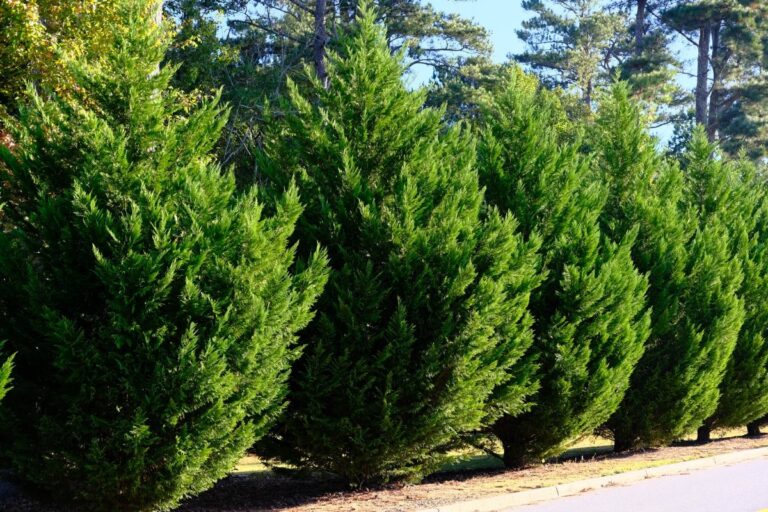
The Leyland cypress is perhaps the most widely planted fast-growing privacy tree in the world — and with good reason. It is evergreen, dense, and extremely tidy. It produces no meaningful fruit drop, no messy seeds, and no litter worth mentioning.
The fine-textured foliage stays on the tree year-round. It is the go-to choice for screens and windbreaks where fast coverage is a priority.
Best for: USDA Zones 6–10. Tolerates a wide range of soils but dislikes prolonged waterlogging.
3. October Glory Red Maple (Acer rubrum ‘October Glory’)
Growth rate: 1.5–3 feet per year
Not all maples are messy. The October Glory cultivar of red maple was selected specifically for its clean, reliable autumn display and its minimal seed production compared to standard red maples.
The helicopter seeds it does produce are far fewer than the straight species. The fall color — a deep, sustained crimson — is exceptional. It is a clean, handsome tree for large residential properties.
Best for: USDA Zones 4–9. Adaptable to wet or dry soils; highly versatile.
4. Bald Cypress (Taxodium distichum)
Growth rate: 2–3 feet per year
Despite being a conifer, the bald cypress is deciduous — and it drops its fine, feathery needles in autumn in a manner that is remarkably tidy. The needles are small and decompose quickly, rarely requiring raking.
It is one of the cleanest large trees available, with a stately pyramidal form that looks elegant in any landscape. It also tolerates wet, poorly drained sites better than almost any other tree.
Best for: USDA Zones 4–10. Excellent for wet areas, pond edges, and rain gardens.
5. Sycamore Maple (Acer pseudoplatanus)
Growth rate: 2–3 feet per year
Where the common sycamore (Platanus occidentalis) drops bark in unsightly sheets, the sycamore maple holds together cleanly. It is a large, robust tree with dense canopy coverage and relatively clean ground drop. The paired samaras (winged seeds) it produces are not a nuisance, and the large leaves decompose rapidly once fallen.
Best for: USDA Zones 4–7. Tolerates coastal exposure and urban pollution well.
6. Arborvitae ‘Green Giant’ (Thuja standishii × plicata ‘Green Giant’)
Growth rate: 3–5 feet per year
The Green Giant arborvitae is arguably the best all-around fast-growing privacy tree for most of the United States. It is virtually maintenance-free, producing almost no debris, no fruit, and no invasive roots. The dense, pyramidal form requires no pruning to remain tidy. It resists deer, tolerates a wide range of soils, and holds its rich green color through winter.
Best for: USDA Zones 5–8. Performs best in full sun with moderate moisture.
7. Aristocrat Pear (Pyrus calleryana ‘Aristocrat’)
Growth rate: 2–3 feet per year
Most homeowners associate ornamental pears with messy fruit drop, but the Aristocrat cultivar produces very small, inconspicuous fruit that birds consume before it ever reaches the ground.
It is one of the cleanest ornamental flowering trees available, with showy white spring blossoms, glossy summer foliage, and excellent fall color ranging from red to purple. The branching structure is stronger than the problematic Bradford pear.
Best for: USDA Zones 5–9. Tolerant of urban conditions, drought, and poor soils.
8. Heritage River Birch (Betula nigra ‘Heritage’)
Growth rate: 3–4 feet per year
River birch is known for its attractive, peeling cinnamon-colored bark — but the Heritage cultivar peels in smaller, neater curls than the standard species, and the shedding is minimal compared to white birch or paper birch.
The catkins it produces in spring are small and short-lived. This tree is an excellent choice for wet areas and naturalistic landscapes where a multi-stem form adds visual interest.
Best for: USDA Zones 4–9. Thrives in moist to wet soils; resists bronze birch borer better than white birch.
9. Sawtooth Oak (Quercus acutissima)
Growth rate: 2–3 feet per year
Most oaks grow slowly. The sawtooth oak is a notable exception — and unlike many fast-growing alternatives, it produces acorns that are relatively small and that wildlife consume efficiently.
Ground-level litter is minimal once the tree matures and nearby wildlife populations recognize it as a food source. The deeply fringed leaves are attractive, and the tree develops a broad, handsome canopy over time.
Best for: USDA Zones 5–9. Adaptable to a wide range of soil types; drought-tolerant once established.
10. Chinese Pistache (Pistacia chinensis)
Growth rate: 2–3 feet per year
The Chinese pistache is one of the most underused shade trees in American landscaping. It grows steadily, develops a broad, vase-shaped canopy, and produces some of the most brilliant fall color of any deciduous tree — reds, oranges, and yellows that rival the best maples.
Female trees produce small berries, but they are not considered a significant litter problem and are eagerly consumed by birds. Male trees produce no fruit at all.
Best for: USDA Zones 6–9. Extremely drought-tolerant; thrives in heat.
11. Willow Oak (Quercus phellos)
Growth rate: 2–3 feet per year
The willow oak occupies a unique category: it is an oak with narrow, willow-like leaves that create far less leaf litter than broad-leafed oaks. The small, thin leaves break down quickly, meaning you spend less time raking than you would with a standard oak.
It produces small acorns, but not in the quantities associated with larger-leaved species. It is a graceful, fine-textured tree with a clean appearance throughout the year.
Best for: USDA Zones 5–9. Tolerates wet soils; excellent for urban and suburban planting.
12. Northern Red Oak (Quercus rubra)
Growth rate: 2 feet per year
For those who want the permanence and dignity of a classic oak without a decades-long wait, the northern red oak is an ideal choice. It grows roughly twice as fast as white oak, develops reliable, vibrant fall color, and produces acorns that wildlife — squirrels, turkeys, deer — consume readily.
The leaf drop is manageable, and the tree has a strong, broadly rounded canopy that provides excellent shade.
Best for: USDA Zones 3–8. Prefers well-drained, acidic soils; not tolerant of compacted urban soils.
13. Eastern Redbud (Cercis canadensis)
Growth rate: 1.5–2.5 feet per year
The eastern redbud is one of the most beloved small trees in North American landscaping — and for good reason. In early spring, it covers itself in magenta-pink blossoms before the leaves emerge, creating a breathtaking display.
The spent flowers drop cleanly, and the heart-shaped leaves that follow are attractive through summer. Seed pods do form in autumn, but they are slender and not considered a significant nuisance.
Best for: USDA Zones 4–9. Tolerates partial shade; excellent understory or specimen tree.
14. Dawn Redwood (Metasequoia glyptostroboides)
Growth rate: 3–5 feet per year
Few trees grow as fast as the dawn redwood, and few are as structurally elegant. Like the bald cypress, it is a deciduous conifer — it drops its feathery needles in autumn, and they decompose so rapidly that cleanup is rarely necessary.
The tree develops a stunning pyramidal form with attractive reddish-brown furrowed bark. It is a living fossil — a species once thought extinct — and it brings a sense of deep natural history to any landscape.
Best for: USDA Zones 4–8. Prefers moist, well-drained soil; tolerates wet conditions.
15. Sweetbay Magnolia (Magnolia virginiana)
Growth rate: 1.5–2 feet per year
Unlike the saucer magnolia and southern magnolia — both of which produce large, leathery leaves that are slow to decompose — the sweetbay magnolia has smaller, more elegant leaves that break down readily.
It produces fragrant white flowers in late spring and early summer, but they do not carpet the ground in the way that larger magnolias do. In warmer climates, it is semi-evergreen, holding much of its foliage through winter.
Best for: USDA Zones 5–10. Tolerates wet, swampy soils; excellent for rain gardens.
16. Serviceberry (Amelanchier × grandiflora)
Growth rate: 1.5–2.5 feet per year
The serviceberry — also called shadbllow or Juneberry — is a multi-season performer that punches well above its size in ornamental value. White flowers in early spring, edible blueberry-like fruit in early summer (which birds typically strip from the tree before it can litter the ground), and orange-red fall color. The fruit, even what falls, does not stain or create a significant mess. It is a tidy, four-season tree.
Best for: USDA Zones 4–9. Adaptable to most soils; tolerates partial shade.
17. Nuttall Oak (Quercus texana)
Growth rate: 2–3 feet per year
The Nuttall oak is rapidly gaining popularity as a faster-growing alternative to more commonly planted oaks. Its acorn crop is smaller than that of many other oaks, and wildlife consumption keeps ground litter minimal.
The fall foliage turns a rich, reliable red, making it ornamentally valuable as well as fast-growing. It is an excellent choice for wet bottomland sites where many other oaks struggle.
Best for: USDA Zones 5–9. Thrives in moist to wet soils; excellent wildlife value.
18. Paperbark Maple (Acer griseum)
Growth rate: 1–2 feet per year
On the slower end of “fast,” the paperbark maple more than compensates with its extraordinary ornamental value. The peeling cinnamon-colored bark is arguably the most beautiful of any tree in temperate landscapes.
The bark peels in thin, papery curls — but it is considered a feature, not a nuisance, and the volume of shed material is minimal. The trifoliate leaves turn brilliant orange-red in autumn. A tree of exceptional elegance.
Best for: USDA Zones 4–8. Prefers well-drained soils; partial shade tolerance.
19. Black Gum (Nyssa sylvatica)
Growth rate: 1–2 feet per year
The black gum — also called tupelo — is one of the most reliable trees for autumn color in eastern North America, producing scarlet, orange, and yellow foliage that appears earlier than most other species.
Its small, dark fruit is consumed by birds almost as fast as it ripens, leaving virtually no ground litter. The tree has an attractive layered branch structure and deep, non-invasive roots that cause no trouble to nearby structures.
Best for: USDA Zones 3–9. Tolerates wet and dry conditions; highly adaptable.
20. Arizona Cypress (Hesperocyparis arizonica)
Growth rate: 2–3 feet per year
For gardeners in hot, dry climates where many other fast-growing trees struggle, the Arizona cypress is an outstanding option. It is evergreen, drought-tolerant, and produces almost no meaningful debris.
The fine, blue-gray foliage is attractive year-round, and the tree develops a strong pyramidal to columnar form that works well as a windbreak or screen. It is one of the cleanest conifers available for arid and semi-arid landscapes.
Best for: USDA Zones 7–11. Ideal for drought-prone regions; requires well-drained soil.
Choosing the Right Tree for Your Landscape
With twenty options in front of you, the natural next question is: which one should you actually plant? Here are a few guiding principles.
Match the tree to your climate first. A dawn redwood thrives in Zones 4–8 but struggles in the deep South. An Arizona cypress excels in the Southwest but would be out of place in the Pacific Northwest. Always check USDA hardiness zones before purchasing.
Consider your primary purpose. If you need a privacy screen quickly, Green Giant arborvitae or Leyland cypress are hard to beat. If you want shade over a patio, the tulip poplar or Chinese pistache may serve you better. If fall color is your priority, black gum, northern red oak, or October Glory red maple will reward you season after season.
Think about the mature size. A dawn redwood or tulip poplar can exceed 70 feet in height at maturity. These are magnificent trees — but not for a small suburban lot. In tighter spaces, serviceberry, eastern redbud, or sweetbay magnolia are better scaled choices.
Consider the soil. If your property has wet, poorly drained areas, bald cypress, sweetbay magnolia, Nuttall oak, or river birch are your best allies. For dry, sandy, or rocky soils, Chinese pistache, Arizona cypress, and sawtooth oak are the most forgiving.
A Note on “Fast” and Long-Term Health
One important truth in arboriculture is that the fastest-growing trees are sometimes the weakest structurally. Trees like silver maple, box elder, and Siberian elm grow rapidly but have brittle wood that breaks easily in storms, creating a genuine safety hazard and a significant cleanup problem over time.
The trees on this list represent a careful balance — they grow at a meaningful pace, but they do so with structural integrity. They are not the very fastest trees that exist; they are the fastest trees that you will still appreciate twenty years from now.
Patience remains part of the equation, but it is far less painful when the tree you are waiting for is not leaving a mess at your feet in the meantime.
References
- University of Florida IFAS Extension — Trees for Urban and Suburban Landscapes https://edis.ifas.ufl.edu/topic_shade_trees
- North Carolina State University Extension — Landscape Plants Databasehttps://plants.ces.ncsu.edu/
- Penn State Extension — Selecting and Planting Trees https://extension.psu.edu/trees-and-shrubs
- Virginia Cooperative Extension — Tree Selection for Strength and Beauty https://www.ext.vt.edu/topics/lawn-garden/trees-shrubs.html
- University of Minnesota Extension — Selecting Trees for Minnesota Landscapes https://extension.umn.edu/trees-and-shrubs/selecting-trees-landscapes

Tim M Dave is a gardening expert with a passion for houseplants, particularly cacti and succulents. With a degree in plant biology from the University of California, Berkeley, he has vast experience in gardening. Over the years, he has cultivated a vast collection of desert plants and learned a great deal about how to grow and care for these unique companions.