European Larch (Larix decidua): Identification, Uses, Problems, and Full Growing Guide
There is a moment in October, high in the Alps or the Carpathians, when something unexpected happens. The conifer forests — dark green and seemingly unchanging — suddenly burst into gold. It is not the broad-leaved trees doing this. It is the larches.
The European larch (Larix decidua) is one of the most extraordinary trees in the northern world.
It is a conifer that behaves like a deciduous tree — dropping its needles every autumn in a blaze of yellow and gold, standing bare through winter like a birch or an oak, then flushing brilliant green again each spring. No other common conifer in its range does this.
That single characteristic makes the European larch unlike almost any other tree you will encounter in a temperate forest. And it is just the beginning of what makes this species remarkable.
Before we dive into details, here is the European Larch at a Glance:
| Common Name | European Larch, Common Larch |
| Scientific Name | Larix decidua Mill. |
| Family | Pinaceae |
| Native Range | Alps, Carpathians, Sudeten Mountains; Central Europe |
| Type | Deciduous conifer |
| Average Height | 25 – 45 metres (80 – 148 ft) |
| Trunk Diameter | Up to 1 metre; occasionally larger on old trees |
| Crown Shape | Broadly conical when young; irregular and open with age |
| Lifespan | 500 – 1,000+ years |
| USDA Hardiness Zones | 2 – 6 |
| Soil Preference | Well-drained, slightly acidic to neutral; tolerates poor soils |
| pH Range | 5.5 – 7.0 |
| Water Needs | Moderate; drought-tolerant once established |
| Sun Requirement | Full sun — highly intolerant of shade |
| Growth Rate | Fast — among the fastest-growing conifers in cool climates |
| Foliage | Soft, needle-like; bright green in spring; golden-yellow in autumn |
| Bark | Grey-brown to reddish; deeply furrowed and scaly with age |
| Cones | Small, upright, egg-shaped; 2 – 4 cm long |
| Autumn Colour | Outstanding golden-yellow |
| Timber Quality | Excellent — strong, durable, resinous hardwood |
| Ecological Value | High — supports diverse invertebrates, birds, and fungi |
| Conservation Status | Least Concern (IUCN) |
What Is the European Larch?
The European larch is a large, fast-growing deciduous conifer native to the mountain ranges of central Europe. Its primary native habitat is the subalpine zone of the Alps, the Carpathian Mountains, the Sudeten Mountains, and the Tatra range — typically at elevations between 1,000 and 2,500 metres above sea level.
At these high altitudes, it often forms pure or mixed forests with Norway spruce (Picea abies) and Swiss stone pine (Pinus cembra). In lower-altitude settings outside its native range — including Britain, Scandinavia, and North America — it has been widely planted as a timber and ornamental tree since the 17th century.
What sets it apart from all other common European conifers is its deciduous habit. It sheds its needles each autumn — a trait shared within Europe only by the unrelated swamp cypress (Taxodium distichum), which is not native to the continent.
The species was formally described by Philip Miller in 1768, and its scientific name reflects its most notable trait: decidua means “falling off” in Latin — a direct reference to its seasonal needle drop.
Botanical Classification and Relatives
The European larch belongs to the family Pinaceae and the genus Larix — a group of approximately 10 to 14 species of deciduous conifers distributed across the cold and montane regions of the Northern Hemisphere.
Its closest relatives include:
- Japanese larch (Larix kaempferi) — widely planted in Britain and Europe for timber; more vigorous in some lowland conditions
- Siberian larch (Larix sibirica) — dominant in the boreal forests of Russia; highly cold-hardy
- Tamarack (Larix laricina) — native to North America; ecological equivalent in cold bogs and subarctic zones
- Dunkeld larch (Larix × marschlinsii) — a hybrid of European and Japanese larch, widely planted for forestry; often more vigorous than either parent
The hybrid Dunkeld larch is particularly important in British and European forestry. It was first recorded in Dunkeld, Scotland, in the early 18th century and has been extensively planted for timber production due to its superior growth rates.
Physical Description: Learning to Identify the European Larch
Needles and Foliage
The needles are soft, slender, and bright green — completely unlike the stiff, sharp needles of pine or spruce. They are typically 2–4 cm long and emerge in dense, brush-like clusters of 30 to 40 on short spur shoots, or singly and spirally on new long shoots.
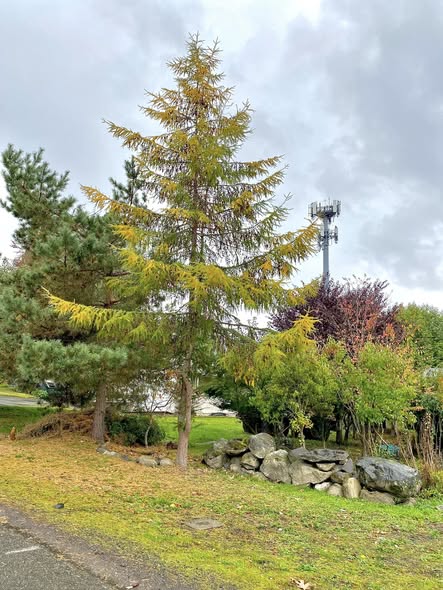
In spring, the emerging needles are a fresh, luminous green — one of the most beautiful sights in any forest in April. In autumn, they turn a rich golden-yellow before falling — creating a display that rivals any broad-leaved tree.
This needle behaviour is the key identification feature. If you see a conifer losing its needles in golden colour, in a forest where everything else stays green, it is almost certainly a larch.
Bark
Young trees have smooth, grey-brown bark. As the tree ages, the bark becomes progressively thicker, developing deep vertical furrows and rough, scaly ridges. On very old specimens, the bark can be 10 cm or more thick — a form of fire resistance adapted to the lightning-prone mountain forests of its native range.
The inner bark has a characteristic warm reddish-brown tone, visible in fresh wounds or where the outer plates have fallen away.
Cones
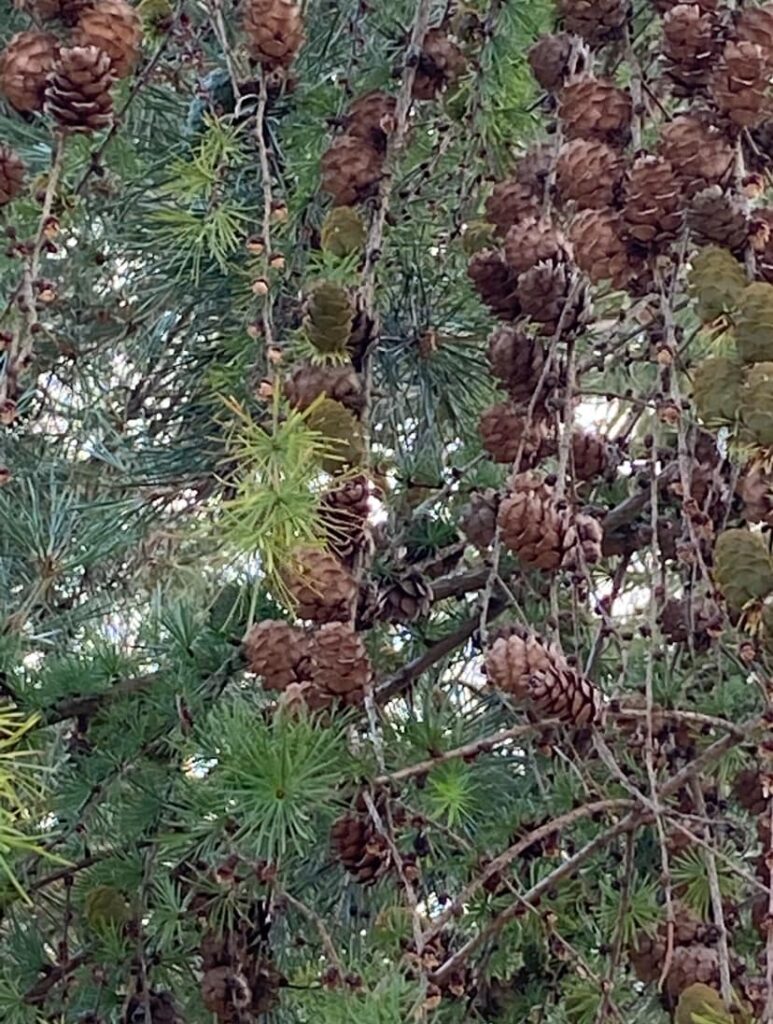
The cones are small and distinctive — upright, egg-shaped, 2–4 cm long, and composed of 40 to 50 thin, rounded scales. Female cones are initially pinkish-red and quite ornamental in spring; they mature to brown by autumn and remain on the tree for several years after releasing their seeds.
Male cones are small, yellow, and catkin-like, releasing pollen in spring before the needles fully expand. The pollen can be produced in remarkable quantities — dusting surfaces near trees with a fine yellow powder in April and May.
Form and Size
Young larches are broadly conical, with a straight central leader and horizontal to slightly drooping branches. With age, the crown becomes more irregular and open — developing a distinctive, somewhat windswept character, particularly in upland plantings.
In ideal conditions — deep, well-drained mountain soils with full sun — the European larch can reach 45 metres in height and live for 1,000 years or more. Some ancient specimens in the Alps are estimated to be several centuries old.
Native Habitat and Ecology
Where It Grows Naturally
In its native range, the European larch is a mountain tree. It occupies the upper subalpine forest zone, growing on steep, well-drained slopes where cold winters, high snowfall, and intense summer sun create conditions too harsh for most other trees.
It is highly cold-tolerant — surviving temperatures below -40°C in some locations — but it demands full sun and good drainage. It will not tolerate waterlogging or deep shade. These two requirements shape its distribution entirely.
In the Alps, larch forests are a defining landscape feature. The open, parkland-like quality of Alpine larch stands — with widely spaced trees, grassy understories, and views across mountain valleys — is one of the characteristic visual signatures of the European high Alps.
Ecological Role
The European larch is an ecologically important pioneer species. Following disturbances such as avalanches, rockfalls, or forest fires, it is often one of the first trees to recolonise bare ground. Its fast growth and tolerance of exposed, unstable soils make it invaluable in stabilising mountain slopes.
It supports a rich invertebrate fauna, including numerous moth and beetle species that are specific to or strongly associated with larch. These invertebrates, in turn, support woodland birds — particularly tits, crossbills, and woodpeckers — that feed on larch-associated insects and seeds.
Several specialist fungi form mycorrhizal associations with larch roots, including some of the finest edible species such as the larch bolete (Suillus grevillei) — a golden-coloured mushroom found almost exclusively beneath larch trees.
Larch woodland floor habitats are botanically rich, because the deciduous habit allows more light to reach the ground than evergreen conifer forests. Spring flowers, grasses, and dwarf shrubs thrive beneath larch in ways they cannot beneath spruce or fir.
History of Cultivation and Timber Use
Early Forestry Introductions
The European larch has been cultivated far outside its native range for over 400 years. In Britain, large-scale planting began in the early 18th century on the estates of Scottish and English landowners, most notably the Dukes of Atholl in Perthshire, who planted millions of larches on their hillside estates between 1730 and 1830.
These Scottish larches — now old trees of considerable size — remain among the most impressive plantings in British forestry history.
In continental Europe, larch was planted extensively at lower elevations for timber, as the quality of its wood was highly regarded for specific demanding applications.
Timber Properties
Larch produces one of the finest structural timbers of any European conifer. Its wood is notably different from that of spruce or pine:
- High density and strength — significantly harder and heavier than spruce
- High resin content — making it naturally durable and resistant to decay
- Distinctive grain — alternating soft and dense growth rings create a beautiful visual character
- Good dimensional stability — it moves relatively little with changes in moisture content
These properties have made larch timber the preferred choice for outdoor cladding, boat building, fencing, flooring, and any application where durability in contact with moisture or weather is important.
Historically, larch was used for the keels and planking of wooden boats throughout northern Europe. The Venetian lagoon city is partly founded on larch piles — an extraordinary testament to the wood’s durability in wet conditions.
Traditional and Cultural Uses
Beyond timber, the European larch has a long history of cultural significance in Alpine communities.
Larch resin (Venetian turpentine) was harvested from living trees and used medicinally and industrially — as a wound treatment, an antiseptic, and a base for varnishes and lacquers.
Alpine communities planted larches near farms and summer pastures, both for timber and as windbreaks. Old, solitary larch trees — sometimes centuries old — are common features of the Alpine landscape, often associated with chapels, shrines, and traditional boundaries.
Growing the European Larch: Cultivation Guide
Climate and Hardiness
This is one of the hardiest trees in cultivation, tolerating extreme cold to USDA Zone 2 (approximately -45°C). It is native to some of the coldest mountain climates in Europe.
It performs best in cool to cold temperate climates with well-distributed rainfall and distinct seasons. It is less well-suited to areas with mild, wet winters or hot, humid summers — conditions that can encourage fungal diseases.
Soil Requirements
The European larch is not particularly demanding about soil, provided two conditions are met: good drainage and adequate sunlight. It grows in sandy, gravelly, loamy, and thin rocky soils. It tolerates poor, nutrient-thin conditions reasonably well.
What it cannot tolerate is waterlogging. Roots in poorly aerated, waterlogged soil will rapidly decline, and trees planted in such conditions rarely thrive.
It prefers slightly acidic to neutral pH (5.5 – 7.0) but tolerates a modest range in either direction.
Planting
Plant in full sun — without exception. Larch in even partial shade grows poorly, develops weak structure, and is highly susceptible to disease and pest pressure.
Plant in autumn or early spring, before new growth begins. Young container-grown trees establish more easily than bare-root stock. Stake firmly in exposed positions — the tree develops a deep taproot over time, but young specimens can be vulnerable to wind rock before the root system establishes.
Space generously in forestry or woodland settings — at least 2.5 to 3 metres between trees when young, thinning progressively as the stand develops.
Watering and Establishment
Water regularly in the first growing season, particularly during dry periods. Once established — typically after two to three years — the European larch is surprisingly drought-tolerant for a tree of its size.
Mulching the root zone in the first few years helps conserve moisture and suppress competition from grass and weeds, which can significantly slow establishment.
Pruning
The European larch generally requires minimal pruning in natural or forestry settings. In amenity or garden contexts, dead and crossing branches can be removed in late winter.
Avoid heavy pruning in spring during bud burst and pollen release — the sap runs strongly at this time and large wounds can weep resin significantly. Late summer to early autumn, after growth has hardened but before dormancy, is often the most suitable time for any necessary pruning.
Pests, Diseases, and Common Problems
Larch Canker (Lachnellula willkommii)
This is the most damaging disease of European larch in cultivation, particularly in Britain and at lower elevations outside its native range. The fungus infects branch wounds and causes swelling, resin bleeding, and ultimately girdling cankers that kill branches or whole stems.
Wet, mild climates — such as much of lowland Britain — favour the disease significantly. This is one reason the hybrid Dunkeld larch has largely replaced pure European larch in British forestry — it has better canker resistance.
Control involves removing and destroying infected material promptly. Good air circulation and avoiding sites prone to late frosts (which create the entry wounds the fungus exploits) reduce risk.
Larch Aphid (Cinara laricis)
A large, grey-green aphid that feeds on larch shoots in spring. Heavy infestations can check growth and produce quantities of sticky honeydew, which encourages sooty mould. Natural predators — especially ladybirds and parasitic wasps — usually provide adequate control in established woodland.
Phytophthora Root Rot
Waterlogged soils create conditions for Phytophthora root rot, which rapidly kills roots and causes progressive crown dieback. The solution is prevention — correct site selection and drainage are essential. There is no effective treatment once infection is established.
Grey Squirrel Damage (UK)
In Britain, grey squirrels strip bark from young larch trees, causing significant damage or death in some plantings. Spiral guards on young trees in squirrel-heavy areas are advisable.
Ornamental and Landscape Value
The European larch is an outstanding ornamental tree for large gardens, parks, and landscape-scale plantings — wherever space allows.
Its value across the seasons is exceptional:
- Spring: Fresh, luminous green needles and ornamental pink female cones
- Summer: Rich mid-green foliage; elegant, airy crown texture
- Autumn: Outstanding golden-yellow colour — one of the finest of any conifer
- Winter: Bare branches with persistent brown cones; architectural skeletal form
The weeping cultivar Larix decidua ‘Pendula’ is a popular garden form, with strongly drooping branches that create a dramatic, sculptural appearance. It is suitable for smaller spaces and makes a striking focal point in a winter landscape.
The European larch also makes an excellent bonsai subject, widely grown in this art form for its graceful needle clusters, attractive bark, and superb autumn colour.
Conservation and Future Outlook
In its native Alpine and Carpathian range, the European larch is not under immediate threat. It is listed as Least Concern by the IUCN. However, climate change introduces genuine uncertainties.
Warmer, drier summers in the Alps are already causing stress in some larch populations, particularly at lower elevations. Range shifts upward in altitude are being documented. The tree’s dependence on cold winters and cool growing seasons means that a warming climate could progressively reduce suitable habitat in its traditional range.
In planted stands at lower elevations, larch canker and changing moisture patterns are challenges requiring active management.
Conservation efforts focus on preserving the genetic diversity of native Alpine larch populations — recognising that trees from different provenances (geographical origins) within the native range may have quite different climate tolerances, representing a genetic resource for adaptation to future conditions.
Final Thoughts
I have stood in Alpine larch forests in October, and the experience stays with you. The way those golden crowns burn against a blue autumn sky, surrounded by the deep green of spruce and the grey of limestone — it is genuinely one of the finest sights in European nature.
The European larch is not just a commercially useful tree or an ecological keystone. It is one of those rare species that reminds you, if you spend time with it, that the natural world is full of surprises.
A conifer that turns gold and goes bare for winter. A mountain tree that has sailed oceans in the keels of wooden ships. A pioneer that holds Alpine slopes together while simultaneously housing rare moths and golden mushrooms beneath its branches.
Few trees earn such varied admiration — from foresters, ecologists, artists, and ordinary walkers alike.
It is a tree well worth knowing.
References
- University of Florida IFAS Extension — Environmental Horticulture Conifer species profiles, ornamental tree evaluation, and temperate landscape use. https://edis.ifas.ufl.edu/
- NC State Extension — Plants Database Larix decidua species profile: identification, growth habits, ornamental features, and regional suitability. https://plants.ces.ncsu.edu/
- Cornell University Cooperative Extension — Horticulture and Forestry Deciduous and coniferous tree identification, selection, and management in temperate climates. https://cals.cornell.edu/cornell-cooperative-extension
- University of Minnesota Extension — Sustainable Forestry Cold-climate forestry species, including larch and other boreal and subalpine conifers. https://extension.umn.edu/
- Penn State Extension — Forest Stewardship Timber tree species profiles, forest health, and woodland management for private landowners. https://extension.psu.edu/

Tim M Dave is a gardening expert with a passion for houseplants, particularly cacti and succulents. With a degree in plant biology from the University of California, Berkeley, he has vast experience in gardening. Over the years, he has cultivated a vast collection of desert plants and learned a great deal about how to grow and care for these unique companions.