Understanding European Beech (Fagus sylvatica): Identification, Growing, Problems, and More
Walk into a mature beech forest in autumn, and the experience stays with you. The smooth, silver-gray trunks rise like columns in a cathedral. The canopy closes overhead in a dense vault of copper and gold. The light filters through in warm, amber tones that feel almost liquid.
There is a quality of silence in an old beech wood that is different from any other forest — denser, more complete, more ancient.
The European Beech (Fagus sylvatica) has shaped the landscapes, cultures, and ecologies of Europe for thousands of years. It is the dominant forest tree across large parts of the continent. It is one of the most widely planted ornamental trees in the world.
This tree has given its name to books — the word “book” in many European languages traces back to words for beech wood, on which early runes were carved. And it remains, by almost any measure, one of the most beautiful and ecologically important trees in the temperate world.
This guide covers everything you need to know about the European Beech — from its biology and native range to its cultivation requirements, ecological role, cultural history, and outstanding ornamental varieties.
Before we dive in, let’s have a quick look at what this tree is all about.
| Scientific Name | Fagus sylvatica L. |
| Common Names | European Beech, Common Beech |
| Family | Fagaceae (Beech family) |
| Typical Height | 100–130 ft (30–40 m); occasionally to 160 ft (49 m) |
| Trunk Diameter | Up to 5 ft (1.5 m) on mature trees |
| Bark | Smooth, thin, pale silver-gray throughout life |
| Leaf Shape | Oval to elliptic, wavy-toothed margins, 2–4 inches long |
| Fall Color | Rich copper-orange to golden-brown |
| Flowers | Monoecious; small, inconspicuous; appear with leaves in spring |
| Fruit | Beechnuts (mast) in spiny husks — 2–3 triangular nuts per husk |
| USDA Hardiness Zones | 4–7 |
| Soil Preference | Well-drained, moderately fertile, slightly acidic to neutral |
| Light Requirement | Full sun to partial shade; young trees shade-tolerant |
| Growth Rate | Slow to moderate — 12–18 inches per year |
| Lifespan | 200–300 years; occasional specimens to 500+ years |
What Is the European Beech?
The European Beech belongs to the family Fagaceae — the beech and oak family — alongside oaks (Quercus), chestnuts (Castanea), and their relatives. It is one of approximately ten species in the genus Fagus, which collectively span the temperate forests of the Northern Hemisphere.
The nearest relatives of Fagus sylvatica include the Oriental Beech (F. orientalis) of the Middle East and Caucasus, and the American Beech (F. grandifolia) of eastern North America.
The species name sylvatica is Latin for “of the forest” — a description as accurate today as it was when Linnaeus formally named the species in 1753. Beech is, above all else, a forest tree. It dominates where it grows, shading out competitors with its dense canopy, carpeting the forest floor with deep leaf litter, and creating one of the most distinctive ecological communities in Europe.
In German, the beech is called “Buche” — a word directly related to the English “book.” Early Germanic peoples carved letters onto thin beech boards, and many scholars believe this practice gave European languages their words for written texts.
Identification: Recognizing European Beech
Bark
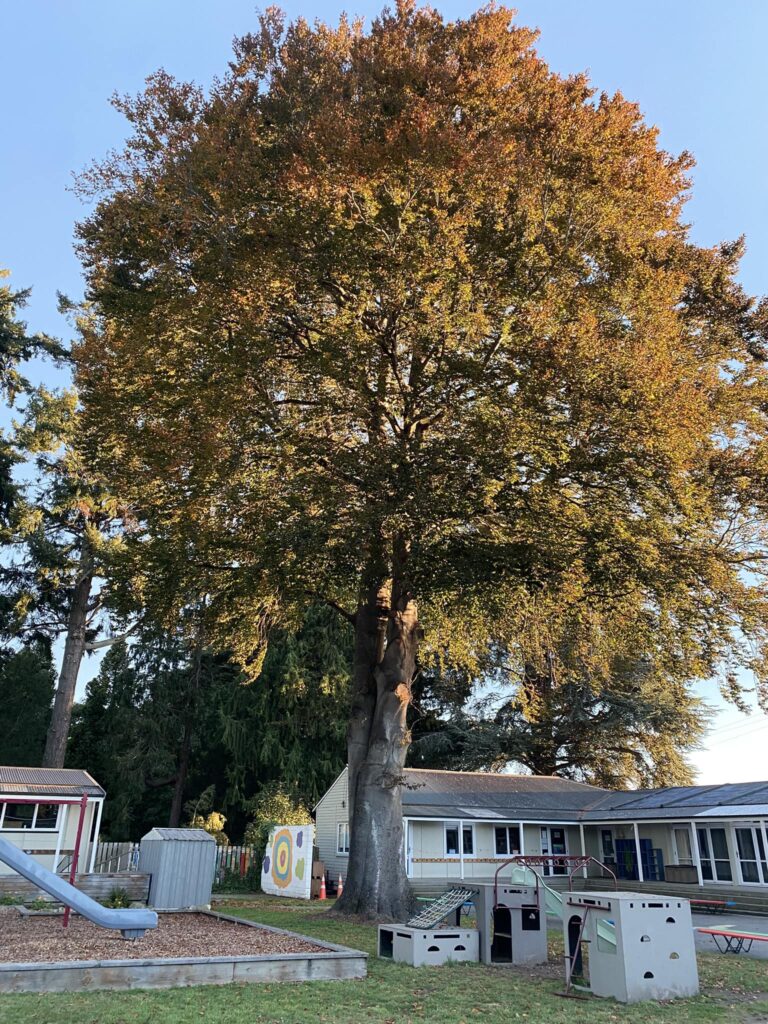
The bark of Fagus sylvatica is one of the most recognizable features of any European tree. Unlike most large deciduous trees, which develop deeply furrowed or plated bark with age, the European Beech remains smooth throughout its life.
The surface is thin, tight to the wood, and pale silver-gray — almost metallic in certain light conditions.
This smooth bark makes the tree notoriously attractive to carvers — initials and dates cut into beech bark remain legible for decades, sometimes centuries. It also makes the trunks particularly striking in winter, when the smooth columns rise bare above the leaf-littered forest floor.
On very old trees, the base may develop slight irregularities and low burrs, but the characteristic smooth silver surface persists on the upper stem and branches throughout the tree’s life.
Leaves
Beech leaves are oval to elliptic, typically 2 to 4 inches long, with a wavy or shallowly toothed margin and a pointed tip. The surface is deep, lustrous green above and paler beneath.
When young — emerging in April or May — the leaves are pale yellow-green and covered in silky white hairs, giving the newly opened canopy a soft, luminous quality that is one of the great seasonal displays of the European countryside.
As they mature through summer, the leaves darken and the hairs are lost. In autumn, they turn rich copper-orange to warm golden-brown — a display that is both intense and long-lasting. In a good autumn, a mature beech woodland burns with color for three to four weeks.
One of the most distinctive features of beech leaves is their marcescence — the tendency for dead leaves to remain attached to the twigs through winter rather than dropping in autumn.
This is particularly pronounced on young trees and hedgerow beeches, where pale tan dead leaves persist until pushed off by new growth the following spring.
The effect on a beech hedge in winter is beautiful — a warm rustle of dry, papery leaves against cold air.
Flowers and Fruit
The European Beech is monoecious — both male and female flowers occur on the same tree. They appear in April and May, simultaneously with the emerging leaves. Male flowers hang in small spherical clusters on long, drooping stalks.
Female flowers are smaller and paired, enclosed in a four-lobed involucre that eventually develops into the spiny husk surrounding the fruit.
The fruit — known as beechmast or beechnuts — consists of two or three small, three-angled nuts enclosed in a woody, bristle-covered husk approximately 1 inch long.
The nuts ripen in September and October and fall in large quantities in mast years — periodic seasons of exceptional seed production that occur every few years in response to weather patterns.
Beechmast is a critical food resource for a wide range of wildlife and has historically been important to humans and their livestock as well.
Native Range and Natural Habitat
Where European Beech Grows Naturally
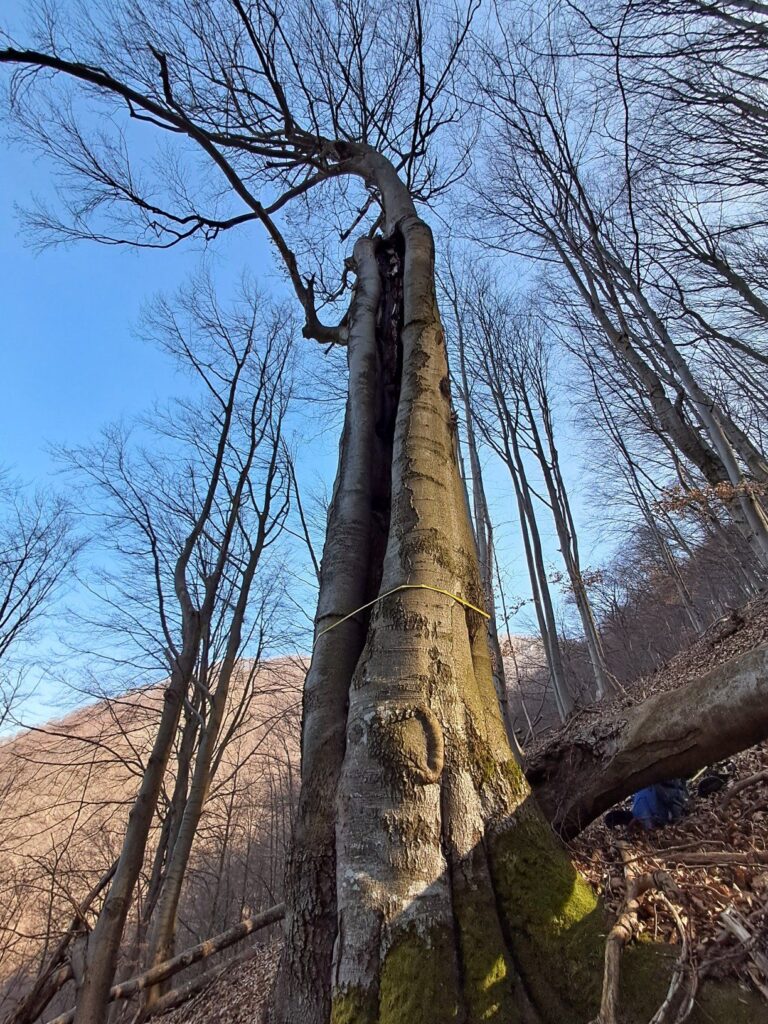
The European Beech is native to a broad band of Western, Central, and Southern Europe, extending from:
- Southern England and Wales in the northwest
- Southern Scandinavia (Denmark and southern Sweden) in the north
- Southern Poland and Ukraine in the east
- The Apennine Mountains of Italy and the Balkans in the south
- Northern Spain and Portugal in the southwest
Its eastern boundary is sharply defined by increasing continentality of climate — beech cannot tolerate the extreme winter cold and summer drought of continental interiors. Where the climate becomes more extreme, it gives way to oak and other more drought-tolerant species.
Preferred Ecological Conditions
In its native range, European Beech strongly prefers:
- Well-drained, deep soils — it is notably intolerant of waterlogged conditions
- Moderate to high rainfall — typically 24 to 40+ inches annually
- Temperate oceanic climates with cool, moist summers and mild winters
- Slightly acidic to neutral soils (pH 4.5–7.5), though it adapts to chalk and limestone substrates
The tree is notable for its exceptional shade tolerance in youth. Young beeches can grow slowly but persistently beneath a closed canopy, waiting for a gap in the overstory before accelerating their growth. This shade tolerance gives beech a powerful competitive advantage in the long-term succession of European forests.
Ecological Importance
Dominance and the Beech Forest Ecosystem
Where conditions suit it, European Beech is a competitive dominant that forms extensive pure or near-pure forests. The dense, closed canopy it creates in summer admits very little light to the forest floor.
As a result, the ground flora of mature beech forest is typically sparse — limited to highly shade-tolerant species such as wood sorrel (Oxalis acetosella) and dog’s mercury (Mercurialis perennis), and early spring ephemerals that complete their life cycles before the canopy closes.
This creates a landscape of great visual drama — wide-spaced trunks, a bare leaf-litter floor, and a high, dense canopy — but relatively low plant species richness at ground level.
The ecological value of beech woodland lies not in floristic diversity but in the structural complexity of old trees, dead wood, and the specialized invertebrate and fungal communities they support.
Biodiversity Value
Old beech trees are among the most important habitat trees in European forests:
- Fungi: European Beech supports an exceptional diversity of mycorrhizal and saprotrophic fungi. Species such as the Beech Bracket (Ganoderma australe) and Beefsteak Fungus (Fistulina hepatica) are closely associated with beech woodland.
- Invertebrates: More than 170 invertebrate species are closely associated with European Beech in the UK alone. Dead and decaying beech wood supports rare beetle species, including the Lesser Stag Beetle (Dorcus parallelipipedus).
- Birds: Beechmast is a critical food source for Bramblings, Chaffinches, Hawfinches, and Woodpigeons in autumn and winter. Nuthatches and treecreepers forage on beech trunks year-round.
- Mammals: Badgers, dormice, and squirrels feed heavily on beechmast in mast years. The deep leaf litter of beech woodland provides winter cover for hedgehogs and small mammals.
Carbon Storage
Mature beech forests are significant carbon sinks. Research confirms that managed and unmanaged beech forests in Central Europe store substantial quantities of carbon both in above-ground biomass and in the deep organic soils beneath long-established beech woodland.
Ornamental Use and Cultivars
European Beech in the Landscape
The European Beech is one of the most celebrated ornamental trees in temperate horticulture. Its smooth silver bark, architectural form, spectacular seasonal transitions, and outstanding longevity make it a premier choice for parks, large gardens, and avenue planting.
It is, admittedly, a tree that demands patience. Growth in the first decade or two is not dramatic. But beech rewards the long view — a specimen of 50 or 100 years is a genuinely magnificent thing.
Beech Hedging
One of the most distinctive and widely used applications of European Beech is as a formal hedge. Beech hedges are dense, attractive, and — thanks to the marcescent quality of the leaves — provide year-round screening despite being a deciduous species.
The pale tan winter leaves create a warm visual barrier even when the rest of the garden is bare.
Beech is one of the finest hedging plants in temperate horticulture, widely used for formal garden enclosures, country estate boundaries, and windbreaks in rural landscapes. It clips well, responds vigorously to cutting, and maintains excellent density under regular management.
Notable Cultivars
The European Beech has produced an exceptional range of cultivated varieties:
- ‘Purpurea’ (Copper Beech / Purple Beech): The most famous beech cultivar — possibly the most recognized ornamental tree in Europe. It produces deep purple-red to copper-purple foliage throughout the growing season. Mature Copper Beeches are among the most impressive trees in any landscape. Named selections include ‘Riversii’ (deepest purple) and ‘Rohanii’ (purple with deeply cut leaf margins).
- ‘Pendula’ (Weeping Beech): A dramatically weeping form with long, sweeping branches that cascade to the ground. Old weeping beeches develop enormous, tent-like structures of extraordinary architectural character.
- ‘Dawyck’ (Fastigiate Beech): A narrow, columnar form ideal for formal avenues and restricted spaces. ‘Dawyck Purple’ and ‘Dawyck Gold’ are purple- and yellow-leaved variants of this upright form.
- ‘Asplenifolia’ (Fern-leaved Beech): A cultivar with deeply cut, narrow leaf lobes giving the foliage a fern-like or feathery texture entirely unlike the typical beech leaf.
- ‘Zlatia’ (Golden Beech): Leaves emerge bright golden-yellow in spring, gradually transitioning to yellow-green through summer.
- ‘Tricolor’: Leaves are variegated in green, white, and pink — the most colorful of all beech cultivars. Best in partial shade to preserve leaf colors without scorching.
Growing European Beech
Hardiness and Climate
European Beech is rated for USDA Hardiness Zones 4 to 7, performing best in cool, temperate climates with moderate, consistent rainfall. It does not tolerate:
- Extreme summer heat and drought — causes leaf scorch and serious stress
- Prolonged waterlogging — roots are highly sensitive to standing water
- Exposed, windy sites — young trees especially need shelter from strong or drying winds
It is best suited to the maritime and temperate zones of the northern United States, the Pacific Northwest, the British Isles, and northern and central Europe.
Soil and Drainage
Good drainage is the single most important soil requirement for European Beech. Plant it in:
- Well-drained, deep loamy soils — avoid heavy clay unless substantially improved
- Slightly acidic to neutral pH (5.5–7.0)
- Moderately fertile ground — very rich soils promote lush, soft growth susceptible to disease
Beech is notably intolerant of soil compaction around the root zone — a key limitation in urban settings. Avoid heavy traffic or construction activity within the root zone of established trees.
Planting and Establishment
- Position: Full sun for best form and autumn color. Tolerates partial shade, particularly useful in woodland garden settings.
- Spacing: For individual specimen trees, allow at least 50 feet of clearance in all directions. For hedges, plant at 18 to 24 inches apart.
- Season: Plant in autumn or early spring. Bare-root plants are widely available for hedging and establish well when planted correctly.
- Watering: Water deeply through the first two to three growing seasons. Established trees tolerate dry periods in cool climates but show stress during prolonged summer drought.
- Mulching: A generous layer of organic mulch (3–4 inches deep, kept clear of the stem base) conserves moisture, moderates soil temperature, and supports establishment significantly.
Pruning
Beech responds well to pruning and clipping. Hedge beech should be cut once a year, in late summer (August) — late-summer cutting allows the marcescent leaves to develop correctly, maintaining winter screening.
Specimen trees require minimal pruning beyond removal of dead or crossing branches, ideally in late autumn or winter when dormant.
Common Pests and Diseases
Beech Bark Disease
This is the most serious threat to European Beech across much of its range. It results from infestation by the Felted Beech Scale (Cryptococcus fagisuga) and subsequent infection by the fungus Neonectria ditissima.
The scale insect creates entry wounds in the bark through which the fungus enters, causing cankers, bark death, and structural decay.
Severe infections can kill large sections of the crown. The disease is particularly destructive in North America, where it has also affected American Beech populations extensively. Maintaining tree vigor and avoiding unnecessary bark wounding is the primary management strategy.
Beech Leaf Disease
An emerging and increasingly serious threat — particularly in North America — caused by the nematode Litylenchus crenatae and associated microbiome disruption.
Affected leaves develop dark banding between leaf veins, leading to distortion, premature drop, and tree decline. First documented in the United States in 2012, it has spread significantly and is under active research.
Phytophthora Root Rot
Waterlogged soils predispose beech to infection by Phytophthora species — pathogens that kill root tissue, causing crown dieback and eventual death. Correct siting in well-drained soil is the most effective prevention.
Beech Aphid (Phyllaphis fagi)
Colonies of woolly beech aphid on leaf undersides cause white waxy deposits on foliage in spring and early summer. Rarely fatal — natural predators typically restore balance within the season without intervention.
Historical and Cultural Significance
Beech and the Origin of “Book”
The connection between beech trees and written language is genuine and historically documented. In Old English, the word for beech was “bōc” — and the same root gives modern English both “beech” and “book.”
Early Germanic runes were carved on thin beech tablets, and the word for a written text evolved directly from the name of the material on which it was first inscribed. Standing beneath an old beech tree, it is impossible not to feel the weight of that history.
Beech in European Culture
The European Beech occupies a central place in the cultural landscapes of several nations:
- In Denmark, the beech is a national symbol — celebrated in poetry and song as emblematic of the Danish countryside.
- In Germany, beech forests (Buchenwälder) hold deep cultural resonance as the archetypal German forest. Several German beech forest landscapes are designated UNESCO World Heritage Sites — including Jasmund National Park on Rügen and Kellerwald-Edersee National Park.
- In Britain, ancient beech woods on the Chiltern Hills and in the New Forest are among the most visited natural landscapes in the country.
Traditional Uses of Beechwood and Mast
Beechwood has been valued for centuries for specific applications:
- Furniture and flooring — particularly chair legs and workbench tops, where hardness, smooth texture, and workability are prized
- Tool handles — planes, mallets, and hand tools
- Charcoal production — historically used in glassmaking and metallurgy
- Beechmast oil — pressed from the nuts, used in cooking and as lamp oil in rural European communities
- Pig pannage — pigs turned into beech woodland in autumn to fatten on fallen mast was a critical component of medieval European agriculture
Frequently Asked Questions
How long does it take for a European Beech to mature?
European Beech is a slow to moderate grower. It typically takes 20 to 30 years to develop into an impressive specimen and 50 to 100 years to reach full ornamental maturity. Well-tended specimens can remain healthy and beautiful for 300 years or more.
Can I grow European Beech in a small garden?
The standard species grows too large for most small gardens. However, cultivars such as ‘Dawyck’ (columnar) or the slower-growing ‘Tricolor’ and ‘Asplenifolia’ are more manageable. Alternatively, beech makes an excellent hedge species — dense, attractive, and fully controllable.
Why does my beech hedge keep its leaves in winter?
This is the marcescent quality described above — a natural and entirely normal characteristic of beech, particularly on younger growth. The dead leaves persist through winter and are pushed off by new buds the following spring. Many gardeners consider this one of beech’s most valued features.
Is Copper Beech the same species as European Beech?
Yes — Copper Beech is a purple-leaved cultivar of Fagus sylvatica, most commonly the selection ‘Purpurea’ or named varieties derived from it. It is the same species in all biological respects, differentiated only by leaf pigmentation.
Is European Beech invasive outside its native range?
No. European Beech does not behave invasively. It regenerates slowly, does not sucker, and does not spread aggressively beyond planted areas. It is safe to plant across its cultivated range without concern about invasive spread.
Final Thoughts
The European Beech is a tree for people who think in decades rather than seasons. It asks for patience. It gives back — eventually — something that no fast-growing substitute can replicate: presence.
The smooth silver trunk, the copper autumn canopy, the whisper of marcescent leaves in a January wind, the structural gravity of a tree that has been growing for two hundred years — these are not effects you can rush.
Plant a beech where it has room. Give it well-drained soil, enough rainfall, and time. Then step back and let it do what it has done across European forests for ten thousand years. You will not regret it, and neither will the generations that come after you.
References
- Virginia Tech Dendrology — Fagus sylvatica Fact Sheet College of Natural Resources and Environment, Virginia Tech University https://dendro.cnre.vt.edu/dendrology/syllabus/factsheet.cfm?ID=56
- University of Florida IFAS Extension — Fagus sylvatica: European Beech Environmental Horticulture Department, UF/IFAS https://edis.ifas.ufl.edu/publication/ST228
- North Carolina State University Extension — Fagus sylvatica Plant Profile NC State Extension Plants, College of Agriculture and Life Sciences https://plants.ces.ncsu.edu/plants/fagus-sylvatica/
- Missouri Botanical Garden Plant Finder — Fagus sylvatica Shaw Nature Reserve and Missouri Botanical Garden https://www.missouribotanicalgarden.org/PlantFinder/PlantFinderDetails.aspx?kempercode=a893
- Penn State Extension — Beech Bark Disease College of Agricultural Sciences, Pennsylvania State University https://extension.psu.edu/beech-bark-disease

Tim M Dave is a gardening expert with a passion for houseplants, particularly cacti and succulents. With a degree in plant biology from the University of California, Berkeley, he has vast experience in gardening. Over the years, he has cultivated a vast collection of desert plants and learned a great deal about how to grow and care for these unique companions.