Understanding Erman’s Birch (Betula ermanii): Identification, Uses, Problems, and Cultivation
There is something quietly remarkable about a tree that chooses to grow where most others give up. High on volcanic slopes, along wind-scoured ridgelines, and across the frost-hardened landscapes of northeast Asia, Erman’s Birch (Betula ermanii) stands firm.
It is not the tallest birch in the world, nor the most widely planted. But it may be the toughest — and among the most beautiful.
For gardeners seeking an elegant, cold-hardy specimen tree, or anyone simply curious about this striking species, this guide covers everything worth knowing about Erman’s Birch — from its features and native range to its landscape uses, cultivation requirements, and ecological value.
But before we dive in, here is a quick understanding of this tree;
| Scientific Name | Betula ermanii Cham. |
| Common Names | Erman’s Birch, Russian Rock Birch, Gold Birch |
| Family | Betulaceae |
| Native Range | Japan, Korea, Russian Far East, northeastern China |
| Typical Height | 50–80 ft (15–25 m); shorter at high elevations |
| Trunk Diameter | Up to 2.5 ft (75 cm) |
| Bark Color | Creamy white to pinkish-orange, peeling |
| Leaf Shape | Ovate, doubly serrated margins, 2–4 inches long |
| Fall Color | Clear yellow |
| Flowers | Monoecious; male catkins appear before leaves |
| Fruit | Small winged nutlets in cylindrical catkins |
| USDA Hardiness Zones | 4–7 |
| Soil Preference | Well-drained, moist, acidic to neutral |
| Light Requirement | Full sun to partial shade |
| Growth Rate | Moderate (12–24 inches per year) |
| Lifespan | 100–200+ years in ideal subalpine conditions |
What Is Erman’s Birch?
Erman’s Birch belongs to the family Betulaceae — the birch family — alongside alders, hornbeams, and hazels. Within the genus Betula, it is placed in the section Costatae, a group of Asian birches known for their distinctive peeling bark and high-altitude adaptations.
The species was named in honor of Georg Adolf Erman (1806–1877), a German physicist and explorer who traveled extensively through Siberia and the Russian Far East during the early 19th century.
His botanical collections from these expeditions helped European scientists document many plant species previously unknown in the West. Erman’s Birch is one of those discoveries — a living legacy of 19th-century scientific exploration.
In Japan, the tree is known as “Dake-kamba” (岳樺), meaning “mountain birch” — a name that captures its preferred alpine and subalpine habitat perfectly. In Russia, it is sometimes called the “Stone Birch” (Kamennaya bereza), reflecting its association with rocky, volcanic terrain.
Identification: How to Recognize Erman’s Birch
Bark
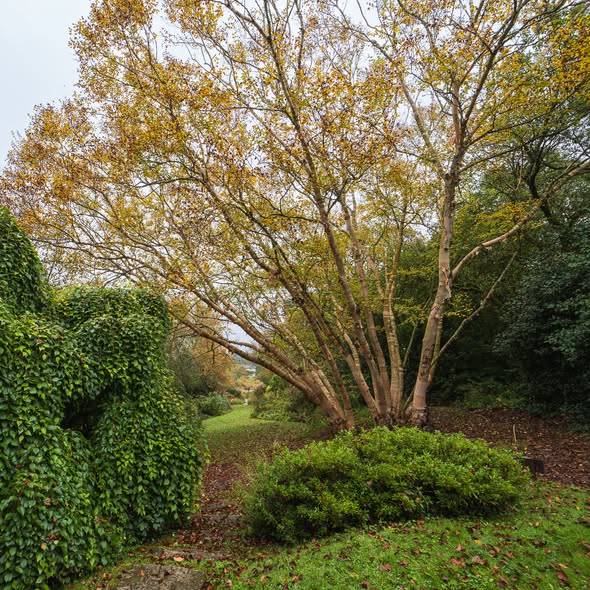
The bark is the defining feature of Erman’s Birch and the reason many gardeners seek it out. It is creamy white to pale pinkish-orange on young trees, peeling away in horizontal papery layers to reveal buff-orange or salmon-tinted inner bark beneath.
On older trunks, the base often becomes rougher and darker gray-brown, while the upper trunk and branches retain their pale, peeling character.
The color shift from cream to warm orange on the inner layers makes this tree exceptional in the winter landscape, when the bark glows against snow or bare ground. I have seen mature specimens in botanical garden collections, and the bark alone stops visitors in their tracks.
Leaves
The leaves are ovate to broadly triangular, typically 2 to 4 inches long, with a heart-shaped or somewhat rounded base and a pointed tip. The margins are doubly serrated — meaning each large tooth carries smaller teeth along its edge — a characteristic shared by many birch species.
Leaf surfaces are deep green above and paler beneath, with prominent veins and sparse hair along the veins on the underside. The petiole (leaf stalk) is short and slightly hairy.
In autumn, the foliage turns a clean, clear yellow — not as fiery as some maples, but warm and genuinely attractive, especially when backlit by low autumn sun.
Catkins and Fruit
Like all birches, Erman’s Birch is monoecious — it bears separate male and female flowers on the same tree. Male catkins are long, pendulous, and appear before the leaves in spring — often in clusters of two to four at the tips of twigs. They are yellowish-green and release abundant pollen.
Female catkins are shorter and more upright. After pollination, they develop into cylindrical fruiting catkins containing hundreds of tiny winged nutlets (samaras). These break apart and disperse on the wind throughout summer and into autumn.
The seeds are extremely small and lightweight — an adaptation for wide dispersal across open, high-altitude terrain where suitable germination sites may be far apart.
Overall Form
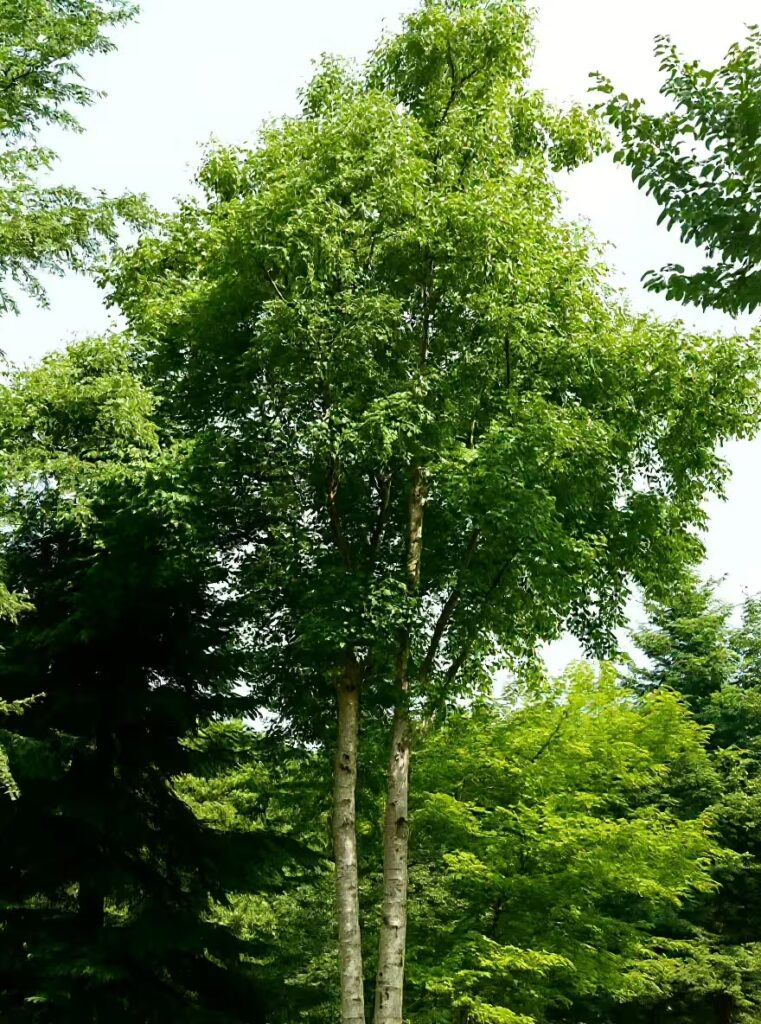
Young trees have a broadly pyramidal shape. As they mature, the crown becomes more open, rounded, and irregular — often with a graceful, slightly arching branch structure.
At high elevations, the wind-sculpted forms of old Erman’s Birch trees are particularly striking, with contorted trunks and asymmetric crowns shaped by decades of exposure.
Native Range and Natural Habitat
Geographic Distribution
Erman’s Birch has a broad but discontinuous distribution across the temperate and boreal regions of northeastern Asia:
- Japan: Found across Hokkaido and in the subalpine zones of Honshu, particularly on volcanic mountains such as Mount Fuji, Mount Asahi, and the Japanese Alps
- South Korea: Present in mountainous regions, particularly on Jeju Island (Hallasan mountain) and in the northern highlands
- Russian Far East: Widespread across Kamchatka, Sakhalin, the Kuril Islands, and parts of Siberia — including some of the most remote and ecologically intact forests on Earth
- Northeastern China: Occurring in Manchuria and adjacent border regions
This distribution places Erman’s Birch within the circum-Pacific temperate zone — one of the world’s most botanically diverse regions, shaped by volcanic activity, monsoon climates, and extreme seasonal temperature variation.
Altitude Range
One of the most remarkable things about this species is its vertical range. It grows from near sea level on exposed coastal sites to elevations of over 8,200 feet (2,500 meters) in the Japanese Alps.
On the volcanic mountains of Kamchatka, it forms the dominant tree line species — growing right up to the point where trees can no longer survive at all.
This makes Erman’s Birch a true timberline tree — a specialist adapted to the zone between closed-canopy forest below and open tundra above.
Ecological Community
In its native range, Erman’s Birch typically grows in subalpine birch forest — a distinctive vegetation type characterized by open, park-like stands of birch with a ground cover of tall herbaceous plants, ferns, and grasses.
In Japan, these forests are called “Dake-kamba forests” and are recognized as important ecosystems for alpine wildlife, including bears, deer, and numerous bird species.
On Kamchatka and Sakhalin, pure stands of Erman’s Birch cover vast areas, forming some of the most extensive naturally occurring birch forests in the world — a landscape unlike anywhere else on Earth.
Ecological Importance
As a Pioneer and Keystone Species
Erman’s Birch is a pioneer species at high elevations. After volcanic eruptions, landslides, or glacial retreat, it is often among the first trees to colonize bare, nutrient-poor ground.
Its light, wind-dispersed seeds reach new sites quickly, and its tolerance of poor soils and harsh conditions allows it to establish where other trees cannot yet survive.
Once established, sycamore birch stands modify the local environment — adding organic matter to the soil, reducing wind exposure, and creating the micro-conditions that allow other plant species to follow.
Wildlife Support
The ecological value of Erman’s Birch extends across multiple trophic levels:
- Birds: Seeds are eaten by siskins, redpolls, and other finches. The open, multi-stemmed structure of birch stands provides excellent nesting habitat.
- Mammals: Bears in Kamchatka and the Russian Far East use dense birch forests for cover and forage on the invertebrates found in decaying birch wood. Red deer and sika deer browse young birch growth.
- Insects: Birch trees in general support hundreds of invertebrate species in their native ranges. The leaves, bark, and dead wood of Erman’s Birch support a range of beetles, moths, and other insects critical to forest food webs.
Soil and Watershed Protection
In steep, high-altitude terrain, Erman’s Birch plays a critical role in watershed protection. Its root systems bind loose volcanic and glacial soils, reducing erosion and preventing landslides.
The dense leaf litter from birch forests contributes to soil development in areas where soil formation is otherwise extremely slow.
Cultivation and Garden Use
Why Grow Erman’s Birch?
For gardeners in cooler climates, Erman’s Birch offers several genuine advantages over more commonly planted birch species:
- Outstanding cold hardiness (Zones 4–7) with reliable survival even in harsh winters
- Striking ornamental bark year-round — arguably among the finest of all birch species
- Excellent disease resistance compared to silver birch (B. pendula) and paper birch (B. papyrifera)
- Attractive seasonal interest: catkins in early spring, fresh green leaves in summer, yellow autumn color, and glowing white-orange bark in winter
- Long lifespan relative to many birch species, which tend to be relatively short-lived trees
Hardiness and Climate
Erman’s Birch is rated for USDA Hardiness Zones 4–7, tolerating temperatures as low as -30°F (-34°C) in Zone 4. It performs best in cool to cold climates with adequate moisture and does not thrive in hot, dry conditions.
High humidity combined with heat (such as in the southeastern United States) is not suitable.
It is well-suited to gardens in:
- The Pacific Northwest of the United States and Canada
- New England and the Great Lakes region
- Scotland, Scandinavia, northern Germany, and the Alps in Europe
- Higher elevations of Central Europe
Soil Requirements
Erman’s Birch prefers well-drained, moist, slightly acidic to neutral soils (pH 5.0–7.0). It tolerates:
- Rocky and shallow soils — in fact, it is one of the few large trees adapted to such conditions
- Loam, sandy loam, and gravelly substrates
- Moderately fertile ground — very rich soils tend to produce soft, lush growth more susceptible to wind damage
It does not tolerate waterlogged, compacted, or heavily clay soils well. Ensure good drainage is in place before planting.
Light Requirements
Full sun produces the best growth and most vivid bark color. Erman’s Birch tolerates light to partial shade but may become more open and leggy without adequate sunlight. Avoid deep shade.
Planting Guidelines
- Spacing: Allow a minimum of 30 feet from structures and other large trees to accommodate the mature crown
- Planting time: Early spring or autumn — avoid planting in summer heat
- Watering: Water deeply and regularly for the first two to three growing seasons to establish the root system
- Mulching: Apply a 3-inch layer of organic mulch around the root zone to conserve moisture and moderate soil temperature
- Staking: Not usually necessary for container-grown specimens, but young bare-root trees may benefit from temporary staking in exposed sites
Pruning
Birch trees, including Erman’s Birch, bleed sap heavily if pruned in late winter or early spring. Prune in late summer (July–August) or mid-autumn to minimize sap bleeding.
Remove any dead, crossing, or damaged branches as needed. Generally, this species requires minimal pruning beyond formative shaping in youth.
Propagation
Erman’s Birch is propagated by:
- Seed: Sow fresh seed in autumn on the soil surface without covering (birch seeds require light for germination). Germination occurs in spring.
- Softwood cuttings: Taken in early summer with appropriate rooting hormone — success rates are variable
- Grafting: Used for specific cultivars; grafted onto B. pendula rootstock
Erman’s Birch Cultivars
Several named cultivars of Erman’s Birch have been selected for ornamental use:
- ‘Grayswood Hill’: Perhaps the most widely available cultivar in cultivation. Selected from a tree at Grayswood Hill, Surrey, England. Known for exceptionally white, peeling bark and a well-formed, upright habit. Awarded the Royal Horticultural Society Award of Garden Merit (RHS AGM).
- ‘Blush’: Selected for particularly warm pinkish-cream bark tones. Less widely available but highly ornamental.
‘Grayswood Hill’ is the form most commonly found in specialist nurseries and is generally regarded as one of the finest birch trees for garden use among horticulturalists.
Common Problems and Pests
Birch Leafminer (Fenusa pusilla)
This sawfly larva feeds within birch leaves, creating brown, papery blotches on the leaf surface. Infestations are unsightly but rarely fatal. Healthy trees typically produce new growth to compensate.
Birch Aphids
Several aphid species feed on birch, causing leaf curling, sticky honeydew deposits, and sooty mold development on surfaces below the tree. Natural predators — including ladybirds, lacewings, and parasitic wasps — usually control populations effectively without intervention.
Bronze Birch Borer (Agrilus anxius)
This beetle is the most serious pest threat to birch trees in North America. The larvae bore beneath the bark, disrupting water and nutrient transport. Trees weakened by drought, heat stress, or poor siting are most vulnerable.
Erman’s Birch, due to its inherent vigor and cold-climate adaptation, is generally less susceptible than paper birch or silver birch when planted within its climate comfort zone.
Anthracnose and Leaf Spot
Fungal leaf diseases can occur during cool, wet springs but are generally not serious health threats to otherwise vigorous trees. Good air circulation around the canopy reduces disease pressure.
Cultural and Historical Significance
In Japanese Culture
In Japan, Dake-kamba forests are more than an ecological category — they are part of the cultural landscape of the mountains.
Hikers and climbers in the Japanese Alps encounter these birch forests as they ascend above the closed conifer zone, entering an open, luminous world of pale trunks and rustling leaves. The transition into Dake-kamba forest is a well-known sensory marker in Japanese mountaineering culture.
The bark of Erman’s Birch has historically been used by indigenous communities in the Russian Far East for crafting containers, canoes, and shelters — similar to the uses of paper birch by Native Americans in North America.
In Russian Exploration
The tree’s association with Georg Adolf Erman connects it to the great age of 19th-century scientific exploration. Erman’s journey through Siberia and Kamchatka between 1828 and 1830 produced a wealth of botanical, zoological, and geographic data.
His collected specimens, including material of this birch, helped establish the taxonomy of the Russian Far East flora for subsequent generations of botanists.
Conservation Status and Threats
Erman’s Birch is currently listed as Least Concern by conservation assessments. Its populations across Japan, Korea, and the Russian Far East remain large and largely intact. However, several pressures warrant monitoring:
- Climate change: As temperatures rise, the subalpine zones where this tree dominates are being compressed from below by advancing forest species. The tree cannot retreat further upslope indefinitely.
- Overgrazing: In parts of its range, deer and livestock browsing of young regeneration is reducing recruitment into the next generation of trees.
- Volcanic activity: Paradoxically, while sycamore birch is well-adapted to volcanic landscapes, major eruptions can destroy established stands.
Supporting botanical garden collections and specialist nursery cultivation of this species helps ensure its representation in living collections outside its native range.
Frequently Asked Questions
Is Erman’s Birch suitable for small gardens? Not ideally. A mature Erman’s Birch can reach 50 to 80 feet in height with a broad crown. It is best suited to medium to large gardens, parks, and open landscapes.
How does Erman’s Birch compare to the Himalayan Birch (B. utilis var. jacquemontii) in terms of bark? Both have beautiful white bark. Himalayan Birch typically has a brighter, more brilliant white bark and is slightly more commonly available in cultivation. Erman’s Birch has a warmer, cream-to-pinkish-orange tone, which many gardeners find equally or more appealing, and it is generally hardier.
Does Erman’s Birch require special soil preparation? Not beyond ensuring good drainage. Avoid planting in clay-heavy, waterlogged soils. Adding organic matter to improve soil structure is beneficial but not mandatory if native soil is loamy.
When is the best time to see the bark at its most attractive? Winter — when the leaves have fallen and the creamy white and pinkish-orange bark catches low winter light or stands against snow. The bare-stemmed winter silhouette of Erman’s Birch is one of the finest displays in any cool-climate garden.
Final Thoughts
Erman’s Birch is not a tree that announces itself loudly. It does not produce dramatic flowers, and it does not turn the fiery autumn shades of a maple or sweet gum. But it has something more durable than spectacle — it has genuine character.
The peeling bark that shifts from cream to warm orange, the catkins that appear before the first leaves of spring, the open crown that lets winter light filter through, the quiet dignity of a tree that has survived on volcanic rock and in the teeth of Kamchatkan storms — these things reward the patient observer.
For cool-climate gardens seeking a specimen tree with year-round interest, long-term staying power, and a connection to one of the world’s great wild landscapes, Erman’s Birch deserves serious consideration. It may well be the most underrated ornamental birch in cultivation today.
References
- Royal Horticultural Society — Betula ermanii ‘Grayswood Hill’ Plant Profile RHS Horticultural Database, Award of Garden Merit assessment https://www.rhs.org.uk/plants/2526/betula-ermanii/details
- Missouri Botanical Garden — Plant Finder: Betula ermanii Shaw Nature Reserve & Missouri Botanical Garden Plant Database https://www.missouribotanicalgarden.org/PlantFinder/PlantFinderDetails.aspx?kempercode=a174
- University of Florida IFAS Extension — Birch Species Overview and Landscape Use Environmental Horticulture Department, UF/IFAS https://edis.ifas.ufl.edu/publication/ST095
- North Carolina State University Extension — Betula Genus Overview NC State Extension Plants Database, College of Agriculture and Life Sciences https://plants.ces.ncsu.edu/plants/betula-ermanii/
- Virginia Tech Dendrology Factsheets — Betulaceae Family College of Natural Resources and Environment, Virginia Tech https://dendro.cnre.vt.edu/dendrology/syllabus2/factsheet.cfm?ID=103

Tim M Dave is a gardening expert with a passion for houseplants, particularly cacti and succulents. With a degree in plant biology from the University of California, Berkeley, he has vast experience in gardening. Over the years, he has cultivated a vast collection of desert plants and learned a great deal about how to grow and care for these unique companions.