Emerald Green vs Green Giant Arborvitae: Which One Should You Choose?
Walk into any nursery in North America and you are almost guaranteed to find both of them — Emerald Green arborvitae and Green Giant arborvitae — standing side by side, looking remarkably similar at first glance.
Both are evergreens. Both form tidy, cone-shaped columns. Both are widely used for privacy screens and hedges. And yet, choosing the wrong one for your landscape can mean years of frustration — or worse, a row of trees that simply does not do the job you bought them for.
I have seen homeowners plant Emerald Greens where they needed Green Giants, and the result was a privacy hedge that topped out well below fence height. I have also seen Green Giants planted in small front yards, where they quickly overwhelmed everything around them.
This comparison guide is here to prevent exactly that. By the end of it, you will know precisely which arborvitae suits your space, your climate, and your goals — and you will understand why.
Understanding the Basics: What Are Arborvitaes?
The word arborvitae comes from Latin, meaning “tree of life.” The name was given by early European explorers who observed Indigenous peoples in North America using the trees for medicinal purposes — particularly to treat scurvy.
Today, arborvitaes are among the most widely planted evergreen conifers in North American residential and commercial landscapes. They are valued for their year-round green color, upright form, relatively low maintenance, and versatility as hedges, screens, and specimen plants.
Emerald Green and Green Giant are the two most popular arborvitae varieties sold in the United States and Canada, and for good reason — both are excellent performers. But they are suited to very different purposes.
Here is a quick comparison table for the two:
| Feature | Emerald Green Arborvitae | Green Giant Arborvitae |
| Scientific Name | Thuja occidentalis ‘Smaragd’ | Thuja standishii × plicata |
| Common Nicknames | Smaragd, Emerald, Emerald Cedar | Giant Green, Green Giant Thuja |
| Mature Height | 10–15 feet (3–4.5 m) | 40–60 feet (12–18 m) |
| Mature Width | 3–4 feet (0.9–1.2 m) | 12–20 feet (3.6–6 m) |
| Growth Rate | Slow (6–9 inches per year) | Fast (3–5 feet per year) |
| USDA Hardiness Zones | 3–8 | 5–9 |
| Shape | Narrow, conical/pyramidal | Broad, pyramidal |
| Foliage Color | Bright emerald green year-round | Deep, rich green year-round |
| Winter Browning | Occasional bronzing in cold climates | Virtually none |
| Deer Resistance | Low — highly susceptible | Moderate — more resistant |
| Drought Tolerance | Moderate | Good once established |
| Soil Adaptability | Prefers moist, well-drained soil | Adapts to wide range of soils |
| Best Use | Foundation planting, small hedges, accents | Tall privacy screens, windbreaks |
| Spacing for Hedge | 2–3 feet apart | 5–8 feet apart |
| Maintenance Level | Low | Very low |
| Pest/Disease Issues | Bagworms, spider mites, tip blight | Minimal — highly disease resistant |
| Price Range | $15–$60 per plant (small nursery size) | $30–$120 per plant (small nursery size) |
Emerald Green Arborvitae: A Closer Look
Origins and Background
Emerald Green arborvitae — also known by its Danish cultivar name, ‘Smaragd’ — was developed in Denmark in the 1950s. It is a selection of Thuja occidentalis, the Eastern White Cedar, which is native to northeastern North America.
It was introduced to the American market in the 1960s and has since become one of the best-selling evergreen shrubs in the United States.
Size and Growth Rate
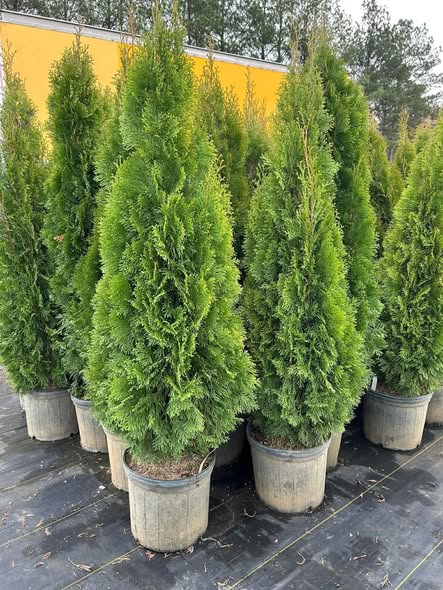
This is where Emerald Green sets itself apart immediately. It is a genuinely small to medium-sized evergreen, reaching just 10–15 feet tall and 3–4 feet wide at full maturity.
Its growth rate is slow — typically 6 to 9 inches per year. That means it will take a decade or more to reach its full height, which is something buyers often underestimate when purchasing small nursery plants.
The upside of that slow growth is a naturally tight, dense, and uniform shape that requires little to no pruning to maintain. The foliage grows in flat, fan-like sprays that stay pleasingly compact over time.
Foliage and Appearance
The foliage of Emerald Green arborvitae is its defining feature. The leaves are a vivid, almost jewel-like shade of emerald green — bright, rich, and consistent throughout the year.
In very cold climates (Zone 3–4), the foliage may take on a slight bronze or olive tint during winter. This is a natural physiological response to cold and is not a sign of disease or damage. By spring, the vibrant color returns.
The texture is fine and feathery, giving the tree an elegant, refined appearance that works beautifully in formal garden designs.
Cold Hardiness
Emerald Green arborvitae is exceptionally cold-hardy, rated for USDA Zones 3 through 8. This makes it one of the few arborvitaes that can be reliably grown in the coldest parts of the northern United States and much of Canada.
Gardeners in Minnesota, Wisconsin, Michigan, and the northern Plains who need an evergreen privacy screen often reach for Emerald Green precisely because it handles their winters better than most alternatives.
Deer Susceptibility
Here is Emerald Green’s biggest weakness, and it is a significant one. Deer find Thuja occidentalis highly palatable, and Emerald Green is no exception.
In areas with high deer pressure — which covers a huge portion of North America — deer can completely strip and kill an Emerald Green hedge in a single winter. This is not an exaggeration. It is one of the most common complaints among arborvitae growers in suburban and rural areas.
If deer are active in your neighborhood, planting Emerald Green without deer protection is a gamble.
Green Giant Arborvitae: A Closer Look
Origins and Background
Green Giant arborvitae is a hybrid between two different species — Thuja standishii (Japanese Arborvitae) and Thuja plicata (Western Red Cedar). It was originally developed in Europe and later introduced to the American nursery trade in the 1960s by the U.S. National Arboretum.
It was relatively obscure until the 1990s, when nurseries began promoting it as a fast-growing alternative to Leyland cypress, which was falling out of favor due to disease problems. Green Giant quickly became a blockbuster seller.
Size and Growth Rate
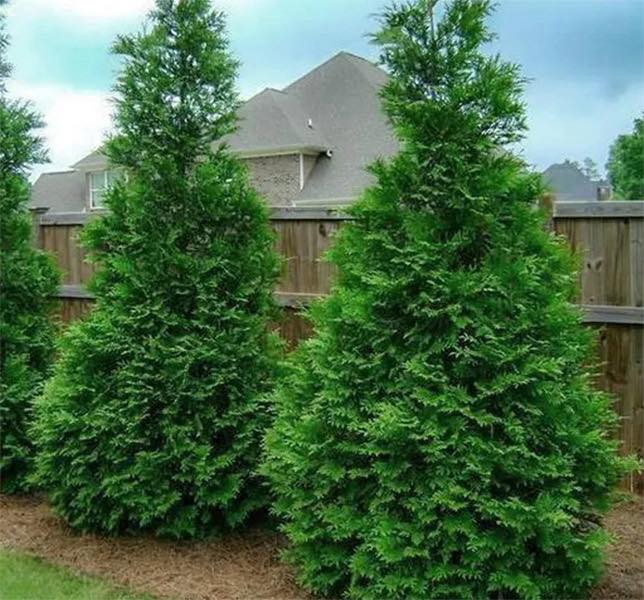
Green Giant is, as the name suggests, a genuinely large tree. At maturity, it reaches 40 to 60 feet in height and 12 to 20 feet in width. In ideal conditions, some specimens have grown even taller.
Its growth rate is where most people are immediately impressed — and occasionally caught off guard. Green Giant grows 3 to 5 feet per year under good conditions, making it one of the fastest-growing evergreens available to residential gardeners.
That rapid growth is a tremendous advantage when you need a tall privacy screen quickly. A row of Green Giants planted in spring can be creating meaningful privacy by the following summer.
Foliage and Appearance
Green Giant’s foliage is a deep, rich green with a slightly glossy sheen. The flat sprays are larger and coarser than Emerald Green’s, which gives the tree a bold, lush, almost tropical-looking density when viewed up close.
Unlike Emerald Green, Green Giant holds its rich color throughout the winter in most climates without any significant bronzing. This consistent winter appearance is one of its most appreciated qualities.
The overall form is a broad, dense pyramid — similar in shape to Emerald Green but on a much larger scale.
Cold and Heat Hardiness
Green Giant is rated for USDA Zones 5 through 9, giving it solid performance across a wide range of climates. It handles heat and humidity better than Thuja occidentalis varieties, which makes it a stronger performer in the Mid-Atlantic, Southeast, and lower Midwest than Emerald Green.
However, it is less cold-hardy than Emerald Green. Gardeners in Zones 3 and 4 — where winter temperatures regularly drop below -20°F (-29°C) — will find that Green Giant does not reliably survive, while Emerald Green will.
Deer Resistance
This is one of Green Giant’s important advantages. While no arborvitae is completely deer-proof, Green Giant shows significantly better deer resistance than Emerald Green or most other Thuja occidentalis varieties.
Its hybrid parentage — particularly the Thuja plicata component — appears to make it less palatable to deer. Many gardeners in moderate deer-pressure areas report that Green Giant is left largely alone while other evergreens in the same landscape are browsed.
In areas with very high deer populations, even Green Giant can be damaged, but it is a considerably safer choice than Emerald Green.
Disease and Pest Resistance
Green Giant is widely regarded as one of the most disease-resistant arborvitaes available. It shows excellent resistance to bagworms, spider mites, root rot, and the tip blights that can affect other conifers.
Its hybrid vigor — a well-documented phenomenon in plant breeding where hybrids often outperform their parent species — contributes to its robust health even in challenging conditions.
Head-to-Head: Key Decision Categories
Size and Space Requirements
This is the clearest differentiator between the two varieties and should be the first thing any buyer considers.
Emerald Green is the right choice for small to medium spaces. It works beautifully along fence lines, as foundation plantings beside homes, in narrow side yards, or anywhere that a tight, contained vertical element is needed without overwhelming the surrounding space.
Green Giant is for large landscapes. It needs room — both vertically and horizontally. Planted in the wrong space, it will eventually shade out everything nearby, crowd structures, and require removal at significant expense.
The rule of thumb is simple: if your available planting space is under 20 feet tall and 6 feet wide, choose Emerald Green. If you have the room and want fast privacy, choose Green Giant.
Privacy Screening
For low to mid-height privacy screening — say, blocking a neighbor’s view of a patio, or screening a fence line — Emerald Green does the job well. At 10–15 feet, it provides solid visual coverage without creating an overwhelming wall of green.
For tall privacy screening — blocking a two-story home, a road embankment, road noise, or a commercial property — Green Giant is the clear winner. Its rapid growth and eventual towering height create the kind of substantial, impenetrable screen that Emerald Green simply cannot match.
Growth Speed: Patience vs. Urgency
If you are patient and want a refined, tidy evergreen that will look polished for decades with minimal intervention, Emerald Green rewards that patience.
If you need results in one to three growing seasons, Green Giant is the only serious choice. Few commonly available trees match its speed, and its rapid establishment means visible privacy within just a few years of planting.
Cold Climate Performance
For gardeners in Zones 3 and 4, Emerald Green is often the only viable option between the two. Green Giant’s cold hardiness limit is Zone 5 (around -10°F / -23°C), and it will sustain significant damage or die outright in colder climates.
Emerald Green, hardy to Zone 3, can handle sustained temperatures as low as -40°F (-40°C) and has a strong track record in Canada and the northern United States.
Heat and Humidity Tolerance
In the southeastern United States and humid Mid-Atlantic regions, the equation reverses. Green Giant’s Thuja plicata genetics give it better heat and humidity tolerance than Thuja occidentalis-based varieties.
Emerald Green can be grown in Zone 7 and 8, but it may struggle in the combination of intense summer heat, humidity, and poorly drained soils that characterize much of the South. Green Giant handles those conditions with far greater ease.
Deer Pressure
High deer pressure? Choose Green Giant. Its relatively better palatability profile is a meaningful practical advantage in the many parts of North America where deer browsing is a constant threat to evergreen plantings.
If deer are not a concern in your area, this distinction matters less.
Maintenance
Both trees are considered low-maintenance once established, but for different reasons.
Emerald Green stays naturally compact and requires virtually no pruning to maintain a tidy shape. Its slow growth means it stays in bounds and rarely needs management.
Green Giant’s maintenance situation is more nuanced. It rarely needs pruning, but because it grows so fast and so large, when it does need corrective work — or when it outgrows its space — the task is considerably more involved and potentially requires professional help.
In terms of day-to-day upkeep, both trees are among the most manageable evergreens available.
Cost and Value
Emerald Green plants are generally less expensive per plant at the nursery. However, because they need to be planted more closely together for hedging (2–3 feet apart versus 5–8 feet for Green Giant), the total cost per linear foot of hedge can be comparable or even higher.
Green Giant plants cost more individually but are spaced further apart, which can partially offset the per-plant price difference.
For large-scale privacy screens, Green Giant often represents better value — fewer plants, faster results, and lower long-term maintenance costs.
Common Mistakes Gardeners Make With Both Trees
Planting Emerald Green Too Close to Structures
Because young Emerald Green plants look so small and tidy, it is tempting to plant them very close to the house, walkways, or fences. The problem is that even at 3–4 feet wide, mature plants can crowd foundations, block windows, and create moisture issues near structures.
Always account for mature width, not just current size, when choosing a planting location.
Underestimating Green Giant’s Size
This is perhaps the most common and costly mistake made with Green Giant. A 3-foot nursery plant can look completely harmless — even a little underwhelming. Within ten years, it can be 30–40 feet tall and 15 feet wide.
Green Giant planted under power lines, too close to a home, or in a small courtyard will inevitably become a problem. Removal of a mature specimen is expensive and disruptive.
Ignoring Deer Pressure
Gardeners in high-deer areas who plant Emerald Green without a plan for deer deterrence often face devastating losses. Deer browse Thuja occidentalis aggressively, especially in winter when other food sources are scarce.
If deer are active in your area, either choose Green Giant, invest in deer fencing, or plan to apply deer repellent regularly throughout the growing season.
Planting in Waterlogged Soil
Neither arborvitae tolerates standing water well, but both are frequently planted in spots with poor drainage without proper soil preparation. Wet feet cause root rot and eventual decline in both species. Raised planting, soil amendment, and proper site selection are essential preventive measures.
Which One Should You Choose? A Practical Decision Guide
Choose Emerald Green if:
- Your space is limited in height and width
- You live in USDA Zones 3 or 4
- You want a formal, tidy, refined appearance with minimal pruning
- You need a foundation planting or narrow hedge along a fence
- You want a smaller investment per plant and a manageable long-term size
Choose Green Giant if:
- You need tall privacy screening of 20 feet or more
- You want fast results — visible privacy within 2–3 years
- You live in Zones 5–9, especially the Southeast or Mid-Atlantic
- Deer are a concern in your area
- You have a large property where the tree’s eventual size is an asset, not a liability
Can You Plant Them Together?
Interestingly, yes — some experienced landscapers plant both varieties in the same hedgerow, alternating Green Giants (for height) with Emerald Greens (for density at lower levels). This creates a layered privacy screen that is dense from ground level all the way up.
This approach works well on larger properties where there is enough space to accommodate Green Giant’s eventual spread. It is not practical for small urban or suburban lots.
Planting Tips That Apply to Both Varieties
Spacing: For a solid hedge, plant Emerald Greens 2–3 feet apart (center to center) and Green Giants 5–8 feet apart. Tighter spacing gives faster coverage but can lead to crowding problems as trees mature.
Watering: Both varieties need regular watering during the first two growing seasons to establish deep root systems. Once established, they are relatively drought-tolerant — especially Green Giant.
Mulching: Apply 2–3 inches of organic mulch around the root zone of newly planted trees. Keep mulch a few inches away from the trunk. This retains moisture, moderates soil temperature, and reduces competition from weeds and grass.
Fertilizing: Both trees can benefit from a slow-release granular fertilizer in early spring during the first few years of establishment. Avoid heavy fertilization of mature trees, which can stimulate soft, disease-prone growth.
Avoid Planting in Late Fall: While both trees can technically be planted in fall, spring or early summer planting gives the root system the longest possible establishment window before winter stress.
Final Thoughts
Both Emerald Green and Green Giant arborvitaes are genuinely excellent trees. Neither is universally better — they are simply built for different jobs.
Emerald Green is the refined, compact specialist — ideal for small spaces, cold climates, and anyone who values a neat, unchanging form over decades.
Green Giant is the landscape workhorse — fast, bold, tall, and tough, with the size and presence to transform a large property into a private, sheltered retreat within just a few years.
The best choice is always the one that matches your specific site conditions, climate, space, and goals. Take the time to assess those factors honestly before purchasing, and you will be rewarded with a thriving, functional planting for years to come.
References
- NC State Extension — Thuja occidentalis ‘Smaragd’ (Emerald Green Arborvitae) North Carolina State University Cooperative Extension Plant Toolbox https://plants.ces.ncsu.edu/plants/thuja-occidentalis/common-name/emerald-green-arborvitae/
- University of Florida IFAS Extension — Thuja × ‘Green Giant’: Green Giant Arborvitae Environmental Horticulture, University of Florida Institute of Food and Agricultural Sciences https://hort.ifas.ufl.edu/database/documents/pdf/tree_fact_pages/thugen.pdf
- University of Wisconsin-Madison Division of Extension — Arborvitae in the Landscape Horticulture Extension, University of Wisconsin-Madison https://hort.extension.wisc.edu/articles/arborvitae/
- Penn State Extension — Selecting and Planting Landscape Trees and Shrubs College of Agricultural Sciences, The Pennsylvania State University https://extension.psu.edu/selecting-landscape-trees-and-shrubs
- University of Maryland Extension — Arborvitae: Selection and Culture Home & Garden Information Center, University of Maryland https://extension.umd.edu/resource/arborvitae

Tim M Dave is a gardening expert with a passion for houseplants, particularly cacti and succulents. With a degree in plant biology from the University of California, Berkeley, he has vast experience in gardening. Over the years, he has cultivated a vast collection of desert plants and learned a great deal about how to grow and care for these unique companions.