Understanding Dracaena Cinnabari: The Dragon Blood Tree — History, Significance, and More
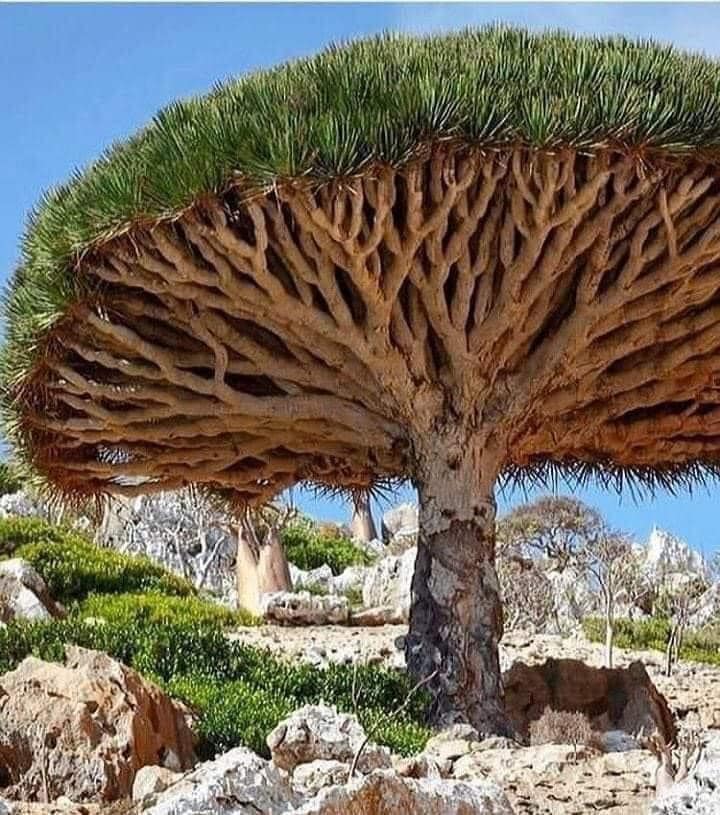
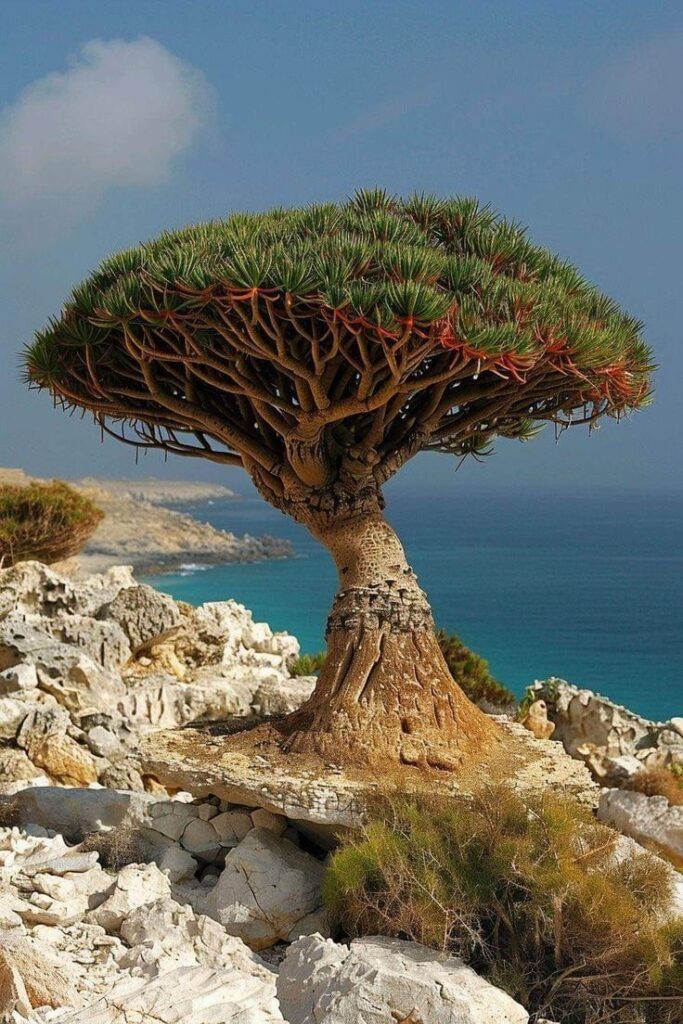
The first time most people see a photograph of Dracaena cinnabari, they assume it has been edited. The flat, perfectly circular canopy. The thick, silvery trunk that branches into a dense, upward-spreading crown.
The alien geometry of a tree that looks as though it was designed rather than grown. And then — the blood-red resin that bleeds from its bark when cut, so vivid and so strange that ancient civilizations wove entire mythologies around it.
This is the dragon blood tree. It grows on one island in the world — Socotra, a remote Yemeni archipelago in the Arabian Sea — and nowhere else on earth does it dominate a landscape the way it does here.
It has survived for millions of years in near-total isolation. It produces one of the most remarkable natural substances known to traditional medicine and commercial industry. And today, it faces an uncertain future.
This article covers everything there is to know about Dracaena cinnabari: its biology, its remarkable adaptation to one of the harshest environments on earth, the legendary properties of dragon blood resin, its cultural and historical significance, conservation status, and what science is discovering about this extraordinary tree.
What Is Dracaena cinnabari?
Dracaena cinnabari is a tree in the family Asparagaceae (formerly placed in Agavaceae or Dracaenaceae, depending on the classification system). It is endemic to the Socotra Archipelago — meaning it is found naturally nowhere else in the world.
The common name “dragon blood tree” comes from the deep crimson resin the tree produces. When the bark or branches are cut, the resin oozes out and dries to a bright, blood-red color — a sight dramatic enough to have inspired legends across ancient cultures for thousands of years.
The tree’s most immediately striking feature is its umbrella-shaped canopy — dense, flat-topped, and extraordinarily symmetrical. This is not random. Every aspect of the dragon blood tree’s unusual form is a precise adaptation to the punishing conditions of Socotra.
Dracaena cinnabari belongs to the same genus as the more familiar houseplant dracaenas, but it could not be more different in scale, habitat, or appearance. It is a monocot — more closely related to grasses, palms, and lilies than to most trees in the traditional sense — yet it grows trunk-like stems, produces woody tissue, and reaches heights of 10 to 12 meters (33 to 40 feet) in maturity.
The Island of Socotra: The Galápagos of the Arabian Sea
To understand Dracaena cinnabari, you must first understand Socotra. The island is located approximately 240 kilometers east of the Horn of Africa and 380 kilometers south of the Arabian Peninsula in the Arabian Sea. It belongs politically to Yemen, though it is geographically closer to Somalia.
Socotra has been isolated from the African and Arabian continental landmasses for an estimated 6 to 7 million years. This extraordinary geological isolation — combined with the island’s extreme climate — has produced a level of biodiversity that is genuinely unparalleled for its size.
37% of Socotra’s plant species are endemic — found nowhere else on earth. UNESCO designated Socotra a World Heritage Site in 2008, describing it as one of the most biodiverse island ecosystems in the world.
The climate on Socotra is brutal. Temperatures regularly exceed 40°C (104°F) in summer. Between June and September, the southwest monsoon brings violent winds and rough seas that historically cut the island off from the outside world entirely.
Annual rainfall averages only 150 to 220 millimeters and falls unpredictably, mostly between March and May. The soils are shallow, rocky, and nutrient-poor.
It is in this harsh, isolated environment that Dracaena cinnabari evolved its extraordinary adaptations over millions of years.
The Biology of the Dragon Blood Tree
Structure and Form
The iconic umbrella canopy of Dracaena cinnabari is arguably the most recognizable tree silhouette in the natural world. The trunk is stout, smooth, and pale gray-silver, growing upright until it branches, typically at 3 to 4 meters. Each branch then forks repeatedly at regular intervals, creating a dense, evenly distributed canopy that is almost perfectly flat on top.
The leaves are long, stiff, and succulent — up to 60 centimeters in length, dark green on the upper surface, and clustered only at the very tips of the outermost branches. They point upward and inward, like a dense brush head. The leaves persist for three to four years before being shed and replaced.
Unlike most trees, Dracaena cinnabari does not produce annual growth rings in the conventional sense. Age estimation is difficult and depends on branching patterns and environmental records. Most researchers estimate that large specimens in the wild are between 300 and 500 years old. Some may be considerably older.
The Umbrella Canopy: A Masterpiece of Adaptation
The flat, dense canopy is not merely decorative. It performs at least three critical functions in Socotra’s harsh environment.
First, it acts as a fog collector. Socotra receives much of its moisture not from rainfall but from the heavy mists that roll in from the sea, particularly during the cooler months. The dense leaf mass and branching structure intercept fog droplets and channel them downward along the branches and trunk to the base of the tree and its root zone.
Studies have shown that fog interception by dragon blood tree canopies contributes substantially to the local water budget in areas where the trees grow densely.
Second, the canopy provides shade. In a landscape that receives intense year-round sunlight and temperatures exceeding 40°C, the umbrella canopy creates a microclimate of shade beneath it — reducing soil temperature and water evaporation, and creating a more hospitable environment for the tree’s own roots and for the seedlings and other plants beneath it.
Third, the canopy structure minimizes water loss. The leaves are succulent and tightly clustered. Their upward-pointing orientation reduces the surface area exposed to direct overhead sun during the hottest part of the day — a straightforward but effective strategy for reducing transpiration.
Roots and Soil Adaptation
The root system of Dracaena cinnabari is extensive and shallow — well-adapted to capturing water from brief, heavy rainfall events before it drains through the rocky soil. The roots spread widely, often well beyond the canopy edge, anchoring the tree against the ferocious monsoon winds and maximizing the catchment area for moisture.
The tree grows almost exclusively on rocky limestone plateaus and steep, well-drained slopes — habitats where most other trees cannot compete. It cannot tolerate waterlogged soils and shows no interest in the deeper, more fertile valley soils that other species occupy.
Flowering and Reproduction
Dracaena cinnabari flowers between February and March. The flowers are small, white to pale green, fragrant, and produced in clusters at the branch tips. They are pollinated by insects, particularly bees, and are followed by berries that ripen from green through orange to a deep brown-black over approximately five months.
Each berry contains one to three seeds. The fruits are eaten by birds — particularly starlings and other frugivorous species — which disperse the seeds across the plateau landscapes.
Seed germination is slow and unpredictable. In controlled conditions, germination can take 30 to 90 days. In the wild, successful seedling establishment requires precise conditions: a nurse plant or rock crevice for shade and protection, sufficient soil moisture, and freedom from grazing pressure.
These demanding conditions make natural regeneration difficult — a problem with serious implications for conservation.
Dragon Blood Resin: Properties, History, and Uses
If Dracaena cinnabari is remarkable as a tree, its resin is extraordinary as a substance. Dragon blood resin has been traded, valued, and used across civilizations for more than 2,000 years — possibly much longer. It is one of the most historically significant natural products in the world.
What Is Dragon Blood Resin?
When the bark, branches, or fruit of Dracaena cinnabari is wounded, the tree produces a deep red, viscous resin that dries to a bright crimson powder or solid. The pigment responsible for this color is a compound called dracorhodin, a type of flavonoid unique to the Dracaena genus. Other bioactive compounds in the resin include dracorubin, dracocarmen, and taspine.
The resin has remarkable physical properties: it is resistant to moisture, adheres strongly to surfaces, dries to a hard film, and produces an intense, stable red color. These properties explain its wide historical and commercial use.
Ancient and Historical Uses
The ancient Greeks knew dragon blood resin as kinnabari — the origin of the species name cinnabari. It was highly valued throughout the ancient Mediterranean, Middle East, and India. The Romans used it in medicines, varnishes, and incense.
Arab traders controlled the supply routes through the Arabian Sea for centuries, and the resin commanded high prices in the markets of Alexandria, Rome, and Constantinople.
Among its documented historical uses:
- Medicine: Applied topically to wounds, skin conditions, and infections. Ancient physicians recommended it for fevers, dysentery, and as a general tonic.
- Dye: Used to color cloth, leather, and wood. The intense red color was prized in fabrics and in decorative arts.
- Varnish: Applied to violins and other stringed instruments, particularly in Renaissance Italy. Some historians have proposed — though not conclusively proven — that the distinctive finish of Stradivarius violins contains dragon blood resin.
- Incense: Burned in religious rituals across the Middle East, North Africa, and India.
- Cosmetics: Used as a pigment in ancient cosmetics and body decoration.
The legendary status of the resin generated many origin myths. In Greek and Roman tradition, dragon blood was said to be the actual blood of dragons slain in battle — typically in titanic struggles between dragons and elephants on the island of Socotra.
Pliny the Elder described the substance in his Naturalis Historia in the 1st century CE, claiming it flowed from mortally wounded dragons. These legends persisted across European cultures well into the medieval period.
Modern Scientific Research
Contemporary science has validated many of the traditional medicinal claims made for dragon blood resin and added considerably to the understanding of its bioactive properties.
Anti-inflammatory and wound-healing activity. Multiple studies have confirmed that taspine — one of the principal compounds in Dracaena resin — has significant wound-healing and anti-inflammatory properties. It promotes the migration of fibroblasts (cells essential for wound closure) and has demonstrated activity in accelerating skin healing in laboratory and animal models.
Antimicrobial properties. Research has shown that dragon blood resin extracts have activity against a range of bacterial pathogens, including Staphylococcus aureus and Escherichia coli. Some studies have also demonstrated antifungal activity.
Antiviral activity. Compounds derived from Dracaena species have shown inhibitory activity against several viruses in laboratory settings, including herpes simplex virus. While this research is preliminary and mostly in vitro, it points to a potentially significant area of pharmacological development.
Antioxidant capacity. The flavonoid compounds in the resin display potent antioxidant properties — the ability to neutralize free radicals — which may partly explain the traditional use of dragon blood in anti-aging cosmetic preparations.
Today, dragon blood resin is used commercially in artist’s paints and varnishes, in the cosmetics industry (particularly in high-end anti-aging skincare formulations), in traditional medicine systems across the Middle East, South Asia, and Latin America (where other Dracaena and Croton species also produce similar resins), and in specialist wood finishes.
Cultural Significance and Mythology
Beyond its practical uses, Dracaena cinnabari occupies a significant place in the cultural life of Socotra and in the broader mythology of the ancient world.
The Socotri People
The indigenous people of Socotra — the Socotri — have lived alongside the dragon blood tree for thousands of years. The tree is woven into every aspect of traditional Socotri life. The resin is used medicinally, cosmetically, and as an incense in daily rituals.
It is mixed with goat fat and applied to protect skin from the harsh sun. It is used to clean and protect teeth. Socotri women traditionally use it as a reddish cosmetic for the lips.
The Socotri language — itself an endangered language with no traditional written form — contains extensive vocabulary relating to the tree and its uses, reflecting centuries of intimate knowledge.
The Dragon and the Elephant
The most enduring legend associated with dragon blood concerns the island’s ancient history as a place where dragons and elephants fought to the death. In Greco-Roman mythology, Socotra (then known as Dioscorida) was described as the site of these battles. The blood of the dragon — vivid red and medicinal — fell to the ground and gave rise to the trees.
This mythology was not confined to Europe. Arab and Persian traders carried similar legends through the Indian Ocean trade networks, and versions of the dragon blood origin story appear in medieval Islamic texts, Indian Ayurvedic manuscripts, and Chinese records of the Arabia trade.
The legend is a beautiful example of how pre-scientific cultures created narratives to explain observations they could not otherwise account for: a tree that bleeds red, grows nowhere else, and produces a substance with apparently miraculous healing properties. The explanation — that it arose from the blood of mythic creatures — is proportionate to the strangeness of the fact.
Geographic Distribution: Where Does Dracaena cinnabari Grow?
Dracaena cinnabari is strictly endemic to the Socotra Archipelago, specifically to Socotra island itself and to a much lesser extent the smaller islands of Abd al Kuri.
Within Socotra, the dragon blood tree is not uniformly distributed. It grows primarily on the Haghier Mountains, the central massif of the island, and on the Dixam Plateau — a spectacular limestone plateau in the center of the island that represents the tree’s stronghold and the most dramatic landscapes associated with it.
The trees grow at elevations typically between 300 and 1,500 meters above sea level, where fog moisture is most reliable and temperatures are slightly moderated compared to the coastal lowlands.
The Dixam Plateau, at approximately 800 to 1,000 meters, contains the densest and most accessible dragon blood tree populations and is the primary destination for the growing ecotourism industry on the island.
Within the Haghier range, populations are more scattered and occur in steeper, rockier terrain. These populations are more isolated and less studied.
Outside Socotra, Dracaena cinnabari does not grow in the wild. Related species — such as Dracaena draco (the Canary Island dragon tree) — occur in the Canary Islands, Madeira, and the Cape Verde Islands, and produce a similar red resin. However, these are separate species with distinct evolutionary histories.
Conservation Status and the Threats Facing the Dragon Blood Tree
The dragon blood tree is classified as Vulnerable on the IUCN Red List (International Union for Conservation of Nature), with population trends assessed as declining. The threats it faces are multiple, interacting, and in several cases accelerating.
Climate Change
Perhaps the most serious long-term threat is climate change. Socotra’s climate is changing measurably: rainfall patterns are becoming less predictable, dry periods are extending, and the fog that dragon blood trees depend on for a significant portion of their moisture is becoming less frequent in some areas.
Because the tree’s natural regeneration is already difficult — requiring precise conditions for successful seedling establishment — even modest reductions in moisture availability can tip the balance from slow recovery to net decline.
A landmark 2019 study published in the journal Biological Conservation modeled the impact of climate change scenarios on Dracaena cinnabari populations and concluded that under mid-range warming projections, suitable habitat for the species could decline by 45% by 2080. Under higher warming scenarios, the reduction was more severe.
Overgrazing
Goats have been part of Socotra’s pastoral economy for thousands of years, and their grazing has historically been managed in ways compatible with forest regeneration. However, increased goat populations in recent decades have placed severe pressure on dragon blood tree regeneration. Goats eat seedlings and young trees before they can establish. In areas with high grazing pressure, populations of mature trees are not being replaced by new generations — a situation that ecologists describe as a “regeneration debt” that will become increasingly apparent as current adults age and die.
Cyclone Damage
Socotra sits in a region exposed to occasional severe tropical cyclones. Cyclone Mekunu (2018) and Cyclone Luban (2018) — unusually, two cyclones struck Socotra within months of each other, the first time this had occurred in recorded history — caused significant damage to dragon blood tree populations, uprooting trees and damaging juvenile specimens that had been slowly establishing. The recovery of damaged populations is slow.
Political Instability
Yemen has been in the grip of a devastating civil war since 2015. While Socotra has been largely spared the direct violence of the conflict, the island’s administration, development planning, and conservation management have all been severely disrupted. Conservation programs that were underway before the conflict have stalled. Monitoring of tree populations has become difficult. And the growth of informal development — road construction, building, land clearance — has proceeded with reduced oversight.
Tourism Pressure
Ecotourism on Socotra has grown significantly in the past decade, attracted by the island’s extraordinary landscapes. When managed well, tourism provides economic incentives for conservation. However, unmanaged tourist access to sensitive plateau areas, vehicle tracks across fragile soils, and disturbance of nesting birds that disperse dragon blood tree seeds all represent growing pressures that require careful management.
Conservation Efforts
Despite the threats, significant conservation work is underway — or was underway before the conflict disrupted it — and there are reasons for cautious optimism.
The Royal Botanic Gardens, Kew has been involved in Socotra research and conservation for decades, documenting the flora, training Socotri botanists, and working to establish seed banks for endemic species including Dracaena cinnabari.
The Socotra Conservation and Development Programme (SCDP) worked for many years to develop community-based conservation approaches that involved Socotri herders in managing grazing pressure on key forest areas.
Ex-situ conservation — growing Dracaena cinnabari outside Socotra in botanical gardens — has been explored as a hedge against catastrophic loss. The species is notoriously difficult to cultivate outside its native habitat, but several botanical institutions have achieved success with carefully managed specimens.
UNESCO’s World Heritage designation continues to provide an international platform for raising awareness of Socotra’s plight and for attracting resources toward conservation goals.
Growing Dracaena cinnabari Outside Socotra
Dracaena cinnabari is exceptionally difficult to cultivate outside its native habitat, and most attempts by home gardeners and even botanical institutions end in failure. The tree’s highly specific requirements — poor, rocky, alkaline soil; minimal irrigation; intense sunlight; low humidity in winter; and a very precise temperature range — are almost impossible to replicate in temperate climates.
That said, several botanical gardens have achieved long-term success with Dracaena cinnabari in climates similar to Socotra:
- The Canary Islands (Spain) — where the related Dracaena draco is native — have climate conditions broadly similar to Socotra, and some D. cinnabari specimens have been established there.
- Southern California and Arizona (USA) — botanical gardens in arid, warm climates have maintained specimens for research purposes.
- Oman and the UAE — the closest mainland climates to Socotra, where some successful cultivation has occurred in botanic collections.
For home gardeners in temperate climates who want to grow a related species, the Canary Island dragon tree (Dracaena draco) is a practical alternative — more adaptable to cultivation, more widely available in nurseries, and producing a similar (though less vivid) red resin.
Dracaena cinnabari and Science: What We Are Still Learning
Despite centuries of human fascination with the dragon blood tree, there is still much that science does not fully understand. Active research areas include:
- The precise mechanism of fog interception and the quantitative contribution of D. cinnabari canopies to the hydrological cycle of the Socotra plateau
- The full pharmacological profile of dragon blood resin compounds, particularly the antiviral and anticancer potential of dracorhodin and related flavonoids
- Population genetics — understanding the genetic diversity within and between dragon blood tree populations to inform conservation planning
- The historical ecology of Socotra — reconstructing how the island’s vegetation has changed over millennia in response to climate shifts and human activity
- Seedling establishment ecology — understanding precisely what environmental conditions are required for successful natural regeneration, with a view to supporting active restoration
Each of these research threads has both scientific interest and direct conservation relevance. The dragon blood tree is not simply a curiosity — it is a scientific subject of genuine depth, and the knowledge being generated about it has implications for conservation biology far beyond Socotra.
Frequently Asked Questions
How old can a dragon blood tree get? There are no definitive age records because the species does not produce conventional annual growth rings. Based on branching analysis and environmental records, most researchers estimate that large specimens are 300 to 500 years old. Some may be considerably older.
Is dragon blood resin still used today? Yes. It is used commercially in artist’s pigments and varnishes, in cosmetics, in traditional medicine across multiple cultures, and in specialty wood finishes. A commercial market for high-quality dragon blood resin continues to exist, though sustainable sourcing is a concern.
Can you visit the dragon blood trees on Socotra? Socotra is accessible to tourists, though travel logistics are complex due to Yemen’s ongoing conflict. The Dixam Plateau is the primary tourist destination for dragon blood tree viewing. Travelers should check current travel advisories and work with established local guides and ecotourism operators.
Are dragon blood trees endangered? Dracaena cinnabari is classified as Vulnerable (not yet Endangered) on the IUCN Red List, but the population trend is declining. Scientists and conservationists have expressed serious concern that without intervention, the species could move to Endangered status within decades.
How does the tree get its red color? The red color comes from dracorhodin — a natural pigment in the flavonoid family — and related compounds found in the resin. These compounds are unique to the Dracaena genus and have no exact equivalent in other plant families.
Suggested For You:
Understanding Weeping Cherry Blossom Tree: Varieties, and Care Tips for a Stunning Landscape Feature
Understanding Cherry Blossom Tree: Types, History and Full Growing Details
Understanding Majesty Palm: History, Size, Problems, Growing, and Maintenance (Indoors and Outdoors)
10 Common Norfolk Pine Problems: Identification, Treating, and Preventing Every Major Issue
Final Thoughts
Dracaena cinnabari is, by almost any measure, one of the most extraordinary trees on earth. It is ancient in evolutionary terms, startling in appearance, singular in geographic distribution, and rich in cultural, historical, and scientific significance.
It produces one of the most remarkable natural substances ever studied. And it does all of this while quietly facing an uncertain future on a remote and increasingly pressured island.
To know about the dragon blood tree is to care about it. Every person who learns about its ecology, its threats, and its conservation needs becomes part of the community of awareness that ultimately sustains the political and institutional will to protect it.
The tree has survived millions of years of isolation. Whether it survives the next century will depend on decisions made right now — about climate, about land use, about conflict, and about the value we place on the natural world’s most extraordinary living things.
References
- Royal Botanic Gardens, Kew — Plants of the World Online: Dracaena cinnabari https://powo.science.kew.org/taxon/urn:lsid:ipni.org:names:536763-1
- UNESCO World Heritage Centre — Socotra Archipelago https://whc.unesco.org/en/list/1263/
- University of Edinburgh — Socotra Biodiversity Project https://www.ed.ac.uk/biology/rbge/socotra
- Smithsonian Institution — National Museum of Natural History: Dragon Blood Tree https://naturalhistory.si.edu
- NC State University Extension — Dracaena Species Profile and Horticultural Notes https://plants.ces.ncsu.edu/plants/dracaena/

Tim M Dave is a gardening expert with a passion for houseplants, particularly cacti and succulents. With a degree in plant biology from the University of California, Berkeley, he has vast experience in gardening. Over the years, he has cultivated a vast collection of desert plants and learned a great deal about how to grow and care for these unique companions.