Dawn Redwood Tree Pros and Cons: Everything You Need to Know Before Planting One
The dawn redwood (Metasequoia glyptostroboides) is one of the most remarkable trees in the world. Scientists once believed it had been extinct for millions of years. Then, in 1944, living specimens were discovered in a remote valley in China.
That discovery sent shockwaves through the botanical community — and rightly so.
Today, the dawn redwood is planted across parks, campuses, and large residential gardens worldwide. It is admired for its fast growth, feathery foliage, and impressive autumn colour. But like every tree, it comes with trade-offs.
If you are considering planting one, this guide gives you a thorough, honest breakdown of the dawn redwood tree pros and cons — so you can make the right decision for your space.
Dawn Redwood Tree at a Glance
| Scientific Name | Metasequoia glyptostroboides |
| Family | Cupressaceae |
| Common Names | Dawn Redwood, Water Fir |
| Type | Deciduous conifer |
| Origin | Sichuan and Hubei provinces, China |
| Mature Height | 70–100 ft (21–30 m) |
| Spread | 15–25 ft (4.5–7.5 m) |
| Growth Rate | Fast — up to 3–5 ft per year |
| USDA Hardiness Zones | 4 to 8 |
| Soil Preference | Moist, slightly acidic, well-drained |
| Sunlight | Full sun |
| Lifespan | 100+ years |
| Foliage | Soft, feathery needles; deciduous |
| Autumn Colour | Russet, copper, bronze |
| Drought Tolerance | Low to moderate |
| Flood Tolerance | High |
| Wildlife Value | Moderate |
| Maintenance Level | Low to moderate |
A Brief History Worth Knowing
Before getting into the pros and cons, a little context goes a long way.
The dawn redwood was first described from 70-million-year-old fossils in the 1940s — and assumed to be long gone. When botanist Kan Ching Wang discovered living trees in Lichuan, China in 1944, it became one of the greatest botanical finds of the 20th century.
Seeds were collected and distributed by the Arnold Arboretum of Harvard University in 1948. Within years, the tree was growing across North America, Europe, and beyond.
That history matters. This is a tree with ancient roots and proven resilience. It has survived climate shifts that wiped out countless other species. There is something deeply grounding about planting a tree that has existed, in some form, for tens of millions of years.
Pros of the Dawn Redwood Tree
1. Exceptionally Fast Growth
One of the biggest draws of the dawn redwood is how quickly it grows.
Under good conditions, it can add 3 to 5 feet of height per year. Young trees are especially vigorous. This makes it one of the fastest-growing large trees available to home gardeners and landscape designers.
If you want significant shade or visual impact within a few years, few trees deliver as reliably as the dawn redwood.
2. Stunning Autumn Colour
Most conifers are evergreen. The dawn redwood is different — it is a deciduous conifer, meaning it drops its needles each autumn.
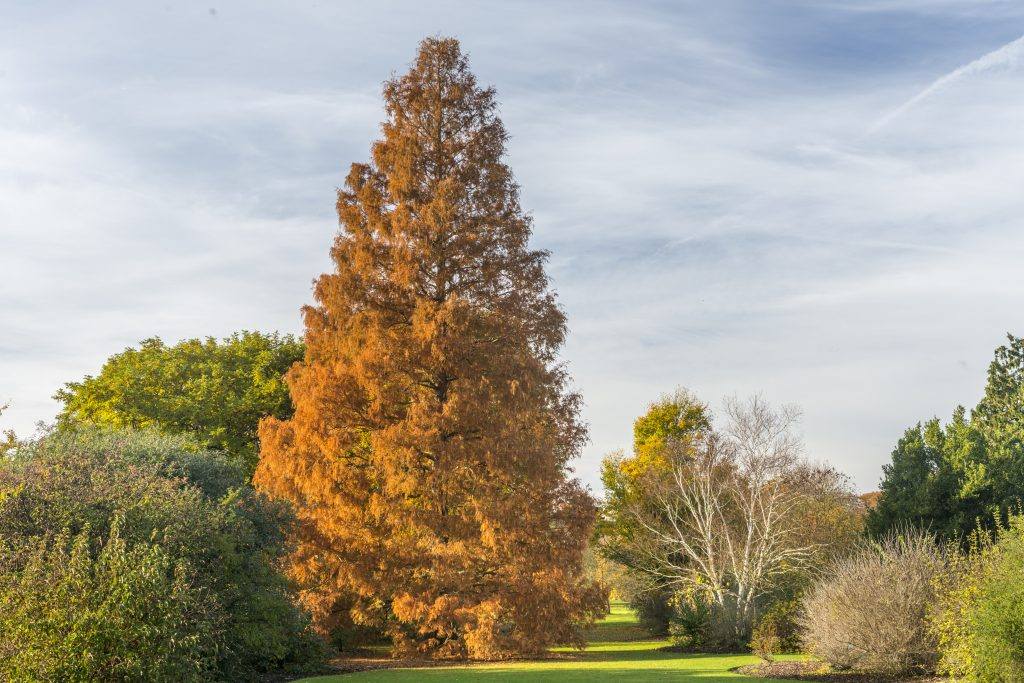
Before it does, the foliage transforms into warm shades of russet, bronze, and copper. The effect is genuinely beautiful. If you have ever seen a mature dawn redwood in October or November, you will understand why gardeners fall in love with it.
This seasonal display adds dynamic interest that most other conifers simply cannot offer.
3. Graceful, Distinctive Form
The dawn redwood has a narrow, pyramidal shape when young that becomes more broadly conical with age. The trunk develops attractive reddish-brown, fibrous bark that adds texture and visual interest, especially in winter once the needles have fallen.
Its overall silhouette is elegant and architectural — the kind of tree that becomes a focal point in any landscape without feeling overpowering.
4. Soft, Feathery Foliage
Unlike many conifers, the dawn redwood’s needles are soft to the touch. They are arranged in two flat rows along the branchlets, giving the foliage a delicate, fern-like appearance.
This makes the tree pleasant to be near — there is no prickling from fallen needles underfoot, and the texture is welcoming rather than harsh. Children and pets are safe around it.
5. Excellent Flood and Wet Soil Tolerance
The dawn redwood evolved in river valleys and lowland areas of China, where seasonal flooding is common. As a result, it is far more tolerant of wet and poorly drained soils than most large trees.
This makes it ideal for planting near streams, ponds, and low-lying areas where other trees might struggle or die. If your garden has a waterlogged corner that nothing else survives in, the dawn redwood may be exactly what you need.
6. Impressive Cold Hardiness
The tree is hardy down to USDA Zone 4, which means it can survive winter temperatures as low as -30°F (-34°C). This is exceptional for a tree of its size and origin.
Gardeners in northern climates who want a large, dramatic specimen tree have very few options that compare to the dawn redwood in terms of cold tolerance combined with visual impact.
7. Low Pest and Disease Problems
The dawn redwood is largely resistant to the common pests and diseases that afflict many landscape trees. It is not typically affected by borers, scales, or serious fungal diseases.
This means less time spent on chemical treatments and less worry about the tree declining due to disease. For a low-maintenance garden, this is a meaningful advantage.
8. Long Lifespan
A well-sited dawn redwood can live for over 100 years. This is a tree you plant not just for yourself, but for future generations.
There is something quietly satisfying about that. A tree planted today could be standing long after the person who planted it is gone. That kind of permanence has real value — ecological, aesthetic, and sentimental.
9. Wildlife and Ecological Value
The dawn redwood provides nesting and shelter opportunities for birds and small mammals. As the tree matures and the bark furroughs deepen, it becomes increasingly attractive to wildlife.
While it does not produce fruit or berries that wildlife feed on heavily, its dense canopy and textured bark offer structural habitat in landscapes that might otherwise lack it.
10. Air Quality and Carbon Sequestration
Like all large trees, the dawn redwood sequesters significant amounts of carbon over its lifetime. Given its fast growth rate, it accumulates biomass — and therefore locks up carbon — faster than most trees.
For homeowners and institutions with sustainability goals, planting a fast-growing, long-lived tree like the dawn redwood is one of the most effective landscape-level actions you can take.
Cons of the Dawn Redwood Tree
1. It Gets Very Large
This is the most important caution.
A mature dawn redwood can reach 70 to 100 feet tall, with a spread of 15 to 25 feet. This is not a tree for small gardens. Planting one in a confined space will cause serious problems within 10 to 15 years.
Many homeowners plant a dawn redwood without fully accounting for how big it will become. Before planting, look up and look around. Consider overhead power lines, roof overhangs, and neighbouring structures. Give this tree the space it genuinely needs.
2. Aggressive Surface Roots
The dawn redwood develops a strong and expansive root system. As the tree matures, surface roots can become quite pronounced.
These roots can damage pavements, driveways, garden walls, and underground utilities if the tree is planted too close to infrastructure. A minimum clearance of 15 to 20 feet from any paved surface or structure is strongly advisable.
This is a factor many planting guides understate — it deserves serious attention.
3. Needs Regular Moisture
Despite its flood tolerance, the dawn redwood does not thrive in drought conditions. It prefers consistently moist soil and will show stress — through needle browning and premature needle drop — during extended dry periods.
In regions with hot, dry summers, you will need to provide supplemental irrigation, particularly in the first several years while the tree establishes. This adds to maintenance demands and water costs.
4. Bare and Stark in Winter
Because it is deciduous, the dawn redwood stands completely bare from late autumn through early spring. In a landscape that relies on this tree for screening or visual structure, that winter nakedness can be jarring.
If you are planting it as a privacy screen or windbreak, its seasonal bare state makes it less effective than an evergreen during the months you might most appreciate shelter.
5. Fallen Needles Require Cleanup
Each autumn, the dawn redwood drops all of its needles. While they are soft and decompose relatively quickly, they can accumulate in significant quantities around pools, patios, and garden beds.
For some gardeners, this is a minor nuisance. For others — particularly those with swimming pools nearby — it becomes a regular seasonal maintenance task that grows with the size of the tree.
6. Not Suitable for All Soil Types
While the dawn redwood tolerates wet soils well, it does not thrive in compacted, alkaline, or extremely dry soils. In urban environments where soils are often degraded, this can limit its performance.
Soil preparation at planting time is important. If your soil is heavy clay, compacted, or has a high pH, you will need to amend it — or reconsider your tree choice entirely.
7. Limited Wildlife Food Value
While the dawn redwood provides habitat, it offers relatively little in the way of food for wildlife. It does not produce fruit, berries, or nuts. Its seeds are small and not a significant food source for birds or mammals.
For gardeners focused on creating wildlife corridors or food-producing ecosystems, the dawn redwood is better as a structural element than a food source tree. You would need to plant it alongside fruiting or flowering plants to maximise biodiversity value.
8. Can Overwhelm Neighbouring Plants
Given its fast growth and large canopy, the dawn redwood can quickly shade out nearby plants. Grass, shrubs, and smaller perennials planted near a young dawn redwood may thrive initially — then struggle as the canopy expands and root competition intensifies.
Plan your planting scheme carefully. Give the dawn redwood space not just above ground, but in the surrounding planting plan. Shade-tolerant ground covers are better companions than sun-loving species.
9. Not Widely Available in All Cultivars
While the species itself is widely available, specific cultivars — such as the compact ‘Ogon’ (golden dawn redwood) or the columnar ‘North Light’ — may be harder to source outside of specialist nurseries.
If you are looking for a particular form or colour variant, you may need to seek out a specialist grower rather than relying on general garden centres.
10. Slow to Establish After Transplanting
Despite its fast growth rate once established, the dawn redwood can be temporarily slow after transplanting, particularly from large container or balled-and-burlapped stock.
The first one to two growing seasons may show little visible growth as the tree directs energy into root development. This is normal — but it can be discouraging if you are expecting rapid results immediately.
Patience in the early years pays off significantly. Growth typically accelerates markedly in year three onwards.
Dawn Redwood vs. Similar Trees: How Does It Compare?
Many gardeners consider the dawn redwood alongside its relatives — the Coast Redwood (Sequoia sempervirens) and the Bald Cypress (Taxodium distichum).
Compared to Coast Redwood: The dawn redwood is more cold-hardy and deciduous. The Coast Redwood is evergreen but limited to milder, humid climates (zones 7 to 10). The dawn redwood is a better choice for inland and northern gardens.
Compared to Bald Cypress: Both are deciduous conifers with excellent wet soil tolerance. The Bald Cypress develops distinctive “knees” (pneumatophores) near water, which the dawn redwood does not. The dawn redwood tends to grow faster and has a cleaner overall form. Both are excellent choices for waterside planting.
Who Should Plant a Dawn Redwood?
The dawn redwood is an excellent choice if:
- You have a large property with plenty of open space
- You want fast canopy and shade within a few years
- You have wet, low-lying ground that other trees struggle in
- You are in USDA zones 4 to 8 and want a cold-hardy specimen tree
- You value seasonal interest — particularly autumn colour and distinctive winter structure
- You are planting for long-term legacy rather than short-term effect
It may not be the right choice if:
- Your garden is small or suburban with limited space
- You need year-round evergreen screening
- You live in a hot, dry climate with limited irrigation options
- You have paved surfaces, buildings, or utilities within 20 feet of the planting site
Care Tips for Dawn Redwood Trees
If you do decide to plant one, here is how to give it the best possible start:
Planting: Choose a site in full sun with plenty of overhead clearance. Dig a hole two to three times the width of the root ball and the same depth. Backfill with the original soil — no need for excessive amendments unless the soil is severely degraded.
Watering: Keep the soil consistently moist during the first two to three years. Once established, the tree is more self-sufficient but still benefits from deep watering during drought.
Mulching: Apply a 3 to 4 inch layer of organic mulch around the base, keeping it away from the trunk. This retains moisture, regulates soil temperature, and suppresses weeds.
Fertilising: A balanced, slow-release fertiliser in early spring supports healthy growth. Avoid over-fertilising — excess nitrogen pushes rapid, weak growth.
Pruning: Minimal pruning is needed. Remove any dead or crossing branches in late winter. Do not aggressively prune the central leader — the natural pyramidal form is one of the tree’s best features.
Final Verdict: Is the Dawn Redwood Worth Planting?
The dawn redwood is, in my honest view, one of the most impressive trees available to the home gardener. Its combination of fast growth, exceptional cold hardiness, stunning autumn colour, and ancient heritage makes it genuinely special.
But it demands respect. It is a large tree that needs large spaces. Its root system is powerful. Its water needs are real.
Plant it thoughtfully — in the right space, with the right expectations — and it will reward you for decades, possibly centuries. Few trees can make that promise and deliver on it quite so reliably.
References
- NC State Extension – Metasequoia glyptostroboides Plant Profile https://plants.ces.ncsu.edu/plants/metasequoia-glyptostroboides/
- University of Florida IFAS Extension – Dawn Redwood (Metasequoia glyptostroboides) https://edis.ifas.ufl.edu/publication/ST408
- Penn State Extension – Trees and Shrubs for Pennsylvania Landscapes https://extension.psu.edu/trees-and-shrubs
- University of Georgia Extension – Landscape Plant Materials https://extension.uga.edu/publications/detail.html?number=B987
- Clemson Cooperative Extension – Tree Selection and Planting https://hgic.clemson.edu/factsheet/tree-selection-and-planting/

Tim M Dave is a gardening expert with a passion for houseplants, particularly cacti and succulents. With a degree in plant biology from the University of California, Berkeley, he has vast experience in gardening. Over the years, he has cultivated a vast collection of desert plants and learned a great deal about how to grow and care for these unique companions.