Coconut Tree vs Palm Tree: Differences, Similarities, and Everything You Need to Know
If you have ever stood on a tropical beach and looked up at those tall, swaying trees lining the shore, you may have wondered — is that a coconut tree or a palm tree? The question sounds simple. But the answer is more layered than most people expect.
Here is the truth: a coconut tree is a type of palm tree — but not every palm tree is a coconut tree. That single distinction is the foundation of this entire comparison.
I find this topic fascinating because it sits at the intersection of botany, agriculture, ecology, and everyday human life. Millions of people worldwide live near, eat from, or work with these trees daily — yet the confusion between the two persists. This article clears that up completely.
By the end, you will understand the full picture: what separates these trees, what they share, where each thrives, and how to tell them apart in the field.
Understanding the Basic Classification
Let us start with science. Both the coconut tree and palm trees belong to the family Arecaceae — commonly called the palm family. This family contains over 2,600 known species spread across approximately 181 genera.
The coconut tree carries the scientific name Cocos nucifera. It is the only living species in the genus Cocos. So when scientists say “coconut tree,” they mean one specific species.
The term “palm tree,” on the other hand, refers to any tree in the Arecaceae family — a group that includes date palms, oil palms, fan palms, areca palms, sago palms, and hundreds more.
Think of it this way: all coconut trees are palms, but saying “palm tree” is like saying “fruit” — it could mean an apple, a mango, or a grape. The coconut is just one fruit.
This is the most important distinction to grasp before going any further.
Coconut Tree vs Palm Tree: Side-by-Side Comparison
| Feature | Coconut Tree | Palm Tree (General) |
| Scientific name | Cocos nucifera | Family: Arecaceae (2,600+ species) |
| Fruit | Coconut (drupe) | Varies: dates, acai, oil palm fruit, etc. |
| Height | 15–30 metres | 1 metre to 60+ metres (varies by species) |
| Trunk | Slender, slightly curved | Straight or curved, varies by species |
| Leaf type | Feathery pinnate fronds | Pinnate or palmate (fan-shaped) |
| Natural habitat | Tropical coastal regions | Tropics, subtropics, deserts, rainforests |
| Economic use | Food, oil, fiber, timber | Varies widely: oil, dates, sugar, ornament |
| Lifespan | 60–100 years | 100–200+ years (some species) |
| Salt tolerance | Very high | Varies by species |
Physical Differences: How to Tell Them Apart
1. The Trunk
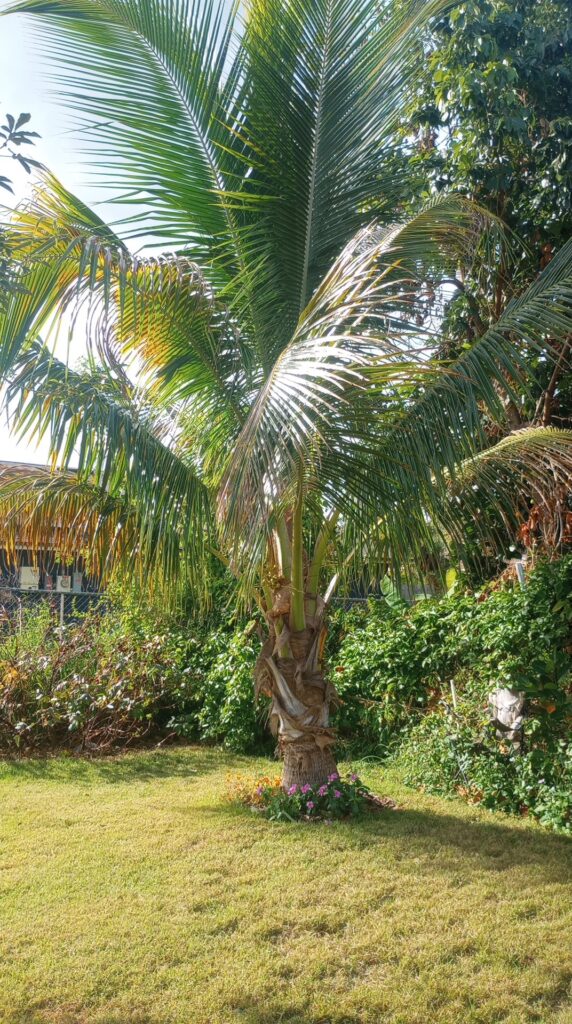
One of the easiest ways to distinguish a coconut tree from many other palms is the trunk shape. Coconut trees have a characteristic gentle lean or slight curve, often growing toward the sea or open sky. The trunk is grey-brown, ringed with old leaf scars, and relatively slender compared to its height.
Other palms vary widely. The Royal Palm (Roystonea regia) has a perfectly straight, smooth, almost concrete-like trunk. The Date Palm (Phoenix dactylifera) has a rough, stocky trunk covered in old leaf bases. The Fan Palm has a shorter, thicker trunk. No single trunk shape defines all palms — but the coconut’s gentle sway is fairly distinctive.
2. The Leaves (Fronds)
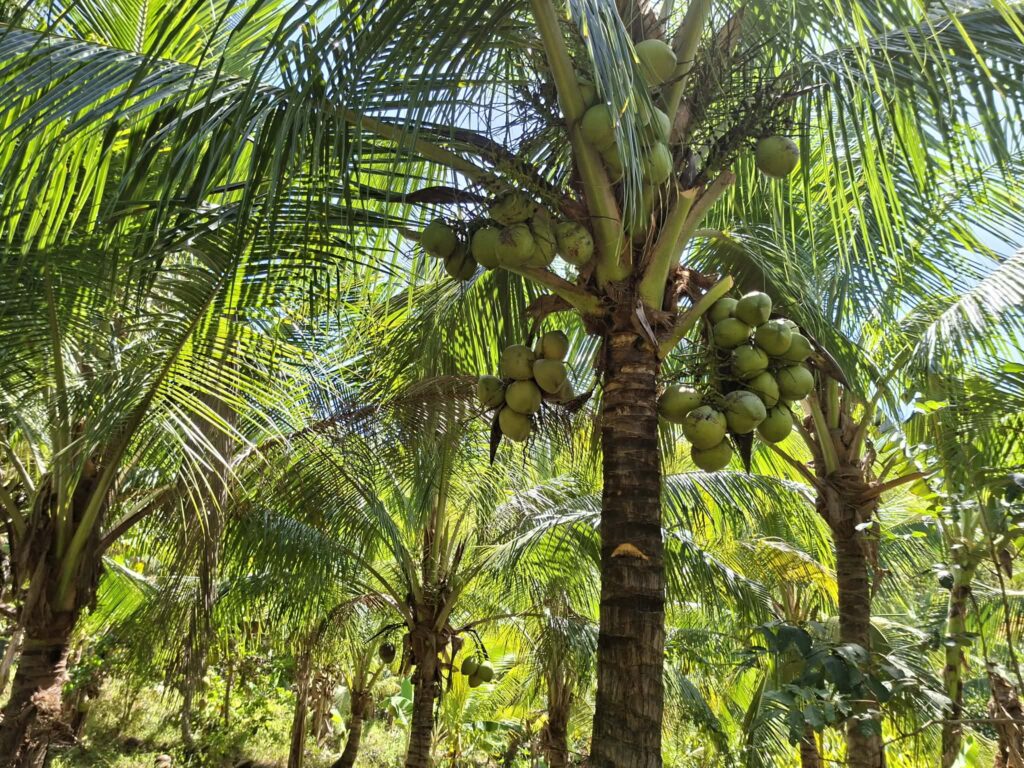
Coconut tree leaves are pinnate — meaning they are feather-shaped, with leaflets arranged on both sides of a central stem (rachis). A mature coconut frond can reach 4 to 6 metres in length. The leaflets are long, narrow, and bright green.
Palm trees can have either pinnate or palmate (fan-shaped) leaves. Palmate leaves radiate from a central point, like fingers on a hand. You see this in the California Fan Palm (Washingtonia filifera) or the Livistona species common in East Africa and Asia.
If you see a fan-shaped leaf, it is definitely not a coconut tree. Coconut trees only produce feathery pinnate fronds.
3. The Fruit
This is the most obvious difference to most people. The coconut tree produces coconuts — large, round to oval drupes with a fibrous outer husk (exocarp and mesocarp), a hard inner shell (endocarp), white meat (endosperm), and liquid (coconut water).
Other palms produce very different fruits:
- Date Palm → sweet, elongated dates
- Oil Palm (Elaeis guineensis) → small reddish-orange drupes, processed for palm oil
- Acai Palm (Euterpe oleracea) → small, deep purple berries
- Areca Palm (Areca catechu) → betel nuts (areca nuts)
- Sago Palm (Metroxylon sagu) → starchy trunk, not fruit-bearing in the commercial sense
No other palm produces a coconut. That alone makes identification straightforward when fruit is present.
4. The Roots
Coconut trees are monocots, meaning they do not have a taproot. Instead, they grow a dense fibrous root system that spreads horizontally close to the soil surface. This system is remarkably effective at anchoring the tree in sandy coastal soils.
Most palms share this fibrous root characteristic since they are all monocots. However, root density, depth, and spread vary considerably across species. Some palms develop more compact root systems suited to rocky terrain; others develop extensive shallow networks ideal for nutrient-poor soils.
5. Height and Growth Pattern
Coconut trees reach 15 to 30 metres at maturity, with dwarf varieties staying under 10 metres. They grow continuously throughout their lives, adding new fronds from the crown.
Palm trees span an enormous height range. The Wax Palm (Ceroxylon quindiuense) of the Colombian Andes — the world’s tallest palm — can exceed 60 metres. The Pygmy Date Palm (Phoenix roebelenii) stays under 3 metres. The variation in palms is enormous.
Similarities Between Coconut Trees and Palm Trees
Since coconut trees are palms, they naturally share many characteristics with other palms. Understanding what they have in common is just as important as understanding their differences.
Monocot Structure
All palms — including coconut trees — are monocotyledonous plants. This means they grow from a single seed leaf (cotyledon), unlike most trees (dicots) which grow from two seed leaves.
Monocots grow differently: they cannot widen their trunks through secondary growth. Whatever diameter the trunk starts at, it stays roughly the same throughout the tree’s life. This is why palms look the same width from base to crown.
Crown of Fronds at the Top
Both coconut trees and most palm species carry their leaves only at the very top of the trunk. The trunk itself is bare — a feature called the apical growth habit. This gives all palms their unmistakable silhouette.
Single Growing Point
All palms, including coconut trees, have one growing point — the apical meristem at the crown. If this point is damaged or removed, the tree will not recover. This is why cutting the heart of a palm (the growing tip) kills it. This biological fact is critically different from most broadleaf trees, which can regrow from multiple points after damage.
Tropical and Subtropical Preference
Most palms, including coconut trees, prefer warm, humid climates. Very few palms are cold-hardy, and none survive long in freezing conditions without protection. The European Fan Palm (Chamaerops humilis) is a notable exception — it can tolerate brief frost. But the coconut tree, in particular, is highly sensitive to cold and dies at temperatures near 0°C (32°F).
Long Lifespan
Both coconut trees and other palms are long-lived plants. A productive coconut tree can fruit for 60–80 years. Some date palms live over 100 years. The Coco de Mer palm (Lodoicea maldivica) of the Seychelles can live for 200–300 years — making it one of the longest-lived monocots on Earth.
Cultural and Economic Importance
Across human history, both coconut trees and other palms have held extraordinary importance to the communities that live among them. The coconut tree is famously called Kalpavriksha (the wish-fulfilling tree) in Sanskrit — because virtually every part of it is useful.
Date palms hold similar status across the Middle East and North Africa. Oil palms drive the economies of Indonesia, Malaysia, and much of West Africa. The link between palms and human civilization is ancient and deep.
Ecological Role: Where Each Thrives
Coconut Tree Habitat
Coconut trees are coastal specialists. They thrive within a few kilometres of the sea, in sandy, well-drained soils with high salinity tolerance. They need:
- Full sun — at least 6–8 hours daily
- Rainfall of 1,000–2,000 mm annually
- Temperature range of 25–32°C
- High humidity — generally above 70%
Coconut trees grow across a global tropical belt extending roughly 25° north and south of the equator. You find them in the Philippines, India, Indonesia, Brazil, Sri Lanka, Tanzania, Jamaica, and dozens more countries.
Other Palm Tree Habitats
Other palms are far more ecologically diverse. Consider these contrasts:
- Date Palms thrive in desert and semi-arid conditions — hot, dry, with minimal rainfall. They are the exact opposite of the coconut’s humid coastal habitat.
- Oil Palms prefer humid equatorial rainforests with high rainfall (2,000+ mm/year) and fertile soils.
- Acai Palms grow in Amazonian floodplains — periodically waterlogged environments that most plants cannot survive.
- Bismarck Palms (Bismarckia nobilis) are native to the open savannas of Madagascar — a completely different ecosystem from any of the above.
- Chilean Wine Palm (Jubaea chilensis) grows in Mediterranean-climate scrubland — one of the few palms native to a temperate zone.
No other plant family matches the ecological spread of the Arecaceae. Palms have colonized every warm environment on Earth, from desert to rainforest to island shores.
Economic Comparison: Coconut Tree vs Other Palms
The Coconut Tree Economy
The coconut industry is a global multi-billion-dollar economy. According to the FAO, Indonesia, the Philippines, and India are the world’s top three coconut producers. The tree provides:
- Coconut water — a growing global beverage market worth billions annually
- Coconut oil — used in cooking, cosmetics, and pharmaceuticals
- Coconut milk and cream — essential in South and Southeast Asian cuisine
- Copra — dried coconut meat used for oil extraction
- Coir — fiber from the husk, used in ropes, mats, and erosion control products
- Coconut shell — used for charcoal, handicrafts, and activated carbon
- Coconut timber — used in construction and furniture
- Toddy — sap tapped from the flower stalk, fermented into alcoholic drinks or vinegar
The coconut tree wastes almost nothing. It remains one of the most fully utilized trees on Earth.
The Oil Palm Economy
In terms of sheer global economic volume, the oil palm (Elaeis guineensis) surpasses the coconut. Palm oil is the world’s most consumed vegetable oil, found in roughly half of all packaged food products, soaps, cosmetics, and biofuels. Indonesia and Malaysia together account for about 85% of global palm oil production.
However, oil palm cultivation has been associated with significant deforestation and biodiversity loss in Southeast Asia and West Africa — a major environmental concern that coconut farming largely avoids.
Date Palms and the Middle Eastern Economy
The date palm (Phoenix dactylifera) is to the Middle East what the coconut tree is to the tropics — a tree of extraordinary cultural and economic importance. Saudi Arabia, Egypt, Iran, Algeria, and Iraq are among the world’s largest date producers. Dates are a staple food, a religious symbol, and a growing global export commodity.
Nutritional Comparison: Coconut vs Other Palm Fruits
Coconut
- Coconut water: Rich in potassium, magnesium, and natural electrolytes. Low in calories. Excellent for hydration.
- Coconut meat: High in medium-chain triglycerides (MCTs), dietary fiber, and minerals like manganese and copper.
- Coconut oil: About 90% saturated fat — primarily MCTs. Debated nutritionally but widely used.
Dates (Date Palm Fruit)
- Very high in natural sugars (glucose, fructose, sucrose) — one of nature’s most energy-dense fruits.
- Rich in fiber, potassium, magnesium, and B vitamins.
- Dates have been a survival food across desert cultures for millennia.
Acai Berries (Acai Palm)
- Extremely high in antioxidants, particularly anthocyanins.
- Rich in healthy fats and low in sugar compared to most berries.
- A global superfood phenomenon over the last two decades.
Each palm fruit has a very different nutritional profile suited to the human communities that evolved alongside those trees. There is no single winner — context and dietary need determine value.
How to Identify a Coconut Tree vs a Palm Tree in the Field
Here is a practical identification guide:
- Look at the leaves. Fan-shaped? Not a coconut. Feathery and long? Could be a coconut — check other features.
- Check for fruit. Large, round, green or brown fibrous fruit? That is a coconut tree. No other palm produces this.
- Observe the trunk. Gently curved or leaning, with circular ring scars? Likely a coconut tree.
- Note the location. Near a coast, in sandy tropical soil? Coconut is very likely. Inland desert or mountain slope? Almost certainly a different palm.
- Measure height relative to age. Coconuts grow to 20–30 metres. A very tall (50+ metre) palm is something else entirely.
Common Misconceptions Cleared Up
“All palm trees produce coconuts.” False. Only Cocos nucifera produces coconuts. Thousands of other palm species produce entirely different fruits or none at all.
“Coconut trees and palm trees are completely different plants.” False. Coconut trees are palms — they belong to the same family (Arecaceae).
“Palm trees only grow on beaches.” False. Palms grow in deserts, rainforests, mountains, and wetlands. The coconut tree prefers coastal zones, but other palms occupy nearly every warm ecosystem on Earth.
“Palm oil comes from coconuts.” False. Palm oil comes from the fruit of the oil palm (Elaeis guineensis). Coconut oil is a separate product entirely.
“Coconut trees are the tallest palms.” False. Several palms, including the Wax Palm of Colombia, grow far taller than any coconut tree.
Suggested For You:
25 Different Types of Coconut Trees: Dwarf, Tall Varieties, and More
20 Different Types of Palm Trees: Identification, Features, and Care
15 Best Trees for a Wildlife Garden: A Complete Planting Guide
15 Dwarf Fruit Trees for Garden Beds: A Complete Growing Guide
Final Thoughts
The coconut tree and the palm tree are not opposites — they are related, with the coconut being one remarkable member of a vast family. What makes the coconut tree stand out is its extraordinary all-round utility, its coastal adaptability, and the profound cultural role it plays in tropical societies across the globe.
Other palms — from the date palm to the oil palm to the towering Wax Palm of the Andes — are equally remarkable in their own ways. Each has shaped human history, local economies, and ecosystems in ways that most people rarely stop to appreciate.
The next time you see a tall, swaying tree on a beach, you will know exactly what to look for — and more importantly, you will understand what you are really seeing.
References
- Food and Agriculture Organization of the United Nations (FAO) — Coconut: Post-Harvest Operations https://www.fao.org/3/a0202e/a0202e00.htm
- University of Florida IFAS Extension — Coconut Palm (Cocos nucifera) https://edis.ifas.ufl.edu/publication/ST155
- Smithsonian Tropical Research Institute — Palm Biology and Ecology https://www.stri.si.edu/english/research/facilities/terrestrial/barro_colorado/index.php
- Royal Botanic Gardens, Kew — Arecaceae (Palm Family) https://www.kew.org/plants/arecaceae
- Tamil Nadu Agricultural University (TNAU) Agritech Portal — Coconut Crop Information https://agritech.tnau.ac.in/horticulture/horti_plantation_coconut.html

Tim M Dave is a gardening expert with a passion for houseplants, particularly cacti and succulents. With a degree in plant biology from the University of California, Berkeley, he has vast experience in gardening. Over the years, he has cultivated a vast collection of desert plants and learned a great deal about how to grow and care for these unique companions.