Understanding Cherry Laurel: Size, Growth Rate, Problems, and Cultivation Details
Cherry Laurel (Prunus laurocerasus) is a broadleaf evergreen shrub or small tree native to the Caucasus region, southwestern Asia, and southeastern Europe — particularly Turkey, the Balkans, and the Black Sea coast.
It was introduced to Western Europe in the late 16th century and has since naturalized widely across the UK, parts of Europe, and the Pacific Northwest of North America.
Despite its common name, Cherry Laurel is neither a true cherry nor a true laurel. It belongs to the genus Prunus — the same family as cherries, plums, and almonds — but it is grouped with the laurels in common speech because of its large, leathery leaves and evergreen habit.
The plant has been cultivated for centuries as an ornamental shrub. In Victorian-era Britain, it was planted extensively in estate gardens for its ability to form dense, impenetrable hedges and woodland screens.
Today, it remains one of the most widely planted hedging plants in temperate climates around the world.
| Common Name | Cherry Laurel, English Laurel |
| Scientific Name | Prunus laurocerasus |
| Family | Rosaceae |
| Type | Broadleaf evergreen shrub / small tree |
| Mature Height | 10–30 ft (varies by cultivar) |
| Mature Spread | 10–25 ft |
| Growth Rate | Fast (12–24 inches/year) |
| USDA Hardiness Zones | 6–9 |
| Sun Requirement | Full sun to full shade |
| Soil Type | Moist, well-drained; tolerates most soils |
| Soil pH | 6.0–7.5 |
| Water Needs | Moderate; drought-tolerant once established |
| Flower Season | Mid to late spring (April–May) |
| Flower Color | White, fragrant racemes |
| Fruit | Small dark purple to black drupes |
| Toxicity | Toxic to humans, dogs, cats, and livestock |
| Wildlife Value | Bees (flowers), birds (fruit) |
| Landscape Use | Hedge, screen, specimen, woodland garden |
| Notable Cultivars | ‘Otto Luyken,’ ‘Schipkaensis,’ ‘Zabeliana,’ ‘Rotundifolia’ |
Important Naming Note
You may encounter the name “English Laurel” particularly in North America. This refers to the same plant — Prunus laurocerasus. The name “English Laurel” arose from its long association with English gardens, even though its natural range is far to the east.
Do not confuse it with:
- Portuguese Laurel (Prunus lusitanica) — a related species, slightly more cold-hardy, with smaller leaves
- Bay Laurel (Laurus nobilis) — the culinary herb, unrelated
- Mountain Laurel (Kalmia latifolia) — a native North American shrub, unrelated
Physical Characteristics – Identification Features
Leaves
The leaves of Cherry Laurel are its most striking feature. They are large, glossy, and deep green — typically 4–8 inches long and 1.5–2.5 inches wide. The surface has a high-gloss finish that catches light beautifully, giving any hedge or planting a well-groomed, sophisticated look even without maintenance.
The leaf edges are finely toothed, and the underside is lighter green with small glands visible near the midrib. When crushed or cut, the leaves release a distinctive almond-like scent — caused by small amounts of hydrogen cyanide compounds.
This smell is immediately recognizable and is one of the most reliable ways to identify the plant.
Flowers
In mid to late spring, Cherry Laurel produces upright clusters (racemes) of small, creamy-white flowers that are surprisingly fragrant. Each raceme can reach 3–5 inches long, and a large, unclipped shrub in full bloom is genuinely beautiful.
The flowers attract bees and other pollinators enthusiastically.
One of the most common mistakes with Cherry Laurel hedges is clipping them with power shears just before or during flowering — this removes the blooms entirely. If you want to enjoy the flowers, delay any major trimming until after the blooms fade.
Fruit
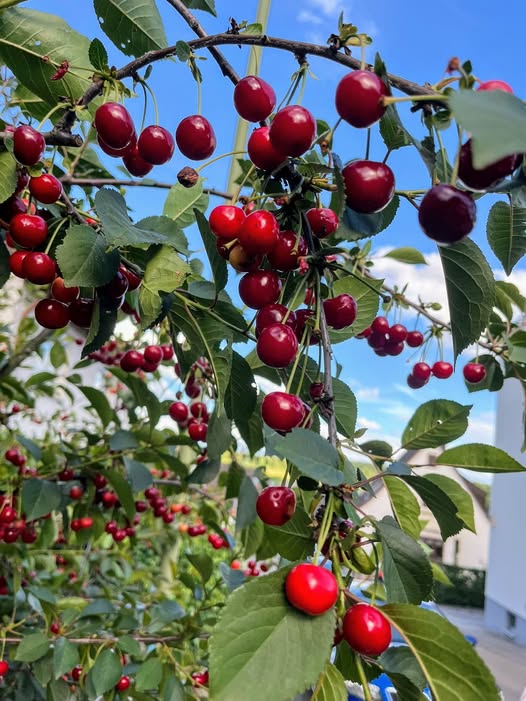
Following the flowers, the plant produces small, cherry-like drupes. They start green, progress through red, and ripen to a deep purple-black by late summer. The fruit resembles miniature cherries and is readily eaten by birds, which contributes significantly to the plant’s spread into wild areas.
The fruit is toxic to humans and animals. This is an important consideration in gardens where children or pets are present.
Bark and Stems
Stems are green when young, maturing to smooth gray-brown bark with age. The plant has a vigorous, multi-stemmed habit that creates a dense interior structure — one reason it forms such effective privacy screens.
Growth Rate and Mature Size
Cherry Laurel is a fast grower. Under good conditions, expect 12–24 inches of new growth per year. This makes it one of the quickest-establishing evergreen hedges available in temperate climates.
Left to grow freely, the plant can reach:
- 10–18 feet tall as a large shrub
- Up to 30 feet when trained as a small tree
- 10–25 feet wide in spread
However, most gardeners keep Cherry Laurel clipped and controlled. As a maintained hedge, it can be held at virtually any height from 3 feet to 15 feet, depending on the cultivar and the garden’s needs.
Cultivar Size Guide
Different cultivars offer very different mature sizes, which makes selecting the right one critical:
| Cultivar | Mature Height | Best Use |
| ‘Rotundifolia’ | 12–18 ft | Large hedges, screening |
| ‘Schipkaensis’ (Schip Laurel) | 6–10 ft | Medium hedges, Zones 5–9 |
| ‘Otto Luyken’ | 3–4 ft | Low borders, ground cover |
| ‘Zabeliana’ | 3–5 ft | Spreading ground cover, slopes |
| ‘Caucasica’ | 15–20 ft | Tall wind screens |
| ‘Mount Vernon’ | 2–3 ft | Compact ground cover |
Choosing the right cultivar at the start saves years of over-pruning or replacing plants that have outgrown the space.
Ideal Growing Conditions
For this tree to thrive, it needs the following:
Sunlight
Cherry Laurel is remarkably adaptable when it comes to light. It performs well in:
- Full sun — produces the densest, most vigorous growth and the best flowering
- Partial shade — still grows well with slightly larger leaves and a more open habit
- Full shade — one of the few large evergreen shrubs that will genuinely thrive in deep shade
This shade tolerance is one of Cherry Laurel’s defining advantages. Most fast-growing hedging plants need good sunlight. Cherry Laurel can fill in those dark corners under trees, along north-facing walls, or in dappled woodland where alternatives simply fail.
In deep shade, growth is somewhat slower and leaf color is a slightly softer green, but the plant remains healthy and presentable.
Soil
Cherry Laurel tolerates a wide range of soil conditions, which is another reason it is so widely planted. It grows in:
- Clay, loam, or sandy soils — it adapts to all three
- Slightly acidic to neutral pH (6.0–7.5)
- Moist conditions — but dislikes prolonged waterlogging
The one soil condition it truly dislikes is waterlogged, poorly drained ground. In soil that stays wet after rain, the roots become vulnerable to Phytophthora root rot, which can kill the plant over one to two seasons.
If your site has drainage problems, improve drainage before planting or choose a different species.
It also tolerates chalky (alkaline) soils better than many evergreens, though heavy chalk can cause leaf yellowing (chlorosis) over time.
Water
Young plants need regular watering during the first growing season to establish. Once established, Cherry Laurel is quite drought-tolerant and rarely needs irrigation in temperate climates with reasonable annual rainfall.
In prolonged summer droughts, new growth may wilt slightly and leaf edges may brown, but the plant rarely suffers permanent damage. A deep watering during extended dry periods is sufficient.
Climate and Hardiness Zones
The standard species (Prunus laurocerasus) is hardy in USDA Zones 6–9. In Zone 5, it may suffer significant winter leaf damage or dieback in harsh years.
For colder climates, ‘Schipkaensis’ (Schip Laurel) is the most cold-tolerant cultivar, rated to Zone 5 and sometimes reported surviving Zone 4 winters in sheltered positions.
In Zones 8–9, Cherry Laurel grows vigorously but may need more attention to prevent it from spreading beyond the intended area — it naturalizes readily in mild, moist climates.
In the Pacific Northwest of North America, Cherry Laurel has become invasive in some natural areas. Check local regulations before planting if you are in Oregon, Washington, or British Columbia.
How to Plant Cherry Laurel
Here is a step-by-step guide on how to grow this plant:
When to Plant
Cherry Laurel can be planted in spring or autumn. Autumn planting (September–November) is often preferred in mild climates because the plant can establish roots over winter before facing the stress of summer heat. Spring planting works well in colder areas where autumn-planted shrubs might not have time to settle before the ground freezes.
Avoid planting in midsummer heat or frozen winter soil.
Planting for a Hedge
Hedges are the most common use of Cherry Laurel. Here is how to get it right:
1. Mark the line. Use string and stakes to define a straight planting line.
2. Spacing: For a dense hedge, plant 3–5 feet apart for ‘Rotundifolia’ or larger cultivars; 2–3 feet apart for compact types like ‘Otto Luyken.’ Closer spacing creates a solid screen faster; wider spacing is more economical and still fills in within 2–3 years.
3. Dig the trench. A continuous trench 18–24 inches wide and 18 inches deep is more efficient than individual holes for hedge planting.
4. Amend if needed. On poor soils, work in compost. On heavy clay, mix in coarse grit or sand to improve drainage.
5. Plant at the correct depth. The root ball top should be level with the surrounding soil — no deeper.
6. Firm in and water. Press soil firmly around the roots to eliminate air pockets. Water thoroughly.
7. Mulch the base. A 3-inch mulch layer conserves moisture, suppresses weeds, and insulates the roots.
Planting as a Specimen or Backdrop Shrub
For a standalone specimen or backdrop planting, the same principles apply: good drainage, correct depth, ample water in the first season. Give the plant room to develop naturally — most cultivars spread substantially and will look their best when not crowded.
Pruning Cherry Laurel: The Right Way
Pruning is where many gardeners make avoidable mistakes with Cherry Laurel. Get this right and you will have a beautiful, healthy plant for decades.
The Most Important Rule: Use Secateurs, Not Shears
Power shears and hedge trimmers cut through the large leaves, leaving brown, ragged cut edges that are visible for weeks. This is one of the most common complaints about Cherry Laurel hedges — that they look “butchered” after trimming.
The professional approach is to prune with secateurs (hand pruners) or loppers, cutting individual stems back to a leaf node or junction. This takes longer on a large hedge but produces clean, natural-looking results with no browning.
If you must use power shears for speed on a large hedge, accept that there will be some leaf browning temporarily. New growth will cover it within four to six weeks during the growing season.
When to Prune
- Main annual prune: Late spring to early summer, after flowering (May–June). This preserves the spring blooms and allows the plant a full growing season to recover.
- Second light trim: Late summer (August) if needed to tidy new growth before winter.
- Avoid pruning in autumn in cold climates — new soft growth stimulated by late pruning may be damaged by early frosts.
Hard Pruning for Renovation
One of Cherry Laurel’s great strengths is its ability to regenerate from very old wood. If a hedge has become too large, too wide, or has an ugly hollow center, you can cut it back hard — even to within 12–18 inches of the ground — and it will reshoot vigorously.
Renovation pruning is best done in early spring before growth begins. The plant may look stark for one growing season but will typically recover within two years to form a dense, well-structured hedge.
Very few evergreen hedging plants tolerate this kind of hard renovation. This resilience is one of Cherry Laurel’s most practical advantages.
Fertilization
Cherry Laurel is not a heavy feeder. In most garden soils, additional fertilization is unnecessary once the plant is established.
If the foliage appears pale yellow or growth seems unusually slow, a balanced slow-release fertilizer applied in spring is usually sufficient. Granular fertilizers worked into the soil at the drip line are more effective than surface applications.
On chalky soils, iron and manganese deficiency can cause yellowing between the leaf veins (interveinal chlorosis). An application of chelated iron or an ericaceous (acidifying) fertilizer can correct this.
Avoid over-fertilizing with high-nitrogen products — this produces excessive, soft growth that is more vulnerable to disease and requires more frequent pruning.
Common Pests and Diseases
Shot Hole Disease (Stigmina carpophila and related fungi)
This is the most visually alarming problem on Cherry Laurel, and it is extremely common. Small brown spots appear on the leaves, and the centers eventually fall out, leaving the foliage riddled with small circular holes — exactly as if someone had fired a shotgun at it.
Shot hole is primarily a cosmetic problem rather than a fatal one. Healthy, well-established plants tolerate it without significant structural damage.
Management: Improve airflow around the plant by pruning to open up the interior. Avoid overhead watering, which keeps foliage wet. Remove and dispose of heavily infected fallen leaves. Fungicide treatments are rarely necessary for established plants.
Phytophthora Root Rot
This soilborne disease is the most serious threat to Cherry Laurel. It causes gradual wilting, yellowing, and eventual death of the plant, usually starting with one section of a hedge dying while adjacent sections appear fine.
Prevention is far more effective than treatment. Plant in well-drained soil, avoid overwatering, and do not mulch directly against the stem base.
Once established, Phytophthora is very difficult to eradicate. Affected plants should be removed and the soil treated or replaced before replanting.
Vine Weevil (Otiorhynchus sulcatus)
Vine weevil larvae feed on the roots of container-grown Cherry Laurels and can kill young plants. Adults notch the leaf edges but cause less serious damage. In the ground, established plants are rarely seriously harmed.
Management: Biological controls (nematodes applied to moist soil in late summer) are effective and environmentally friendly.
Aphids and Scale Insects
These sap-sucking insects occasionally appear on new growth. They rarely cause lasting damage to established plants. A forceful water spray or insecticidal soap deals with most infestations.
Frost Damage
In Zone 6 and at the edges of Zone 5, Cherry Laurel leaves may turn brown and fall in hard winters. This is often alarming to look at, but most plants recover and reshoot vigorously in spring. Wait until late spring before assuming the plant is dead and cutting it back.
Toxicity: An Important Consideration
This is something every grower should understand clearly.
All parts of Cherry Laurel are toxic — leaves, bark, seeds, and fruit. The plant contains prunasin, a cyanogenic glycoside that releases hydrogen cyanide when metabolized. Symptoms of poisoning include nausea, vomiting, rapid breathing, and in severe cases, coma or death.
The toxicity is most significant when the plant material is crushed or chewed — this is why the crushed leaves have that distinctive almond smell.
Key precautions:
- Keep children away from the berries, which can look appealing.
- Do not allow dogs, cats, or horses to graze on the leaves or fruit.
- Wear gloves when pruning and avoid touching your eyes or mouth.
- Do not compost large quantities of fresh prunings in an enclosed space — the volatile compounds can accumulate.
- Never burn Cherry Laurel prunings. The smoke is toxic and can cause serious respiratory problems.
Dispose of prunings by chipping, bagging for green waste collection, or allowing them to dry fully before composting in small amounts.
Landscape Uses and Design Ideas
Privacy Hedges and Screens
This is where Cherry Laurel truly excels. Its large, glossy leaves create a dense, visually impenetrable screen that blocks both sight and sound far more effectively than many competing hedging plants.
A well-established Cherry Laurel hedge along a boundary is one of the most effective privacy solutions available in temperate gardens.
It is faster-establishing than Yew (Taxus) or Holly (Ilex), less formal than Beech (Fagus), and far more shade-tolerant than Leyland Cypress.
Woodland Gardens
Cherry Laurel is one of the best large evergreen shrubs for underplanting beneath mature deciduous trees. It tolerates the dry, shaded conditions found under oak, beech, and lime canopies — conditions where most shrubs struggle.
It provides year-round structure and a glossy, reflective ground-level layer in spaces that would otherwise be bare.
Windbreaks
The dense, flexible branching of Cherry Laurel makes it an effective windbreak in exposed gardens. It bends in wind without breaking and retains its leaves through most winters, providing year-round protection.
Ground Cover on Slopes
Low-growing cultivars like ‘Zabeliana’ and ‘Otto Luyken’ spread horizontally and suppress weeds effectively on banks and slopes. Their root systems also help control erosion.
Specimen Shrub
Allowed to grow freely without clipping, Cherry Laurel develops into a handsome, architectural specimen with a full, rounded form. In spring, the white flower racemes are genuinely ornamental, and the glossy foliage is attractive year-round.
Urban Gardens and Difficult Sites
Cherry Laurel tolerates pollution, coastal winds, compacted soils (within reason), and neglect better than most ornamentals. It is one of the most reliable choices for difficult urban plots where other plants fail to establish.
Cherry Laurel vs. Competing Hedging Plants
| Plant | Growth Rate | Shade Tolerance | Hardiness | Notes |
| Cherry Laurel | Fast | Excellent | Zones 6–9 | Best all-rounder |
| Portuguese Laurel | Moderate | Good | Zones 6–9 | More elegant; less invasive |
| Yew (Taxus) | Slow | Excellent | Zones 4–7 | Finest formal hedge; slow |
| Holly (Ilex) | Slow–Moderate | Good | Zones 5–9 | Good wildlife value |
| Laurustinus (Viburnum tinus) | Moderate | Good | Zones 7–9 | Winter flowers; smaller scale |
| Photinia ‘Red Robin’ | Moderate | Partial | Zones 7–9 | Less shade-tolerant |
Cherry Laurel wins outright on speed, shade tolerance, and sheer adaptability. Where a more refined or wildlife-friendly option is preferred, Portuguese Laurel or Holly are excellent alternatives.
Invasive Status: Know Before You Plant
In parts of the Pacific Northwest (Oregon, Washington) and British Columbia, Cherry Laurel has naturalized aggressively and is considered an invasive species. Birds spread the seeds into woodland areas, where the plant’s shade tolerance allows it to outcompete native understory vegetation.
If you live in these regions, check with your local extension service or invasive species authority before planting. Alternatives such as Portuguese Laurel or native evergreen species may be recommended.
In most of Europe and the eastern United States, Cherry Laurel is not classified as invasive, though it does self-seed freely and young seedlings should be removed if they appear outside the intended planting area.
Seasonal Interest
Spring: Creamy white flower racemes appear in April–May. Fragrant and attractive to pollinators. New leaves emerge bright, glossy green.
Summer: The hedge or shrub is at its fullest and most lush. Deep green foliage provides rich color and dense screening.
Autumn: Fruits ripen from red to deep purple-black, attracting birds. Foliage remains fully evergreen.
Winter: Cherry Laurel remains green and presentable through most winters, providing essential structure in the dormant garden. In Zone 6 it may show some leaf browning in hard frosts but maintains its framework.
Final Thoughts
Cherry Laurel is not a glamorous plant. It does not turn crimson in autumn or produce showy flowers through three seasons. What it does, it does with quiet, dependable excellence — year-round greenery, rapid establishment, extraordinary adaptability, and a resilience that outlasts almost everything planted alongside it.
In over thirty years of widespread ornamental use, it has proven itself in urban gardens, rural estates, woodland edges, coastal plots, and shaded north-facing boundaries. It does not ask for much. In return, it delivers structure, privacy, and beauty through every month of the year.
Choose the right cultivar for your scale, plant it in well-drained soil, prune with care rather than speed, and respect its toxicity around children and pets. Do those things, and Cherry Laurel will reward you with one of the most reliable and attractive evergreen plantings you can make.
For gardeners who need results without complexity — this is the plant.
References
- North Carolina State University Extension — Plant Toolbox: Prunus laurocerasus https://plants.ces.ncsu.edu/plants/prunus-laurocerasus/
- University of Connecticut Plant Database — Prunus laurocerasus https://hort.uconn.edu/detail.php?pid=252
- Penn State Extension — Landscape Shrub Selection and Care https://extension.psu.edu/landscape-shrub-selection-and-care
- University of Florida IFAS Extension — Prunus laurocerasus: Cherry Laurel https://edis.ifas.ufl.edu/publication/ST520
- Virginia Cooperative Extension — Woody Ornamentals: Pest and Disease Management https://www.pubs.ext.vt.edu/450/450-600/450-600.html

Tim M Dave is a gardening expert with a passion for houseplants, particularly cacti and succulents. With a degree in plant biology from the University of California, Berkeley, he has vast experience in gardening. Over the years, he has cultivated a vast collection of desert plants and learned a great deal about how to grow and care for these unique companions.