Understanding Champaca (Magnolia champaca): Identification, Uses, Problems and More
Few plants in the world have commanded as much reverence, poetic devotion, and spiritual significance as Magnolia champaca — a tree whose golden blossoms produce what many perfumers, botanists, and flower lovers consider the most intoxicating natural fragrance on Earth.
The scent is warm, deeply floral, with layers of orange, tea, spice, and honey that have no real equivalent in the plant kingdom.
The Champaca has been woven into the religious rituals, romantic poetry, folk medicine, and daily life of South and Southeast Asia for thousands of years. It perfumes temple courtyards in India, garlands hair in Thailand, and inspires ghazals in Persian and Urdu literature.
Yet beyond its legendary fragrance, Champaca is also a magnificent tree in its own right — tall, graceful, fast-growing, and generous with its blossoms across much of the year. This guide covers everything worth knowing about it: let’s dive in!
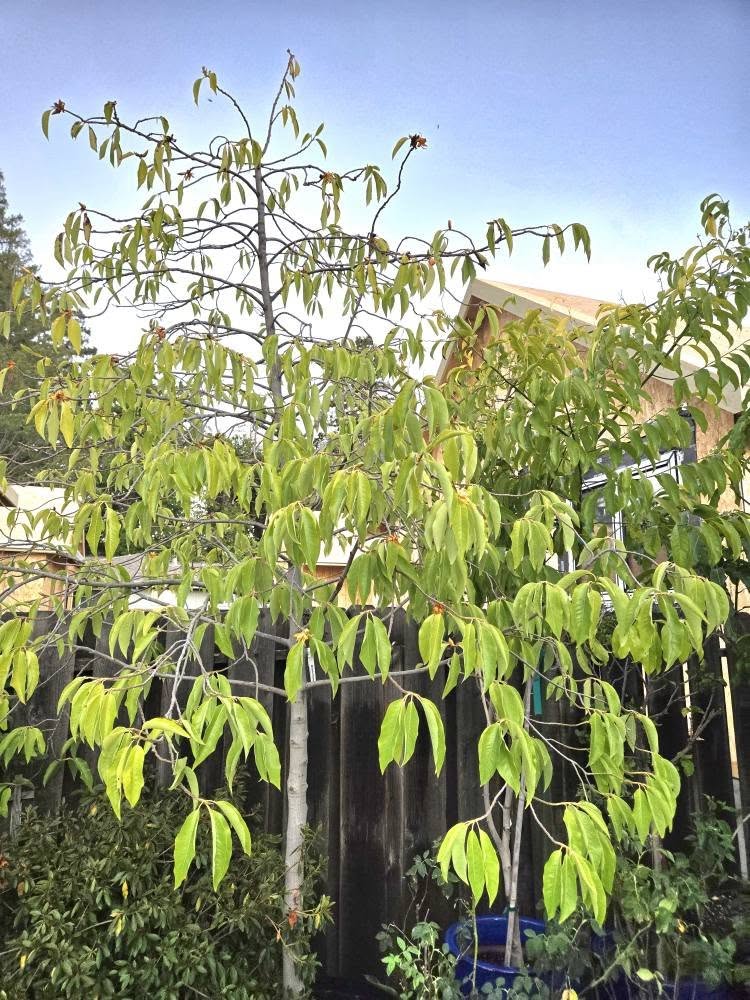
What Is the Champaca?
The Champaca belongs to the family Magnoliaceae — the magnolia family — and was long classified under the genus Michelia before being reclassified into Magnolia in modern botanical treatments. You will still encounter it under both names in botanical literature, nursery catalogs, and online resources:
- Magnolia champaca — the current, accepted scientific name
- Michelia champaca — the older name, still widely used
Both names refer to the same plant. When purchasing or researching Champaca, search under both names to ensure comprehensive results.
The common names are numerous and culturally rich:
- Champaca or Champak — the pan-Asian standard, used across India, Southeast Asia, and the global perfume trade
- Joy Perfume Tree — a trade name used in the nursery industry, referencing the famous “Joy” perfume by Jean Patou
- Yellow Champaca or Orange Champaca — referring to the most common flower color forms
- Golden Champaca — used when flowers are particularly deep golden-yellow
- Champak — the Sanskrit-derived name used across the Indian subcontinent
- Chan — the Thai common name
- Cempaka Kuning — used in Indonesia and Malaysia, meaning “yellow cempaka”
The name champaca itself derives from the Sanskrit campaka — a word that appears in ancient Hindu and Buddhist texts going back over two thousand years.
| Scientific Name | Magnolia champaca (syn. Michelia champaca) |
| Family | Magnoliaceae |
| Common Names | Champaca, Champak, Joy Perfume Tree, Chan |
| Native Range | South and Southeast Asia, southern China |
| Mature Height | 30–50 feet in cultivation; up to 100 feet in nature |
| Growth Rate | Fast (3–5 feet/year in tropics) |
| Leaf Type | Evergreen; large, glossy, elliptical |
| Flower Color | Cream, golden-yellow, orange |
| Fragrance | Exceptionally strong; orange-floral-honey |
| Bloom Season | Nearly year-round in tropics; spring–autumn in subtropics |
| Hardiness Zones | USDA Zones 9–12 (container in 7–8) |
| Soil | Rich, well-drained, slightly acidic |
| Wildlife Value | Pollinators, birds (fruit) |
| Cultural Significance | Sacred in Hindu and Buddhist traditions; classical poetry |
Native Range and Natural Habitat
The Champaca is native to a broad arc of South and Southeast Asia, with its natural range extending across the eastern Himalayas (Nepal, northeastern India, Bhutan), through Myanmar, Thailand, Laos, Vietnam, Cambodia, Malaysia, and Indonesia into the Philippines and southern China.
Within this range, it grows naturally in tropical and subtropical forests, typically at elevations from sea level to approximately 5,000 feet (1,500 meters). It prefers the lower slopes of tropical mountain forests and forest margins — areas with high humidity, rich well-drained soils, and warm temperatures year-round.
However, the Champaca’s cultivation history spans so many millennia that its precise natural range is difficult to establish. It has been planted around temples, homes, and gardens across South and Southeast Asia for at least 2,000 years, and many populations that appear “wild” may in fact be naturalized from ancient plantings.
Today, the tree is cultivated throughout the tropical and subtropical world — from Hawaii and Florida in the United States to the Caribbean, South America, East Africa, and the Pacific Islands. Wherever tropical temperatures prevail year-round, the Champaca has found a home.
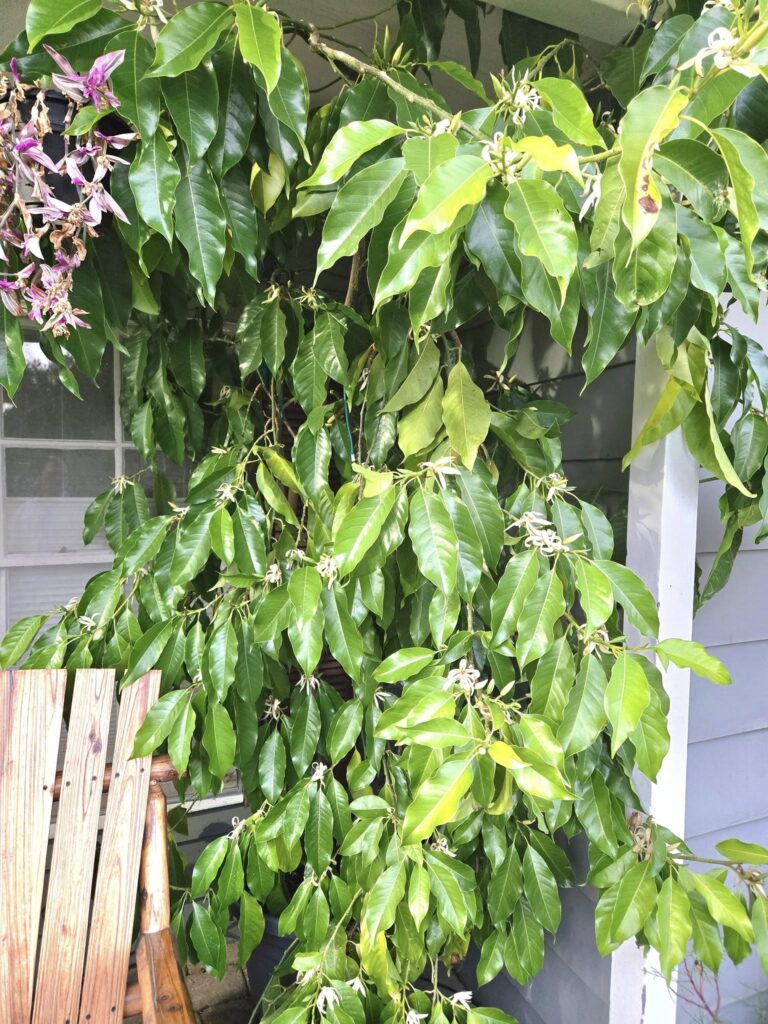
Physical Characteristics
Size and Form
The Champaca is a fast-growing, medium to large evergreen tree, typically reaching 30 to 50 feet (9–15 meters) in cultivation, with some forest specimens in native habitat exceeding 100 feet (30 meters). It is one of the faster-growing members of the magnolia family — adding 3 to 5 feet per year under good tropical conditions.
The crown is broadly conical to oval, with a straight central trunk and upward-sweeping branches that create an elegant, flame-like silhouette. The overall form is tall and stately — a tree that reads as genuinely impressive even at a moderate distance.
In tropical gardens, a mature Champaca becomes a landmark. The sheer scale of the tree combined with the persistent bloom season makes it the kind of specimen that organizes an entire garden around its presence.
Bark and Branches
The bark is gray-brown and smooth on young trees, becoming slightly rougher and more finely fissured with age. The branches are moderately stout, covered in fine hairs when young. The wood is moderately hard, light-colored, and aromatic.
Leaves
The leaves are simple, alternate, and elliptical to lance-shaped, measuring 6 to 12 inches (15–30 cm) in length. They are glossy, bright green on the upper surface and paler beneath, with a smooth, somewhat leathery texture. The margins are smooth — not toothed.
The leaves are large enough to create a bold-textured canopy that provides dense shade. Like the flowers and bark, the leaves are mildly aromatic when bruised — the resinous fragrance of the magnolia family is present throughout the plant.
Flowers — The Defining Feature
The flowers of the Champaca are, without question, the tree’s defining feature — and they are extraordinary by any standard.
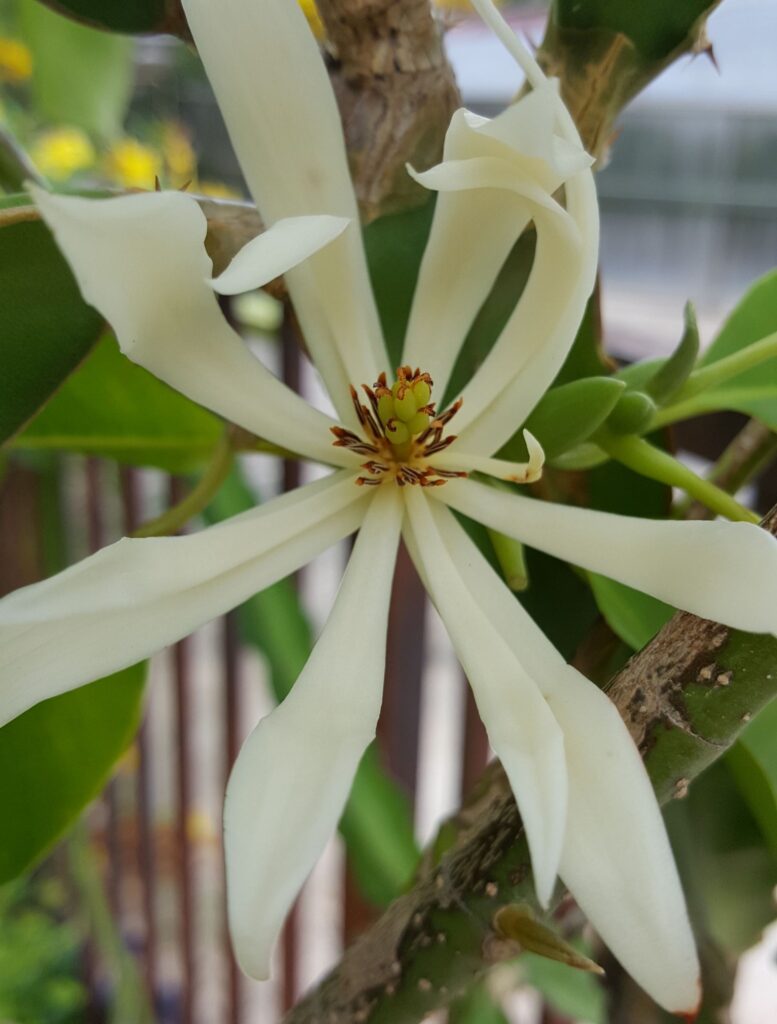
Each flower is 2 to 4 inches (5–10 cm) across, with 12 to 20 narrow, strap-shaped tepals (the magnolia family does not produce true petals and sepals as separate structures, but undifferentiated tepals). The tepals curve outward and reflex slightly in a star-like arrangement.
The color ranges from pale cream to golden yellow to deep orange, depending on the individual tree, cultivar, and growing conditions. The most commonly encountered forms produce warm golden-yellow to orange flowers — the color of ripe mangoes or autumn light filtering through amber glass.
The flowers are borne at the tips of leafy shoots, often nestled partially among the foliage, which means the tree never appears entirely bare of foliage-covered buds during bloom. This creates an elegant, embedded quality to the flower display — the blossoms seem to emerge from within the tree rather than simply sitting on top of it.
Bloom Season — Nearly Year-Round in the Tropics
One of the Champaca’s most practically valuable traits — and one of the reasons it is so highly regarded in tropical garden design — is its extended bloom season.
In tropical climates with minimal seasonality, Champaca may bloom nearly continuously throughout the year, with peak flushes during the warmer, wetter months. In subtropical climates, it typically blooms most heavily from late spring through autumn, with possible light winter flowering in mild years.
Even a single tree in good health can produce hundreds of individual flowers during a bloom flush, filling the surrounding air with fragrance that may carry for hundreds of meters on a warm evening.
I have stood at the gate of a temple courtyard in India where a single Champaca tree perhaps fifty feet away was invisible behind walls — and yet its fragrance was so present, so unmistakable, that the tree itself almost seemed unnecessary. The scent had arrived before the tree was ever visible.
The Fragrance: Science, Perfumery, and Cultural Significance
The Chemistry of Champaca Fragrance
The scent of Champaca flowers is complex, warm, and deeply floral — described by perfumers as having notes of orange blossom, jasmine, tea, honey, stone fruit, and warm spice, with a creamy, slightly waxy base note that carries the whole composition forward.
Chemically, Champaca absolute — the concentrated aromatic extract produced from the flowers — contains a complex mixture of compounds including:
- Methyl anthranilate — responsible for the characteristic orange-like, grape-like quality
- Linalool — a terpene alcohol providing fresh, floral sweetness
- Various indoles — contributing depth, warmth, and complexity
- Phenylethyl alcohol — rose-like facets
- Beta-ionone — violet and woody nuance
The combined effect is a fragrance that perfumers consistently describe as uniquely full-bodied and tenacious — it has remarkable longevity on skin and in perfume formulations, making it among the most technically valuable natural flower absolutes in the industry.
Connection to the Perfume “Joy”
The Champaca’s global fragrance reputation is closely tied to one of the most famous perfumes in history. “Joy” by Jean Patou, created in 1930 and long marketed as “the world’s most expensive perfume,” was formulated with an extraordinarily high concentration of natural jasmine and Champaca absolutes.
Champaca absolute remains one of the most expensive natural floral materials used in haute parfumerie — its extraction is labor-intensive, yield per kilogram of flowers is low, and the material must be produced in the tree’s growing regions, primarily India (especially Orissa and Karnataka), Indonesia, and parts of Southeast Asia.
Cultural and Religious Significance
In Hindu tradition, Champaca flowers are sacred to Vishnu and to Lord Krishna, and are among the most important flowers used in temple offerings and religious garlands. The flower appears in numerous Puranic texts and is mentioned in the Mahabharata and Ramayana.
In Buddhist tradition, the Champaca is associated with spiritual purity and is commonly planted in temple grounds across Sri Lanka, Thailand, Cambodia, and Vietnam.
The connection between the tree and sacred spaces is so deep that in many parts of South and Southeast Asia, the presence of a mature Champaca near a building is assumed to indicate a former temple or monastery site.
In Urdu and Persian poetry — particularly in the ghazal tradition — the champak flower is a recurring image of beauty, longing, and divine fragrance, appearing in the verses of classical poets including Mirza Ghalib and Amir Khusrau.
In Indian classical literature and Sanskrit poetry, the Champaca is used as a metaphor for the beloved’s complexion, for golden beauty, and for sweetness of character. The tree appears in Kalidasa’s Meghaduta — considered one of the greatest poems in Sanskrit — among other classical works.
The connection between this tree and human culture is not incidental or superficial. It is a relationship built over at least two thousand years and embedded in the spiritual, poetic, and domestic life of hundreds of millions of people.
Medicinal Uses and Ethnobotany
The Champaca has an extensive history of use in Ayurvedic, Unani, and traditional Southeast Asian medicine systems. While modern clinical evidence remains limited for many applications, the plant’s pharmacological compounds have attracted genuine scientific research interest.
Traditional Medicinal Applications
Across its native range, various parts of the tree have been used for:
- Flowers — used in aromatherapy and as nervines to relieve headache, anxiety, and nervous tension; applied as hair oil infusions across India
- Bark — used as a fever treatment, astringent, and tonic; preparations applied for rheumatism and joint pain
- Leaves — leaf decoctions used for fever, urinary disorders, and as a general tonic
- Seeds — used as a warming carminative for digestive complaints
- Root bark — used in some traditional systems as an emmenagogue and oxytocic, stimulating menstruation; should be avoided during pregnancy
- Flower essential oil — used in aromatherapy for its calming, mood-elevating properties
Phytochemical Research
Modern phytochemical analysis has identified alkaloids (including champacine and liriodenine), flavonoids, essential oils, and terpenes in various plant parts. Some of these compounds have demonstrated antimicrobial, anti-inflammatory, antifungal, and antioxidant activity in laboratory studies.
Research on Champaca’s biological activity remains an active area of scientific inquiry, particularly in India and Southeast Asia, where the plant’s traditional uses provide a starting point for investigating specific pharmacological properties.
Ecology and Wildlife Value in Cultivation
While Champaca is not a native species in most regions where it is now grown, it provides meaningful ecological services wherever it is planted in tropical and subtropical landscapes.
Pollinators
The flowers are strongly visited by native bees, honeybees, and various beetle species — the magnolia family has one of the most ancient evolutionary relationships with beetle pollination, predating the evolution of bees. Champaca flowers produce abundant pollen and are valued as a pollinator resource in tropical garden settings.
Birds
The fruit — a cone-like aggregate of fleshy red-orange seeds on long threads, ripening several months after flowering — is consumed by various fruit-eating birds including bulbuls, mynas, and other tropical fruit specialists. Seed dispersal is primarily bird-mediated, a relationship typical of the magnolia family.
Shade and Microclimate Modification
A mature Champaca creates significant shade canopy that moderates temperature and humidity beneath it — a practically important function in tropical gardens and streetscapes where heat mitigation is a landscape priority.
Landscape and Garden Uses
The Champaca is one of the most valuable large ornamental trees available for tropical and subtropical landscapes. Its combination of fragrance, bloom duration, evergreen foliage, and architectural form makes it genuinely irreplaceable in the design palette of warm-climate gardening.
Specimen and Focal Tree
As a single specimen in a large garden or courtyard, a mature Champaca becomes the organizing center of the entire space. Its scale, form, and fragrance create a sensory and visual experience that no other tropical tree quite replicates.
Temple and Sacred Garden Planting
Following the ancient tradition, Champaca is ideally suited for contemplative gardens, meditation spaces, and spiritual landscapes. Its fragrance creates atmosphere in ways that purely visual plants cannot.
Street and Avenue Tree
In tropical cities across South and Southeast Asia — Bangkok, Colombo, Bangalore, Surabaya — Champaca is planted as a street and boulevard tree, where its upright form, moderate root habit, and fragrance make it one of the best choices for urban tropical planting programs.
Screening and Privacy
Its dense, evergreen canopy and upright form make it effective as a tall privacy screen or windbreak in tropical landscape settings.
Container Growing in Cooler Climates
In temperate climates (USDA Zones below 9), Champaca can be grown in large containers brought indoors during cold months. Container plants typically remain smaller — 6 to 12 feet — but can bloom prolifically. This is the primary growing strategy for gardeners in Zones 7 and 8 who wish to enjoy Champaca fragrance without a frost-free microclimate.
Hardiness Zones
Champaca is hardy in USDA Zones 9 through 12 in the ground outdoors. It tolerates light frost briefly but is damaged by sustained temperatures below 28°F (−2°C). In Zone 9, a warm, sheltered microclimate near a south-facing wall significantly extends survivability.
How to Plant and Grow Champaca
Soil Requirements
Champaca performs best in deep, rich, well-drained soils with high organic matter content. It prefers slightly acidic to neutral pH (5.5–7.0). It does not tolerate waterlogged, heavy clay, or highly alkaline soils.
Good drainage is the single most critical soil requirement. In its native habitat, Champaca grows on well-drained forest slopes and loamy river terraces — not in swamps or standing water.
Light Requirements
Full sun to partial shade. Full sun produces the best flowering and most vigorous growth. Trees in heavy shade flower sparsely and grow poorly. In very hot, dry climates, some afternoon shade during the hottest months may reduce heat stress.
Water Requirements
Champaca is a moisture-loving tree that performs best with consistent, moderate watering — it should not dry out completely between waterings. However, it is equally intolerant of waterlogging. The ideal is evenly moist but well-drained soil, especially during the growing and flowering season.
Established trees in tropical climates typically need no supplemental irrigation where annual rainfall exceeds 50 inches (1,250 mm). In drier climates, regular deep watering during dry periods is necessary to maintain flowering.
Planting Instructions
- Choose a site with full sun and excellent drainage — this is non-negotiable.
- Amend the planting area generously with compost or aged organic matter before planting.
- Dig the planting hole two to three times wider than the root ball and no deeper.
- Plant at correct grade — the root flare at or slightly above soil level.
- Water thoroughly at planting and establish a regular watering schedule through the first year.
- Mulch generously — 3 to 4 inches of organic mulch, keeping it away from the trunk. Mulch is especially important in subtropical and marginal climates for moisture retention and root temperature moderation.
- Apply a balanced, slow-release fertilizer in spring and midsummer to support vigorous growth and flowering.
Pruning
Champaca requires minimal pruning. Remove dead or crossing branches as needed. Avoid heavy structural pruning, which reduces flowering and disrupts the tree’s naturally elegant form. If size control is necessary, prune immediately after the main bloom flush to allow recovery before the next cycle.
Pests, Diseases, and Common Challenges
Champaca is generally a robust and pest-resistant tree when grown in appropriate conditions.
Scale Insects and Mealybugs
Soft scales and mealybugs are the most common pest concerns, particularly on container-grown plants or trees stressed by drought or cold. Horticultural oil or neem oil sprays control light infestations effectively.
Root Rot
Phytophthora root rot and other water-mold diseases attack trees in poorly drained or overwatered conditions. Prevention through drainage management is far more effective than treatment. Once established, root rot is difficult to reverse.
Frost Damage
In marginal climates, frost damage to leaves, flowers, and young shoots is the most common problem. Protect young trees with frost cloth during cold events. Established trees recover from light frost more readily than young transplants.
Nutrient Deficiencies
In alkaline soils or heavy clay, iron and magnesium deficiencies cause yellowing between leaf veins. Adjust soil pH and apply chelated iron or magnesium sulfate as corrective measures.
Conclusion
The Champaca is one of those rare plants that seems to exist at the intersection of everything — beauty, fragrance, history, spirituality, science, and art. It is simultaneously a botanical specimen, a cultural artifact, a perfume ingredient, a medicinal plant, and a living poem.
For gardeners in tropical and subtropical climates, planting a Champaca is not simply adding a tree to the landscape. It is joining a tradition of cultivation and appreciation that has been unbroken for two thousand years.
The same flower that scented temple courtyards in ancient Varanasi, inspired ghazals in Mughal Delhi, and perfumed the hair of women across Southeast Asia for generations can, with the right soil and sun, do the same in any warm-climate garden today.
That kind of continuity, carried in the molecules of a fragrance, is genuinely extraordinary.
The Champaca rewards every care given to it — with blossoms that smell like no other flower, a canopy that shades and cools, and a presence in the garden that is felt as much as seen.
Plant one. Be patient. Let it grow.
When it blooms for the first time — and the fragrance reaches you before you even see the flowers — you will understand why this tree has been revered for millennia.
References
- Purdue University Center for New Crops and Plant Products — Michelia champaca (Magnolia champaca): Champaca https://hort.purdue.edu/newcrop/duke_energy/Michelia_champaca.html
- University of Florida IFAS Extension — EDIS — Magnolia champaca: Champaca Magnolia https://edis.ifas.ufl.edu/publication/ST401
- University of Hawaii at Manoa — College of Tropical Agriculture and Human Resources (CTAHR) — Michelia champaca: Joy Perfume Tree https://www.ctahr.hawaii.edu/oc/freepubs/pdf/OF-39.pdf
- North Carolina State University Cooperative Extension — Magnolia champaca Plant Profile https://plants.ces.ncsu.edu/plants/magnolia-champaca/
- Missouri Botanical Garden — Plant Finder — Magnolia champaca https://www.missouribotanicalgarden.org/PlantFinder/PlantFinderDetails.aspx?taxonid=277836

Tim M Dave is a gardening expert with a passion for houseplants, particularly cacti and succulents. With a degree in plant biology from the University of California, Berkeley, he has vast experience in gardening. Over the years, he has cultivated a vast collection of desert plants and learned a great deal about how to grow and care for these unique companions.