Brown Spots on Fiddle Fig Leaves: Identification and Fixes
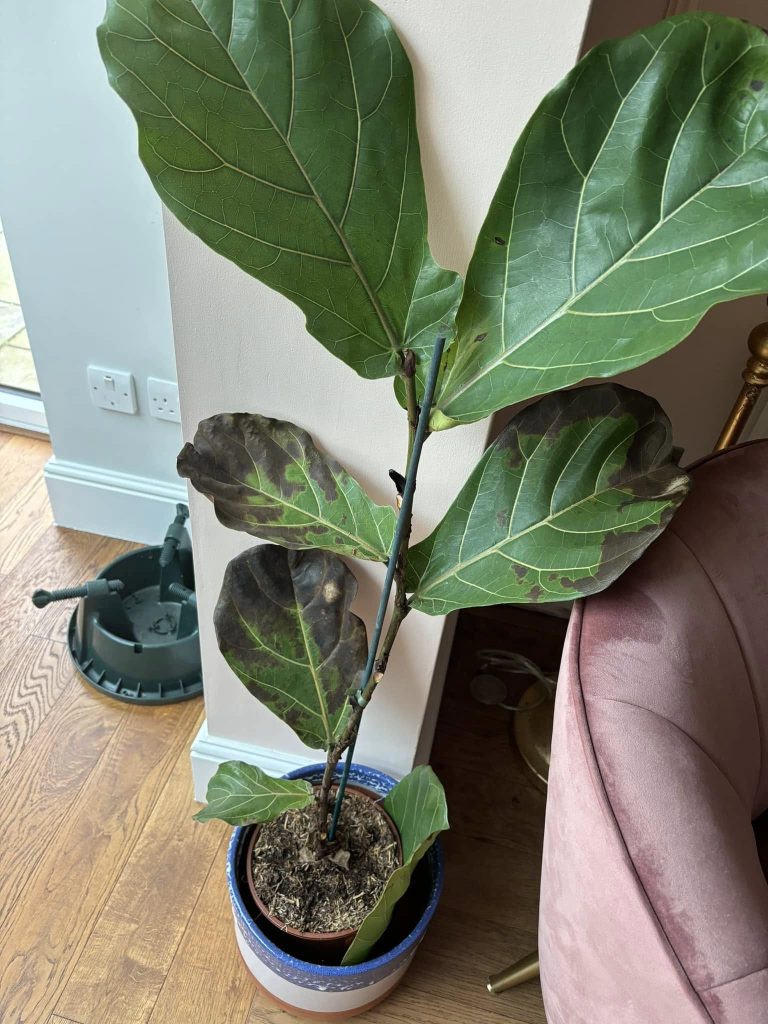
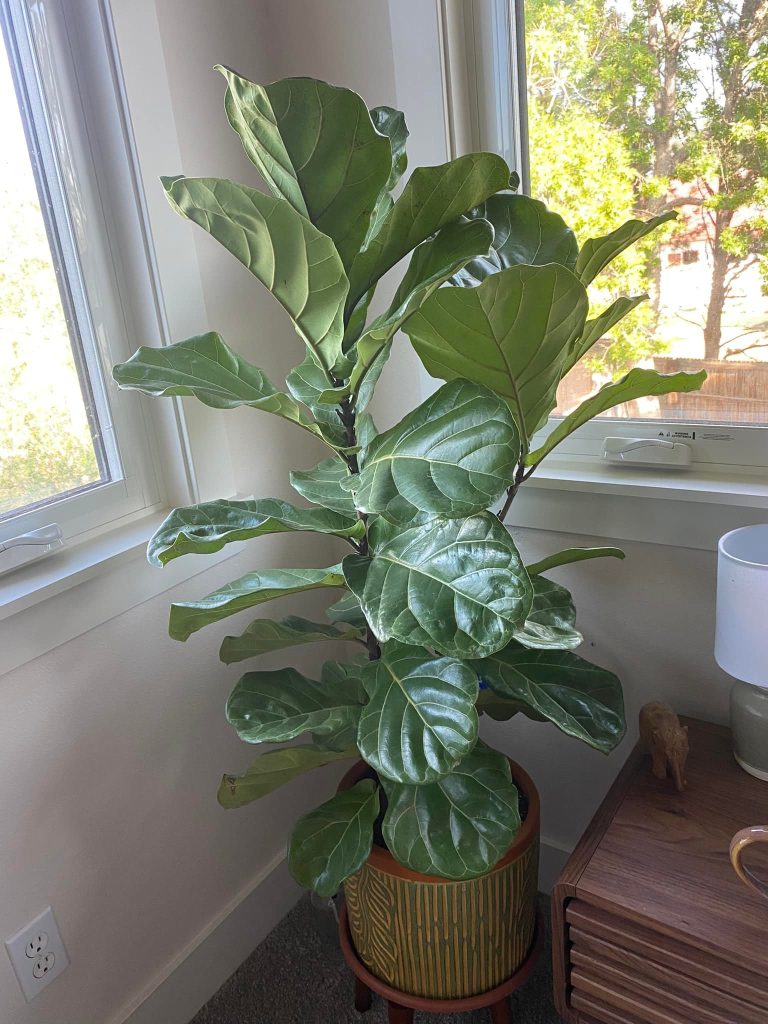
I’ll never forget the day I noticed brown spots on my fiddle leaf fig. It was my pride and joy, sitting in the corner of my living room, its glossy green leaves adding a touch of elegance to my home. Then, one morning, I saw them—ugly, brown patches marring those perfect leaves.
Panic set in. Was my plant dying? Had I failed as a plant parent? If you’re reading this, you’re probably feeling the same way. In this guide, I’ll break down why your fiddle leaf fig has brown spots, how to fix them, and how to keep your plant thriving.
What Causes Brown Spots on Fiddle Leaf Fig Leaves?
Brown spots on fiddle leaf fig leaves can feel like a mystery, but they’re usually a sign your plant is trying to tell you something. Here are the most common culprits:
1. Overwatering: The Silent Plant Killer
I learned this the hard way. One summer, I was so eager to keep my fiddle leaf fig happy that I watered it every few days. Big mistake. Overwatering is the number one cause of brown spots. When the roots sit in soggy soil, they can’t breathe, leading to root rot. This shows up as brown, mushy spots, often starting at the edges or base of the leaves.
Signs of Overwatering
- Brown spots with yellow halos, especially on lower leaves.
- Soggy soil that smells musty.
- Soft or mushy roots.
- Leaf drop alongside brown spots.
Quick fix: Check the soil. If it’s wet an inch down, stop watering. Let the top 2 inches dry out before watering again.
2. Underwatering: When Your Plant Is Too Thirsty
On the flip side, underwatering can also cause brown spots. I once forgot to water my fiddle leaf fig for weeks (life gets busy!), and the leaves developed dry, crispy brown edges. Underwatering stresses the plant, causing it to conserve water, and as a result it begins browning at the tips.
Signs of Underwatering
- Dry, brittle brown spots on leaf edges.
- Soil pulling away from the pot’s sides.
- Drooping or wilting leaves.
Quick fix: Water thoroughly until water drains from the pot’s bottom. Stick to a consistent watering schedule.
3. Low Humidity: A Common Issue in American Homes
Fiddle leaf figs are tropical plants, so they love humidity. Many American homes, especially in dry climates like Arizona or during winter with indoor heating, have low humidity. This can cause brown, dry spots on the leaves.
Signs of Low Humidity
- Brown, crispy leaf tips or edges.
- Curling or drooping leaves.
- Slow growth despite proper care.
- Small, dry brown spots scattered across the leaves.
Quick fix: Use a humidifier or place a tray of water with pebbles near the plant. Misting can help, but it’s not an effective long-term solution.
4. Too Much Direct Sunlight
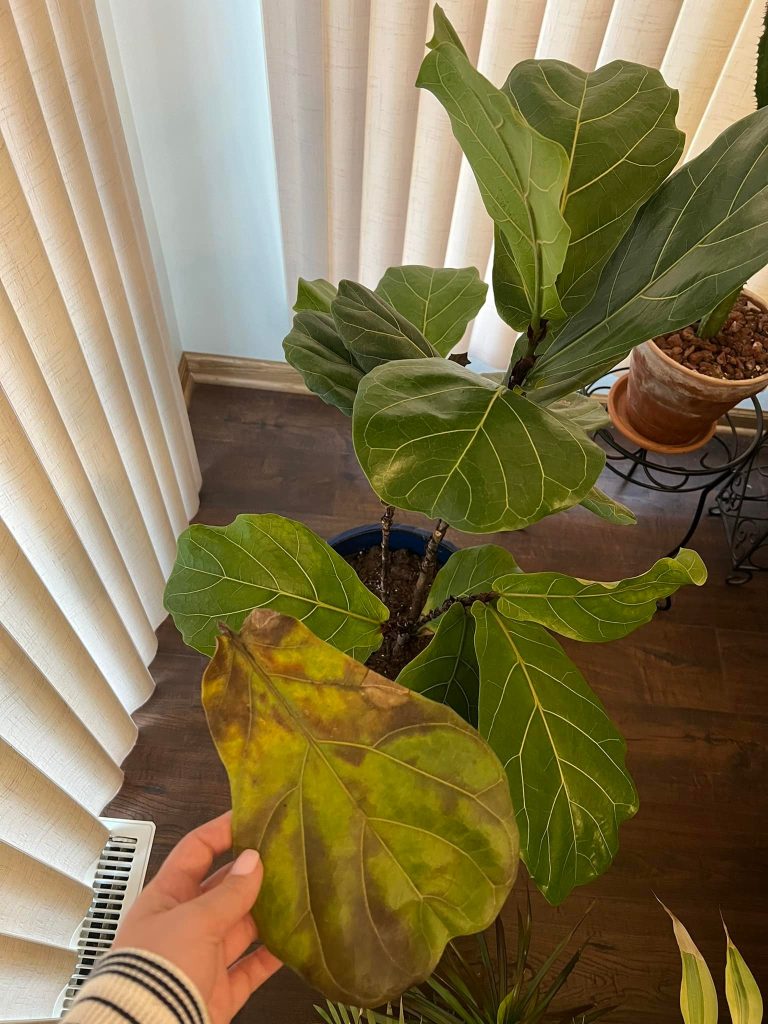
Fiddle leaf figs love bright, indirect light, but too much direct sun can scorch their leaves. I once moved my plant to a south-facing window, thinking it would thrive. Instead, it developed large, tan-brown patches.
Signs of sunburn: Large, faded brown or tan spots, especially on leaves facing the sun.
Quick fix: Move your plant to a spot with bright, indirect light, like near an east-facing window or behind a sheer curtain.
5. Pests: Tiny Troublemakers
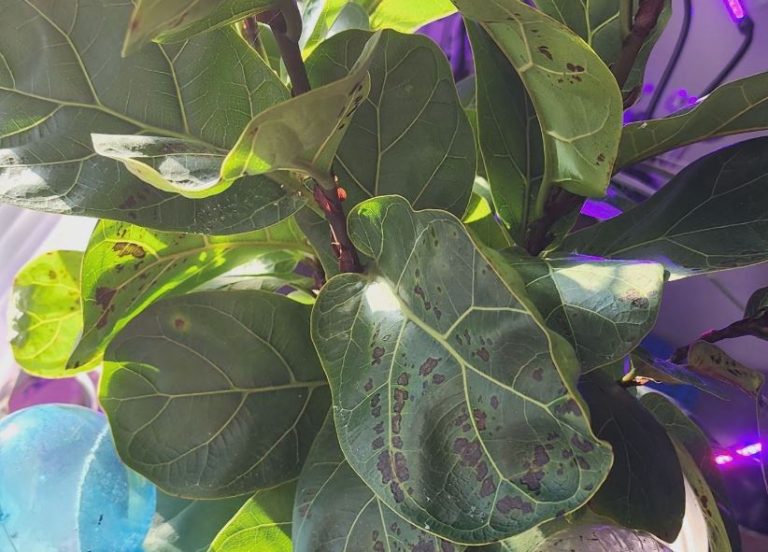
Pests like spider mites, mealybugs, or scale can cause brown spots by sucking the sap from leaves. I once found tiny webs under my fiddle leaf fig’s leaves—spider mites! These pests leave small, speckled brown spots.
Signs of Pests or Diseases
- Tiny webs (spider mites).
- White, cottony spots (mealybugs).
- Sticky residue or small bumps (scale).
- Tiny brown dots, webbing, or sticky residue on leaves.
Quick fix: Wipe leaves with a damp cloth and use neem oil or insecticidal soap to treat infestations.
6. Fungal or Bacterial Infections
Fungal infections, like leaf spot disease, or bacterial issues, can cause brown spots. These often appear as dark, water-soaked spots that spread. Poor air circulation or overwatering can make this worse.
Signs of infection: Dark, spreading brown spots with a yellow halo.
Quick fix: Remove affected leaves with clean scissors and improve air circulation. Avoid overhead watering.
7. Nutrient Deficiency
Fiddle leaf figs need nutrients like nitrogen, potassium, and magnesium to thrive. A lack of these can cause brown spots or yellowing. I noticed this when my plant hadn’t been fertilized in months.
Signs of deficiency: Brown spots paired with yellowing or slow growth.
Quick fix: Use a balanced liquid fertilizer (like 10-10-10) every 4-6 weeks during the growing season, in spring and summer.
Note: Overfertilizing can also burn the roots and cause brown spots on your fiddle leaf fig plant. So, fertilize moderately and skip feeding in fall and winter when growth slows. Your plant doesn’t need extra food then.
How to Diagnose Brown Spots on Your Fiddle Leaf Fig
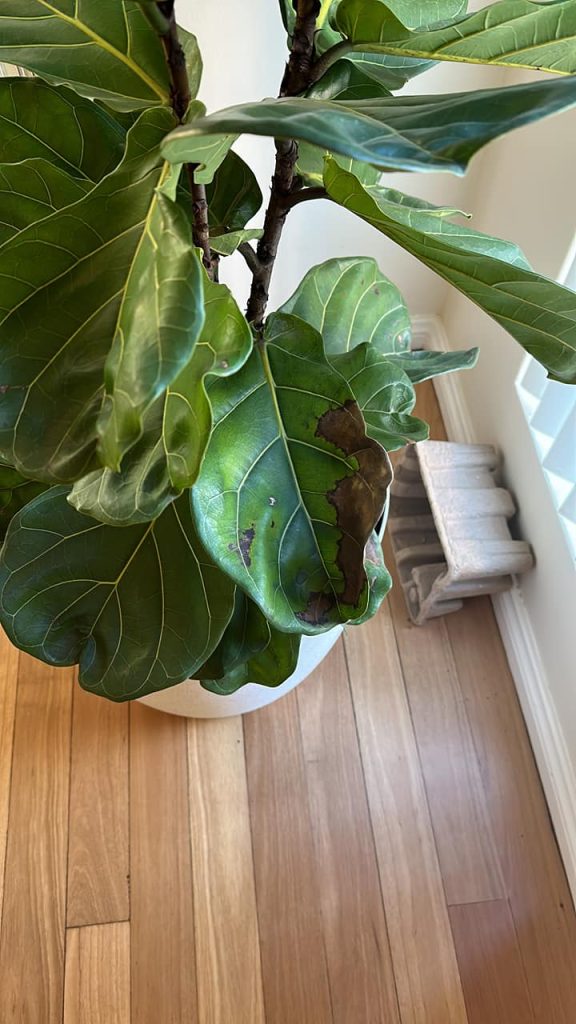
Before you can fix the problem, you need to know what’s causing it. Here’s how I diagnose brown spots:
- Check the soil: Stick your finger an inch into the soil. Is it soggy? Dry? This will tell you if watering is the issue.
- Inspect the leaves: Are the spots soft and mushy (overwatering) or dry and crispy (underwatering or sunburn)?
- Look for pests: Use a magnifying glass to check for tiny bugs or webbing under leaves.
- Assess the environment: Is the plant near a heater, air vent, or in direct sun? Check humidity levels with a hygrometer.
- Review your care routine: When did you last fertilize? Have you repotted recently?
Once you’ve pinpointed the cause, you can take action. Let’s explore how to fix those brown spots.
How to Fix Brown Spots on Fiddle Leaf Fig Leaves
Here is a comprehensive solution to the problem of spots on the fiddle leaf fig:
Step 1: Adjust Your Watering Routine
Watering is tricky, but it’s the foundation of fiddle leaf fig care. Here’s what I do:
- Watering schedule: Water when the top 1-2 inches of soil feel dry. For me, this is every 7-10 days in summer and every 10-14 days in winter.
- How to water: Pour water evenly until it drains from the bottom. Empty the saucer to avoid root rot.
- Tools I love: A moisture meter takes the guesswork out of watering. It’s a lifesaver for plant newbies!
Step 2: Boost Humidity
Most American homes have humidity levels of 30-40%, but fiddle leaf figs prefer 50-60%. Here’s how to increase humidity:
- Use a humidifier: I use a small humidifier near my plant. It’s easy and effective.
- Use a pebble tray: Fill a tray with pebbles and water, then place the pot on top (not in the water).
- Group plants: Cluster your fiddle leaf fig with other plants to create a humid microclimate.
Step 3: Optimize Light
Fiddle leaf figs need bright, indirect light. Here’s how to get it right:
- Choose an ideal spot: Place your plant near an east-facing window or a few feet from a south- or west-facing window with a sheer curtain.
- Rotate the plant: I rotate my fiddle leaf fig every few weeks to ensure even light exposure.
- Avoid direct sun: If you see brown spots on sun-facing leaves, move the plant immediately.
Step 4: Treat Pests
If pests are the issue, act fast:
- Wipe leaves: Use a damp cloth to remove pests and their residue.
- Apply neem oil: Mix neem oil with water and spray leaves weekly until pests are gone.
- Isolate the plant: Keep your fiddle leaf fig away from other plants to prevent spreading.
Step 5: Address Infections
For fungal or bacterial issues:
- Remove affected leaves: Use clean, sharp scissors to cut off brown-spotted leaves. Sterilize the scissors between cuts.
- Improve air circulation: Place a small fan near the plant or move it to a less crowded spot.
- Use fungicide: Use a copper-based fungicide for severe cases, following the label instructions.
Step 6: Fertilize Properly
Feed your fiddle leaf fig during the growing season (spring and summer):
- Fertilizer type: Use a balanced liquid fertilizer (10-10-10 or 3-1-2 ratio).
- Frequency: Fertilize every 4-6 weeks. I dilute the fertilizer to half-strength to avoid burning the roots.
- Avoid over-fertilizing: Too much fertilizer can cause brown spots, too!
Step 7: Prune and Clean
If brown spots have damaged several leaves, prune them to encourage new growth:
- How to prune: Cut just above a leaf node with clean scissors. I removed a few spotted leaves, and my plant bounced back beautifully.
- Clean leaves: Dust can block light, so wipe leaves with a damp cloth monthly.
Preventing Brown Spots: Long-Term Care Tips
When I first got my fiddle leaf fig, I was clueless. I placed it in a dark corner, watered it randomly, and ignored humidity. Brown spots appeared, and I thought I’d lost it. But after researching, tweaking my care routine, and being patient, my plant is now the star of my living room
Now that your fiddle leaf fig is on the mend, let’s keep it that way. Here are my top tips for preventing brown spots:
- Stick to a watering schedule: Consistency is key. I set a reminder on my phone to check the soil every week. If it’s dry, I water; if not, I wait.
- Monitor humidity and temperature: Keep humidity above 50% and temperatures between 65-85°F. Avoid placing your plant near drafts, heaters, or air conditioners.
- Rotate and dust regularly: Rotate your plant every few weeks for even growth. Dust the leaves to keep them shiny and healthy.
- Inspect for pests monthly: Check under leaves and along stems for pests. Catching them early saves a lot of trouble.
- Repot every 1-2 Years: Fiddle leaf figs outgrow their pots, which can stress the plant. I repotted mine last year, and it’s thriving. Use a well-draining potting mix and a pot with drainage holes.
- Use filtered water: Tap water with chlorine or fluoride can cause brown spots over time. I use filtered water or let tap water sit overnight to reduce chemicals.
Common Mistakes American Plant Owners Make
Living in the U.S., we face unique challenges with fiddle leaf figs. Here are mistakes I’ve made (and seen others make):
- Overwatering in winter: Indoor heating dries out the air, but soil stays wet longer. Adjust your watering accordingly.
- Ignoring humidity: Dry climates or heated homes zap moisture from your plant.
- Placing near vents: Air conditioners or heaters can stress your plant, causing brown spots.
- Using small pots: Fiddle leaf figs need room to grow. A cramped pot leads to stress and brown spots.
FAQs
Here are quick answers to the frequently asked questions about brown spots on fiddle leaf fig leaves.
Q: Why are the edges of my fiddle leaf fig leaves turning brown?
A: Brown edges are usually caused by underwatering, low humidity, or too much direct sun. Check the soil moisture, increase humidity, and move the plant to indirect light.
Q: Can I save a fiddle leaf fig with brown spots?
A: Yes! Identify the cause (overwatering, pests, etc.), adjust care, and prune damaged leaves. With patience, your plant can recover.
Q: How often should I water my fiddle leaf fig?
A: Water when the top 1-2 inches of soil are dry, typically every 7-14 days, depending on the season and climate.
Q: Should I cut off brown leaves?
A: Yes, if the brown spots cover most of the leaf or are spreading. Use clean scissors to cut just above a leaf node.
Q: Can brown spots spread to other plants?
A: If caused by pests or fungal infections, yes. Isolate your fiddle leaf fig and treat it promptly.
Q: Is my fiddle leaf fig dying if it has brown spots?
A: Not necessarily. Brown spots are a sign of stress, but with proper care, your plant can recover.
Suggested For You:
Fiddle Leaf Fig Root Rot: Saving Your Plant From The Silent Killer
7 Reasons: Why Is My Fiddle Leaf Fig Dropping Leaves?
Fiddle Leaf Fig Cultivation: Your Ultimate Guide to Growing This Stunning Houseplant
Black Spots on Fiddle Leaf Fig Leaves: Causes, Fixes, and Prevention
Fiddle Leaf Fig Root Rot: Saving Your Plant From The Silent Killer
Fiddle Leaf Fig Leaves Curling? 8 Easy Fixes to Save Your Plant
7 Reasons: Why Are My Fiddle Leaf Fig Leaves Turning Yellow?
Conclusion
Brown spots on your fiddle leaf fig can be frustrating, but they’re not a death sentence. By identifying the cause, you can take action to save your plant. I’ve shared my journey, from panic to plant parent success, and I hope it inspires you to keep going. With the right care, your fiddle leaf fig will stay lush and beautiful, adding that perfect touch of green to your home.
Have questions or tips of your own? Drop them in the comments below, and let’s keep the plant love growing!
References
- The Spruce. (2023). How to Care for a Fiddle Leaf Fig. https://www.thespruce.com
- University of Florida IFAS Extension. (2022). Ficus lyrata: Fiddle Leaf Fig. https://edis.ifas.ufl.edu
- Missouri Botanical Garden. (2021). Ficus lyrata Care Guide. https://www.missouribotanicalgarden.org
- Penn State Extension. (2020). Common Houseplant Pests. https://extension.psu.edu
- American Horticultural Society. (2019). Plant Care: Tropical Houseplants. Book reference.

Tim M Dave is a gardening expert with a passion for houseplants, particularly cacti and succulents. With a degree in plant biology from the University of California, Berkeley, he has vast experience in gardening. Over the years, he has cultivated a vast collection of desert plants and learned a great deal about how to grow and care for these unique companions.