Understanding Black Gum (Nyssa sylvatica): Identification, Uses, Problems and Full Cultivation Details
Some trees earn lasting admiration through sheer size. But the Black Gum (Nyssa sylvatica) reveals itself most fully on a crisp September morning when the rest of the forest is still green and a single Black Gum blazes red, orange, and scarlet as if autumn arrived there first.
No native tree in eastern North America colors earlier or more intensely than Black Gum. That alone would be enough to make it remarkable. But the Black Gum offers far more than seasonal spectacle.
It is a long-lived ecological cornerstone, an exceptional wildlife tree, a reliable and adaptable landscape species, and a tree whose quiet virtues have made it increasingly sought after by native plant gardeners, landscape architects, and conservationists alike.
What Is the Black Gum?
The Black Gum belongs to the family Nyssaceae — a small family sometimes placed within the dogwood family (Cornaceae) in older classifications. Its genus, Nyssa, takes its name from a water nymph in Greek mythology — an apt tribute to the tree’s frequent association with wet, riparian, and swampy habitats.
The species name, sylvatica, means “of the forest” in Latin — equally appropriate for a tree that is one of the most consistent members of eastern forest communities across dozens of soil types and ecological settings.
The Black Gum travels under a surprisingly large collection of common names, each revealing something about the tree’s character or history:
- Black Gum — the most widely used common name
- Blackgum — the single-word variant used in many botanical references
- Tupelo — used broadly across the South, derived from the Creek (Muscogee) words ito opilwa, meaning “swamp tree”
- Black Tupelo — combines both naming traditions
- Sourgum — a reference to the tart, blue-black fruit
- Pepperidge — an older New England name of uncertain origin, still used in parts of Connecticut and Massachusetts
- Bear Plum — used in some Appalachian communities
The name “Tupelo” deserves particular mention. In the American South and in botanical literature, Black Gum and Black Tupelo are used interchangeably and refer to exactly the same species. When you encounter either name, you are reading about Nyssa sylvatica.
| Scientific Name | Nyssa sylvatica |
| Family | Nyssaceae |
| Common Names | Black Gum, Black Tupelo, Sourgum, Pepperidge |
| Native Range | Eastern North America (Zones 4–9) |
| Mature Height | 30–60 feet (occasionally to 80+ feet) |
| Crown Form | Horizontal, tiered, layered |
| Lifespan | 300–650+ years |
| Bark | Deeply alligator-ridged, dark gray |
| Fall Color | Scarlet, crimson, orange — earliest of eastern trees |
| Fruit | Blue-black drupe; critical for migratory birds |
| Soil | Adaptable; requires acidity (pH 5.5–6.5) |
| Wildlife Value | Exceptional |
| Honey Plant | Yes — Tupelo honey from Nyssa species |
Native Range and Natural Habitat
The Black Gum is native to a broad swath of eastern North America, with a range extending from southern Maine and Ontario in the north, south through Florida, and west through the Gulf states to eastern Texas and Oklahoma. It also extends into Mexico and Central America at higher elevations.
Within this range, Black Gum is exceptionally habitat-flexible. It grows in moist bottomland forests and flooded swamp margins, but also on dry upland ridges and slopes, in sandy coastal plain forests, and in rocky Appalachian woodlands.
This ecological breadth is unusual — most trees that prefer wet conditions do not also perform well on dry sites, and vice versa.
It is perhaps most commonly encountered as an understory or midstory tree in mixed hardwood forests alongside oaks, hickories, maples, and sweetgum — but it also appears as a canopy tree in older, more open woodland settings.
In the Deep South and coastal plain regions, Black Gum frequently grows in or alongside standing water in swampy forests. In the northeastern states and Appalachian highlands, it is as likely to be found on dry, rocky hillsides.
This ecological flexibility is one of its most practically useful traits for landscaping.
Physical Characteristics
Size and Form
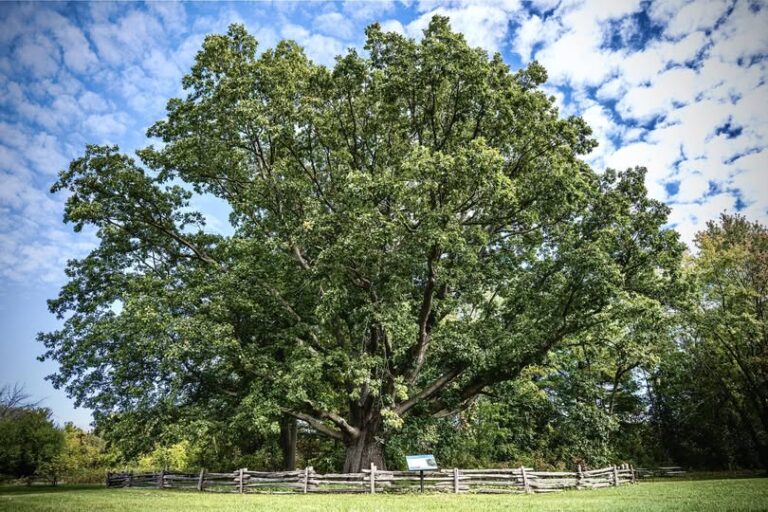
In typical forest conditions, Black Gum reaches 30 to 60 feet (9–18 meters) in height, with a trunk diameter of 1 to 2 feet. Under optimal open-grown conditions, old specimens occasionally exceed 80 feet.
Open-grown trees develop a broad, layered, horizontal branching pattern — one of the most architecturally distinctive silhouettes of any native tree.
The branches extend outward in roughly horizontal tiers, creating a stratified, pagoda-like crown structure that is immediately recognizable in the winter landscape.
This tiered branching is especially apparent in older trees and is one of the key reasons Black Gum has gained strong favor among landscape designers seeking strong structural presence.
In youth, the tree is often more pyramidal or oval. With age, the crown becomes broadly irregular, with sweeping horizontal limbs that give mature specimens a sculptural, ancient quality.
Lifespan
Black Gum is a remarkably long-lived tree. Individual specimens regularly reach 300 to 400 years of age.
Some dendrochronological studies in old-growth forest remnants have documented Black Gum trees exceeding 650 years — making it one of the longest-lived trees in eastern North American forests outside of the largest oaks and chestnuts.
This longevity makes very old Black Gum trees ecologically invaluable. Their cavities, deeply furrowed bark, and structural complexity provide habitat resources that younger trees simply cannot replicate.
Bark — Deeply Distinctive
The bark of Black Gum is one of its most reliable identification features. On young trees, it is gray-brown and relatively smooth.
As the tree matures, it becomes deeply ridged and furrowed, breaking into thick, rectangular, interlocking blocks with a distinctive alligator-hide or broken-up checkerboard pattern that is remarkably similar to the bark of the Persimmon (Diospyros virginiana).
On old trees, this pattern becomes so pronounced that the bark looks almost carved — deeply three-dimensional, with blocks projecting outward from the surface. It is a bark that photographs beautifully and rewards close inspection in every season.
Leaves — Glossy, Simple, and Unmistakable
The leaves are simple, alternate, and ovate to elliptical, measuring 3 to 6 inches (7–15 cm) in length. They have smooth or slightly wavy margins — no teeth, no lobes, no serrations. This smooth-edged leaf distinguishes Black Gum immediately from most of its forest companions, which tend toward toothed or lobed margins.
The upper leaf surface is exceptionally glossy — shiny dark green in summer, almost lacquer-like in quality. The lower surface is paler and may have fine hairs along the midrib. The glossiness of the summer foliage makes Black Gum visually distinctive even before autumn arrives.
When those glossy leaves turn in autumn, the effect is all the more striking because the shiny surface seems to amplify the color — the reds and oranges almost glow.
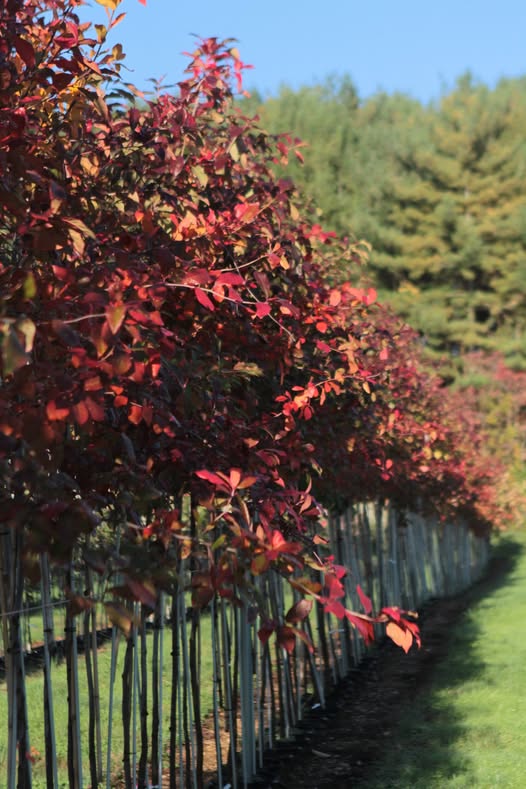
Autumn Color — The Tree’s Most Celebrated Feature
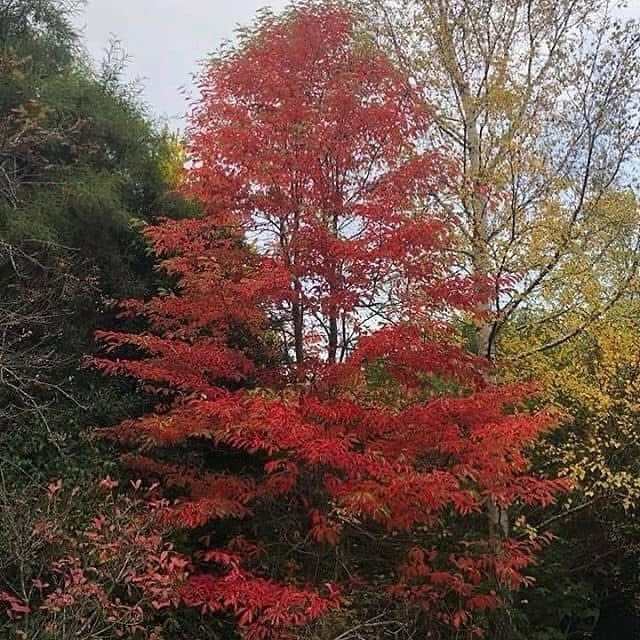
There is a reason Black Gum consistently appears on every authoritative list of the best native trees for fall color. Its autumn display is simply exceptional — among the finest produced by any tree in temperate North America.
The leaves turn in early to mid-September across much of the range — often the first tree in the forest to show color, weeks ahead of maples, oaks, and most other species.
The color ranges from brilliant scarlet and crimson to orange, yellow, and deep purple, often with multiple colors present simultaneously on a single tree or even a single branch.
The combination of early timing, intensity, and duration makes Black Gum the autumn tree of choice for landscape professionals seeking reliable, spectacular fall display. Unlike some species whose color performance varies significantly from year to year, Black Gum colors reliably regardless of temperature swings or drought.
The glossy leaf surface enhances the display further — colors appear more saturated and luminous than they would on a matte leaf surface.
Flowers
Black Gum is typically dioecious — male and female flowers on separate trees — though some trees bear both. Flowers appear in late spring, small, greenish-white, and clustered. They are not ornamentally significant, but they are extremely important to pollinators.
Black Gum is one of the most highly valued honey plants in eastern North America. The small flowers produce abundant nectar, and the resulting Tupelo honey is one of the most prized artisanal honey varieties in the United States — particularly in the Florida panhandle and Georgia, where extensive bottomland Black Gum forests support commercial Tupelo honey production.
Tupelo honey has a distinctive, mild, floral flavor and resists crystallization due to its unusual fructose-to-glucose ratio — a chemical property attributed directly to the nectar composition of Nyssa sylvatica and its close relative, Water Tupelo (Nyssa aquatica).
Fruit
The fruit is a small, oval drupe, about ½ inch (1–1.5 cm) long, ripening from green to blue-black in late summer and early autumn. Fruits are borne in clusters of two to three, on long pendulous stalks. They have thin flesh surrounding a hard, ridged pit.
The flavor is described as tart to slightly bitter — not appealing to humans, but extremely attractive to wildlife. The fruit is technically edible and was used by Indigenous peoples, though it is not commonly foraged today.
Ecological Value and Wildlife Benefits
Few trees of Black Gum’s relatively modest size deliver the level of ecological value that this species provides. It is a keystone resource for wildlife across its range.
Birds — An Exceptional Fruit Tree
The blue-black drupes of Black Gum ripen in early September — perfectly timed to coincide with the beginning of southbound bird migration. This timing is not coincidental from an evolutionary perspective; it is a co-evolutionary relationship between tree and bird that has developed over millions of years.
More than 30 bird species have been documented feeding on Black Gum fruit, including:
- Wood Thrush, Hermit Thrush, Swainson’s Thrush — heavily dependent on fruit during fall migration
- American Robin and Veery
- Rose-breasted Grosbeak and Scarlet Tanager
- Northern Flicker and Red-bellied Woodpecker
- Eastern Bluebird
- Wild Turkey
- Pileated Woodpecker
- Cedar Waxwing and Gray Catbird
The early fruiting of Black Gum makes it particularly critical for migratory species that need to rapidly accumulate fat reserves before long-distance flights. Trees that fruit at this precise seasonal window provide irreplaceable nutritional resources that cannot be substituted by later-fruiting species.
Mammals
White-tailed deer, black bears, foxes, raccoons, and opossums all consume the fruit. The Eastern Black Bear is particularly associated with Black Gum — it is one of the bear’s preferred autumn food sources in the Appalachian Mountains and throughout the Southeast.
Beavers use the wood for dam-building in riparian settings. Various small mammals, including gray squirrels and chipmunks, consume both the fruit and cached seeds.
Cavity Habitat
Old Black Gum trees are notable for developing hollow trunks and large cavities — a consequence of the wood’s decay characteristics over centuries. These cavities provide critical nesting habitat for:
- Chimney Swift — uses hollow snags for roosting
- Wood Duck and Hooded Merganser
- Barred Owl and Eastern Screech-Owl
- Pileated Woodpecker — excavates cavities that other species then use
- Various bat species
Because Black Gum is so long-lived, a single old individual may develop multiple usable cavities over centuries — creating what ecologists describe as a “wildlife condominium” — a single tree simultaneously supporting numerous breeding pairs of cavity-dependent species.
Pollinators and Bees
As noted above, Black Gum flowers are among the most nectar-productive of any native eastern tree. They support native bees, honeybees, bumblebees, and numerous other pollinating insects in late spring when reliable nectar sources can be scarce.
The commercial Tupelo honey industry of the Florida panhandle — centered on White Tupelo (Nyssa ogeche) and Black Gum — represents a direct economic manifestation of this pollinator value.
Soil, Light, and Growing Conditions
Light Requirements
Black Gum grows in full sun to partial shade. It is moderately shade-tolerant — more so than oaks and hickories — and can persist in the forest understory for years before gaps allow it to reach the canopy.
For best growth, fall color intensity, and fruit production, full sun is preferred. Trees in deep shade produce less fruit and may show reduced fall color saturation.
Soil and Moisture Adaptability
This is where Black Gum surprises most people. Despite its association with swamps and wet sites, it is genuinely adaptable across a wide moisture spectrum:
- Moist to wet bottomlands and seasonally flooded sites — grows readily
- Average, well-drained garden soils — performs well
- Dry, rocky upland slopes — establishes and grows, though more slowly
- Sandy coastal plain soils — common and productive
- Clay-loam upland soils — tolerates well
The key soil requirement is acidity. Black Gum strongly prefers acidic soils, pH 5.5 to 6.5. Alkaline soils cause iron chlorosis and chronic decline. Testing soil pH before planting — and amending if needed — is the single most important site preparation step.
Hardiness Zones
Black Gum is hardy in USDA Zones 4 through 9 — covering virtually the entire eastern and southern United States and a significant portion of the Midwest and Pacific Northwest.
Landscape and Garden Uses
The Black Gum has moved from botanical obscurity to genuine landscape popularity over the past two decades, and the reasons are compelling.
Fall Color Specimen
There is simply no better native tree for guaranteed, brilliant autumn color in the eastern United States. For a homeowner who wants a single specimen tree whose primary purpose is seasonal beauty, Black Gum delivers more reliably than Sugar Maple, Sweetgum, or any oak. The color comes early, burns intensely, and holds for weeks.
Street and Urban Tree
Several named cultivars — particularly ‘Wildfire’ and ‘Forum’ — have been developed and tested specifically for urban street tree use. Black Gum has demonstrated good tolerance for urban soil conditions, air pollution, and site stress, making it increasingly specified in municipal tree planting programs.
Rain Gardens and Wet Sites
Its tolerance of wet soils and seasonal flooding makes Black Gum an excellent choice for rain gardens, bioswales, and low-lying areas where drainage is poor. Few trees with Black Gum’s ornamental quality also tolerate standing water as well.
Native Plant and Ecological Gardens
For wildlife gardeners, Black Gum is a must-plant species. The combination of migratory bird fruit, pollinator flowers, cavity habitat potential, and caterpillar support makes it one of the most ecologically productive choices available.
Four-Season Interest
Landscape designers value Black Gum for its contribution in every season:
- Spring — fresh, bright green glossy foliage; small, nectar-rich flowers
- Summer — dense, lustrous dark green canopy with distinctive horizontal branching
- Autumn — brilliant scarlet, orange, and crimson fall color; blue-black fruit clusters
- Winter — striking horizontal branch structure; deeply furrowed, architectural bark
Notable Black Gum Cultivars
Several cultivars have been selected for improved landscape performance:
- ‘Wildfire’ — new foliage emerges bright red in spring before turning green; excellent fall color; popular street tree
- ‘Forum’ — strong central leader, symmetrical form; good urban tolerance
- ‘Afterburner’ — exceptionally intense fall color; vigorous growth
- ‘Red Rage’ — consistent deep red fall color; improved heat tolerance
- ‘Firestarter’ — compact form, outstanding fall color; suitable for smaller spaces
- ‘Miss Scarlet’ — smaller, shrubby form; brilliant fall color
When selecting a cultivar, consider ultimate size, site conditions, and whether fall color or structural form is the priority. The straight species — seed-grown Nyssa sylvatica — remains an excellent choice where local genetic provenance is valued.
How to Plant and Grow Black Gum
Sourcing
Purchase from reputable native plant nurseries using stock propagated from seed or cuttings. Container-grown plants establish well and are far easier to transplant successfully than field-dug specimens.
Black Gum develops a deep, fleshy taproot that makes large specimens very difficult to transplant. This is one of the primary reasons this tree has historically been underused in landscapes — it was difficult to transplant as a large field-grown tree. Container-grown nursery stock has solved this problem, and small trees establish readily when properly planted.
Planting Steps
- Choose a full-sun to partial-shade site with acidic soil.
- Test soil pH before planting — this step is not optional. If pH exceeds 7.0, address the issue before planting.
- Dig the planting hole two to three times wider than the root ball and no deeper than the root ball height.
- Plant at correct grade — the root flare should sit at or just above soil level.
- Backfill with native soil. Do not add large quantities of peat or amendment to the hole.
- Mulch with 3 to 4 inches of wood chip mulch, extending well beyond the drip line. Mulch is particularly important for Black Gum — it keeps soil moist, cool, and acidic.
- Water consistently during the first two to three growing seasons. Once established, irrigation is rarely needed.
Pruning
Black Gum requires minimal pruning. Its natural horizontal branching habit is its primary ornamental and structural asset — do not prune it into an unnatural shape. Remove only dead, damaged, or crossing branches in late winter. Avoid heavy structural pruning, which can disfigure the characteristic form.
Pests, Diseases, and Common Challenges
Black Gum is generally a hardy and low-maintenance tree with few serious pest or disease concerns in the landscape.
Leaf Spots and Minor Diseases
Several fungal leaf spot diseases can cause brown spotting or early leaf drop in wet seasons. These are cosmetic concerns and rarely threaten overall tree health. No treatment is typically necessary.
Scale Insects
Soft scales and other scale insects occasionally infest Black Gum. Healthy trees manage low infestations without intervention. Severe infestations can be treated with horticultural oil applications in late winter or early spring.
Iron Chlorosis
On alkaline soils — the most common cultural mistake with this species — Black Gum develops iron chlorosis: yellowing between leaf veins while veins remain green. The solution is soil acidification, not iron supplementation alone. Applying sulfur or acid-forming fertilizers addresses the root cause.
Transplant Shock
Because of its deep taproot, large or improperly handled Black Gum transplants may experience significant transplant shock, with dieback and slow establishment. Always plant young, container-grown stock and water consistently during establishment to minimize this risk.
Black Gum and Tupelo Honey: A Cultural Connection
No discussion of Black Gum is complete without its connection to Tupelo honey — one of the most regionally distinctive and highly prized honey varieties in the United States.
In the swampy river floodplains of the Florida panhandle — particularly along the Apalachicola, Chipola, and Ochlockonee Rivers — vast stands of Water Tupelo (Nyssa ogeche) and Black Gum provide an extraordinary nectar flow in late April and early May.
Beekeepers transport hives to the swamps by boat, positioning them to capture this brief but intense floral resource.
The resulting honey is exceptionally light in color, mild in flavor, and resistant to crystallization — properties attributed to its high fructose content. Pure Tupelo honey commands premium prices in specialty food markets and is protected by strict standards in the apicultural community.
This living economic and cultural tradition — beekeepers in boats, floating hives among swamp trees, harvesting honey from one of North America’s most ancient forest trees — is a connection between a native tree and human culture that spans centuries and continues today.
Final Thoughts
The Black Gum is the kind of tree that rewards every person who takes the time to know it well. It offers beauty in every season — the glossy summer canopy, the breathtaking autumn blaze, the architectural winter silhouette, the nectar-rich spring flowers.
It asks only for the right soil — acidic, not alkaline — and a little patience during establishment. After that, it largely takes care of itself.
Perhaps its greatest virtue is that same quality that defines the best native plants: it belongs here. It has shaped, and been shaped by, the forests and wildlife communities of eastern North America over millions of years.
Planting it in a landscape is not simply choosing a beautiful tree — it is rejoining a relationship that is older than anything else in the garden.
That is worth quite a lot.
References
- Virginia Tech Department of Forest Resources and Environmental Conservation — Dendrology Fact Sheet: Nyssa sylvatica https://dendro.cnre.vt.edu/dendrology/syllabus/factsheet.cfm?ID=63
- North Carolina State University Cooperative Extension — Nyssa sylvatica Plant Profile https://plants.ces.ncsu.edu/plants/nyssa-sylvatica/
- University of Florida IFAS Extension — Nyssa sylvatica: Black Tupelo https://edis.ifas.ufl.edu/publication/ST424
- USDA Forest Service — Silvics of North America — Nyssa sylvatica Marshall — Black Tupelo https://www.srs.fs.usda.gov/pubs/misc/ag_654/volume_2/nyssa/sylvatica.htm
- University of Connecticut Plant Database — Nyssa sylvatica — Black Gum https://hort.uconn.edu/detail.php?pid=269

Tim M Dave is a gardening expert with a passion for houseplants, particularly cacti and succulents. With a degree in plant biology from the University of California, Berkeley, he has vast experience in gardening. Over the years, he has cultivated a vast collection of desert plants and learned a great deal about how to grow and care for these unique companions.