6 Best Liquid Fertilizer for Lawns: Faster Green, Stronger Roots, and a Healthier Yard
There is something deeply satisfying about watching a lawn go from dull and patchy to thick and deeply green within a matter of days. Liquid fertilizers make that transformation possible faster than almost any other lawn care product.
I have tested and observed many lawn fertilization approaches over the years — and liquid fertilizers consistently impress when used correctly. They are not a magic fix, but they are among the most efficient, fast-acting, and flexible tools available to any homeowner or lawn care professional.
This guide will walk you through everything — from understanding how liquid fertilizers work, to choosing the right one for your grass type, to applying it without damaging your lawn.
What Is a Liquid Lawn Fertilizer?
A liquid lawn fertilizer is a nutrient solution applied either as a concentrate mixed with water or as a ready-to-use spray. Unlike granular fertilizers, which sit on the soil surface and dissolve gradually, liquid fertilizers deliver nutrients almost immediately — either through the soil or directly through the grass blades in a process called foliar feeding.
This speed of absorption is the defining advantage of liquid fertilizers. When a lawn is showing signs of stress, deficiency, or discoloration, liquid fertilizers can correct the problem faster than any granular product.
They are available in two main delivery forms:
- Concentrate: Diluted with water before application, typically through a hose-end sprayer or pump sprayer
- Ready-to-Use (RTU): Pre-mixed and applied directly, usually in smaller quantities for spot treatment
Both work on the same principle — nutrients in solution are absorbed readily by grass roots and, in some cases, leaf tissue.
Why Choose Liquid Fertilizer Over Granular?
This is one of the most common questions homeowners ask. The honest answer is that neither is superior in every situation — but liquid fertilizers have clear advantages in specific circumstances.
Advantages of Liquid Fertilizers
1. Faster Results Liquid fertilizers show results within 24 to 72 hours in most cases. For a lawn that needs a quick green-up before a garden party or event, nothing beats liquid application.
2. More Even Coverage Sprayed nutrients distribute uniformly across the lawn surface, eliminating the streaky or uneven growth patterns that poorly calibrated granular spreaders can cause.
3. Better for Foliar Feeding Some nutrients — particularly iron, magnesium, and manganese — are absorbed more efficiently through the leaf blade than through the soil. Liquid fertilizers are the only practical way to deliver these micronutrients foliar-style.
4. Easier Customization Liquid fertilizers can be mixed and combined to create tailored nutrient blends. This makes them popular among lawn care professionals who adjust formulations based on soil test results.
5. Effective on Compacted Soils Granular fertilizers depend on water to carry nutrients into the soil. On compacted or clay-heavy soils, this process can be slow. Liquid fertilizers penetrate compacted ground more reliably, especially when applied with a sprayer that delivers moderate pressure.
6. Lower Equipment Requirements You do not need a spreader. A simple hose-end sprayer or backpack sprayer is all it takes, which makes liquid fertilizers accessible to every homeowner.
Disadvantages of Liquid Fertilizers
To be fair, liquid fertilizers have limitations worth understanding:
- They require more frequent application compared to slow-release granular products
- They can burn the lawn if applied at incorrect concentrations or during peak summer heat
- They are less practical for large areas unless you use commercial spraying equipment
- Rainfall immediately after application washes them away before they can be absorbed
Understanding both sides helps you decide when to use liquid fertilizers — and when granular products are the better choice.
Understanding the NPK Ratio in Liquid Fertilizers
Every fertilizer — liquid or granular — displays an NPK ratio on the label. These three numbers represent the percentages of:
- N — Nitrogen: Drives leafy, green growth and gives the lawn its color
- P — Phosphorus: Supports root development and seedling establishment
- K — Potassium: Builds stress resistance, disease tolerance, and drought hardiness
For established lawns, a fertilizer with higher nitrogen and potassium (and little to no phosphorus) is typically the best choice. Something like 24-0-6 or 20-0-10 delivers strong green color alongside resilience.
For new lawn establishment or overseeding, a higher phosphorus ratio — such as 10-10-10 or 16-4-8 — helps young roots develop quickly.
For summer or drought stress recovery, lean toward higher potassium formulas, which help grass retain moisture and recover faster from environmental damage.
Reading the label carefully before purchasing is essential. The NPK ratio is the single most important piece of information on any fertilizer product.
Types of Liquid Lawn Fertilizers
1. Synthetic Liquid Fertilizers
These are the most widely available and most commonly used. They are formulated with precise, consistent nutrient concentrations and deliver fast, predictable results.
Best for: Homeowners who want quick greening, consistent application, and easy-to-follow dilution instructions.
Caution: Higher nitrogen concentrations in synthetic liquid fertilizers carry a real burn risk if over-applied or applied during hot, dry conditions.
2. Organic Liquid Fertilizers
Organic liquid fertilizers are derived from natural sources — fish emulsion, seaweed extract, compost tea, bone meal hydrolysate, and similar materials. They are slower-acting than synthetics but far safer for the soil ecosystem, children, and pets.
They also provide secondary benefits that synthetics do not: improving microbial activity in the soil, enhancing moisture retention, and contributing trace minerals that support long-term lawn health.
Best for: Homeowners focused on soil health, organic lawn care, or properties with pets and children.
3. Chelated Micronutrient Solutions
These are specialized liquid products formulated to correct specific nutrient deficiencies — most commonly iron chlorosis, which causes grass to yellow between the veins while the veins remain green.
Chelated iron, manganese, and zinc solutions are absorbed rapidly through the leaf tissue, correcting deficiencies that soil-applied fertilizers sometimes cannot address efficiently.
Best for: Lawns showing signs of specific nutrient deficiencies, identified through a soil test.
4. Biostimulant Liquid Fertilizers
A growing category in modern lawn care, biostimulants contain compounds like humic acid, fulvic acid, amino acids, and seaweed extracts that stimulate root development and nutrient uptake rather than delivering nutrients directly.
They work best as a companion to a standard fertilizer program — enhancing the efficiency of whatever else you apply.
Best for: Lawns recovering from stress, high-performance lawn programs, and anyone looking to improve fertilizer efficiency.
5. Weed-and-Feed Liquid Formulas
Some liquid products combine fertilizer with selective herbicide, targeting broadleaf weeds while feeding the grass. These are convenient but require careful timing to avoid damaging desirable plants nearby.
Best for: Lawns with moderate broadleaf weed problems alongside nutrient deficiencies.
Best Liquid Fertilizers for Lawns: Top Picks
Simple Lawn Solutions Advanced 16-4-8 Balanced NPK: Best Overall
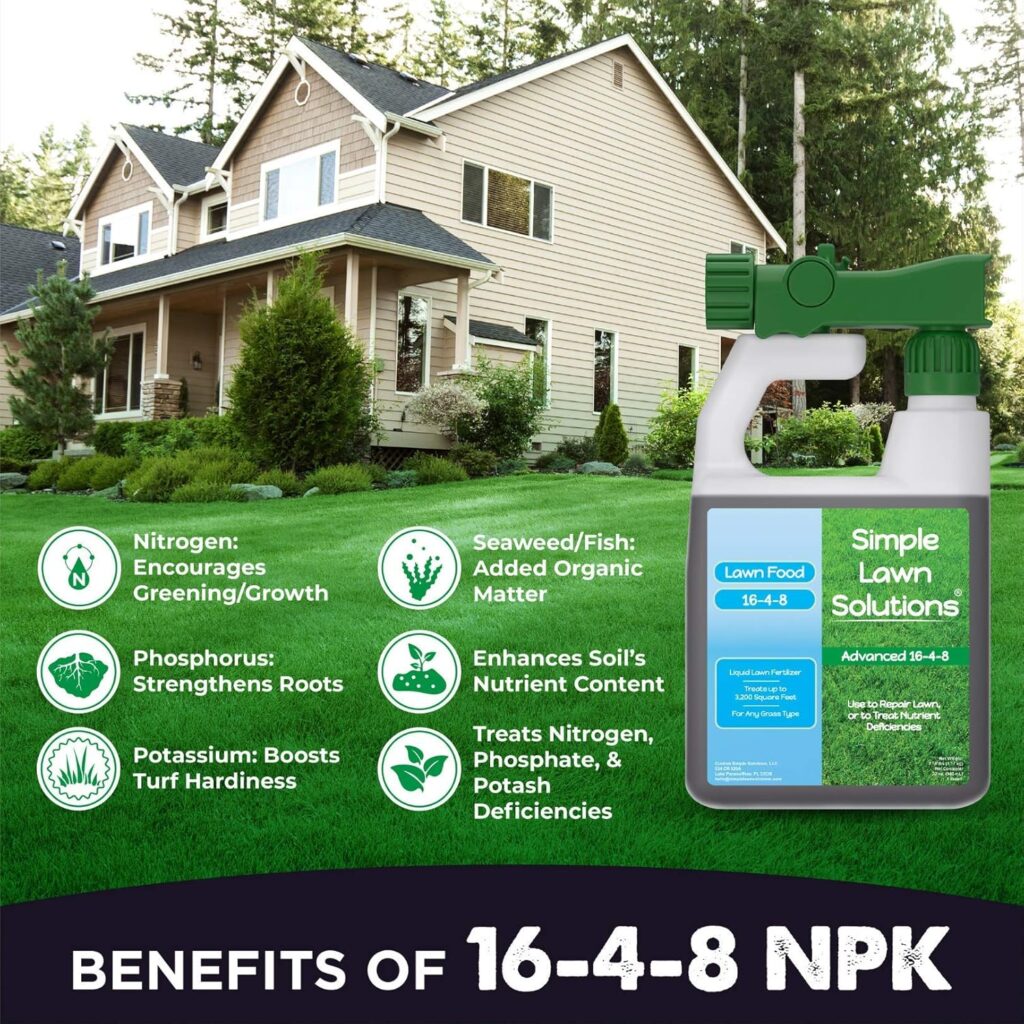
This is one of the most consistently recommended liquid fertilizers among homeowners and lawn professionals alike. The balanced NPK ratio suits most grass types and growth situations. It is formulated with both quick- and slow-release nitrogen sources, which means you get fast greening without sacrificing longevity.
Key features:
- Works on all grass types
- Contains humic acid for enhanced root uptake
- Easy hose-end application
- Results visible in 5–7 days
Best for: General lawn maintenance, all grass types, all seasons.
Scotts Liquid Turf Builder with Plus 2 Weed Control: Best for Quick Green-Up
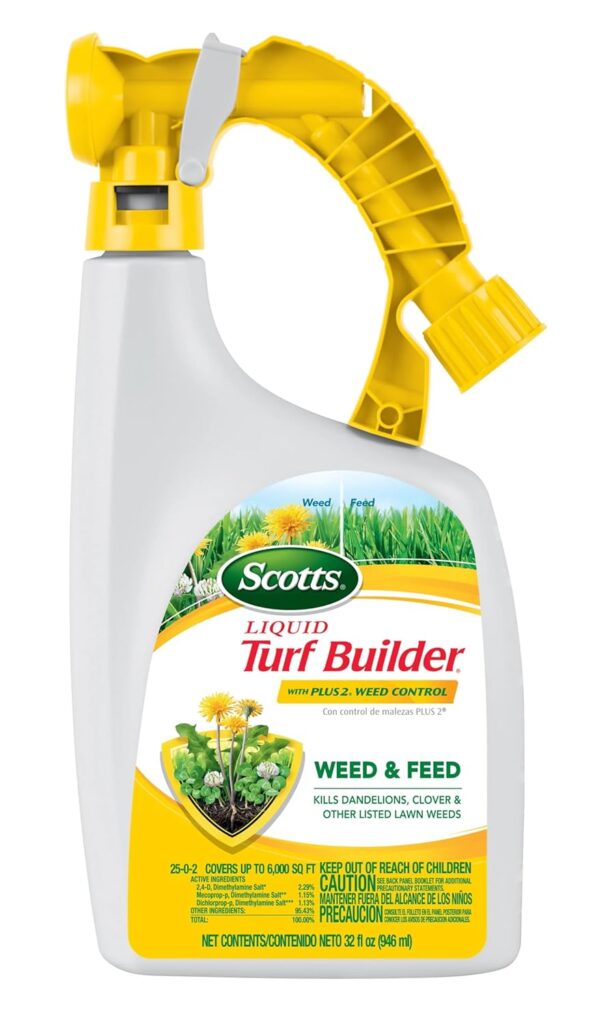
For homeowners dealing with a pale, nutrient-depleted lawn that also has weed pressure, this product addresses both in a single application. The nitrogen-forward formula delivers visible greening within 24 hours in ideal conditions.
Key features:
- Kills over 50 broadleaf weed types
- Fast-acting nitrogen formula
- Connects to a garden hose for easy application
- Covers up to 6,000 square feet
Best for: Cool-season lawns with weed pressure and color deficiency.
Neptune’s Harvest Fish & Seaweed Fertilizer (2-3-1): Best Organic Option
Neptune’s Harvest is a benchmark product in organic lawn care. Derived from Atlantic fish and North Atlantic seaweed, it delivers a gentle but complete nutrient profile alongside natural growth hormones, trace minerals, and soil-beneficial organisms.
The smell is potent for the first 24 hours — but it fades, and the results are worth it.
Key features:
- OMRI listed and certified organic
- Improves soil microbial activity
- Safe for pets, children, and water-sensitive areas
- Excellent for overseeded or newly established areas
Best for: Organic programs, pet-friendly lawns, overseeding, and soil restoration.
Southern Ag Chelated Liquid Iron (5-0-0 with 5% Iron): Best for Iron Deficiency
If your lawn is yellowing in a pattern where the leaf blades turn pale but the veins remain green, you are likely dealing with iron deficiency — particularly common in high-pH soils. Southern Ag’s chelated liquid iron corrects this quickly.
Key features:
- Corrects iron chlorosis within days
- Chelated formula ensures iron stays available even in alkaline soils
- Can be applied through hose-end or pump sprayer
- Also deepens color in already-healthy lawns
Best for: Lawns showing iron deficiency, high-pH (alkaline) soils, Bermuda and St. Augustine grass.
Xtreme Gardening Mykos Pure Mycorrhizal Inoculant (liquid form): Best for Root Development
While not a traditional fertilizer in the NPK sense, this biostimulant product enhances the root system’s ability to absorb nutrients from whatever else you apply. It introduces beneficial mycorrhizal fungi to the root zone, dramatically increasing the root surface area and improving both nutrient and water uptake.
Key features:
- Increases root mass and nutrient absorption efficiency
- Works synergistically with any fertilizer program
- Reduces the total amount of fertilizer needed over time
- Beneficial for all turfgrass species
Best for: New lawn establishment, recovery programs, high-performance lawn care.
Miracle-Gro Water Soluble Lawn Food (36-6-6): Best Budget Option
For homeowners on a budget who still want reliable results, Miracle-Gro’s water-soluble lawn food delivers strong performance at a low cost. The high nitrogen content produces fast, visible greening. However, use carefully — the high N ratio requires precise dilution to avoid burning the lawn.
Key features:
- Very affordable per application
- High nitrogen for fast greening
- Easy hose-end applicator included
- Works on all grass types
Best for: Budget-conscious homeowners, spring green-up, established healthy lawns.
How to Apply Liquid Fertilizer to Your Lawn
Correct application is what separates a lush, even lawn from a burnt, patchy one. Follow these steps for the best results.
Step 1: Test Your Soil First
A soil test tells you what nutrients are already present and what is missing. Applying fertilizer without testing is like taking medication without a diagnosis — it may help, or it may cause harm. University extension programs and garden centers offer affordable testing kits.
Step 2: Choose the Right Equipment
For most homeowners, a hose-end sprayer is the easiest and most effective tool. It attaches directly to your garden hose and mixes the concentrate automatically as water flows through.
For larger properties or more precise application, a backpack pump sprayer gives you better control over coverage and rate.
Step 3: Read the Label — Dilution Ratios Matter
Every liquid fertilizer has a specific dilution ratio. Do not guess. Over-concentration is the leading cause of fertilizer burn. Measure carefully, especially when using high-nitrogen concentrates.
Step 4: Apply at the Right Time of Day
Early morning is ideal. The lawn is cool, dew is still present to assist absorption, and temperatures will not spike immediately after application. Avoid application at midday or when temperatures exceed 85°F (29°C).
Avoid applying before rain. Rainfall within 2–4 hours of application washes the fertilizer away before it can be absorbed.
Step 5: Walk at a Steady Pace
Move the sprayer in overlapping passes at a consistent walking speed. Uneven application leaves some areas over-fertilized and others under-nourished.
Step 6: Water Lightly After Application
For soil-applied liquid fertilizers, a light watering after application helps carry nutrients into the root zone. For foliar-applied products, wait 30 minutes before light watering to allow leaf absorption.
Step 7: Keep Pets and Children Off the Lawn
Most liquid fertilizers require a minimum drying time of 1–2 hours before the lawn is safe for pets and children. Organic products are generally safer, but caution is still advisable.
Application Frequency: How Often Should You Apply?
Liquid fertilizers do not last as long as slow-release granular products. Here is a general guide:
| Fertilizer Type | Application Frequency |
| Synthetic Quick-Release Liquid | Every 2–4 weeks |
| Organic Liquid (e.g., fish emulsion) | Every 3–4 weeks |
| Chelated Micronutrient Solution | As needed (when deficiency symptoms appear) |
| Biostimulant Liquid | Every 4–6 weeks |
| Combination Slow/Quick-Release Liquid | Every 4–6 weeks |
Over-application is a real risk. More frequent feeding does not mean better results — it means wasted money and potential lawn damage. Follow the label schedule as a baseline and adjust based on how your specific lawn responds.
Common Mistakes When Using Liquid Lawn Fertilizers
Even experienced lawn owners make these errors. Recognizing them before you start is valuable.
Applying to dry, stressed grass. Drought-stressed grass cannot absorb nutrients efficiently. The concentrated solution can pull moisture from already-depleted cells, causing burn. Always water the lawn the day before fertilizing if conditions are dry.
Using too high a concentration. Doubling the dose does not double the results. It burns the lawn. Always stick to the recommended dilution.
Applying in full sun at midday. Liquid droplets act as magnifying glasses on grass blades in direct sunlight, intensifying heat and causing scorch marks.
Not cleaning the sprayer after use. Residual fertilizer solution left in sprayers between applications can clog nozzles, degrade equipment, and create inconsistent results on the next use. Rinse your sprayer thoroughly after every application.
Ignoring grass type. Warm-season and cool-season grasses have different nutrient needs and different seasonal growth cycles. A high-nitrogen liquid applied to a dormant cool-season lawn in late summer is largely wasted and potentially damaging.
Skipping soil testing. If your lawn lacks results despite regular feeding, a soil pH problem is likely. Fertilizers are largely ineffective when pH is too high or too low. Test the soil, correct the pH, and then fertilize.
Liquid Fertilizer and Lawn Health: The Bigger Picture
Liquid fertilizers work best as part of a complete lawn care program, not as a standalone solution. For the healthiest possible lawn, combine liquid feeding with:
- Proper mowing height: Mowing too short weakens the grass and reduces nutrient uptake efficiency
- Deep, infrequent watering: Encourages deep root growth, making the lawn more resilient
- Core aeration: Reduces soil compaction and improves fertilizer penetration
- Overseeding thin areas: Fills in bare patches that fertilizer alone cannot fix
- Weed management: Weeds compete for the same nutrients you are applying — address them as part of your overall program
Liquid fertilizers are powerful tools. But a strong, healthy lawn is built on the foundation of consistent, holistic care — not any single product.
Environmental Responsibility When Using Liquid Fertilizers
Liquid fertilizers carry specific environmental risks that deserve attention.
Because they are in solution form, they move quickly with water. This means runoff into storm drains, ditches, and water bodies is a real concern — particularly after heavy rain or overwatering.
Excess nitrogen and phosphorus entering waterways cause algae blooms that deplete oxygen and harm aquatic life, a process called eutrophication.
To fertilize responsibly:
- Do not apply before rain or when rain is forecast within 4 hours
- Avoid applying near water bodies, drainage ditches, or slopes prone to runoff
- Use phosphorus-free formulas for established lawns, as most soils have sufficient phosphorus already
- Follow local fertilizer ordinances, which in some regions restrict application near water or during specific months
- Measure accurately — over-application is not just expensive, it is environmentally harmful
Being a responsible lawn owner means thinking beyond the property line.
Suggested For You:
Best Lawn Fertilizer for Spring: What to Use, When to Apply, and How
Beginner: How Often Should I Mow My Lawn?
Overseeding: How to Plant a New Lawn over an Old Lawn
Understanding Lawn Fertilizer Burn: Identification and Fixes
10 Best Weed Killers That Won’t Kill Grass: Safe Selective Herbicides for Lawn
Liquid Fertilizer by Region: What Works Where
Southeastern United States (Florida, Georgia, Alabama, Carolinas) Warm-season grasses dominate — Bermuda, St. Augustine, Zoysia. Liquid fertilizers with moderate-to-high nitrogen work well during peak growing season (spring through early fall). Iron-supplemented liquids address the common chlorosis issues in sandy, alkaline soils.
Midwest and Great Plains Cool-season grasses including Kentucky Bluegrass, Fescue, and Ryegrass are predominant. Spring and fall liquid fertilization are most effective. Midsummer applications should use diluted, potassium-rich formulas.
Pacific Northwest and Northern California Mild, wet winters followed by dry summers require careful timing. Liquid fertilizers shine in spring and early fall here. During summer dry spells, reduce application to avoid burn on moisture-stressed lawns.
United Kingdom and Northern Europe Cool, moist conditions support cool-season grass growth through much of the year. Liquid fertilizers can be used from March through October with excellent results. Iron sulfate liquids are particularly popular for moss control and color improvement.
Australia and New Zealand Warm-season grasses (Couch, Buffalo, Kikuyu) thrive with liquid feeding during the spring-to-autumn growing period (September through April in the Southern Hemisphere). Organics are gaining popularity in water-sensitive regions.
Final Thoughts: The Best Liquid Fertilizer Is the One Used Correctly
The market offers an impressive range of liquid fertilizers — from budget synthetic blends to certified organic concentrates. The best one for your lawn is not necessarily the most expensive or the highest-rated on a retail website. It is the one that matches your grass type, your soil’s current condition, your climate, and your application habits.
If I could summarize everything in this guide into a single principle, it would be: start with a soil test, choose the right NPK ratio for your grass type and season, apply at the right time, and never overdo it.
Liquid fertilizers reward patience and precision. A well-fed, well-maintained lawn does not just look beautiful — it is also more resilient against weeds, pests, drought, and disease. That is the real return on investment.
Take care of your lawn thoughtfully, and it will take care of your outdoor space all year long.
References
- University of Florida IFAS Extension — Fertilizing Lawns https://edis.ifas.ufl.edu/publication/LH011
- Penn State Extension — Lawn Fertilization https://extension.psu.edu/lawn-fertilization
- Clemson University Cooperative Extension — Fertilizing Lawns https://hgic.clemson.edu/factsheet/fertilizing-lawns/
- University of California Agriculture and Natural Resources — Nitrogen Management for Lawns https://ucanr.edu/sites/UrbanHort/Lawns/Lawn_Fertilization/
- Purdue University Extension — Fertilizing Home Lawns (AY-22) https://www.extension.purdue.edu/extmedia/AY/AY-22.pdf

Tim M Dave is a gardening expert with a passion for houseplants, particularly cacti and succulents. With a degree in plant biology from the University of California, Berkeley, he has vast experience in gardening. Over the years, he has cultivated a vast collection of desert plants and learned a great deal about how to grow and care for these unique companions.