Understanding Anise Magnolia (Magnolia salicifolia): Identification, Uses, Problems, Cultivation and More
Most flowering trees announce their arrival in spring with a visual statement. The Anise Magnolia (Magnolia salicifolia) announces itself differently — with a scent.
Scratch the bark of a young branch. Crush a single leaf between your fingers. Snap a small twig cleanly in two. In each case, the same thing happens: a clean, spicy, distinctly anise-like fragrance rises immediately.
This aromatic quality is where the tree gets its common name. It is one of the features that sets Magnolia salicifolia apart from the many other magnolias that compete for garden space each spring. The fragrance is not subtle. It is present in every living part of the tree.
But the Anise Magnolia is far more than a fragrant curiosity. It is a genuinely beautiful flowering tree — slender, graceful, early-blooming, and covered in white star-shaped flowers on bare branches each March and April.
| Feature | Detail |
| Scientific Name | Magnolia salicifolia |
| Family | Magnoliaceae |
| Common Names | Anise Magnolia, Willow-Leaved Magnolia, Tamushiba |
| Native Range | Japan (Honshu, Shikoku, Kyushu) |
| Mature Height | 20–30 feet (occasionally to 40 feet) |
| Crown Form | Upright to narrowly oval; refined and airy |
| Leaf Shape | Narrow, lance-shaped; willow-like |
| Fragrance | Anise in bark, leaves, wood; sweet in flowers |
| Bloom Time | March–April (on bare branches) |
| Flower Color | White; 6–9 tepals |
| Fall Color | Yellow (modest) |
| Hardiness Zones | USDA Zones 4–8 |
| Soil | Moist, well-drained, slightly acidic (pH 5.5–7.0) |
| Light | Full sun to partial shade |
| Frost Risk | Moderate — early bloom on bare branches |
| Best Cultivar | ‘Wada’s Memory’ |
| Breeding Significance | Parent of ‘Galaxy’ and related National Arboretum hybrids |
What Is the Anise Magnolia?
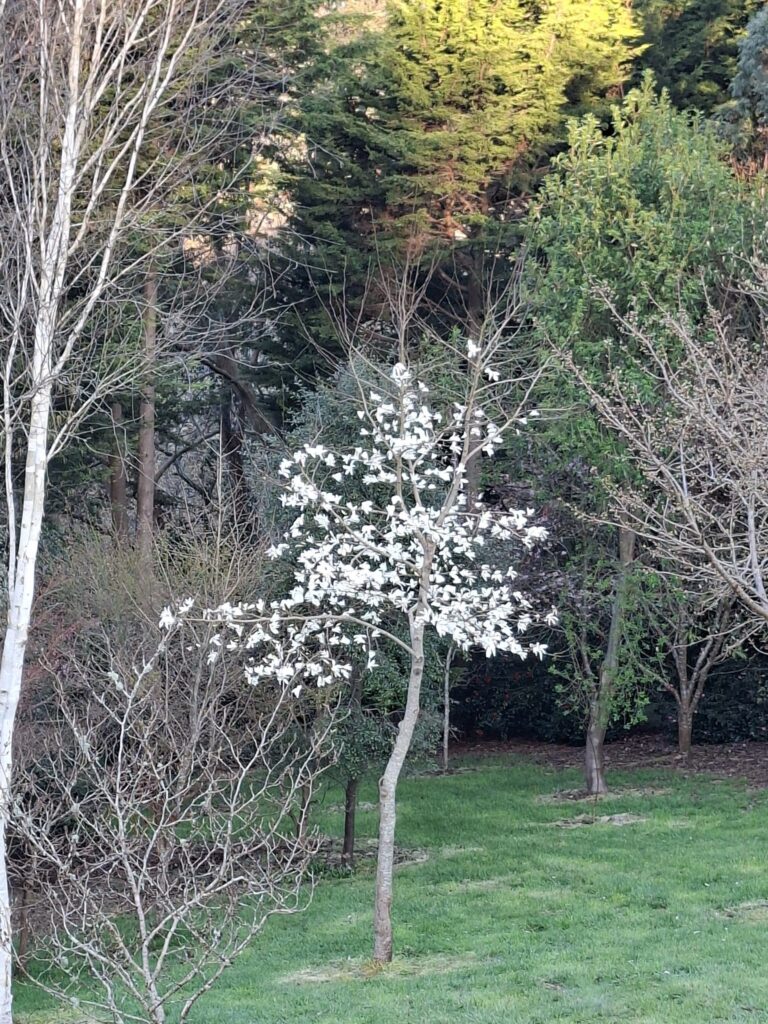
The Anise Magnolia belongs to the family Magnoliaceae — the magnolia family — one of the oldest angiosperm plant families, with fossil records extending back approximately 95 million years.
Within this ancient family, Magnolia salicifolia is classified in subgenus Yulania — the group of primarily Asian magnolias that bloom on bare branches before or alongside leaf emergence in early spring.
Its scientific name is a study in botanical precision. Magnolia honors Pierre Magnol, the seventeenth-century French botanist.
Salicifolia derives from the Latin salici (willow) and folia (leaves) — meaning “willow-leaved” — a reference to the species’ unusually narrow, lance-shaped leaves, which are significantly more slender than those of most magnolias and recall the leaf form of willows (Salix spp.).
The name is accurate and diagnostic. If you see a magnolia with narrow, willow-like leaves and you are in the right hardiness zone, you are almost certainly looking at Magnolia salicifolia.
Common names:
- Anise Magnolia — the standard name in Western horticulture, referencing the anise fragrance of crushed bark, leaves, and wood
- Willow-Leaved Magnolia — a direct translation of the scientific name, used in some botanical texts
- Willow-Leaf Magnolia — a variant of the above
- Japanese Willow-Leaf Magnolia — occasionally used to emphasize the native origin
- Koba-no-Hô or Tamushiba — Japanese vernacular names; tamushiba is the more commonly encountered Japanese name
The anise fragrance, which gives the tree its most widespread common name, is caused by the presence of methyl chavicol (estragole) — the same aromatic compound responsible for the scent of culinary anise, French tarragon, and sweet basil.
Its presence throughout the tree’s tissues is unusual and botanically interesting — most magnolias are fragrant in their flowers alone, if at all.
Physical Characteristics
Size and Form
The Anise Magnolia is a small to medium-sized deciduous tree, typically reaching 20 to 30 feet (6–9 meters) in height under cultivation. Some specimens in favorable conditions can reach 40 feet or slightly more. In native Japanese mountain forests, it can grow taller under the competitive pressure of dense woodland.
The form is distinctly upright to narrowly oval or conical — more vertical in habit than the spreading, rounded form of many ornamental magnolias.
This upright character is one of the tree’s most useful landscape traits: it fits comfortably into spaces where a broader-spreading tree would be impractical, including narrow borders, smaller residential gardens, and sites with restricted lateral space.
The branch structure is clean and open, with ascending main branches and a relatively sparse secondary branching pattern that gives the tree a lighter, more airy quality than denser magnolias.
Bark — Smooth, Gray, and Aromatic
The bark is smooth and grayish — similar to the bark of many other magnolias and not a primary ornamental feature. On older specimens it develops a shallow, slightly roughened texture, but never the dramatic furrowing or exfoliation seen in some ornamental trees.
The bark’s ornamental interest is aromatic rather than visual. Scratch or break a small twig or a piece of young bark, and the anise fragrance released is immediate and substantial — a distinctive sensory experience that makes the tree memorable to anyone who discovers it.
This aromatic bark was historically used in Japan. In traditional Japanese medicine and craft, the bark and wood of tamushiba were valued for their aromatic properties, and the wood was used in applications where a pleasant scent was desirable.
The Leaves — Willow-Like and Distinctive
The leaves are what give this magnolia its scientific name and one of its common names — and they are genuinely distinctive within the genus. They are narrow, lance-shaped to elliptical, significantly more slender than the leaves of most other magnolias, measuring 3 to 5 inches (7–13 cm) in length but only 1 to 2 inches (2.5–5 cm) wide.
The upper surface is medium to dark green, somewhat glossy. The lower surface is pale grayish-green, sometimes finely hairy along the midrib. The margins are smooth.
In the context of a family known for large, broad, tropical-looking foliage, the Anise Magnolia’s narrow leaves are notably unusual and contribute significantly to the tree’s refined, lighter-textured character.
When the leaves are crushed or torn, the anise fragrance is immediately and distinctly present — perhaps even more pronounced from the foliage than from the bark, because the leaf surface area releases it more readily. This is the simplest and most reliable way to confirm an identification in the field.
In autumn, the leaves turn yellow — not spectacular, but clean and warm, providing a modest but pleasant seasonal contribution before they drop.
The Flowers — White, Star-Shaped, and Early
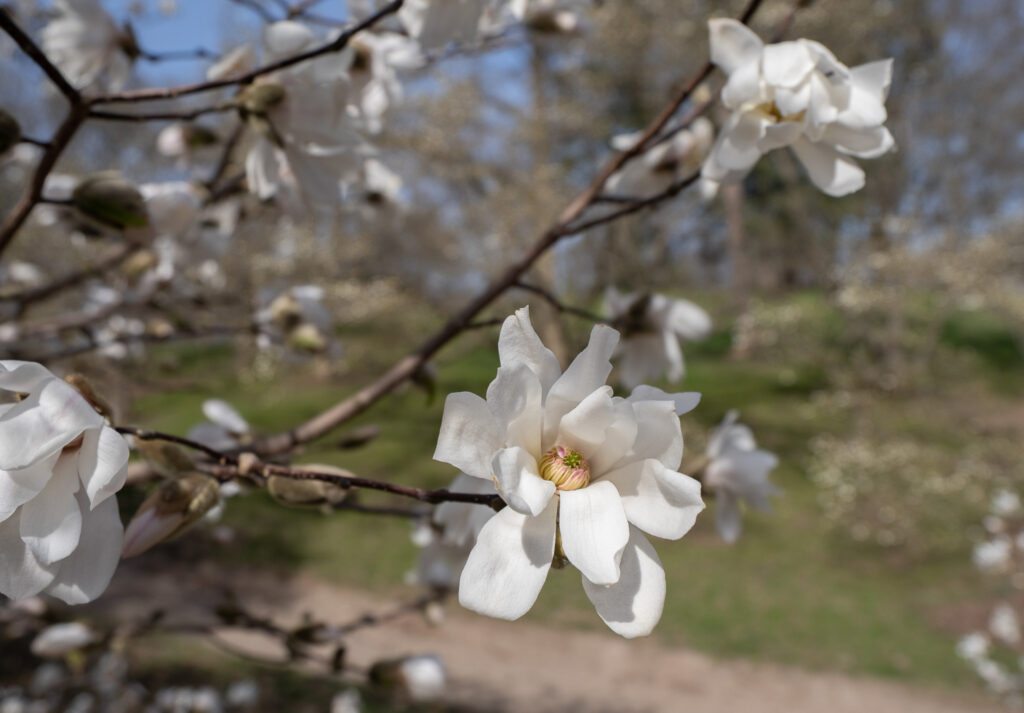
The flowers are the Anise Magnolia’s most celebrated visual feature, and they appear with admirable timing — in March and April across most of the temperate range, on bare branches before the leaves emerge, at a moment when most other flowering trees have not yet begun.
Each flower is composed of 6 to 9 tepals — white, narrow, and spreading in a loose, somewhat star-like arrangement. The tepals are strap-shaped and slightly reflexed at maturity, each approximately 2 to 3 inches (5–7 cm) long.
The overall flower diameter is roughly 3 to 4 inches — modest compared to the dinner-plate blooms of Saucer Magnolia, but elegantly proportioned for a tree of M. salicifolia‘s scale and character.
The flowers are fragrant — a fresh, slightly sweet magnolia scent that complements rather than duplicates the anise fragrance of the bark and leaves. The floral fragrance is lighter and more traditionally floral than the herbal sharpness of the crushed foliage.
Frost Vulnerability — The Early Bloomer’s Risk
Like all early-blooming magnolias, the Anise Magnolia’s primary cultural challenge is the risk of late frost damage to open flowers. Open tepals are damaged at temperatures around 27 to 28°F (approximately −2 to −3°C), and a single late frost event can brown the entire flower display within hours.
This is not a reason to avoid the plant. It is a reason to site it thoughtfully — avoiding south-facing walls that create a warm microclimate accelerating early bud break, and preferring slightly shaded or north-facing exposures that delay bloom by a week or two, statistically reducing the frequency of damaging frost coincidence.
In favorable years — when frosts end before bloom peaks — the display is extraordinary. In frost years, it is a brief disappointment quickly forgotten when the foliage emerges cleanly and the tree settles into a full summer of good performance.
Landscape and Garden Uses
The Anise Magnolia’s combination of early bloom, upright form, fragrant foliage, and cold hardiness makes it a distinctive and valuable contribution to the temperate garden palette — one that fills specific design needs that few other trees address as well.
Narrow Spaces and Vertical Emphasis
The tree’s upright, relatively narrow form makes it one of the best magnolias for gardens where horizontal space is restricted. It can be used as a vertical accent in a border, planted alongside buildings without risk of overgrowth, or positioned in a narrow planting strip where a broader tree would be impractical.
This is a genuinely practical advantage. Most ornamental magnolias require substantial horizontal space — the Anise Magnolia provides comparable flower quality and early-season impact in a significantly smaller footprint.
Sensory and Fragrance Gardens
In fragrance gardens, sensory gardens, and therapeutic landscape designs, the Anise Magnolia provides a multi-modal sensory experience unlike most trees — not just fragrant flowers, but fragrant bark, fragrant leaves, and fragrant wood, accessible by touch and proximity throughout the growing season.
Positioning the tree near a path, garden entrance, or seating area maximizes the aromatic experience — visitors walking past can brush a leaf or touch a branch and be rewarded with the characteristic scent immediately.
Woodland Garden and Forest Edge
In woodland gardens and naturalistic landscapes, the Anise Magnolia performs beautifully as a mid-story or canopy edge tree. Its preference for cool, moist conditions and dappled light reflects its native mountain forest habitat — it integrates naturally into plantings of native ferns, wildflowers, and shade-tolerant shrubs.
Companion plants that suit the Anise Magnolia’s cool-moist-acidic preferences include: rhododendrons, native azaleas, mountain laurel, ferns, hellebores, bloodroot, trilliums, and other spring woodland wildflowers.
Specimen Planting
As a single specimen in a lawn or garden focal position, the Anise Magnolia’s early bloom and elegant upright form create strong visual impact without the spatial dominance of larger ornamental trees. Its bloom coincides with daffodils, early tulips, and flowering cherries.
Hardiness Zones
The Anise Magnolia is hardy in USDA Zones 4 through 8 — one of the more cold-hardy magnolias in cultivation. This hardiness, combined with its mountain-climate origins, makes it particularly valuable for gardeners in colder regions where less hardy magnolias are not reliable.
In Zone 4, a sheltered microclimate and winter mulching over the root zone improve reliability at the northern limit.
Notable Cultivars and Forms
While the straight species performs well in most garden applications, several selected cultivars offer enhanced ornamental qualities:
- ‘Else Frye’ — a selection noted for exceptionally fragrant flowers; slightly larger blooms than the species average; considered one of the finest fragrant forms in cultivation
- ‘Wada’s Memory’ — perhaps the most celebrated Anise Magnolia cultivar; large, white, fragrant flowers; vigorous, upright growth; heavy flower production; widely regarded as the outstanding garden form of the species and one of the finest white-flowered magnolias in cultivation; named for Koichiro Wada, the renowned Japanese nurseryman who selected it
- ‘Mount Fuji’ — very white, pure flowers; vigorous; clean upright form
How to Plant and Grow Anise Magnolia
Soil Requirements
Anise Magnolia performs best in deep, moist, well-drained, organically rich soils with a slightly acidic to neutral pH — ideally 5.5 to 7.0. Like all magnolias, it is sensitive to:
- Waterlogged soils — root rot risk is significant in heavy, poorly drained conditions
- Highly alkaline soils — causes iron chlorosis and chronic decline
- Severely compacted soils — restricts root development and reduces vigor
Generous soil preparation — incorporating aged compost across a broad planting zone — produces significantly better establishment and long-term performance than minimal hole preparation.
Light Requirements
Full sun to partial shade. Best flower production and most compact, well-structured growth occur in full sun to light partial shade. In warmer parts of the range (Zones 7 and 8), some afternoon shade reduces heat stress and improves the tree’s performance through summer.
For frost protection purposes, a slightly shaded site on a north or northeast-facing exposure slows early bud development, reducing the frequency of frost damage to open flowers — a meaningful practical benefit worth considering in site selection.
Planting Instructions
- Select the site carefully, considering sun exposure, frost protection, viewing angle, and soil drainage.
- Test soil pH before planting — amend with sulfur if pH exceeds 7.0.
- Incorporate generous compost across the full planting zone, not just the planting hole.
- Dig the planting hole two to three times wider than the root ball and no deeper.
- Set the root flare at or slightly above grade — deep planting is the most common cause of long-term magnolia decline.
- Backfill with native soil amended with compost. Avoid heavy fertilizer additions at planting.
- Mulch generously — 3 to 4 inches of organic mulch extending well beyond the root ball. Maintain the mulch layer annually.
- Water thoroughly at planting and consistently through the first two to three growing seasons. Consistent moisture is the single most important establishment practice for this species.
Pruning
The Anise Magnolia requires minimal pruning. Its natural upright form is its primary structural asset and should not be altered by heavy shaping.
Remove dead or crossing branches in late summer or early autumn — after the bloom season and while the tree is still in active growth. Avoid major structural pruning in late winter or early spring, which removes flower buds for the current season.
Pests, Diseases, and Common Problems
The Anise Magnolia is generally a low-maintenance tree with few serious pest or disease issues in appropriate growing conditions.
Scale Insects
Magnolia scale (Neolecanium cornuparvum) and other scale species are the most common insect pests. They appear as bumpy, waxy masses on stems and branches. Horticultural oil applied in late winter before bud break, and again during the crawler stage in late summer, provides effective control.
Frost Damage to Flowers
As discussed — this is the most common disappointment with the Anise Magnolia and all early-blooming magnolias. The plant itself is unharmed by frost events that damage open flowers. The following year’s flower display is not affected.
Thoughtful siting and cultivar selection (later-blooming forms) are the primary management strategies.
Iron Chlorosis
On alkaline soils, yellowing between leaf veins signals iron deficiency. Correct soil pH for long-term resolution. Chelated iron applications provide temporary improvement.
Verticillium Wilt and Root Rots
Verticillium wilt and Phytophthora root rot occasionally affect magnolias under stress or in poorly drained conditions. Maintain tree vigor through proper planting depth, mulching, and consistent moisture management. Avoid waterlogged sites and correct drainage issues before planting.
Final Thoughts
The Anise Magnolia is the kind of tree that rewards gardeners who look beyond the most obvious choices. The fragrance alone — in the bark, the leaves, the wood, and the flowers — gives it a sensory presence that no other temperate flowering tree quite replicates.
The early white flowers on bare branches, the elegant upright form, the cold hardiness that extends its reach into Zone 4, the historical significance in breeding the ‘Galaxy’ hybrids — each of these is a genuine merit, and together they make a compelling case.
‘Wada’s Memory’ — the cultivar selected by one of Japan’s greatest twentieth-century nurserymen — delivers all of these qualities at their peak, and remains one of the finest white-flowering trees available to temperate gardeners at any scale.
References
- North Carolina State University Cooperative Extension — Magnolia salicifolia Plant Profile https://plants.ces.ncsu.edu/plants/magnolia-salicifolia/
- Missouri Botanical Garden — Plant Finder — Magnolia salicifolia https://www.missouribotanicalgarden.org/PlantFinder/PlantFinderDetails.aspx?taxonid=276888
- University of Connecticut Plant Database — Magnolia salicifolia — Anise Magnolia https://hort.uconn.edu/detail.php?pid=228
- American Magnolia Society — Magnolia Species Reference — Magnolia salicifolia https://www.magnoliasociety.org/magnolia-salicifolia/
- USDA PLANTS Database — Magnolia salicifolia (Siebold & Zucc.) Maxim. https://plants.usda.gov/plant-profile/MASA12

Tim M Dave is a gardening expert with a passion for houseplants, particularly cacti and succulents. With a degree in plant biology from the University of California, Berkeley, he has vast experience in gardening. Over the years, he has cultivated a vast collection of desert plants and learned a great deal about how to grow and care for these unique companions.