Understanding American Sycamore (Platanus occidentalis): The Giant of the Eastern Forests
If you have ever walked along a river bank in eastern North America and noticed a massive tree with bark that peels away in patches to reveal a creamy white, tan, and pale green surface beneath, you were almost certainly standing next to an American Sycamore.
This tree is hard to miss, and once you know it, you never forget it.
Few native trees match the American Sycamore in sheer size, ecological importance, or cultural history. It is the largest broadleaf deciduous tree native to North America. It has sheltered wildlife for centuries, shaped riverbank ecosystems, and left its mark on American folklore and landscape design.
This guide covers everything you need to know — from its biology and identification to its ecological role, uses, and care.
What Is the American Sycamore?
The American Sycamore belongs to the family Platanaceae and is the only species of this family native to the eastern United States. Its scientific name, Platanus occidentalis, translates loosely to “western plane tree” — a reference to its position in the Western Hemisphere.
Common names for this tree include:
- Buttonball tree — named after its distinctive round seed balls
- Buttonwood — a term used historically, especially in finance (the Buttonwood Agreement of 1792 was signed under a sycamore in New York City)
- American plane tree
- Ghostwood — inspired by its pale, almost white upper trunk
Despite sharing the name “sycamore” with an entirely different tree in the UK (Acer pseudoplatanus, a maple species), the American Sycamore is not related to it. Always check the scientific name when researching this species.
Physical Characteristics and Identification
Size and Longevity
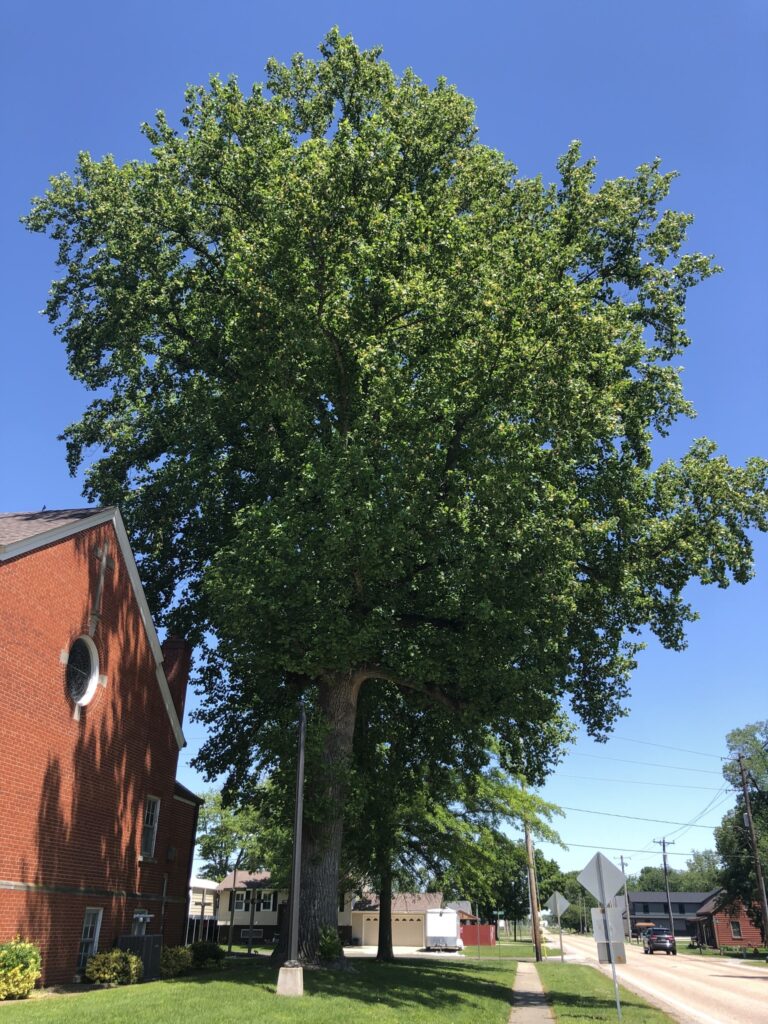
The American Sycamore is an impressive tree by any measure. Mature trees routinely reach 75 to 100 feet in height, with some specimens exceeding 150 feet. Trunk diameters of 6 to 10 feet are not uncommon in old-growth conditions.
The champion tree, located in Marion County, Ohio, reportedly had a trunk circumference exceeding 42 feet.
These trees are also long-lived. Under ideal conditions, they can survive for 500 to 600 years, though many urban specimens have much shorter lifespans due to environmental stress.
The Distinctive Bark
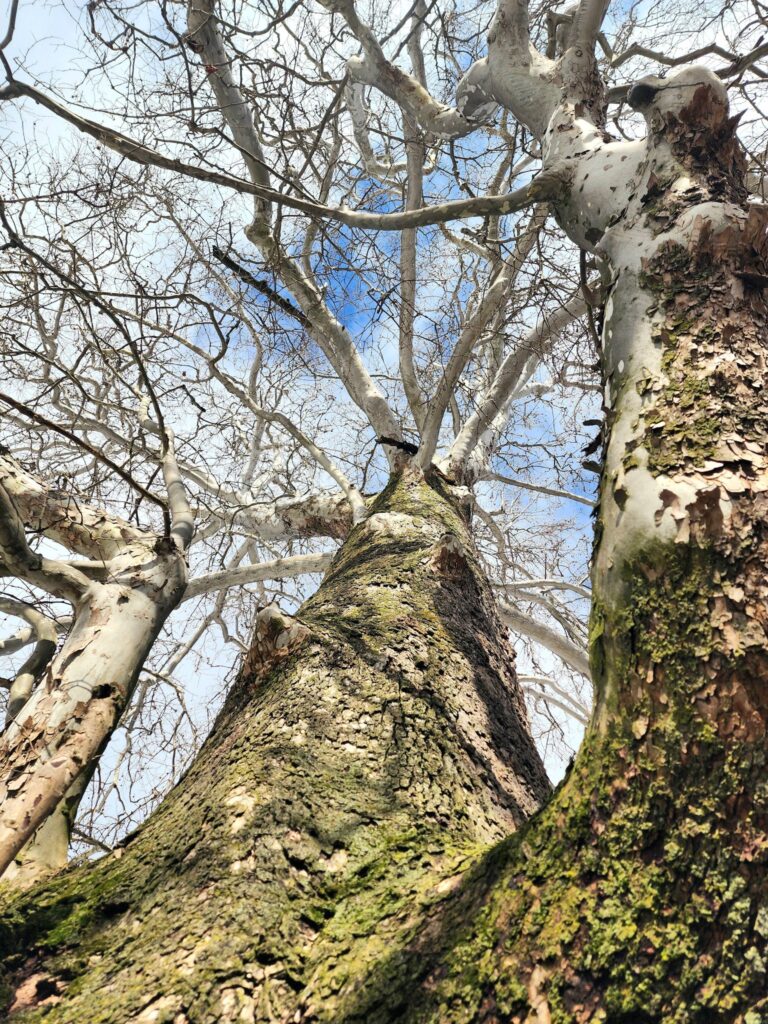
This is the tree’s most recognizable feature. The bark of a young sycamore is grayish-brown and furrowed. As the tree matures, the outer bark exfoliates in irregular patches, revealing inner layers of white, tan, cream, and olive green.
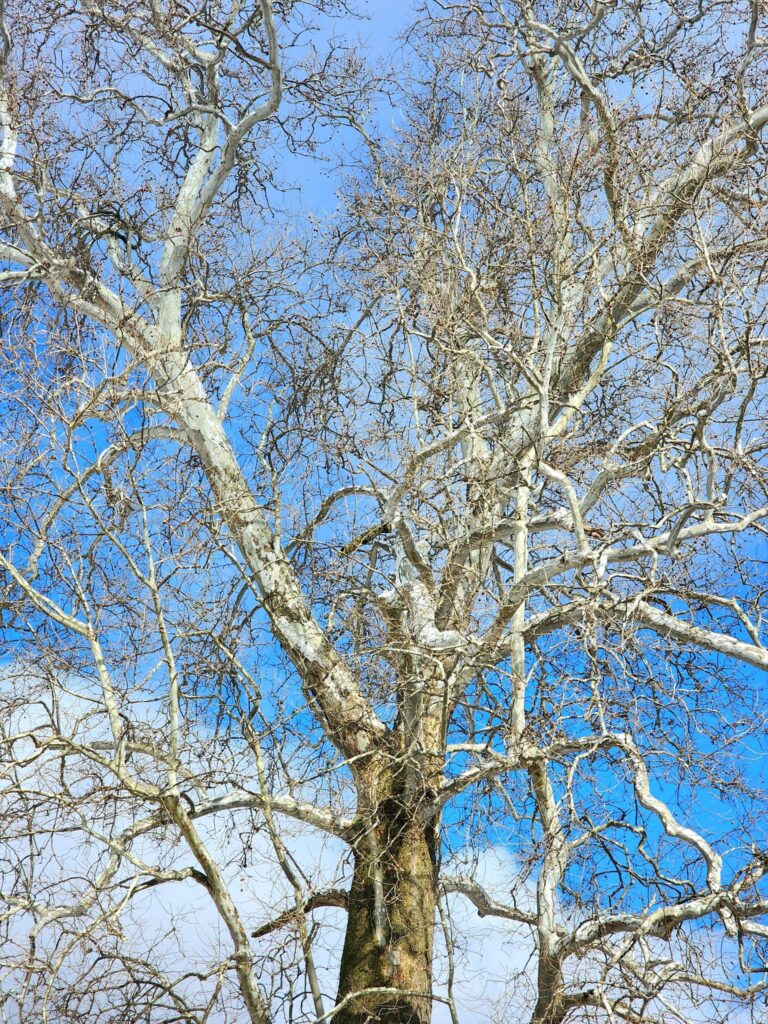
The upper trunk and major limbs are often strikingly white, giving the tree a ghostly appearance in winter forests.
This exfoliation is not a sign of disease — it is completely natural. The tree’s bark simply cannot stretch as fast as the trunk grows, so it peels away. The result is one of the most visually dramatic tree trunks in North America.
Leaves
Sycamore leaves are large and maple-like in shape, typically 5 to 9 inches wide, with 3 to 5 shallow lobes and coarsely toothed margins. They are bright green on top and paler beneath, with a soft, slightly fuzzy texture when young.
One interesting leaf feature is the enlarged, hollow leaf base (petiole base) that surrounds each bud like a small cap. This structure, called the stipule or ochrea, is visible after the leaf drops and is a useful identification feature.
In autumn, sycamore leaves turn brown-yellow — not the brilliant red or orange of maples, but still a warm seasonal display.
Flowers
American Sycamore is monoecious, meaning it produces separate male and female flowers on the same tree. Both types are small, inconspicuous, and appear in spherical clusters in spring (April to May) as the leaves are unfolding.
They are wind-pollinated and of little ornamental value. Most people do not notice them unless they look closely.
Fruit — The “Buttonballs”
The fruit is one of the most distinctive of any North American tree. Each fruit is a spherical seed ball approximately 1 inch in diameter, hanging singly on long, slender stalks.
They develop from the female flowers and persist on the tree through winter, slowly breaking apart in late winter and early spring to release hundreds of small, seed-bearing achenes.
Each seed has a tuft of hair (a pappus) that helps carry it on the wind — a design similar in principle to a dandelion seed. One buttonball can release up to 1,000 seeds.
The hanging seed balls are a key identification feature and give the tree its “buttonball” and “buttonwood” common names.
Native Range and Habitat
Natural Distribution
The American Sycamore is native to a large portion of the eastern United States and parts of southern Ontario and northern Mexico. Its range extends:
- North to southern Ontario and southern New England
- South to northern Florida and the Gulf Coast
- West to Nebraska, Kansas, and Oklahoma
- East to the Atlantic Coast
It reaches its greatest size in the Ohio and Mississippi River valleys, where deep, fertile, moist soils allow for exceptional growth.
Preferred Habitat
This is primarily a riparian tree — meaning it naturally grows along rivers, streams, lake margins, and in bottomland forests. It thrives in areas with:
- High moisture availability — it is highly tolerant of wet, even occasionally flooded soils
- Full sun — it does not perform well under shade
- Deep, rich alluvial soils — floodplain deposits created by river activity
- Disturbed ground — it is often one of the first large trees to colonize bare, disturbed riverbanks
You will rarely find a wild American Sycamore growing on a dry ridge or upland site. It is fundamentally a moisture-lover, and its natural habitat reflects that preference.
Ecological Importance
Role in Riparian Ecosystems
The American Sycamore plays a critical role in maintaining the health of river and stream corridors. Its massive root systems stabilize riverbanks, reducing erosion and preventing the kind of bank collapse that degrades water quality.
The overhanging canopy shades streams, helping regulate water temperature — which is essential for cold-water fish species like trout.
Fallen leaves and woody debris from sycamore trees add organic matter to stream channels, forming the base of aquatic food webs. The tree is, in a very real sense, a keystone species in riparian habitats.
Wildlife Value
The American Sycamore supports an impressive range of wildlife:
- Birds: Great horned owls, chimney swifts, wood ducks, and various woodpecker species use the hollow trunks and large branches of old sycamores for nesting. The seeds are eaten by goldfinches, juncos, and other small birds.
- Mammals: Raccoons, squirrels, and opossums often shelter in hollow sycamore trunks.
- Insects: More than 50 species of Lepidoptera (moths and butterflies) use sycamore as a larval host plant, according to entomologist Doug Tallamy’s research. This makes it a highly valuable tree for supporting insect biodiversity, which in turn supports birds and other wildlife.
Hollow sycamore trunks are among the most important wildlife den trees in the eastern United States. Some historical hollow sycamores were reportedly large enough to shelter small groups of humans.
Carbon Sequestration
Due to its large size and rapid growth, the American Sycamore sequesters substantial amounts of carbon. It is considered a high-value species for urban and rural carbon offset programs, especially where it can be planted in its preferred moist-to-wet conditions.
Growth Rate and Cultivation
How Fast Does It Grow?
The American Sycamore is one of the fastest-growing native trees in North America. Under good conditions, it can add 3 to 6 feet of height per year in its early decades. This rapid growth makes it appealing for reforestation projects and as a large shade tree — but it also means it requires space.
Do not plant this tree where space is limited. A mature sycamore will dwarf most structures within 50 to 75 years.
Hardiness and Climate Tolerance
The American Sycamore grows well in USDA Hardiness Zones 4 through 9, making it suitable across a vast geographic area. It tolerates:
- Heat: adapts well to hot summers
- Cold: withstands temperatures well below freezing
- Flooding: can tolerate extended periods of standing water, though prolonged inundation is damaging
- Air pollution: reasonably tolerant of urban pollution, one reason it was historically planted as a street tree
Soil Requirements
Sycamore prefers moist, deep, fertile loamy soils but adapts to clay and even compacted urban soils. It performs poorly in dry, rocky, or very sandy soils unless irrigation is provided. Soil pH between 6.0 and 7.5 is ideal, though the tree tolerates mild deviations from this range.
Planting Tips
- Plant in full sun — a minimum of 6 hours of direct sunlight daily
- Allow at least 50 feet of clearance from structures, underground utilities, and other large trees
- Water deeply during the first two to three years after planting to establish the root system
- Avoid planting near driveways or sidewalks — the surface roots can become significant over time
- Consider Platanus × acerifolia (London plane tree), a hybrid of P. occidentalis and P. orientalis, if disease resistance is a priority in humid climates
Common Diseases and Pests
Anthracnose (Apiognomonia veneta)
This fungal disease is the most serious threat to American Sycamore in regions with cool, wet springs. It causes blighting of young shoots, leaf distortion, and premature defoliation. Severe infections can cause twig dieback and give the tree a ragged appearance.
Healthy trees typically refoliate by midsummer and recover without lasting damage. However, repeated severe infections over several years can weaken a tree significantly.
The London plane tree hybrid is substantially more resistant to anthracnose, which is why it replaced the American Sycamore as a popular street tree in many American cities during the 20th century.
Powdery Mildew
A white, powdery fungal coating can appear on leaves during warm days followed by cool nights. It is primarily cosmetic and rarely causes lasting harm.
Sycamore Lace Bug (Corythucha ciliata)
This small sap-sucking insect feeds on the undersides of sycamore leaves, causing a stippled, bleached appearance on the upper surface. Heavy infestations can be unsightly but are rarely life-threatening. Natural predators typically keep populations in check.
Other Concerns
- Sycamore scale (a bark-feeding insect)
- Bacterial leaf scorch (in stressed trees)
- Canker stain disease (more common in the London plane tree)
Maintaining good tree health through proper watering, mulching, and avoiding unnecessary wounding is the best defense against most of these issues.
Historical and Cultural Significance
Early American History
The American Sycamore has deep roots — pun intended — in North American history. Native American tribes used the hollow trunks as shelters and meeting places. The Lenape people reportedly used the bark for medicinal purposes.
European settlers took note of the tree’s massive size almost immediately. Many early accounts of the North American interior mentioned sycamores with awe, describing trunk sizes that seemed almost unbelievable.
The Buttonwood Agreement
Perhaps the most historically notable sycamore connection is the Buttonwood Agreement of May 17, 1792. A group of 24 stockbrokers signed this landmark document under a buttonwood (sycamore) tree at 68 Wall Street in New York City.
This agreement established what eventually became the New York Stock Exchange — arguably the world’s most influential financial institution. The sycamore tree, in a sense, helped found Wall Street.
Civil War Era
During the American Civil War, hollow sycamore trunks along rivers were reportedly used as hiding spots by both soldiers and civilians. The tree’s prominence in the landscape made it a natural landmark and meeting point in an era before GPS.
Landscape and Urban Applications
As a Shade Tree
When given adequate space, the American Sycamore makes a spectacular shade tree. Its broad, irregular crown can spread 70 feet or more, casting dense shade over large areas. The winter silhouette — massive white branches against a gray sky — is genuinely beautiful and architecturally striking.
It is best suited to large properties, parks, golf courses, and naturalized areas rather than small suburban yards.
Riparian Restoration
This is where the sycamore truly excels in modern landscaping. It is widely used in stream bank restoration and erosion control projects across its native range. Conservation organizations and state forestry agencies often distribute free or low-cost sycamore seedlings for riparian planting programs.
Urban Forestry
The American Sycamore — or more commonly its London plane hybrid — has long been planted along urban streets. New York City’s plane trees are some of the most famous urban trees in the world, tolerating compacted soils, pollution, and drought better than most large species.
Wood and Timber Uses
Sycamore wood is hard, tough, and difficult to split, with an interlocked grain that made it valuable for specific historical applications. Uses have included:
- Butcher blocks — the interlocked grain resists splitting from heavy chopping
- Furniture and cabinetry — “lacewood” (quarter-sawn sycamore) has a distinctive flecked pattern prized in fine woodworking
- Shipping crates and boxes (historical)
- Musical instrument parts
- Veneer — quarter-sawn sycamore veneer, sold as lacewood or harewood, is used in decorative woodworking
The wood is not particularly durable in outdoor applications and is not commonly used for exterior timber or fence posts.
Conservation Status
The American Sycamore is listed as a species of least concern and is not currently threatened at the population level. Its natural habitat — riparian corridors — is, however, under significant pressure from:
- Urban and agricultural development of floodplains
- River channelization
- Invasive plant species encroachment
- Climate change affecting rainfall and flood patterns
Supporting riparian restoration programs and planting sycamores in appropriate locations helps protect the long-term presence of this species across its native range.
Frequently Asked Questions
How can I identify an American Sycamore from a distance? Look for the distinctive white or cream-colored upper trunk and branches visible even from a considerable distance. No other common eastern North American tree has this feature.
Is the American Sycamore the same as the London plane tree? No. The London plane tree (Platanus × acerifolia) is a hybrid between the American Sycamore and the Oriental plane tree (P. orientalis). It is more disease-resistant and is the species most commonly planted in cities.
Can I plant a sycamore in my backyard? Only if you have a very large property. A mature American Sycamore needs significant space — ideally 100 feet of clearance from structures. For smaller spaces, consider the hybrid London plane tree or a different shade tree species.
Do sycamore trees have invasive roots? Like most large trees, sycamores have wide-spreading surface roots that can interfere with sidewalks, foundations, and underground utilities. Plant at least 50 feet from structures.
Final Thoughts
The American Sycamore is a tree that demands attention — and deserves it. It is a giant of the American landscape, a critical part of riparian ecosystems, a wildlife haven, a piece of living history, and one of the most visually distinctive trees on the continent.
If you live within its natural range and have the space, planting a sycamore is one of the most meaningful contributions you can make to your local ecosystem. It will outlast you by centuries, shade the river, shelter the owls, and stand as a gleaming white landmark long after you are gone.
That is, I think, something worth planting.
References
- Virginia Tech Dendrology — American Sycamore Fact Sheet Virginia Tech College of Natural Resources and Environment https://dendro.cnre.vt.edu/dendrology/syllabus/factsheet.cfm?ID=39
- University of Florida IFAS Extension — Platanus occidentalis: American Sycamore UF/IFAS Environmental Horticulture Department https://edis.ifas.ufl.edu/publication/ST474
- NC State Extension Plants — Platanus occidentalis North Carolina State University College of Agriculture and Life Sciences https://plants.ces.ncsu.edu/plants/platanus-occidentalis/
- Iowa State University Extension and Outreach — American Sycamore Department of Natural Resource Ecology and Management https://www.extension.iastate.edu/forestry/iowa_trees/trees/american_sycamore.html
- University of Kentucky Cooperative Extension Service — Native Trees of Kentucky UK College of Agriculture, Food and Environment — Forestry Extension https://www.uky.edu/hort/American-Sycamore

Tim M Dave is a gardening expert with a passion for houseplants, particularly cacti and succulents. With a degree in plant biology from the University of California, Berkeley, he has vast experience in gardening. Over the years, he has cultivated a vast collection of desert plants and learned a great deal about how to grow and care for these unique companions.