Understanding Amanogawa Cherry (Prunus serrulata ‘Amanogawa’): History, Features, Cultivation, Problems and More
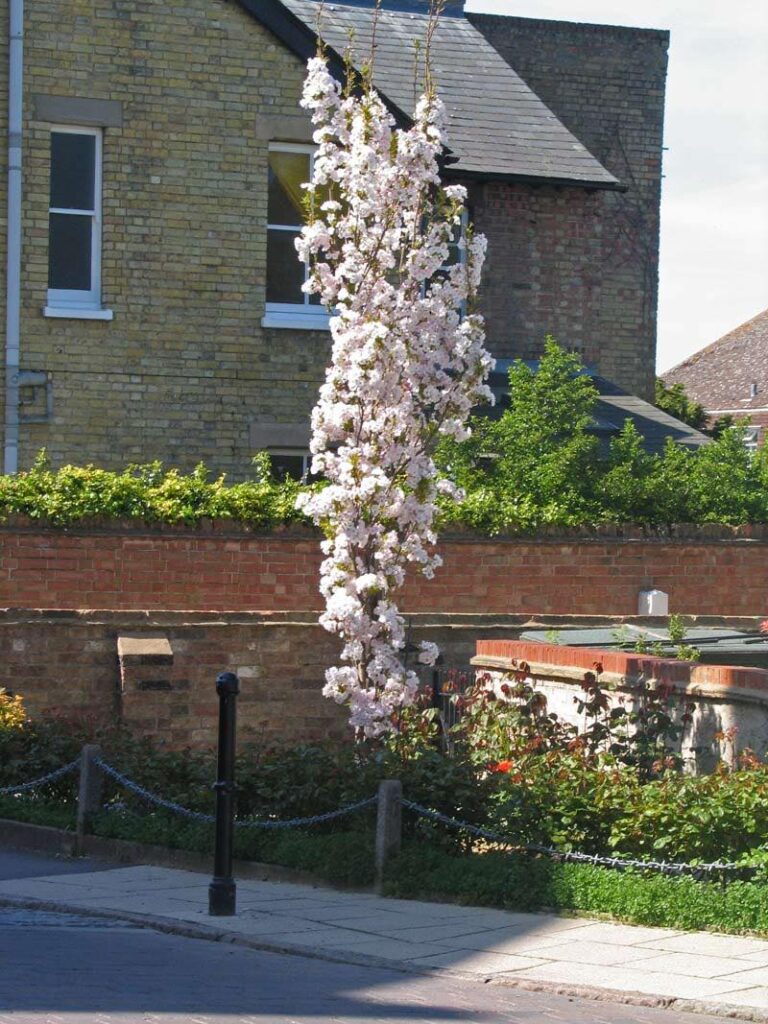
Amanogawa Cherry, Prunus serrulata ‘Amanogawa’, is a deciduous ornamental flowering cherry tree selected for its distinctly upright, columnar growth habit — a characteristic that sets it apart from virtually every other ornamental cherry in common cultivation.
It belongs to the species Prunus serrulata, the Japanese flowering cherry, which encompasses hundreds of named cultivars — including the famous ‘Kanzan’ (Kwanzan) and ‘Shirotae’ (Mount Fuji Cherry). Within this species, ‘Amanogawa’ is uniquely narrow, growing several times taller than it is wide at maturity.
The name “Amanogawa” (天の川) is Japanese for “Milky Way” or literally “river of heaven” — a poetic reference to the way the pale pink blossoms appear to float upward along the vertical branches like stars in a heavenly stream. It is one of the more evocative names in ornamental horticulture, and the tree earns it.
It is sometimes called the Lombardy Cherry in reference to its resemblance in form to the Lombardy Poplar — another famously columnar tree. This nickname reinforces the key message: this is a tree grown primarily for its narrow, vertical profile.
Key Characteristics at a Glance
Mature Height: 20 to 25 feet (6 to 7.5 metres), occasionally taller in ideal conditions.
Mature Spread: 4 to 8 feet (1.2 to 2.4 metres). This narrow spread is the tree’s defining feature — it may be up to five times taller than it is wide.
Growth Rate: Moderate — typically 12 to 18 inches per year.
Bloom Time: Mid to late spring — typically April to May in most temperate climates, coinciding with the peak of the main cherry blossom season.
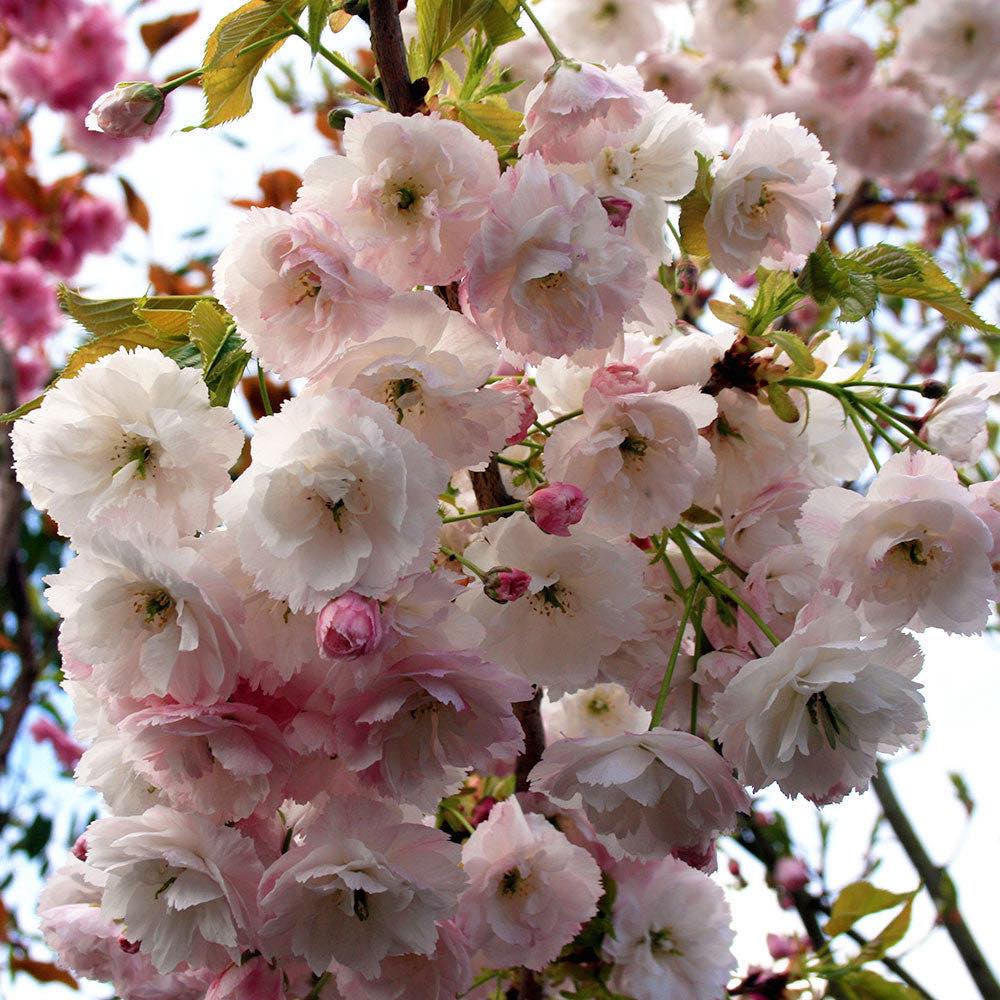
Flower Colour: Pale pink to soft shell-pink, semi-double flowers with multiple petals per bloom. The flowers are lightly fragrant — a quality relatively uncommon among ornamental cherries and one that adds an extra dimension to the spring display.
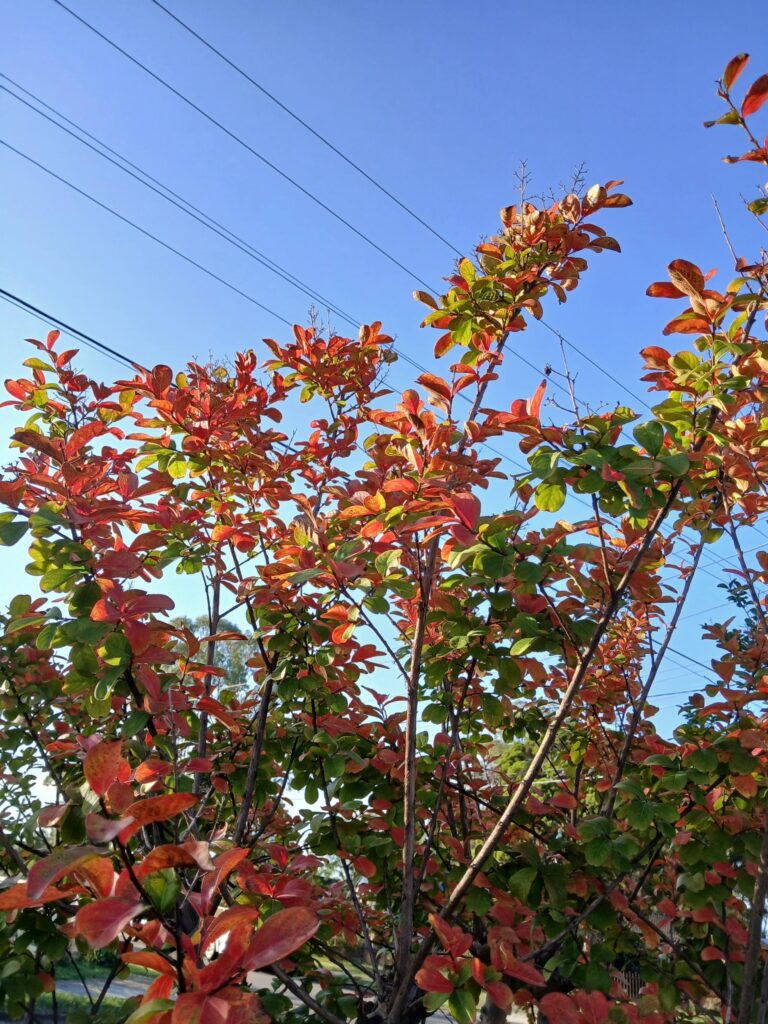
Foliage: Ovate, medium to dark green leaves with serrated margins. Young foliage emerges with a bronze-copper tint before maturing to green. Autumn colour is orange to bronze-yellow.
Bark: Grey-brown to reddish-brown, smooth with prominent horizontal lenticels.
Fragrance: Mild, pleasant floral fragrance from the semi-double blossoms — notably more fragrant than many other Prunus serrulata cultivars.
USDA Hardiness Zones: 5 to 8, offering good adaptability across a wide range of temperate garden climates.
Lifespan: Typically 15 to 25 years in landscape settings, consistent with most ornamental Japanese cherry cultivars.
Origins and Cultural Meaning
Prunus serrulata is native to China, Japan, and Korea, and has been cultivated in Japan as a flowering ornamental — sakura — for well over a thousand years. The specific cultivar ‘Amanogawa’ was selected in Japan, likely during the Edo period (1603–1868) when the intensive cultivation and selection of ornamental cherries reached its historical peak.
Japanese horticulturists of this era maintained extensive cherry collections and selected cultivars for specific ornamental qualities — flower colour, petal form, leaf emergence colour, and habit. ‘Amanogawa’ was selected specifically for its vertical columnar habit, a form unusual enough to be considered ornamentally distinctive and valuable in the context of Japanese garden design.
It was introduced to Western horticulture in the early 20th century and gained its place in the broader ornamental cherry canon alongside other Prunus serrulata cultivars that were popularised through the botanical and horticultural exchanges of that era.
In Japan, the sakura season remains a deeply cultural event — a time for hanami (flower-viewing gatherings) that carries philosophical meaning about the transience of beauty. ‘Amanogawa’, with its celestial name and its association with the Milky Way, carries an additional layer of poetic significance within that tradition.
Why Choose Amanogawa Cherry?
The case for this tree rests on a clear and specific set of advantages.
It solves the narrow-space problem. This is the primary reason most people choose it. At 4 to 8 feet wide and 20 to 25 feet tall, it provides genuine ornamental cherry performance in spaces where a typical cherry would be completely unsuitable — narrow borders, tight driveway edges, small urban gardens, courtyard plantings, and restricted streetscape positions.
The flowers are fragrant. Most ornamental Japanese cherries produce flowers that are visually spectacular but have little or no scent. ‘Amanogawa’ is a meaningful exception. The semi-double pale pink flowers carry a soft, pleasant fragrance that rewards close planting near paths, entrances, and windows — positions where the narrow habit already makes it a practical choice.
It creates vertical structure. Good garden design uses plants at multiple heights to create depth and visual interest. A narrow, tall columnar tree like Amanogawa creates a vertical accent that draws the eye upward, frames views, and provides structural definition in ways that spreading trees cannot.
Four-season interest. Spring blossoms, bronze young foliage, summer green canopy, warm autumn colour, and clean winter silhouette — the tree contributes meaningfully in every season, not just during its brief flowering period.
It is formally adaptable. The columnar habit suits both formal and contemporary garden styles. It works equally well in a symmetrically arranged formal courtyard and in a modern urban garden where clean lines and restrained planting are the design language.
Ideal Growing Conditions
Sunlight
Full sun is essential for best performance. Amanogawa Cherry requires a minimum of six hours of direct sunlight per day. In ideal conditions, eight or more hours produces the strongest blooming, the most upright branch structure, and the healthiest foliage.
In partial shade, flowering is reduced, the naturally tight columnar habit tends to loosen and open up, and fungal disease pressure increases. Given that this tree is often chosen for restricted sites — against walls, along property boundaries, between buildings — it is worth confirming that sufficient sunlight reaches the position before planting.
Soil
Perform best in moist, well-drained, moderately fertile soil with a pH of 5.5 to 7.0. It adapts to loam, sandy loam, and well-drained clay-loam but performs poorly in waterlogged or compacted soils.
Drainage is the critical factor. Like all ornamental cherries, Amanogawa is susceptible to root and crown rot in poorly drained conditions. If the planting site holds water after rain, improve drainage through soil amendment, raised planting, or site selection before committing the tree.
Water
Consistent moisture is important during establishment — the first two growing seasons after planting. Water deeply once or twice per week during dry periods, moistening the entire root zone rather than just the surface.
Once established, the tree has moderate drought tolerance. However, sustained summer drought affects flower bud formation for the following spring. Maintaining adequate moisture through the growing season directly supports next year’s bloom quality.
Climate
Hardy in USDA Zones 5 to 8. In Zone 5, it tolerates winter lows of around -20°F (-29°C) and performs reliably in northern temperate climates. Late spring frosts can damage open flowers, which is worth considering in gardens with a known late-frost risk.
The narrow, upright habit means the tree can sometimes be positioned closer to a wall for frost protection without sacrificing the clear sky exposure needed for full sun.
Planting Instructions
Best planting time: Early spring before bud break, or autumn after leaf drop. Container-grown trees can be planted throughout the growing season with adequate subsequent irrigation.
Site selection: Think carefully about the long-term vertical profile. At 20 to 25 feet tall, the tree will eventually reach second-storey window height. Confirm that overhead utilities, eaves, and neighbouring structures will not interfere as the tree matures.
Planting hole: Dig a hole two to three times the width of the root ball, and only as deep as the root ball height. Set the tree so the root flare — the gentle widening at the base of the trunk — sits at or very slightly above the surrounding soil grade. Planting too deep is a consistent and serious mistake with ornamental cherries.
Backfill: Use the excavated soil without added fertiliser or compost in the planting hole. This encourages outward root development rather than root concentration within an enriched zone.
Mulching: Apply 2 to 3 inches of organic mulch (shredded bark, wood chips) over the root zone, keeping mulch 6 inches clear of the trunk. Mulch-on-trunk contact retains moisture against bark, encouraging rot and providing pest shelter.
Watering: Water thoroughly immediately after planting. Maintain consistent moisture through the first full growing season.
Fertilisation
Amanogawa Cherry does not require intensive feeding. In most reasonably fertile garden soils, a single spring application of balanced slow-release fertiliser is sufficient. A 10-10-10 formulation or a dedicated tree and shrub product, applied at label-recommended rates, supports healthy growth without pushing excessive leafy production.
Avoid high-nitrogen fertilisers, which stimulate rapid, soft vegetative growth at the cost of flowers and increase aphid pressure on new shoots.
If the tree shows yellowing foliage, slow growth, or reduced flowering, a soil pH test is the first diagnostic step. Nutrient uptake issues are commonly caused by soil pH imbalance rather than genuine nutrient shortage, and correcting pH resolves the symptom more effectively than adding more fertiliser.
Pruning the Amanogawa Cherry
The columnar habit of ‘Amanogawa’ develops naturally and requires minimal pruning when given appropriate space. The goal of pruning is to maintain health and structure, not to reshape or artificially restrict growth.
Prune immediately after flowering — late spring as blossoms fade. This timing protects next season’s flower buds, which develop on current-year growth through summer and autumn, and minimises wound exposure during wet, disease-prone periods.
Begin with the three Ds: remove dead, damaged, and diseased wood, cutting cleanly just outside the branch collar.
Maintain the columnar form by removing any strongly outward-growing lateral branches that extend significantly beyond the natural silhouette. The tree naturally maintains its narrow habit, so these interventions should be modest and infrequent.
Watch for basal suckers and watersprouts — vigorous, upright-growing shoots emerging from the base or the main trunk. Remove these promptly, as they compete with the main canopy and can disrupt the columnar outline.
Do not top or heavily cut back. Large pruning wounds on cherries heal slowly and provide entry points for fungal decay organisms and borers. If size is a long-term concern, ensure adequate vertical clearance is available before planting rather than managing an overgrown tree with repeated heavy cuts.
Pests and Diseases
Amanogawa Cherry shares the pest and disease vulnerabilities common to Prunus serrulata cultivars. Maintaining tree vigour through correct cultural practices is the most effective preventive strategy.
Common Pests
Aphids are the most routine problem, particularly on spring new growth. Soft colonies of small insects cause leaf curling, sticky honeydew, and potential sooty mould. Natural predators, insecticidal soap, or strong water sprays resolve most infestations without chemical intervention.
Tent caterpillars build communal silk nests in branch forks and can rapidly defoliate sections of the canopy. Remove nests manually while small, or treat with Bacillus thuringiensis (Bt) while larvae are young and actively feeding.
Scale insects can establish on bark in humid climates, weakening branches over time. Dormant-season horticultural oil applications are effective.
Cherry fruit fly and spotted wing drosophila may target the small fruits that form after flowering. In purely ornamental plantings, these pests are typically a minor concern.
Common Diseases
Brown rot blossom blight (Monilinia spp.) causes rapid browning and collapse of flowers in cool, wet spring weather. Good air circulation and avoidance of overhead irrigation reduce risk. Fungicide applications at pink bud stage protect flowers in high-pressure years.
Black knot (Apiosporina morbosa) produces elongated, hard, black galls on branches. Remove affected wood immediately, cutting at least 4 inches below visible symptoms. Destroy — do not compost — infected material.
Bacterial canker (Pseudomonas syringae) causes sunken, dark lesions on bark and progressive branch dieback, most common after cold, wet springs. Prune in dry weather, sterilise tools, and protect bark from wounds.
Silver leaf disease (Chondrostereum purpureum) enters through pruning cuts and bark damage, producing a silvery sheen on affected foliage. Prune during dry weather and avoid leaving large wounds to reduce exposure.
Landscape Uses and Design Applications
The columnar habit of Amanogawa Cherry opens up landscape applications that broad-spreading ornamental trees simply cannot serve.
In narrow borders and restricted spaces, it is the primary solution for those who want ornamental cherry performance without width. Borders as narrow as 6 to 8 feet can accommodate a mature Amanogawa Cherry where no other cherry cultivar would fit.
As a formal accent or punctuation point, a columnar tree creates a vertical exclamation mark in the landscape — drawing the eye upward, framing a view, or marking an arrival point. A single well-placed Amanogawa at the end of a path or at a garden entrance creates a strong formal statement.
In avenue plantings, rows of Amanogawa Cherry along a path, driveway, or boundary create a unified formal corridor of spring blossom that is visually striking without the width requirements of a traditional cherry avenue. This is an application where the columnar habit is not just acceptable but actively preferable.
In urban and streetscape settings, the narrow profile makes it one of the most practical ornamental flowering trees for street tree use in tight urban conditions — narrow tree pits, restricted overhead clearance, and limited root zones that would rule out wider trees.
Near walls and boundaries, the columnar form can be positioned comfortably against a wall, fence, or property boundary without branches overhanging into neighbouring space. In gardens where boundary-crossing branches are a practical or legal concern, this is a meaningful advantage.
In contemporary minimalist garden design, the clean vertical line of a columnar cherry suits the restrained aesthetic of modern gardens that work with strong geometric forms, limited plant palettes, and structured compositions.
Four-Season Interest
Spring is the headline season, but the Amanogawa Cherry contributes genuinely across the full year.
Spring: The semi-double pale pink flowers open in mid to late spring, covering the upright branches with dense blossom. The fragrance — mild, sweet, and clean — distinguishes this tree from the many ornamental cherries that are visually beautiful but scentless. Young bronze-copper foliage emerges among or just after the last flowers, creating a transitional period of warm colour.
Summer: The mature dark green canopy fills the columnar profile and creates a vertical architectural element in the summer garden. The small dark fruits that follow flowering attract birds and add ecological activity.
Autumn: Foliage turns orange to bronze-yellow — a warm, pleasant autumn display that, while not the most dramatic of any ornamental tree, adds genuine seasonal colour and contributes to the overall garden palette.
Winter: The bare columnar silhouette remains architecturally significant after leaf drop. The upright scaffold of branches, the smooth grey-brown bark with its horizontal lenticels, and the clean vertical outline provide quiet structural interest through the dormant months.
Frequently Asked Questions
How wide does Amanogawa Cherry get? At maturity, the spread is typically 4 to 8 feet. Young trees may appear very narrow — almost pencil-like — before gradually widening slightly with age. It remains significantly narrower than its height throughout its lifespan.
Does it stay columnar, or does it spread with age? It remains substantially columnar throughout its life. It does widen slightly as it matures, but the fundamental narrow habit is genetically determined and persistent. It does not develop into a broadly spreading tree with age.
Is the fragrance strong? Mild to moderate. It is not a powerfully scented tree, but the fragrance is clearly perceptible at close range — when walking past, sitting nearby, or viewing through an open window. It is notably more scented than most ornamental Japanese cherry cultivars.
Can it be grown in a container? Young trees can be maintained in large containers for a period, but Amanogawa is ultimately a ground-planting tree. Container culture limits root development, shortens lifespan, and requires attentive watering and feeding. For long-term health and full flowering, ground planting is strongly preferable.
How does it compare to other columnar cherries? ‘Amanogawa’ is the most widely available and best-established columnar Japanese cherry. ‘Columnaris’ (a columnar Sargent Cherry form) is another option with better cold hardiness but less visual similarity to the classic sakura blossom style. ‘Amanogawa’ remains the standard reference for columnar ornamental cherry performance.
Suggested For You:
Understanding Taiwan Cherry (Prunus campanulata): History, Features, Problems, and More
Understanding Weeping Cherry Blossom Tree: Varieties, and Care Tips for a Stunning Landscape Feature
Understanding Cherry Blossom Tree: Types, History and Full Growing Details
Final Thoughts
The Amanogawa Cherry occupies a genuinely unique position in ornamental horticulture. It is not simply a cherry that happens to be narrow — it is the cherry that makes ornamental cherry culture possible in spaces where it would otherwise be impossible.
For the urban gardener with a narrow border, the homeowner with a tight driveway edge, the landscape designer seeking a vertical accent without spread, or anyone who has ever looked at a flowering cherry and thought “beautiful, but too wide” — this tree is the answer.
It blooms in soft, fragrant pink in spring, it colours in autumn, it holds its architectural form in winter, and it does all of this in a footprint that most ornamental trees cannot approach. That combination of beauty and practicality is rare, and it is exactly why this centuries-old Japanese selection continues to earn its place in gardens across the temperate world.
References
- North Carolina State University Extension – Prunus serrulata ‘Amanogawa’ Plant Profile https://plants.ces.ncsu.edu/plants/prunus-serrulata-amanogawa/
- University of Connecticut Plant Database – Prunus serrulata Cultivars https://hort.uconn.edu/detail.php?pid=293
- Arnold Arboretum of Harvard University – Cherry Collection: Japanese Flowering Cherries https://arboretum.harvard.edu/plants/highlighted-plants-and-collections/cherry-collection/
- Virginia Tech Dendrology – Prunus serrulata Fact Sheet https://dendro.cnre.vt.edu/dendrology/syllabus/factsheet.cfm?ID=106
- Pennsylvania State University Extension – Ornamental Cherry Tree Selection and Care https://extension.psu.edu/ornamental-cherry-trees

Tim M Dave is a gardening expert with a passion for houseplants, particularly cacti and succulents. With a degree in plant biology from the University of California, Berkeley, he has vast experience in gardening. Over the years, he has cultivated a vast collection of desert plants and learned a great deal about how to grow and care for these unique companions.